How Contested Stories Shaped Azerbaijan's Public Image
Azerbaijan has few well-documented “classic” hoaxes involving invented monsters, fraudulent séances or spectacular forged relics. Its most consequential cases of contested truth are different: seductive pseudo-history, politically useful reinterpretations of monuments, covert reputation-laundering and organised online amplification.
Page outline Jump by section
Introduction
The cases below should not be treated as evidence that Azerbaijanis are unusually credulous. They arose from familiar forces found worldwide: nationalism, war, commercial publicity, political patronage, media weakness and the authority granted to famous outsiders. They also differ in intent. Thor Heyerdahl’s theory about Azerbaijani origins for the Norse gods appears to have been sincerely held pseudohistory, whereas covert payments and inauthentic accounts involved more deliberate attempts to influence what audiences believed.
Did the Vikings come from Azerbaijan?
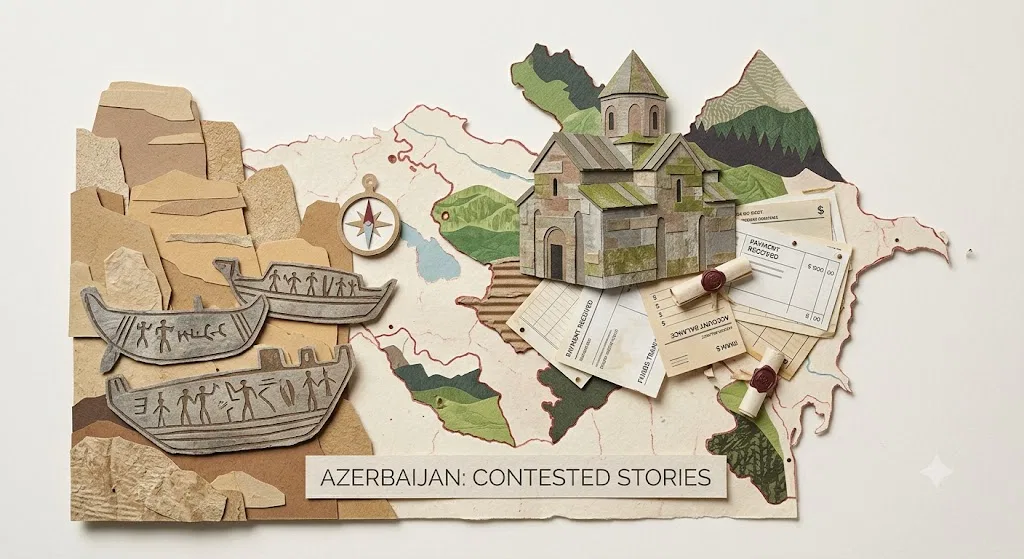
The most colourful Azerbaijani pseudo-historical claim began with Thor Heyerdahl, the Norwegian adventurer celebrated for the 1947 Kon-Tiki voyage. During visits to Azerbaijan, Heyerdahl became fascinated by prehistoric boat carvings at Gobustan, south-west of Baku. He believed they resembled Scandinavian rock art and suggested that ancient people might have travelled from the Caspian region towards northern Europe.
The theory became more ambitious. Heyerdahl treated a medieval account of Odin as if it preserved literal migration history, proposing that the Norse gods had once been real rulers from the region east of the Black Sea. Similar-sounding names supplied much of the argument: the Norse Æsir were linked with Azerbaijan, Odin with the Udi people, and other mythological names with modern places or peoples around the Caucasus and the Sea of Azov. Azerbaijani promoters found the idea naturally attractive because it associated the country with the origins of one of Europe’s best-known mythological traditions.[Cambridge University Press & Assessment]cambridge.orgReview of “Thor Heyerdahl og Per Lillieström. Jakten på Odin: På sporet av vår fortid.” Maal og minne 1: 98–109.Google Scholar. Hovdhauge…
The claim was persuasive partly because Heyerdahl possessed enormous public authority. He had crossed oceans in reconstructed ancient vessels and demonstrated that seemingly impossible journeys were physically possible. Yet showing that a voyage could have happened is not evidence that a particular migration did happen. The Gobustan and Scandinavian carvings were separated by large distances, uncertain chronologies and different cultural settings. A broad resemblance between simple boat outlines could not establish direct contact, still less the Azerbaijani origin of Norse religion.
Norwegian historians, linguists, archaeologists and scholars of religion strongly criticised Heyerdahl’s final project. They argued that he selected convenient passages from late literary sources, ignored normal methods of historical linguistics and treated coincidental word similarities as proof. Some of the proposed place-name connections were also anachronistic: the names did not necessarily exist in the form required at the period when the supposed migration was said to have occurred. The academic response classified the project as pseudoarchaeology rather than an established historical hypothesis.[Wikipedia]WikipediaJakten på OdinJakten på Odin
It is therefore misleading to call the Odin story a deliberate hoax in the narrow sense. There is no good evidence that Heyerdahl privately knew it was false. It is better understood as sincere but poorly controlled speculation, magnified by celebrity and national enthusiasm. The story survives because it offers a memorable formula—“the Vikings came from Azerbaijan”—whereas the scholarly objection requires slower explanations about dating, language change, archaeological context and the difference between myth and documentary history.
When monuments become evidence for a national story
The most serious Azerbaijani disputes over authenticity concern the Christian heritage of the South Caucasus. At the centre is Caucasian Albania, an ancient kingdom that covered parts of what are now Azerbaijan and neighbouring territories. It was unrelated to the modern Balkan state of Albania. The kingdom was real, possessed its own Christian traditions and forms an important part of the region’s history. The controversy begins when its name is used to detach medieval Armenian churches, inscriptions and artistic traditions from their documented Armenian connections.
From the later Soviet period onwards, influential Azerbaijani historical writing increasingly presented many Christian monuments in and around Nagorno-Karabakh as exclusively Caucasian Albanian. In its strongest form, the argument claimed that Armenian inscriptions or features were later additions and that Armenians had appropriated an older Albanian heritage. Recent academic work traces a shift from relatively mixed accounts in the mid-twentieth century towards more aggressively revisionist narratives in textbooks, museums and public culture during the conflict over Nagorno-Karabakh.[Cambridge University Press & Assessment]cambridge.orgIn the 1960 version, Armenian…Read more…
The problem is not the legitimate study of Caucasian Albania. Scholars agree that Albanian political and ecclesiastical history was complex and that communities and identities changed over centuries. The deceptive element lies in presenting uncertain or plainly contradictory claims as settled fact, especially when architectural forms, inscriptions and manuscript evidence point to Armenian patrons, builders or congregations. This sometimes turns a real ancient kingdom into an all-purpose explanation capable of absorbing almost any inconvenient Christian monument.
Caucasus Heritage Watch, a research initiative based at Cornell and Purdue universities, uses satellite imagery and other documentation to monitor cultural sites in the region. It reports that specialists in Caucasian art and architecture overwhelmingly reject broad claims that Armenian monuments are simply Albanian monuments with fraudulent Armenian features. The project has also warned that revisionist interpretations can have physical consequences when inscriptions, crosses or other evidence are removed as supposedly inauthentic additions.[caucasusheritage.cornell.edu]caucasusheritage.cornell.eduHow Monitoring WorksThe vast majority of experts in the region's art, architecture, and archaeology have all rejected Azerbaijan's revisi…
This dispute is difficult to discuss responsibly because cultural destruction and historical distortion have occurred on more than one side of the Armenian-Azerbaijani conflict. Azerbaijani heritage was damaged or neglected in territories formerly controlled by Armenian forces, a subject also documented by independent monitoring. That fact, however, does not validate the reclassification or alteration of Armenian monuments. Competing acts of destruction do not cancel one another, and the identity of a medieval building must be established from evidence rather than present-day territorial claims.[caucasusheritage.cornell.edu]caucasusheritage.cornell.eduSPECIA L REPORT #2SPECIA L REPORT #2
These narratives gained power because monuments appear objective. A church wall or carved inscription seems more trustworthy than a politician’s speech. Once visitors are told that visible Armenian writing was added by later “falsifiers”, contrary evidence can be absorbed into the theory rather than allowed to disprove it. This is a familiar mechanism in conspiratorial history: every awkward feature becomes evidence of an especially thorough historical plot.
The resulting controversy is larger than an academic quarrel over labels. Reassigning monuments changes who appears indigenous, who seems to have arrived late and whose losses are recognised. It can influence schoolbooks, tourism, restoration and public willingness to protect a site. In this setting, historical falsification is not merely false information about the past; it helps determine what survives in the present.
The Azerbaijani Laundromat and manufactured approval
Between 2012 and 2014, a complex financial system later nicknamed the Azerbaijani Laundromat moved about US$2.9 billion through companies and bank accounts, according to the Organised Crime and Corruption Reporting Project. The money had several alleged purposes, including private enrichment, payments to intermediaries and efforts to improve Azerbaijan’s reputation abroad. A purportedly independent organisation involved in lobbying in Washington was found to have received money linked to the system.[OCCRP]occrp.orgus lobbying firm launders azerbaijans reputation and gets laundromat cashus lobbying firm launders azerbaijans reputation and gets laundromat cash
This was not a hoax built around one fabricated document. It was an influence operation that helped produce misleading appearances: apparently independent advocates, respectable foreign supporters and positive assessments that did not reveal the financial or institutional relationships behind them. The public-facing message was that outside experts and politicians had examined Azerbaijan and reached favourable conclusions. The concealed transactions raised the possibility that some praise was less independent than it appeared.
The most notorious part of this wider system became known as “caviar diplomacy”. Azerbaijani representatives were accused of cultivating members of the Parliamentary Assembly of the Council of Europe through gifts, hospitality, personal relationships and, in some cases, corrupt financial arrangements. The Council of Europe established an independent investigation after the allegations threatened the credibility of its monitoring and election work. Its inquiry found conduct of a corruptive nature involving several assembly members, while stopping short of treating every gift or friendly vote as proven bribery.[coe.int]assembly.coe.intOpen source on coe.int.
The contrast surrounding Azerbaijan’s 2013 presidential election showed why such influence mattered. The Organization for Security and Co-operation in Europe’s specialist election-monitoring office reported restrictions on expression, assembly and association, allegations of intimidation and serious problems during voting and counting. Other visiting delegations delivered far more favourable verdicts. Later investigations and debates raised questions about “electoral tourism”: short, sponsored visits by politicians whose optimistic statements could be quoted as international validation despite conflicting with more systematic observation.[OSCE ODIHR]odihr.osce.orgOpen source on osce.org.
The deception worked through borrowed credibility. A statement from a European parliamentarian sounds like neutral external confirmation, particularly to audiences unfamiliar with the difference between a large professional observation mission and a small invited delegation. Television reports and official publicity could present the friendly verdict without explaining who arranged the visit, who paid for it or how limited the observation had been.
The exposure came through leaked banking data, cross-border investigative journalism, court proceedings and the Council of Europe’s own inquiry. The scandal did not prove that every international supporter of Azerbaijan was bought. It demonstrated something subtler and more important: opaque money and hospitality had contaminated a system intended to supply independent democratic scrutiny. Once that happened, even genuine praise became harder to trust.
Fake crowds in the COP29 conversation
A more recognisably modern form of fakery appeared before the 2024 United Nations climate conference in Baku. Global Witness examined accounts on the social platform X that were posting under COP29-related hashtags and identified 71 suspicious profiles repeatedly amplifying Azerbaijani government messages. The accounts displayed striking similarities in their creation patterns, behaviour and content, giving the appearance of separate ordinary users while acting more like a coordinated network.[Global Witness]globalwitness.orgOpen source on globalwitness.org.
Many profiles used harmless-looking nature imagery and posted broadly supportive material about Azerbaijan’s environmental record or role as conference host. Their function was not necessarily to persuade readers through one spectacular lie. Instead, they appeared to manufacture the atmosphere of grassroots approval: many apparently independent voices repeating the same themes, liking the same official posts and crowding critical discussion.
This technique is often called coordinated inauthentic behaviour. The decisive issue is not whether every sentence posted by an account is factually false. The deception lies in the identity and independence of the speakers. One operator controlling many personas can make a government message look like an emerging public consensus.
Investigators found the accounts suspicious rather than conclusively identifying who controlled them, an important distinction. Available evidence supported the finding of artificial amplification, but it did not establish that the Azerbaijani state personally operated every profile. Contemporary influence networks may be run by public-relations contractors, commercial engagement farms, political organisations or combinations of actors whose relationships remain hidden. Reporting at the time therefore described the accounts as apparently fake or inauthentic rather than assigning ownership beyond the evidence.[The Guardian]theguardian.comapparently fake social media accounts boost azerbaijan before cop29apparently fake social media accounts boost azerbaijan before cop29
The operation’s impact also appears to have been limited. Some accounts gained little genuine interaction, illustrating that organised fakery does not always succeed. Yet even a weak network can distort what journalists, conference delegates or casual users see when searching a hashtag. It can create additional work for fact-checkers and platform moderators while forcing critics to compete against an artificial volume of repetitive content.
This case belongs in Azerbaijan’s hoax history because it updates an old method. Caviar diplomacy created supportive foreign voices whose dependencies were concealed; social-media networks created supportive citizen voices whose identities were questionable. Both relied less on inventing a single false event than on disguising the source of apparent approval.
Why the stories remain persuasive
Azerbaijan’s strongest examples of deception share several mechanisms despite their different subjects.
They attach themselves to something real. Gobustan contains genuine ancient rock art. Caucasian Albania was a genuine historical kingdom. Foreign politicians genuinely visited Azerbaijan, and real social-media users genuinely praised COP29. The misleading claim begins only when the genuine material is pushed beyond what the evidence supports.
They exploit prestigious messengers. Heyerdahl’s fame gave speculative linguistic comparisons the glamour of scientific discovery. European office-holders supplied the appearance of democratic approval. Heritage claims gain authority when placed in textbooks, museums or official restoration programmes.
They offer emotionally satisfying simplicity. A direct ancestral link between Azerbaijan and the Vikings is easier to remember than a discussion of unrelated artistic traditions. Calling every disputed church “Albanian” removes ambiguity from a culturally mixed frontier. Declaring an election fair or a climate summit widely admired avoids uncomfortable examination of institutions and competing evidence.
They survive correction by changing form. Heyerdahl’s exact migration route could shift while the general Azerbaijan–Scandinavia connection remained marketable. Heritage narratives can retreat from “this monument was never Armenian” to “its Armenian elements were added later”. Suspicious accounts can disappear while their content is reposted by genuine users.
The central lesson is that exposure rarely arrives as one cinematic confession. It is usually cumulative: linguistic dating makes a wordplay impossible; inscriptions contradict a national story; satellite images document alteration; bank records reveal hidden payments; account analysis exposes coordinated behaviour. The investigator’s task is therefore to reconstruct provenance—who created the claim, when its evidence first appeared, who financed its promotion and whether independent methods reach the same conclusion.

What counts as a hoax in Azerbaijan?
Not every false or unsupported Azerbaijani story should be placed in the same category. Doing so would obscure the difference between error and organised deception.
Heyerdahl’s Odin theory is best described as pseudohistory: an apparently sincere hypothesis constructed through selective evidence and weak method. Traditional claims such as a local association with Noah may be religious folklore or tourism legend unless someone fabricates archaeological proof. Arguments over Caucasian Albania range from genuine scholarly disagreement to demonstrable distortion, depending on the particular monument and claim. The Laundromat and caviar-diplomacy scandal concerned concealed influence and corruption. The COP29 accounts represented suspected coordinated inauthentic behaviour.
That distinction matters because the remedy changes with the problem. Sincere error requires better scholarship and public explanation. Invented tradition needs clear separation between cultural meaning and archaeological fact. Historical erasure demands documentary preservation and independent conservation. Covert lobbying requires financial transparency and enforceable ethics rules. Fake online personas require platform investigation, network analysis and disclosure of organised political communications.
Azerbaijan’s history of contested truth is consequently less a cabinet of amusing curiosities than a study in how authority is manufactured. Its most revealing “hoaxes” were persuasive not because people believed something obviously absurd, but because fragments of truth were arranged into stories that served prestige, territory or power.
Amazon book picks
Further Reading
Books and field guides related to How Contested Stories Shaped Azerbaijan's Public Image. Use these as the next step if you want deeper reading beyond the article.
Black Garden
Explains competing narratives, identity politics and information battles shaping Azerbaijan's image.
Orientalism
Explores how societies construct and project narratives about cultures and regions.
Prisoners of Geography
Helps readers understand how geography shapes regional conflicts and narratives.
The Silk Roads
Places the Caucasus within larger historical networks and identity formation.
eBay marketplace picks
Marketplace Samples
Live-tested eBay searches with available results related to this page.


Endnotes
1.
Source: cambridge.org
Link:https://www.cambridge.org/core/journals/yearbook-for-traditional-music/article/land-of-our-origin-music-and-history-in-the-norwayazerbaijan-connection/9A29FE60CF9A5551D566947ED56B832C
Source snippet
Review of “Thor Heyerdahl og Per Lillieström. Jakten på Odin: På sporet av vår fortid.” Maal og minne 1: 98–109.Google Scholar. Hovdhauge...
2.
Source: Wikipedia
Title: Jakten på Odin
Link:https://en.wikipedia.org/wiki/Jakten_p%C3%A5_Odin
3.
Source: cambridge.org
Link:https://www.cambridge.org/core/journals/nationalities-papers/article/knowledges-that-cannot-be-known-structuring-azerbaijani-attachment-to-nagornokarabakh/36793CE239D99BFC1093E90D5E036818
Source snippet
In the 1960 version, Armenian...Read more...
4.
Source: caucasusheritage.cornell.edu
Link:https://caucasusheritage.cornell.edu/?page_id=1826
Source snippet
How Monitoring WorksThe vast majority of experts in the region's art, architecture, and archaeology have all rejected Azerbaijan's revisi...
5.
Source: caucasusheritage.cornell.edu
Title: sparked some iconoclastic
Link:https://caucasusheritage.cornell.edu/wp-content/uploads/2024/06/Report-2024-07Spread.pdf
Source snippet
monitoring report - june 2024 - Caucasus Heritage Watch7 Jun 2024 — The vast majority of experts in the region's art, architecture, Azerb...
Published: june 2024
6.
Source: caucasusheritage.cornell.edu
Title: SPECIA L REPORT #2
Link:https://caucasusheritage.cornell.edu/wp-content/uploads/2023/04/CHW_SpecialReport2B.pdf
7.
Source: occrp.org
Title: us lobbying firm launders azerbaijans reputation and gets laundromat cash
Link:https://www.occrp.org/en/project/the-azerbaijani-laundromat/us-lobbying-firm-launders-azerbaijans-reputation-and-gets-laundromat-cash
8.
Source: occrp.org
Link:https://www.occrp.org/en/news/council-of-europe-releases-report-on-azerbaijan-corruption
9.
Source: odihr.osce.org
Link:https://odihr.osce.org/odihr/elections/106908
10.
Source: Wikipedia
Title: Falsification of history in Azerbaijan
Link:https://en.wikipedia.org/wiki/Falsification_of_history_in_Azerbaijan
11.
Source: Wikipedia
Title: Noah’s Mausoleum (Nakhchivan, Azerbaijan)
Link:https://en.wikipedia.org/wiki/Noah%27s_Mausoleum_%28Nakhchivan%2C_Azerbaijan%29
12.
Source: Wikipedia
Title: Thor Heyerdahl
Link:https://en.wikipedia.org/wiki/Thor_Heyerdahl
13.
Source: Wikipedia
Title: Caviar diplomacy
Link:https://en.wikipedia.org/wiki/Caviar_diplomacy
14.
Source: cambridge.org
Link:https://www.cambridge.org/core/journals/iranian-studies/article/azerbaijan-between-two-empires-a-contested-borderland-in-the-early-modern-period-sixteentheighteenth-centuries/8C1AF1009475BFD7DA6B9777B23B871E
15.
Source: cambridge.org
Title: Chapter Seven
Link:https://www.cambridge.org/core/books/peopling-of-the-caucasus/linguistic-diversity-in-the-caucasus/594D307A44FC25E2AD781533B5E0F98B
16.
Source: assets.cambridge.org
Title: 9780521849258 index
Link:https://assets.cambridge.org/97805218/49258/index/9780521849258_index.pdf
17.
Source: cambridge.org
Link:https://www.cambridge.org/core/books/balkan-languages/balkan-peninsula-and-its-languages/59F9CDB70BD107FF996A7594E9926151
18.
Source: resolve.cambridge.org
Title: the imperial marwanid caliphate
Link:https://resolve.cambridge.org/core/services/aop-cambridge-core/content/view/8BB3DF062CEF1198B17D8F67E5836238/9781399527392c6_p127-161_CBO.pdf/the-imperial-marwanid-caliphate.pdf
19.
Source: resolve.cambridge.org
Title: christians zoroastrians jews and others in the umayyad empire
Link:https://resolve.cambridge.org/core/services/aop-cambridge-core/content/view/887FF7E7124767D8402905626C384042/9781399527392c11_p257-293_CBO.pdf/christians-zoroastrians-jews-and-others-in-the-umayyad-empire.pdf
20.
Source: cambridge.org
Title: Part II
Link:https://www.cambridge.org/core/books/cambridge-companion-to-the-age-of-attila/attila-and-the-world-around-rome/093CE826D2214CE553B9798ABFB22C3A
21.
Source: cambridge.org
Title: Concepts, Theories, Methods (Chapter 3)
Link:https://www.cambridge.org/core/books/balkan-languages/concepts-theories-methods/33BF816A46923FEBFFA35B9B7895CA1A
22.
Source: cambridge.org
Link:https://www.cambridge.org/core/books/cambridge-history-of-the-byzantine-empire-c5001492/earlier-empire-c-500c-700/AD855AD459E0768EAAA47D269A746469
23.
Source: resolve.cambridge.org
Title: ottoman expansion in the east
Link:https://resolve.cambridge.org/core/services/aop-cambridge-core/content/view/35EAA8380CBAA3E3EC096799BB2E7F66/9781139049047c4_p74-140_CBO.pdf/ottoman_expansion_in_the_east.pdf
24.
Source: cambridge.org
Link:https://www.cambridge.org/core/services/aop-cambridge-core/content/view/36793CE239D99BFC1093E90D5E036818/S0090599225100792a.pdf/knowledges_that_cannot_be_known_structuring_azerbaijani_attachment_to_nagornokarabakh.pdf
25.
Source: cambridge.org
Link:https://www.cambridge.org/core/books/worlds-of-byzantium/byzantine-georgiageorgian-byzantium/D3C7E849CF518ECBCE5843DA0751E967
26.
Source: assets.cambridge.org
Title: 9781107595590 index
Link:https://assets.cambridge.org/97811075/95590/index/9781107595590_index.pdf
27.
Source: cambridge.org
Title: Languages, Confessions, Empire (III)
Link:https://www.cambridge.org/core/books/worlds-of-byzantium/languages-confessions-empire/4532A554B52A27BB4CCFFE2958684FD4
28.
Source: cambridge.org
Title: Historical Legacies (Part I)
Link:https://www.cambridge.org/core/books/cambridge-history-of-the-kurds/historical-legacies/299FA65BF83F55EF43C5E8220F58EA16
29.
Source: resolve.cambridge.org
Link:https://resolve.cambridge.org/core/services/aop-cambridge-core/content/view/DBECF55120D5566F32F97B3772092019/9781139050555bib_p874-983_CBO.pdf/bibliography.pdf
30.
Source: cambridge.org
Link:https://www.cambridge.org/core/books/cambridge-history-of-communism/becoming-global-becoming-national/A9808D90628F160C6C87E33CB35E9C46
31.
Source: occrp.org
Link:https://www.occrp.org/en/project/know-your-host/ahead-of-cop29-azerbaijan-cultivated-allies-in-the-uks-house-of-lords-who-praised-its-leadership
32.
Source: occrp.org
Link:https://www.occrp.org/en
33.
Source: occrp.org
Title: swiss private bank reyl investigated for money laundering
Link:https://www.occrp.org/en/investigation/swiss-private-bank-reyl-investigated-for-money-laundering
34.
Source: occrp.org
Title: annual report 2020
Link:https://www.occrp.org/assets/annual-reports/annual-report-2020.pdf
35.
Source: occrp.org
Link:https://www.occrp.org/documents/AnnualReport2017.pdf
36.
Source: caucasusheritage.cornell.edu
Title: edumonitoring report
Link:https://caucasusheritage.cornell.edu/wp-content/uploads/2023/06/CHW-Report-2022-04.pdf
37.
Source: caucasusheritage.cornell.edu
Title: edumonitoring report
Link:https://caucasusheritage.cornell.edu/wp-content/uploads/2023/12/Report-2023-06.pdf
38.
Source: classe.cornell.edu
Title: hor v1
Link:https://www.classe.cornell.edu/~ib38/hor/hor_v1.pdf
39.
Source: classe.cornell.edu
Title: hor v1
Link:https://www.classe.cornell.edu/~ib38/hor/hor_v1_html/hor_v1.html
40.
Source: cs.cornell.edu
Link:https://www.cs.cornell.edu/courses/cs1110/2014sp/labs/lab06/scowl_utf-8.txt
41.
Source: cs.cornell.edu
Link:https://www.cs.cornell.edu/courses/cs1110/2014fa/assignments/assignment4/code/complete.txt
42.
Source: odihr.osce.org
Link:https://odihr.osce.org/odihr/elections/106901
43.
Source: cdn.osce.org
Link:https://cdn.osce.org/sites/default/files/f/documents/0/0/110015.pdf
44.
Source: odihr.osce.org
Link:https://odihr.osce.org/sites/default/files/f/documents/4/5/373981_0.pdf
45.
Source: cdn.osce.org
Link:https://cdn.osce.org/sites/default/files/f/documents/5/e/107644.pdf
46.
Source: cdn.osce.org
Link:https://cdn.osce.org/sites/default/files/f/documents/1/b/105586.pdf
47.
Source: cdn.osce.org
Link:https://cdn.osce.org/sites/default/files/f/documents/0/6/586281_0.pdf
48.
Source: odihr.osce.org
Link:https://odihr.osce.org/sites/default/files/f/documents/e/7/119809.pdf
49.
Source: cdn.osce.org
Link:https://cdn.osce.org/sites/default/files/f/documents/d/5/107605.pdf
50.
Source: odihr.osce.org
Link:https://odihr.osce.org/sites/default/files/f/documents/e/4/377617.pdf
51.
Source: azerbaijan.travel
Link:https://azerbaijan.travel/ancient-noahs-ark-place-at-nakhchivan-city
52.
Source: youtube.com
Title: VIKINGS FROM AZERBAIJAN? Thor Heyerdahl’s Secret Theory
Link:https://www.youtube.com/watch?v=3gnBrVzamnk
Source snippet
Thor Heyerdahl - the Hunt for Odin...
53.
Source: youtube.com
Title: Thor Heyerdahl
Link:https://www.youtube.com/watch?v=DW-LLguaIMA
Source snippet
Gobustan and Thor Heyerdahl...
54.
Source: youtube.com
Title: Gobustan and Thor Heyerdahl
Link:https://www.youtube.com/watch?v=fBZgmYX3LSY
Source snippet
The Azerbaijani Laundromat...
55.
Source: youtube.com
Title: The Azerbaijani Laundromat
Link:https://www.youtube.com/watch?v=X3Yt0zsl1Ao
Source snippet
Who Profited From The 'Azerbaijani Laundromat'?...
56.
Source: sca.uwpress.org
Link:https://sca.uwpress.org/content/88/3/246
Source snippet
Trouble in Paradise: Revising Identity in Two Texts by Thor...by J Coughlin · 2016 · Cited by 4 — Review of Jakten på Odin: På sporet av...
57.
Source: assembly.coe.int
Link:https://assembly.coe.int/Communication/IBAC/IBAC-GIAC-Report-EN.pdf
58.
Source: pace.coe.int
Link:https://pace.coe.int/files/34196/html
59.
Source: globalwitness.org
Link:https://globalwitness.org/en/campaigns/digital-threats/scores-of-suspicious-accounts-on-x-promote-the-azerbaijan-governments-messages-on-cop/
60.
Source: theguardian.com
Title: apparently fake social media accounts boost azerbaijan before cop29
Link:https://www.theguardian.com/environment/2024/oct/29/apparently-fake-social-media-accounts-boost-azerbaijan-before-cop29
61.
Source: esiweb.org
Link:https://www.esiweb.org/proposals/caviar-diplomacy
62.
Source: assembly.coe.int
Title: Xref XML2HTML en.asp
Link:https://assembly.coe.int/nw/xml/XRef/Xref-XML2HTML-en.asp?fileid=24035&lang=en
63.
Source: assembly.coe.int
Link:https://assembly.coe.int/Documents/Records/2018/E/1804261000E.htm
64.
Source: assembly.coe.int
Link:https://assembly.coe.int/Documents/Records/2018/E/1804231130E.htm?ref=oc-media.org
65.
Source: assembly.coe.int
Link:https://assembly.coe.int/CommitteeDocs/2013/NYFf%C4%B1nalpressfjdoc1e.pdf
66.
Source: globalwitness.org
Title: CO P29 facilitates fossil fuel talks
Link:https://www.globalwitness.org/en/press-releases/cop29-officials-facilitate-fossil-fuel-talks-fake-investor-during-undercover-investigation/
67.
Source: globalwitness.org
Link:https://globalwitness.org/en/regions/europe/azerbaijan/
68.
Source: globalwitness.org
Title: cop is for oil deals
Link:https://www.globalwitness.org/en/campaigns/fossil-gas/cop-is-for-oil-deals/
69.
Source: globalwitness.org
Link:https://globalwitness.org/en/topics/cop/?page=3
70.
Source: globalwitness.org
Link:https://globalwitness.org/en/press-releases/?page=8
71.
Source: globalwitness.org
Link:https://globalwitness.org/en/regions/europe/?page=5
72.
Source: globalwitness.org
Link:https://globalwitness.org/en/press-releases/fossil-fuel-lobbyists-eclipse-delegations-from-most-climate-vulnerable-nations-at-cop29-climate-talks/
73.
Source: globalwitness.org
Link:https://globalwitness.org/en/press-releases/global-witness-condemns-move-by-azerbaijan-authorities-to-shut-down-bbc-baku-bureau/
74.
Source: globalwitness.org
Link:https://globalwitness.org/en/topics/disinformation/?page=2
Additional References
75.
Source: lemonde.fr
Link:https://www.lemonde.fr/en/pixels/article/2024/11/06/a-strange-online-disinformation-network-called-cop-29-is-promoting-azerbaijan-and-the-uae_6731844_13.html
Source snippet
Despite its sophistication, the network attracted minimal engagement, with posts getting only a few hundred views, and the accounts thems...
76.
Source: wired.com
Title: by thunder
Link:https://www.wired.com/2001/11/by-thunder
Source snippet
Heyerdahl references 13th-century sagas to argue that Odin was a king living near the Sea of Azov in present-day Russia. According to the...
77.
Source: historysnob.com
Link:https://www.historysnob.com/eras/20-archaeological-hoaxes-that-fooled-people-for-way-too-long
78.
Source: facebook.com
Link:https://www.facebook.com/anewztv/videos/ancient-figurine-in-damjili-cave-rewrites-art-history/1231283675457891/
79.
Source: bankwatch.org
Link:https://bankwatch.org/press_release/azerbaijan-s-laundromat-scandal-raises-concerns-over-the-eu-s-growing-business-ties-with-the-authoritarian-regime
80.
Source: instagram.com
Link:https://www.instagram.com/p/DWMeTZEkXJN/
81.
Source: westernunion.com
Link:https://www.westernunion.com/kz/en/fraudawareness/fraud-types.html
82.
Source: alamy.com
Link:https://www.alamy.com/stock-photo/counterfeit-stamps.html
83.
Source: facebook.com
Link:https://www.facebook.com/groups/149844915349213/posts/2545076822492665/
84.
Source: reddit.com
Link:https://www.reddit.com/r/history/comments/1lc0x4b/how_fake_artifacts_fooled_the_worlds_best_museums/
Topic Tree
Follow this branch
Related pages 192
- Albanian Hoaxes
- Algerian Hoaxes
- Antigua Deceptions
- Argentina Hoaxes
- Armenian Hoaxes
- +187 more in sidebar