Within Ukraine Hoaxes
How Modern Fakes Became Ancient Ukrainian Treasures
The Saitaphernes Tiara and Book of Veles show how craftsmanship, missing provenance and cultural desire can make modern fakes seem ancient.
On this page
- The Tiara That Fooled the Louvre
- Why the Book of Veles Looked Ancient
- Provenance, Language and the Evidence of Forgery
Page outline Jump by section
Introduction
Some forged antiquities succeed because they look old. The most successful ones succeed because they look exactly like what scholars, collectors and institutions hope to find. Ukraine’s most famous examples show how easily craftsmanship, missing provenance and cultural desire can combine to create apparent evidence of the distant past. In one case, a spectacular gold tiara convinced the Louvre that it had acquired a major relic of the ancient Black Sea world. In another, a supposed pre-Christian chronicle appeared to offer an ancient written history for the Slavs despite the absence of the original artefact. Both cases initially gained credibility from respected intermediaries and both eventually collapsed when investigators focused on provenance, language and material evidence rather than the attractiveness of the story.[Wikipedia]WikipediaTiara of SaitaferneTiara of Saitaferne

These episodes remain important not simply because they were fakes, but because they reveal how institutions decide what counts as evidence. They are cautionary tales about expertise, national identity and the temptation to accept discoveries that seem to answer long-standing historical questions.
The Tiara That Fooled the Louvre
The Tiara of Saitaphernes is one of the most celebrated archaeological forgeries ever accepted by a major museum. In 1896 the Louvre purchased an elaborate gold tiara said to have been created for the Scythian ruler Saitaphernes and presented by the Greek city of Olbia, a colony located near the northern Black Sea coast in what is now Ukraine. An inscription on the object appeared to support the story, while the artwork blended Greek and Scythian themes in a way that matched contemporary archaeological expectations.[Wikipedia]WikipediaTiara of SaitaferneTiara of Saitaferne
The forgery was exceptionally effective because it arrived during a period of intense European interest in Black Sea archaeology. Rich discoveries from Scythian burial sites had convinced museums that remarkable treasures were still waiting to be found. The tiara seemed to fit neatly into that intellectual landscape. Its supposed discovery story was plausible, its iconography looked scholarly, and the object itself displayed extraordinary technical skill.[amusingplanet.com]amusingplanet.comthe tiara of saitapharnesJul 2, 2021 — Among the finds exhibited was the tiara that Rouchomovsky had unknowingly forged. The Imperial Court Museum in Vienna and B…
Doubts emerged almost immediately. Critics noted stylistic inconsistencies and questioned why such an important artefact appeared without a secure archaeological context. Yet the Louvre defended the acquisition for years, demonstrating how institutional prestige can reinforce belief. Once a famous museum had endorsed the object, sceptics had to challenge not only the artefact but also the authority of the institution displaying it.[Wikipedia]WikipediaTiara of SaitaferneTiara of Saitaferne
The turning point came when the object was connected to Israel Rouchomovsky, a highly talented goldsmith working in Odesa. Dealers had commissioned him to manufacture the tiara, reportedly telling him it was intended as a modern presentation piece rather than an ancient treasure. When the scandal became public, Rouchomovsky travelled to Paris and demonstrated the techniques used to create the work, convincing experts that he was indeed its maker. The Louvre eventually acknowledged the forgery. Today the tiara survives as a famous fake rather than an authentic antiquity.[wikipedia.org]WikipediaTiara of SaitaferneTiara of Saitaferne
Why Experts Believed It
The tiara succeeded through a combination of factors:
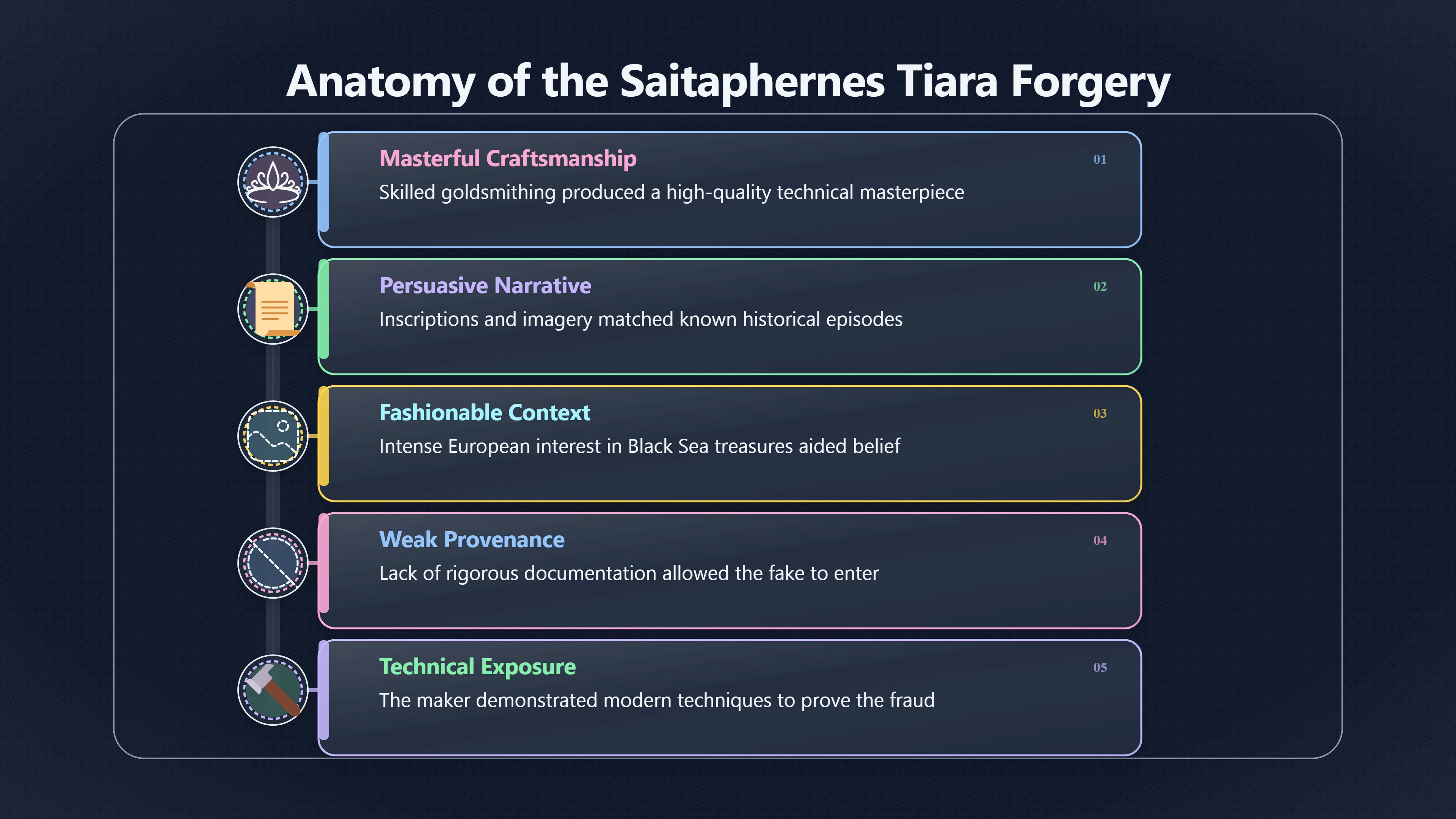
- Exceptional craftsmanship. The object was not a crude imitation but a masterwork produced by a skilled goldsmith.[Wikipedia]WikipediaTiara of SaitaferneTiara of Saitaferne
- A persuasive historical narrative. The inscription and imagery appeared to confirm a known episode involving Olbia and Scythian rulers.[Wikipedia]WikipediaTiara of SaitaferneTiara of Saitaferne
- Fashionable archaeology. Interest in Scythian and Black Sea discoveries made scholars receptive to spectacular finds from the region.[amusingplanet.com]amusingplanet.comthe tiara of saitapharnesJul 2, 2021 — Among the finds exhibited was the tiara that Rouchomovsky had unknowingly forged. The Imperial Court Museum in Vienna and B…
- Weak provenance standards. Documentation of where the object came from was far less rigorous than modern archaeological practice demands.[Archaeology Magazine]archive.archaeology.orgMagazine Saitaphernes' Golden Tiaraimage] Life magazine featured the tiara in its September 26…
The case is still cited as a classic example of why provenance—the documented history of an object’s discovery and ownership—matters as much as artistic or scientific analysis.
Why the Book of Veles Looked Ancient
The Book of Veles represents a different kind of forged antiquity. Instead of a precious object, it was presented as an ancient text supposedly inscribed on wooden boards and preserving a record of early Slavic religion and history. If genuine, it would have transformed understanding of the pre-Christian Slavic world.[Wikipedia]WikipediaBook of VelesBook of Veles
Its appeal was obvious. Historians possess relatively few written sources describing early Slavic beliefs from within the culture itself. A text claiming to preserve indigenous traditions therefore seemed capable of filling a major gap. For some readers, it also offered a powerful narrative of historical continuity and cultural antiquity.[Wikipedia]WikipediaBook of VelesBook of Veles
Unlike the tiara, however, the Book of Veles suffered from a fundamental problem: the original artefacts were unavailable for independent examination. The supposed wooden boards disappeared, leaving only copies, photographs and transcriptions. Scholars therefore had to judge authenticity largely through linguistic and textual analysis rather than direct physical inspection.[Wikipedia]WikipediaBook of VelesBook of Veles
As specialists examined the text, they found numerous anomalies. The language appeared to combine features from different Slavic languages and historical periods in ways that did not form a coherent ancient linguistic system. Grammatical structures, vocabulary and spelling patterns suggested an attempt to imitate antiquity rather than a genuine early medieval text. Most historians and linguists who have studied the work consequently regard it as a modern forgery.[Wikipedia]WikipediaBook of VelesBook of Veles
Yet the Book of Veles retained influence in some popular and nationalist circles long after scholars rejected its authenticity. Its persistence illustrates a recurring pattern in historical forgery: once a text fulfils a cultural or ideological need, scholarly refutation may not completely eliminate belief in it.[Wikipedia]WikipediaBook of VelesBook of Veles
Provenance, Language and the Evidence of Forgery
Although the Tiara of Saitaphernes and the Book of Veles are very different, the evidence that exposed them follows a similar logic.
In the tiara case, the decisive weakness was provenance. Experts eventually realised that the object lacked a reliable archaeological history. Once attention shifted from appearance to documented origin, the forgery became vulnerable. The later identification of Rouchomovsky provided the final confirmation.[Wikipedia]WikipediaTiara of SaitaferneTiara of Saitaferne
In the Book of Veles case, provenance problems were even more severe because the alleged originals could not be examined at all. Scholars therefore turned to language. Linguistic inconsistencies, invented forms and mixtures of features from different eras suggested that the text had been artificially aged by someone with incomplete knowledge of historical Slavic languages.[Wikipedia]WikipediaBook of VelesBook of Veles
These cases highlight three warning signs that repeatedly appear in forged antiquities:
- Missing or uncertain origin stories.
- Evidence that exists only through copies or intermediaries.
- Claims that conveniently fill a major historical gap.
None of these features automatically prove fraud, but together they often signal the need for heightened scepticism.
What These Fakes Reveal About Institutional Trust
The enduring importance of these Ukrainian-linked forgery stories lies not in embarrassment but in methodology. The Louvre was not deceived because its experts lacked intelligence. The Book of Veles was not influential because readers were uniquely gullible. In both cases, people encountered evidence that appeared to fit existing knowledge and desires. The deception worked because it looked plausible within its historical context.[Wikipedia]WikipediaTiara of SaitaferneTiara of Saitaferne
Modern museums, archives and researchers place far greater emphasis on excavation records, ownership histories, scientific testing and transparent documentation partly because of scandals such as these. The lesson is straightforward: authenticity is rarely established by appearance alone. An object can be beautifully made, and a text can sound ancient, yet neither quality can replace a verifiable chain of evidence.[British Museum]britishmuseum.orgBritish Museumtiara; case… Louvre in 1896 and denounced as a fake in 1903, having been made by Israel Rouchomovsky in Odessa in 1895-6…
The Tiara of Saitaphernes and the Book of Veles remain among the most instructive examples of forged antiquities connected to Ukraine because they demonstrate two different routes to institutional trust: one through artistic brilliance, the other through the promise of a lost historical voice. Both ultimately failed when investigators asked the same question—where is the evidence that this really comes from the past?[Wikipedia]WikipediaTiara of SaitaferneTiara of Saitaferne
Amazon book picks
Further Reading
Books and field guides related to How Modern Fakes Became Ancient Ukrainian Treasures. Use these as the next step if you want deeper reading beyond the article.
Scientific Investigation of Copies, Fakes and Forgeries
Directly matches stories about fake antiquities and museum errors.
The Confidence Game
Examines why intelligent people believe convincing frauds and myths.
eBay marketplace picks
Marketplace Samples
Live-tested eBay searches with available results related to this page.

Endnotes
1.
Source: Wikipedia
Title: Tiara of Saitaferne
Link:https://en.wikipedia.org/wiki/Tiara_of_Saitaferne
2.
Source: Wikipedia
Title: Book of Veles
Link:https://en.wikipedia.org/wiki/Book_of_Veles
3.
Source: archive.archaeology.org
Title: Magazine Saitaphernes’ Golden Tiara
Link:https://archive.archaeology.org/online/features/hoaxes/saitaphernes_tiara.html
Source snippet
[image] Life magazine featured the tiara in its September 26...
4.
Source: amusingplanet.com
Title: the tiara of saitapharnes
Link:https://www.amusingplanet.com/2021/07/the-tiara-of-saitapharnes.html
Source snippet
Jul 2, 2021 — Among the finds exhibited was the tiara that Rouchomovsky had unknowingly forged. The Imperial Court Museum in Vienna and B...
5.
Source: youtube.com
Title: The Tiara of Saitaphernes | STUFF YOU MISSED IN HISTORY CLASS
Link:https://www.youtube.com/watch?v=LRWnkUnS6cg
Source snippet
The Book of Veles: The Mystery of the Manuscript That Vanished Without a Trace...
6.
Source: britishmuseum.org
Link:https://www.britishmuseum.org/collection/object/H_1986-1021-1-a-b
Source snippet
British Museumtiara; case... Louvre in 1896 and denounced as a fake in 1903, having been made by Israel Rouchomovsky in Odessa in 1895-6...
7.
Source: rodnovery.ru
Title: Book of Veles
Link:https://rodnovery.ru/en/articles/book-of-veles
Source snippet
May 28, 2015 — A literary forgery claimed to be a text of ancient Slavic religion and history purportedly written on wooden planks.Read more...
Published: May 28, 2015
8.
Source: windowthroughtime.wordpress.com
Title: the tiara of saitaphernes
Link:https://windowthroughtime.wordpress.com/tag/the-tiara-of-saitaphernes/
9.
Source: the-slavic-forgery-universe.fandom.com
Title: The Book of Veles
Link:https://the-slavic-forgery-universe.fandom.com/wiki/The_Book_of_Veles
10.
Source: mythus.fandom.com
Link:https://mythus.fandom.com/wiki/Veles
Additional References
11.
Source: guinnessworldrecords.com
Link:https://www.guinnessworldrecords.com/world-records/115161-greatest-goldsmith-fraud
Source snippet
Guinness World RecordsGreatest goldsmith fraud... Louvre bought it for a record 200,000 gold French francs. It was later shown to be a fa...
12.
Source: magnumphotos.com
Title: book veles jonas bendiksen hoodwinked photography industry
Link:https://www.magnumphotos.com/arts-culture/society-arts-culture/book-veles-jonas-bendiksen-hoodwinked-photography-industry/
Source snippet
Magnum PhotosThe Book of Veles17 Sept 2021 — But today, most historians and linguists conclude that the entire Book of Veles was a forger...
13.
Source: youtube.com
Title: The Book of Veles: The Mystery of the Manuscript That Vanished Without a Trace
Link:https://www.youtube.com/watch?v=phduZ98UWJA
Source snippet
The Book of Veles: Authentic or the Greatest Forgery?...
14.
Source: news.artnet.com
Title: the hunt the tiara of saitaphernes 2558944
Link:https://news.artnet.com/art-world/the-hunt-the-tiara-of-saitaphernes-2558944
Source snippet
It holds the world record for the greatest goldsmith fraud of all time. On...
15.
Source: researchgate.net
Link:https://www.researchgate.net/publication/371841733_Ancient_Texts_and_Sibylline_Truths_A_Reflection_on_Forged_Documentary_Evidence_and_its_Value_in_the_Historia_Augusta
16.
Source: reddit.com
Link:https://www.reddit.com/r/pagan/comments/x6svcz/anyone_read_book_of_vele%C5%A1/
17.
Source: reddit.com
Link:https://www.reddit.com/r/wikipedia/comments/9dq2wj/book_of_veles_is_a_literary_forgery_purporting_to/
18.
Source: judithbenhamou.com
Link:https://judithbenhamou.com/the-book-of-veles-its-not-a-photojournalism-masterpiece-its-a-masterpiece-of-fake-news/
19.
Source: bewilderingstories.com
Link:https://www.bewilderingstories.com/issue55/goldtiara.html
20.
Source: reddit.com
Link:https://www.reddit.com/r/HistoryAnecdotes/comments/o9uqao/the_mockery_of_the_tiara_of_saitaferne_when_the/
Topic Tree