Why Jordan's Ancient Fakes Seemed So Convincing
Jordan’s history of hoaxes is dominated not by imaginary monsters or celebrated practical jokes, but by objects that promised access to the ancient biblical world.
Page outline Jump by section
Introduction
The best-known cases range from the nineteenth-century “Moabite” antiquities associated with Moses Wilhelm Shapira to the disputed Jordanian lead codices publicised in 2011. A separate museum scandal showed a more direct form of fraud, in which genuine coins were reportedly replaced by copies. Recent episodes at Petra also demonstrate a subtler problem: legitimate archaeology can be exaggerated until an interesting discovery resembles a media stunt. Together, these stories show why provenance — the documented history of where an object came from — matters at least as much as an exciting inscription or laboratory result.
The fake antiquities made for a biblical age
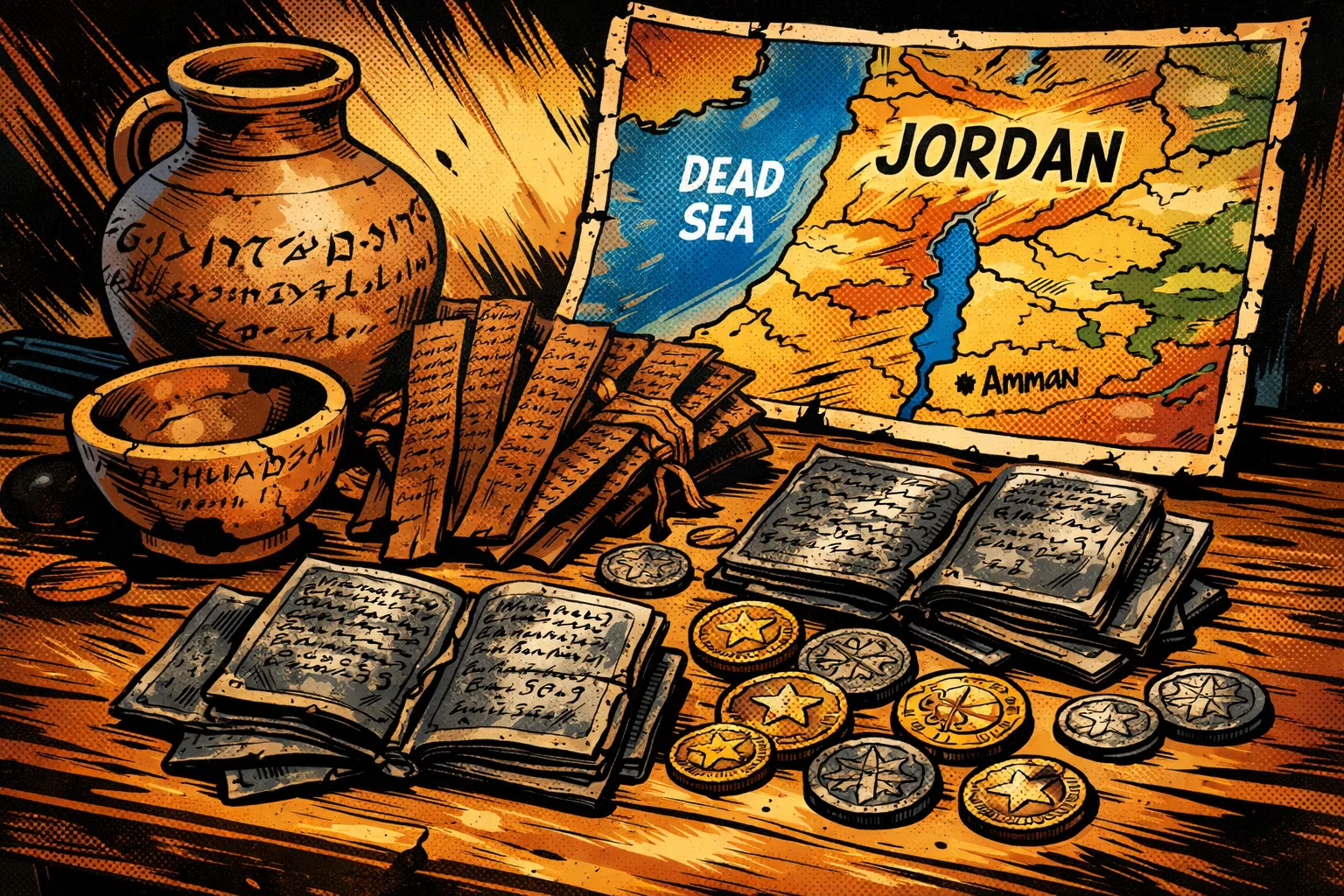
The earliest major Jordan-linked forgery scandal followed the discovery of the Mesha Stele in 1868. Found in the region of ancient Moab, in present-day Jordan, the stele carried a lengthy inscription attributed to King Mesha. Its importance created immediate demand for more objects from the same culture. Antiquities dealers, collectors and European museums hoped that further discoveries might illuminate peoples known from the Bible but poorly represented in surviving material evidence.
Into this atmosphere came hundreds of unusual ceramic vessels, figurines and inscribed fragments marketed as ancient Moabite objects. Many passed through the Jerusalem shop of Moses Wilhelm Shapira, a dealer who said that local intermediaries had obtained them east of the Dead Sea. Berlin acquired a large collection in the early 1870s, while other buyers also purchased examples. The objects seemed valuable partly because they filled a scholarly gap: there was so little established Moabite material with which to compare them.[tandfonline.com]tandfonline.comTaylor & Francis OnlineMoses Wilhelm Shapira, Hermann Weser and the Moab…by H Goren · 2025 — The 1870s case of the archaeological forg…
That scarcity made the supposed finds easier to accept. Their strange symbols and unfamiliar designs could be presented as evidence of an unknown artistic tradition rather than warning signs. European institutions were also competing for prestige. Berlin had failed to secure the Mesha Stele itself, giving its curators an added incentive to obtain other spectacular Moabite material before rival museums did.
French archaeologist and diplomat Charles Clermont-Ganneau investigated the trade and concluded that the objects were modern fabrications. He traced parts of the production network through local suppliers and craftsmen, while scholars found that the inscriptions did not form convincing ancient texts. German specialists eventually accepted that the collection was fraudulent. Modern research continues to examine where individual pieces were manufactured and how responsibility should be divided between Shapira, his intermediaries and the artisans who made them, but the “Moabitica” collection is generally treated as a landmark archaeological forgery affair.[tandfonline.com]tandfonline.comTaylor & Francis OnlineMoses Wilhelm Shapira, Hermann Weser and the Moab…by H Goren · 2025 — The 1870s case of the archaeological forg…
The episode is important because it established a pattern repeated in later Jordan-related controversies:
- a dramatic connection to biblical history;
- an undocumented story involving objects found by local people;
- artefacts entering scholarship through dealers rather than excavation;
- institutional or commercial pressure to authenticate them quickly;
- and a shortage of comparable genuine material against which to test them.
The deception therefore exploited more than individual credulity. It exploited the structure of the nineteenth-century antiquities market, in which colonial competition, religious enthusiasm and incomplete archaeological knowledge often rewarded sensational claims.
The Shapira scrolls: forgery or a verdict reached too quickly?
In 1883, Shapira returned with a still more extraordinary object: fifteen narrow leather strips carrying a version of Deuteronomy in an ancient-looking script. He claimed that the manuscript had been recovered from a cave near the Dead Sea, commonly associated in his accounts with the Moab region of present-day Jordan. Had it been genuine, it would have been by far the oldest known biblical manuscript at the time.
Shapira offered the strips to the British Museum for £1 million, an enormous sum. Portions were publicly displayed while scholars examined the writing and material. Several experts rejected the manuscript. They argued that its language contained suspicious forms, that the writing resembled a modern imitation of ancient script and that the strips may have been cut from the margins of an older manuscript before being artificially darkened. Shapira’s inconsistent accounts of where and how the fragments had been found added to the doubts.[biblicalarchaeology.org]biblicalarchaeology.orgBiblical Archaeology SocietyThe Shapira Scrolls—Authentic or Forged?December 8, 2021 — 8 Dec 2021 — Do the Shapira Scrolls contain an aut…
Clermont-Ganneau, already known for exposing the Moabite pottery, declared the strips forged. Other scholars, including the British Museum’s Christian David Ginsburg, reached the same conclusion. The manuscript’s reputation collapsed, and Shapira died by suicide in 1884. The strips later disappeared; their present location is unknown.
The apparent exposure seemed decisive for more than a century. Yet the discovery of the genuine Dead Sea Scrolls from 1947 onwards changed the historical background. Ancient biblical manuscripts really had survived in caves near the Dead Sea, sometimes in forms that differed from the later standard text. A minority of modern researchers have therefore argued that the Shapira strips deserve reconsideration and that Victorian specialists may have dismissed them too quickly. Other scholars maintain that the wording, grammar, reported physical features and suspicious provenance still point strongly towards forgery.[biblicalarchaeology.org]biblicalarchaeology.orgBiblical Archaeology SocietyThe Shapira Scrolls—Authentic or Forged?December 8, 2021 — 8 Dec 2021 — Do the Shapira Scrolls contain an aut…
Because the originals are missing, modern tests cannot settle the dispute. Photographs, drawings and transcriptions preserve much of the text, but they cannot provide radiocarbon dates, ink analysis or a microscopic examination of the leather. The Shapira affair is consequently not a simple tale of a fake being conclusively exposed. It is also a warning about lost evidence: even a sound nineteenth-century judgement is difficult to recheck once the disputed object has vanished.
The distinction matters. The earlier Moabite ceramics were manufactured objects supported by an identifiable commercial trade and exposed through investigation of their production. The scrolls were condemned primarily through textual, palaeographic and physical observations made before modern scientific testing. They may still have been forged, as the prevailing scholarly view holds, but the surviving evidence permits more debate than popular retellings often suggest.
The Jordanian lead codices and the danger of testing the wrong question
In 2011, international newspapers reported another remarkable supposed discovery: dozens of small books made from sheets of lead, allegedly found in a cave in northern Jordan. Their pages carried symbols, portraits and writing in forms resembling Hebrew and other ancient scripts. Promoters suggested that the books might date from Christianity’s earliest centuries and could include an early representation of Jesus.
The story spread because it combined all the ingredients of an archaeological sensation. The objects were visually strange, the alleged find location sounded plausible, and the secrecy surrounding their ownership suggested hidden knowledge. Claims about early Christianity guaranteed worldwide attention. Yet the codices had not emerged from a controlled archaeological excavation. Their reported chain of custody involved competing accounts, private holders and movement across the Jordanian-Israeli border.[wikipedia.org]WikipediaJordan Lead CodicesJordan Lead Codices
Specialists quickly identified serious problems. Some inscriptions appeared to reproduce known ancient texts inaccurately, while images and letter forms seemed to have been copied from published sources. Oxford classicist Peter Thonemann examined photographs of one inscription and argued that it was a modern imitation derived from an ancient tombstone. Israeli antiquities specialists and Jordan’s Department of Antiquities also treated the objects as forgeries. A BBC investigation questioned both the claims being made and the credentials of one of their principal promoters.[Wikipedia]WikipediaJordan Lead CodicesJordan Lead Codices
Supporters responded with scientific tests suggesting that some of the lead was old and that its corrosion did not resemble a freshly manufactured object. This produced a recurrent but misleading argument: if the metal was ancient, the inscriptions must also be ancient.
Old material, however, does not prove an old artefact. A modern forger can engrave a reused sheet of ancient lead, just as a forged painting can be made on an old canvas. Testing the metal may establish when the lead was smelted or how long it has corroded, but it does not necessarily establish when symbols were cut into its surface or when the sheets were assembled as books.
The controversy remains active. A materials-analysis paper published in 2026 reported that some tested lead objects could not simply be classified as modern, while explicitly acknowledging that the central debate is whether the codices are ancient works or recent fabrications. That finding complicates an easy dismissal of every component, but it does not answer the linguistic and iconographic objections or establish the claimed early-Christian interpretation. Jordanian and Israeli antiquities authorities have continued to regard the collection as forged.[sciencedirect.com]sciencedirect.comOpen source on sciencedirect.com.
The safest conclusion is therefore narrower than either publicity campaign suggests. Some lead used in the objects may be old. That does not demonstrate that the codices themselves are ancient books, still less that they preserve lost Christian scripture. Until representative pieces can be studied through transparent, independent and repeatable testing — including tool marks, corrosion inside engraved lines, inscriptions and documented ownership history — the spectacular historical claims remain unsupported.
When museum originals were replaced by copies
Jordan’s most concrete antiquities deception did not involve persuading scholars that newly surfaced objects were ancient. It involved the reported substitution of copies for genuine objects already held in public custody.
In 2016, Jordanian officials and parliamentarians disclosed that hundreds of ancient gold and silver coins associated with the archaeological museum at Amman’s Citadel had been replaced with fakes. Early reports said that 400 of 401 coins had been substituted, apparently during 2001–02. Further proceedings concerned a large group of Ptolemaic silver coins from Iraq al-Amir, almost all of which investigators concluded had been replaced by counterfeits.[Jordan Times]jordantimes.comJordan Times House panel looking into museum artefacts after 400Jordan Times House panel looking into museum artefacts after 400
The deception was reportedly uncovered when an archaeologist returned with students to view coins connected with his earlier work and recognised that the displayed or stored pieces were not the originals. A committee established by the tourism and antiquities authorities examined the objects. Jordanian courts later imposed a prison sentence and a substantial financial penalty in connection with replacing museum coins with copies. Reports differ in their totals because the investigation covered more than one group of coins and because news accounts referred to different parts of the case.[Jordan News]jordannews.joJordan News Ex-museum director sentenced to prison for counterfeiting antiJordan News Ex-museum director sentenced to prison for counterfeiting anti
Unlike the lead codices, this was not principally an argument about ambiguous evidence. The copies functioned as substitutes, allowing genuine antiquities to disappear while maintaining the outward appearance of an intact collection. Such fraud benefits from a museum’s authority: visitors and even staff generally assume that an object inside an official collection has already been authenticated and securely catalogued.
The case exposed the importance of less glamorous safeguards. Detailed photography, weights, dimensions, metal analysis, accession records and regular audits can reveal substitution even where a copy is visually convincing. It also illustrates why cultural-property crime is not limited to illicit excavation. Objects can be endangered after entering museums if record-keeping, storage controls and staff accountability are weak.
Petra and the difference between a fake discovery and an inflated one
Not every misleading archaeological story is a manufactured artefact. Sometimes the excavation is real but the publicity turns it into something it is not.
In 2024, a televised excavation at Petra revealed a tomb containing human remains and grave goods near the Khazneh, the monument popularly called the Treasury. Promotional language described the work as historic and compared one broken pottery object to the “Holy Grail” seen in Indiana Jones and the Last Crusade, whose exterior scenes were filmed at Petra.
The tomb and remains were genuine. The problem was exaggeration. Specialists in Nabataean archaeology noted that the tomb’s existence was already known to Jordan’s Department of Antiquities and that burials inside a Petra tomb were hardly unexpected. The supposed grail-like object was the upper part of a broken vessel, not evidence of a unique ritual treasure. Archaeologists did not deny that the excavation could add useful knowledge; they disputed claims that it represented an unprecedented revelation.[The Guardian]theguardian.comOpen source on theguardian.com.
This is better described as media hype than a hoax. No fake corpse or invented chamber was required. Instead, familiar entertainment conventions — the hidden tomb, the legendary cup and the adventurous presenter — encouraged audiences to interpret normal archaeological work as a dramatic quest.
The distinction protects both public understanding and the reputation of Jordanian archaeology. Petra still contains unanswered questions about Nabataean society, burial customs and religious life. A find need not be the “discovery of the century” to matter. When every tomb is promoted as a world-changing secret, genuinely important results become harder to recognise and public trust is weakened when the promised revelation proves ordinary.
How modern falsehoods borrow Jordanian scenery
Online misinformation has extended the same mechanism beyond archaeology. Images and videos acquire credibility when they are attached to recognisable Jordanian places, institutions or political tensions, even when the footage was recorded elsewhere or in a different context.
Fact-checkers have documented videos falsely described as showing military incidents on Jordan’s borders, fabricated claims about foreign bases and unrelated footage relabelled as attacks involving Jordanian authorities. In one case, a video circulated as evidence that Jordanian soldiers had fired at Israelis near the border; investigation and official reporting did not support the claim. Another clip was presented as revealing a French base in Jordan established to protect Israel, although its context had been misrepresented.[Misbar]misbar.comThe Jordanian Army Did Not Fire on Israelis Near the BorderThe Jordanian Army Did Not Fire on Israelis Near the Border
A particularly revealing example involved footage recorded in Jordan during the COVID-19 lockdown. It showed a staged funeral used as part of an attempt to evade movement restrictions. Years later, the same video was recirculated with the false claim that Palestinians were staging deaths during the Gaza war. The original event involved real deception, but the later post imposed an entirely different political meaning on it.[Misbar]misbar.comthis video does not show a staged funeral during the war on gazathis video does not show a staged funeral during the war on gaza
AI-generated pictures have added another layer. Following the 2024 drone attack on a United States base in Jordan, false images circulated purporting to show President Joe Biden in military clothing. Fact-checkers identified visual defects consistent with artificial generation. The pictures succeeded not because they offered detailed evidence, but because they matched expectations of crisis, military response and presidential authority.[Misbar]misbar.comOpen source on misbar.com.
These examples are not famous national hoaxes in the mould of the Moabite antiquities. They are faster, more disposable deceptions designed for social-media circulation. Their basic method nevertheless remains familiar: attach an emotionally charged claim to material that looks authentic, then allow urgency and prior belief to outrun verification.
Why Jordan attracts claims of hidden history
Jordan’s archaeological landscape makes it particularly easy to construct plausible stories about undiscovered manuscripts and lost treasures. Petra, the Dead Sea region, ancient Moab, Roman cities and biblical sites give even invented objects a convincing geographical background. A claim that would sound absurd in a less archaeologically rich setting can seem possible when linked to a real cave, tomb or ruin.
Religious expectation adds further power. An artefact said to mention Jesus, Moses, an Israelite king or an unknown biblical text is not merely an academic object. It may promise confirmation of belief, revision of scripture, national prestige or commercial success. That expands the audience far beyond professional archaeology and rewards promoters who speak with certainty before specialists have completed their work.
The illicit antiquities market creates another incentive. Objects with dramatic inscriptions usually command more attention and value than ordinary pottery, coins or tools. Removing artefacts from their archaeological setting also destroys the contextual evidence that could authenticate them. A genuine object without provenance and a clever forgery can therefore become difficult to distinguish.
Several practical questions help separate a credible discovery from a likely deception:
- Was it excavated under documented conditions? A recorded archaeological context is far stronger than a story about a cave, shepherd, dealer or anonymous finder.
- Can independent specialists inspect the original? Photographs selected by promoters do not allow full analysis.
- Do the script and images fit their alleged period? Ancient-looking letters can still contain modern copying mistakes or mixtures of incompatible styles.
- Does scientific testing date the finished object? Old metal, leather or wood may have been reused.
- Is the claim more precise than the evidence? “The lead may be old” is not equivalent to “this is the earliest Christian gospel”.
- Who gains from publicity? Book contracts, films, sales, fundraising and institutional prestige do not prove fraud, but they can encourage premature certainty.
Jordan’s most memorable deception stories endure because they sit close to genuine possibility. Ancient manuscripts have been found near the Dead Sea. Extraordinary inscriptions do survive in Jordan. Petra still yields new information. Precisely because real discoveries occur there, false ones do not need to invent an entirely imaginary world. They need only produce an object convincing enough to borrow the authority of the landscape.

Amazon book picks
Further Reading
Books and field guides related to Why Jordan's Ancient Fakes Seemed So Convincing. Use these as the next step if you want deeper reading beyond the article.
Frauds, Myths, and Mysteries: Science and Pseudoscience in Ar...
Examines archaeological hoaxes, myths and mistaken claims.
The Dead Sea Scrolls Today
Helps readers understand why claims of ancient texts attract attention.
The Bible Unearthed
Rating: 3.5/5 from 9 Google Books ratings
Covers the archaeological world that made biblical artifacts so valuable.
Archaeological Theory
Provides the provenance and context principles central to the page.
eBay marketplace picks
Marketplace Samples
Live-tested eBay searches with available results related to this page.



Endnotes
1.
Source: academia.edu
Title: Between Apostate and Forger Moses Wilhelm Shapira and the Moabite Pottery Affair
Link:https://www.academia.edu/24911481/Between_Apostate_and_Forger_Moses_Wilhelm_Shapira_and_the_Moabite_Pottery_Affair
Source snippet
Moses Wilhelm Shapira and the Moabite Pottery Affair15 Mar 2022 — Shapira sold a tremendous collection of figurines and clay vess...
2.
Source: Wikipedia
Title: Shapira Scroll
Link:https://en.wikipedia.org/wiki/Shapira_Scroll
3.
Source: ancientjewreview.com
Title: the myth of moses shapira
Link:https://www.ancientjewreview.com/read/2021/8/31/the-myth-of-moses-shapira
4.
Source: Wikipedia
Title: Jordan Lead Codices
Link:https://en.wikipedia.org/wiki/Jordan_Lead_Codices
5.
Source: sciencedirect.com
Link:https://www.sciencedirect.com/science/article/pii/S0168583X25003374
6.
Source: misbar.com
Title: The Jordanian Army Did Not Fire on Israelis Near the Border
Link:https://www.misbar.com/en/factcheck/2021/12/28/the-jordanian-army-did-not-fire-on-israelis-near-the-border
7.
Source: misbar.com
Title: is there a french military base in jordan for safeguarding israel
Link:https://www.misbar.com/en/editorial/2023/12/24/is-there-a-french-military-base-in-jordan-for-safeguarding-israel
8.
Source: misbar.com
Title: this video does not show a staged funeral during the war on gaza
Link:https://www.misbar.com/en/factcheck/2023/10/14/this-video-does-not-show-a-staged-funeral-during-the-war-on-gaza
9.
Source: misbar.com
Link:https://www.misbar.com/en/editorial/2024/12/24/top-12-ai-generated-images-fact-checked-by-misbar-in-2024
10.
Source: misbar.com
Link:https://www.misbar.com/en/factcheck/2026/07/10/old-video-falsely-shared-showing-recent-strike-us-base-jordan
11.
Source: misbar.com
Title: ten countries reject claims taking gazans amid resettlement calls
Link:https://www.misbar.com/en/editorial/2025/04/05/ten-countries-reject-claims-taking-gazans-amid-resettlement-calls
12.
Source: misbar.com
Title: video does not show recent us strike bandar abbas port
Link:https://www.misbar.com/en/factcheck/2026/05/10/video-does-not-show-recent-us-strike-bandar-abbas-port
13.
Source: misbar.com
Title: viral video does not show assault jordan’s king
Link:https://www.misbar.com/en/factcheck/2025/05/11/viral-video-does-not-show-assault-jordan%E2%80%99s-king
14.
Source: misbar.com
Title: photo of woman in chains is from play, not taliban takeover
Link:https://www.misbar.com/en/factcheck/2021/08/19/photo-of-woman-in-chains-is-from-play%2C-not-taliban-takeover
15.
Source: misbar.com
Title: china did not conduct humanitarian airdrops gaza despite israeli blockade
Link:https://www.misbar.com/en/factcheck/2025/05/18/china-did-not-conduct-humanitarian-airdrops-gaza-despite-israeli-blockade
16.
Source: Wikipedia
Title: Archaeological forgery
Link:https://en.wikipedia.org/wiki/Archaeological_forgery
17.
Source: academia.edu
Link:https://www.academia.edu/Documents/in/Archaeological_Forgeries
18.
Source: academia.edu
Title: The [Shapira Scrolls]({{ ‘shapira-scrolls/’ | relative_url }}) The Case for Authenticity Dershowitz and Tabor
Link:https://www.academia.edu/81814044/The_Shapira_Scrolls_The_Case_for_Authenticity_Dershowitz_and_Tabor
19.
Source: academia.edu
Title: Sources for the Reinvestigation of the Shapira Strips
Link:https://www.academia.edu/144135552/Sources_for_the_Reinvestigation_of_the_Shapira_Strips
20.
Source: archaeology.wiki
Title: Jordan lead codices not modern forgeries
Link:https://www.archaeology.wiki/blog/2016/12/12/jordan-lead-codices-modern-forgeries/
21.
Source: tandfonline.com
Link:https://www.tandfonline.com/doi/full/10.1080/00310328.2024.2435787
Source snippet
Taylor & Francis OnlineMoses Wilhelm Shapira, Hermann Weser and the Moab...by H Goren · 2025 — The 1870s case of the archaeological forg...
22.
Source: bengurion.ca
Link:https://bengurion.ca/where-were-the-moabite-antiquities-created/
Source snippet
Ben-Gurion University CanadaWhere Were the 'Moabite Antiquities' Created?In the 1870s, several cases of alleged archaeological forgeries...
23.
Source: biblicalarchaeology.org
Link:https://www.biblicalarchaeology.org/daily/biblical-topics/hebrew-bible/the-shapira-scrolls-authentic-or-forged/
Source snippet
Biblical Archaeology SocietyThe Shapira Scrolls—Authentic or Forged?December 8, 2021 — 8 Dec 2021 — Do the Shapira Scrolls contain an aut...
Published: December 8, 2021
24.
Source: site.tusculum.edu
Link:https://site.tusculum.edu/reference/the-shapira-strips/
Source snippet
TUSCULUM UNIVERSITYThe Shapira StripsShapira offered to sell the strips to the British Museum after showing them to some biblical scholar...
25.
Source: ft.com
Link:https://www.ft.com/content/7a03cb4c-bdc2-44bb-924e-8d53e84717c4
Source snippet
Their exploration draws them into a web of intrigue, involving a charismatic but volatile Bedouin named Hassan Saida, conflicting scholar...
26.
Source: labrujulaverde.com
Link:https://www.labrujulaverde.com/en/2025/11/an-ion-beam-analysis-reveals-that-some-fragments-of-the-controversial-jordan-lead-codices-may-be-ancient/
27.
Source: jordantimes.com
Title: Jordan Times House panel looking into museum artefacts after 400
Link:https://jordantimes.com/news/local/house-panel-looking-museum-artefacts-after-400-ancient-coins-replaced-fakes
28.
Source: jordantimes.com
Title: ancient coins were replaced fakes between 2001 2002 — pm
Link:https://jordantimes.com/news/local/ancient-coins-were-replaced-fakes-between-2001-2002-%E2%80%94-pm
29.
Source: jordannews.jo
Title: Jordan News Ex-museum director sentenced to prison for counterfeiting anti
Link:https://www.jordannews.jo/Section-109/News/Ex-museum-director-sentenced-to-prison-for-counterfeiting-antique-coins-26550
30.
Source: theguardian.com
Link:https://www.theguardian.com/science/2024/oct/19/petra-jordan-archaeology-tomb-excavation-nabataean-experts
31.
Source: jordantimes.com
Title: one arrested deceiving citizens fake artefacts
Link:https://jordantimes.com/news/local/one-arrested-deceiving-citizens-fake-artefacts
32.
Source: theguardian.com
Link:https://www.theguardian.com/artanddesign/picture/2013/oct/23/photography
33.
Source: tandfonline.com
Link:https://www.tandfonline.com/doi/abs/10.1080/00310328.2024.2435787
34.
Source: biblicalarchaeology.org
Title: how to spot a biblical fake
Link:https://www.biblicalarchaeology.org/daily/how-to-spot-a-biblical-fake/
35.
Source: library.biblicalarchaeology.org
Title: tracking the shapira case a biblical scandal revisited
Link:https://library.biblicalarchaeology.org/article/tracking-the-shapira-case-a-biblical-scandal-revisited/
Additional References
36.
Source: youtube.com
Title: The Lost Bible Scroll… Real or One of History’s Biggest Fakes? | Dr. Joel Baden
Link:https://www.youtube.com/watch?v=Iso7fS-dHrA
Source snippet
Shapira vs. Dead Sea Scrolls: An Authenticity Test...
37.
Source: bgu.ac.il
Link:https://www.bgu.ac.il/en/news-and-articles/where-were-the-moabite-antiquities-created/
Source snippet
Ben-Gurion UniversityWhere Were the 'Moabite Antiquities' Created?In the 1870s, several cases of alleged archaeological forgeries were at...
38.
Source: youtube.com
Title: The Roman Lead Scrolls Deciphering an Ancient Mystery
Link:https://www.youtube.com/watch?v=RhXEmO_Jxg8
Source snippet
The Lost Bible Scroll… Real or One of History's Biggest Fakes? | Dr. Joel Baden...
39.
Source: youtube.com
Title: The Scroll BEFORE The Dead Sea Scrolls
Link:https://www.youtube.com/watch?v=9dQGLFFeeG0
Source snippet
The Lost Ten Commandments? The Shapira Scroll Mystery | Ross K. Nichols...
40.
Source: instagram.com
Link:https://www.instagram.com/reel/Ce3EJCID2UF/
41.
Source: researchgate.net
Link:https://www.researchgate.net/publication/233557773_Mysterious_Books_from_Jordan
42.
Source: facebook.com
Link:https://www.facebook.com/NatGeoUK/posts/a-curious-tale-of-fakery-that-traversed-the-holy-land-and-the-decades-before-bei/10160151718378970/
43.
Source: reddit.com
Link:https://www.reddit.com/r/AncientCoins/comments/t7dzqg/bought_at_petra_afraid_to_ask_they_fake/
44.
Source: rollstonepigraphy.com
Link:https://www.rollstonepigraphy.com/?p=896
45.
Source: facebook.com
Link:https://www.facebook.com/groups/149844915349213/posts/2346705845663098/
Topic Tree
Follow this branch
Related pages 192
- Albanian Hoaxes
- Algerian Hoaxes
- Antigua Deceptions
- Argentina Hoaxes
- Armenian Hoaxes
- +187 more in sidebar