When Suriname's Strangest Stories Met the Evidence
Suriname does not have a long, neatly catalogued tradition of celebrated public hoaxes comparable with Britain’s Piltdown Man or America’s Cardiff Giant. Its most revealing stories of contested truth instead lie at the borders between fabrication, colonial fantasy, literary invention, scientific disbelief and state propaganda.
Page outline Jump by section
Introduction
These cases matter because they show that deception is not always a single prank with an identifiable inventor. A false story may be produced by commercial ambition, copied between respected authorities, disguised as eyewitness testimony or enforced by political power. Suriname’s history also supplies an important corrective: sometimes the supposed “hoax” was the accusation itself, made against evidence that challenged European expectations.
El Dorado put an imaginary landscape on the map
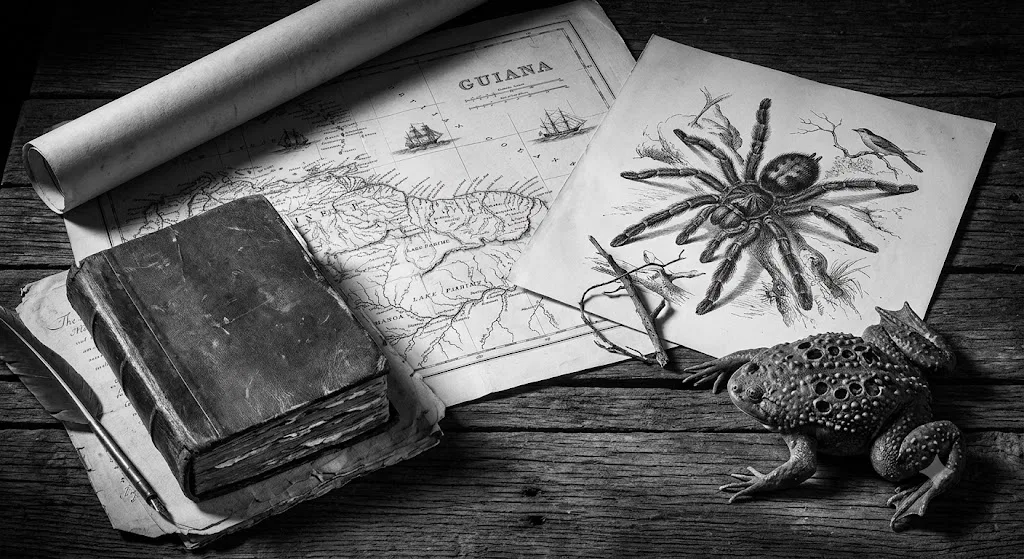
The most influential geographical falsehood connected with the region was the supposed existence of Lake Parime, usually shown beside Manoa, the fabulous city associated with El Dorado. The imaginary lake was generally placed farther west or south than present-day Suriname, in territory now divided among Guyana, Venezuela and Brazil. Nevertheless, it belonged to the wider European construction of “Guiana”, a poorly understood region that included the lands later called Suriname.
The story did not begin as a simple confidence trick. Reports of Indigenous goldworking, misunderstood descriptions of seasonal flooding and older tales about a gilded ruler gradually merged into a European fantasy of a wealthy inland kingdom. Walter Raleigh’s Discoverie of Guiana, published in 1596, gave the idea unusual authority. Raleigh presented Manoa and Lake Parime as credible geographical objectives despite never reaching the supposed lake. His account mixed observation, hearsay, political advocacy and extravagant promises of mineral wealth at a time when he needed royal support for further expeditions.[Wikipedia]WikipediaLake ParimeLake Parime
Mapmakers then converted uncertainty into apparent fact. Jodocus Hondius’s influential map of Guiana in 1598 showed a large Lake Parime with Manoa on its shore. Later publishers copied the feature, sometimes describing the city as exceptionally large or rich. Repetition gave the fiction durability: a reader encountering the lake in several atlases could reasonably assume that different cartographers had independently confirmed it, when many were recycling the same reports.[Wikipedia]WikipediaLake ParimeLake Parime
The imagined geography benefited several groups. Explorers could attract investors; monarchs could justify territorial claims; publishers could sell dramatic maps; and colonial promoters could portray the interior as a reserve of untapped wealth. The legend also survived because Europeans possessed only fragmentary knowledge of the Guiana Shield. Large seasonally flooded savannahs may have helped sustain accounts of a vast inland body of water, while each failed expedition could be explained by placing the lake slightly farther away.
Doubt accumulated slowly. Eighteenth-century cartographers increasingly marked Lake Parime as uncertain rather than established. Alexander von Humboldt’s surveys around the turn of the nineteenth century found no evidence for the immense lake described by earlier writers, and the feature gradually disappeared from serious maps. Modern remote-sensing work has examined whether the legend retained a distant environmental basis, such as extensive past or seasonal flooding, but it has not restored Raleigh’s golden city or the enormous permanent lake shown in old atlases.[Wikipedia]WikipediaLake ParimeLake Parime
Lake Parime is therefore best understood as a compounded cartographic myth rather than a single deliberate hoax. Some promoters almost certainly overstated what they knew, but mapmakers also inherited errors from apparently reputable predecessors. Its history demonstrates how a claim can become more persuasive when it moves from a traveller’s tale into a technical-looking visual form.

Oroonoko blurred eyewitness report and fiction
Aphra Behn’s Oroonoko; or, The Royal Slave, published in 1688, is one of the most famous literary works set in Suriname. It tells of an African prince deceived into slavery, transported to the colony and brutally killed after leading a rebellion. The title labelled the book “A True History”, while its narrator claimed personal knowledge of the principal characters and colonial setting.
That claim has shaped the book’s reputation for centuries. Early readers and biographers frequently treated the narrator as Behn herself, using details from the story as evidence about the author’s life. The technique was powerful because late seventeenth-century readers were accustomed to travel narratives, captivity accounts and colonial reports that promised direct testimony from distant places. Behn’s first-person voice, geographical description and insistence that she was recording rather than inventing events gave the story the texture of reportage.[Wikipedia]WikipediaOpen source on wikipedia.org.
Scholars now treat the matter more cautiously. Behn may have travelled to Suriname, and she may have encountered stories about an enslaved person of high status. Yet no independent record confirms an individual whose life matches Oroonoko’s complete romantic and tragic biography. Some local details are inaccurate or appear to have been taken from published works and acquaintances rather than direct observation. The book is consequently read as prose fiction built from colonial knowledge, literary convention and perhaps remembered experience—not as a reliable transcript of a documented rebellion.[cambridge.org]resolve.cambridge.orgCambridge University Press & AssessmentOroonoko: reception, ideology, and narrative strategyTrue, Behn probably travelled to Surinam in h…
Calling Oroonoko a hoax would be too crude. Early prose fiction often borrowed the authority of history, and the boundary between novel, biography and travel writing was not yet fixed. The phrase “true history” could signal moral or emotional truth as well as strict factual reporting. Behn’s work nevertheless illustrates a recognisable mechanism of deception: an invented or heavily reshaped narrative gains authority by presenting its narrator as a witness.
The distinction matters because the story has influenced popular ideas about slavery in Suriname. Its violence reflects genuine features of plantation society, including coercion, rebellion and exemplary punishment. At the same time, Oroonoko is an idealised royal hero filtered through European assumptions about nobility, race and monarchy. Readers can therefore value the work as an early and disturbing representation of colonial slavery without treating every event as documented Surinamese history.[Cambridge University Press & Assessment]resolve.cambridge.orgCambridge University Press & AssessmentOroonoko: reception, ideology, and narrative strategyTrue, Behn probably travelled to Surinam in h…
The Suriname wildlife that looked too strange to be true
Maria Sibylla Merian travelled to Suriname in 1699 to study insects, plants and other animals. Her lavishly illustrated Metamorphosis of the Insects of Suriname, published in 1705, challenged inherited European beliefs by showing insects developing through eggs, larvae and pupae rather than appearing spontaneously from decaying matter. She also depicted creatures whose behaviour seemed fantastic to readers who had never encountered tropical ecology.[Natural History Museum]nhm.ac.ukOpen source on nhm.ac.uk.
Two images attracted particular suspicion. One showed the Suriname toad, whose young develop in cavities embedded in the female’s back. Another depicted a large spider attacking a hummingbird. Both scenes appeared grotesque enough to resemble the invented monsters and composite curiosities that circulated in European collections. Merian’s gender and her reliance on knowledge supplied by Indigenous and enslaved people also made it easier for later commentators to discount her testimony.[rct.uk]rct.ukshoreline purslane and suriname toadshoreline purslane and suriname toad
Subsequent naturalists confirmed the extraordinary reproductive behaviour of the Suriname toad. Large tropical spiders can also prey on small vertebrates, including birds, although such attacks are not their normal daily diet. Merian’s compositions were artistic arrangements rather than photographic snapshots, and individual plates could combine observations made at different moments. That does not make the central biological claims fraudulent.
This episode reverses the usual hoax pattern. The remarkable claim was substantially genuine; the charge of fantasy arose because the observation violated European expectations. It is a useful warning for any history of deception: scepticism is essential, but disbelief based chiefly on prejudice, unfamiliarity or confidence in an inadequate scientific model can itself preserve error.
Merian’s work also shows why local knowledge matters. She recorded information obtained from people living within Suriname’s environment, although she rarely preserved their individual names. European science later celebrated the published observer while leaving many of her informants anonymous. The eventual vindication of her images therefore belongs not only to the history of natural science, but also to the history of whose testimony was considered credible.[The Guardian]theguardian.comOpen source on theguardian.com.
The false “escape attempt” after the December Murders
Suriname’s gravest documented episode of official deception followed the killing of 15 government critics in December 1982. The victims—including journalists, lawyers, trade-union figures, academics and military officers—had been detained and taken to Fort Zeelandia in Paramaribo during the military rule of Dési Bouterse.
On 10 December, Bouterse appeared on national television and claimed that the detainees had been shot while attempting to escape. The formulation supplied the killings with the outline of a security operation rather than an execution: prisoners supposedly fled, guards responded and deaths followed. Coming from the regime that controlled the armed forces and major channels of information, the account was designed to establish the official version before independent investigators could examine the bodies or question witnesses.[Wikipedia]WikipediaDecember murdersDecember murders
Evidence contradicted that story. Accounts of detention, signs of torture and the nature of the injuries supported the conclusion that the men had been deliberately killed. Human-rights proceedings and the later criminal case treated the deaths as extrajudicial executions, not the accidental outcome of an escape. The Inter-American Commission on Human Rights described allegations that the victims were targeted, tortured and executed by the military dictatorship.[OAS]oas.orgsuad1212 14ensuad1212 14en
The false account persisted for reasons very different from a newspaper prank. It was protected by fear, institutional power and the long obstruction of legal accountability. The regime benefited immediately by obscuring responsibility and warning opponents that the state controlled not only physical force but also the public narrative. Political loyalties later helped keep alternative explanations alive even as testimony and forensic evidence accumulated.
After a trial lasting many years, Bouterse was convicted for his role in the killings. Suriname’s Court of Justice upheld his 20-year sentence on 20 December 2023, leaving no further domestic appeal. The judgment did not merely assign criminal responsibility; it completed the legal destruction of the “escape attempt” story that had been presented to the public four decades earlier.[nuhanovicfoundation.org]nuhanovicfoundation.orgCase Against Desi Bouterse (December Murders Case)OnCase Against Desi Bouterse (December Murders Case)On
This case should not be treated as colourful folklore. It was propaganda attached to lethal state violence. Yet it belongs in a history of Surinamese deception because it shows the highest-stakes form of a familiar technique: issue a simple explanation quickly, exploit control over information and force critics to spend years disproving a claim that required only minutes to announce.
Why these stories lasted
Suriname’s best-supported deception stories differ sharply in scale and intent, but several common mechanisms connect them.
Authority made uncertainty look settled. A printed atlas transformed rumours about Lake Parime into geography. A first-person narrator made fiction resemble testimony. A televised statement by a military ruler sought to define killings before independent evidence could emerge.
Distance favoured invention. European readers knew little about the Guiana interior, plantation society or tropical animals. Claims were therefore difficult to check, whether they concerned a golden city, an enslaved prince or a toad carrying young in its back.
Stories travelled more easily than corrections. Lake Parime remained on maps long after doubts arose. Oroonoko continued to be read biographically after its factual status became disputed. The December Murders required decades of legal investigation to replace one brief official assertion with a judicially established account.
Belief and disbelief could both be distorted. Greed and imperial rivalry made Europeans too willing to accept El Dorado. Literary convention encouraged readers to accept a polished “true history”. Conversely, unfamiliarity and prejudice led some commentators to reject Merian’s accurate observations as fantasy.
The surviving record also warns against padding Suriname’s past with weakly sourced monster stories or modern viral images merely to produce a longer catalogue. The country’s most instructive cases are not necessarily conventional practical jokes. They are episodes in which maps, books, science and political power shaped what distant or frightened audiences were able to regard as true.

Amazon book picks
Further Reading
Books and field guides related to When Suriname's Strangest Stories Met the Evidence. Use these as the next step if you want deeper reading beyond the article.
The Map That Changed the World
Supports themes of maps, evidence and accepted knowledge.
The discoverie of the large, rich, and bewtiful empyre of Guiana
Central source behind several contested stories discussed on the page.
Metamorphosis Insectorum Surinamensium
Connects directly to Suriname's history of disputed observations.
eBay marketplace picks
Marketplace Samples
Live-tested eBay searches with available results related to this page.
Endnotes
1.
Source: Wikipedia
Title: Lake Parime
Link:https://en.wikipedia.org/wiki/Lake_Parime
2.
Source: Wikipedia
Link:https://en.wikipedia.org/wiki/Oroonoko
3.
Source: resolve.cambridge.org
Link:https://resolve.cambridge.org/core/services/aop-cambridge-core/content/view/386CE1CBCAD0B8882943340779693135/9780511999192c10_p151-165_CBO.pdf/oroonoko_reception_ideology_and_narrative_strategy.pdf
Source snippet
Cambridge University Press & AssessmentOroonoko: reception, ideology, and narrative strategyTrue, Behn probably travelled to Surinam in h...
4.
Source: cambridge.org
Link:https://www.cambridge.org/core/books/cambridge-companion-to-british-literature-and-empire/travel-narratives-and-the-early-novel/36A75920315106CF69C3DF7085C81FA8
5.
Source: Wikipedia
Title: December murders
Link:https://en.wikipedia.org/wiki/December_murders
6.
Source: oas.org
Title: suad1212 14en
Link:https://www.oas.org/en/iachr/decisions/2022/suad1212-14en.pdf
7.
Source: nuhanovicfoundation.org
Title: Case Against Desi Bouterse (December Murders Case)On
Link:https://nuhanovicfoundation.org/case/december-murders-case/
8.
Source: cambridge.org
Title: Passivity (Chapter 5)
Link:https://www.cambridge.org/core/books/postsecular-restoration-and-the-making-of-literary-conservatism/passivity/A29E0A4350BA7B26E0E4D7361E54E7DC
9.
Source: resolve.cambridge.org
Title: history before defoe nashe deloney behn manley
Link:https://resolve.cambridge.org/core/services/aop-cambridge-core/content/view/D2D4BA7AFFB7B5036783900CFA29C364/9780511582066c7_p141-157_CBO.pdf/history_before_defoe_nashe_deloney_behn_manley.pdf
10.
Source: cambridge.org
Title: core reader
Link:https://www.cambridge.org/core/books/cambridge-companion-to-british-literature-and-empire/black-atlantic-slave-narratives-and-empire/65EA9F73F8934143D15A04DF3505A538/core-reader
11.
Source: cambridge.org
Link:https://www.cambridge.org/core/books/emergent-nation-early-modern-british-literature-in-transition-16601714/profit-and-power-literature-and-the-english-commercial-empire-16511714/10DEB4BD6DF20B25B4A48EC23010C5DF
12.
Source: cambridge.org
Link:https://www.cambridge.org/core/books/cambridge-companion-to-british-literature-and-empire/early-intimations-and-literary-genres-15001800/B283141C1BCA62D1FA426DCF5E12CF6B
13.
Source: cambridge.org
Link:https://www.cambridge.org/core/books/cambridge-history-of-the-novel-in-french/eighteenth-century-learning-letters-libertinage/39BFE39E29311E1666F4E9ADCC6D5002
14.
Source: cambridge.org
Link:https://www.cambridge.org/us/files/6413/6690/0130/6214_WG_web_ch_9.pdf
15.
Source: cambridge.org
Link:https://www.cambridge.org/core/books/fragile-empire/fragile-empire/6B905FC9E618A4FB8DF2FF06FBA6B54D
16.
Source: tandfonline.com
Link:https://www.tandfonline.com/doi/full/10.1080/03096564.2025.2559515
Source snippet
Taylor & Francis OnlineFull article: Aphra Behn, Oroonoko, and Surinameby H Wilcox · 2025 · Cited by 1 — The significance of Aphra Behn's...
17.
Source: nhm.ac.uk
Link:https://www.nhm.ac.uk/discover/maria-sibylla-merian-metamorphosis-art-and-science.html
18.
Source: theguardian.com
Link:https://www.theguardian.com/environment/article/2024/sep/01/maria-sibylla-merian-17th-century-female-scientist-insect-illustrations-rijksmuseum-show
19.
Source: rct.uk
Title: shoreline purslane and suriname toad
Link:https://www.rct.uk/collection/921217/shoreline-purslane-and-suriname-toad
20.
Source: delpher.nl
Link:https://www.delpher.nl/nl/kranten/view?coll=ddd&identifier=MMRHCE01%3A000050134%3Ampeg21%3Ap003
21.
Source: facebook.com
Link:https://www.facebook.com/groups/6482181692/posts/10159517266186693/
22.
Source: icj.org
Link:https://www.icj.org/country/suriname/
Additional References
23.
Source: mapmyths.com
Link:https://mapmyths.com/blog/el-dorado/
Source snippet
Map MythsEl Dorado: The myth that fooled gold diggers for centuries8 Jul 2025 — Perhaps the first map to depict Lake Parime was by Jodocu...
24.
Source: elib.dlr.de
Title: ELIBRemote Sensing Archaeology
Link:https://elib.dlr.de/133510/1/Remote%20Sensing%20Archaeology%20-%20Searching%20for%20Lake%20Parime%20from%20Space-.pdf
Source snippet
DLR ELIBRemote Sensing Archaeology - Searching for Lake Parime...by JM Perez Gomez · 2019 — The legend of a Lake Parime persisted until...
25.
Source: youtube.com
Title: The Hunt for El Dorado: Unveiling the Lost City
Link:https://www.youtube.com/watch?v=qdfPua-uTYE
Source snippet
Comparing Two Copies of Maria Sybilla Merian's "Insects of Suriname"...
26.
Source: youtube.com
Title: El Dorado Was Real — But It Was Never a City
Link:https://www.youtube.com/watch?v=kpgz1dqHKJ0
Source snippet
Bouterse confronted with December murders crime scene after 40 years...
27.
Source: instagram.com
Link:https://www.instagram.com/reel/DUXD2yxDpav/
28.
Source: facebook.com
Link:https://www.facebook.com/Famouspulse/posts/a-viral-image-of-a-so-called-amazon-snake-cat-recently-shocked-the-internet-leav/122205392690307698/
29.
Source: pressbooks.pub
Link:https://pressbooks.pub/earlybritishlit/chapter/oroonoko-by-aphra-behn/
30.
Source: reuters.com
Link:https://www.reuters.com/
31.
Source: facebook.com
Link:https://www.facebook.com/timesofmalta/posts/counterfeit-documents-presented-to-identit%C3%A0/1082821923893957/
32.
Source: occrp.org
Link:https://www.occrp.org/en/news/dutch-police-arrest-8-in-fake-id-platform-probe
Topic Tree
Follow this branch
Related pages 192
- Albanian Hoaxes
- Algerian Hoaxes
- Antigua Deceptions
- Argentina Hoaxes
- Armenian Hoaxes
- +187 more in sidebar