How Nepal's Most Famous Hoaxes Were Exposed
Nepal’s best-known stories of deception are unusually varied: fabricated Buddhist relics, supposed remains of the yeti, digitally altered Everest photographs, miracle claims that resisted proper testing, and organised fraud built around helicopter rescues. Some were deliberate schemes for money, prestige or professional advancement.
Page outline Jump by section
Introduction
The most revealing point is not that people in Nepal were unusually credulous. These stories succeeded because they exploited trusted systems: archaeology, monasteries, expedition certification, spiritual authority, insurance paperwork and photographic evidence. Exposure usually came when someone checked the object, image or document against an independent source. Nepal’s hoax history is therefore also a history of verification — and of what happens when institutions accept an impressive claim before testing how it was produced.
The archaeologist who mixed discovery with forgery
One of the most consequential fraud scandals associated with Nepal concerned Alois Anton Führer, a German archaeologist employed by the Archaeological Survey of India in the late nineteenth century. Führer worked in the borderlands where scholars were trying to locate places connected with the historical Buddha. In 1896, he became associated with the identification of the Ashokan pillar at Lumbini, now recognised as powerful evidence that the site was regarded in antiquity as the Buddha’s birthplace. Yet Führer’s wider career collapsed after investigators found that he had invented inscriptions, misrepresented discoveries and distributed false Buddhist relics.[Wikipedia]WikipediaAlois Anton FührerAlois Anton Führer
The important distinction is that Führer’s misconduct does not automatically make the Lumbini pillar inscription a fake. Specialists have argued that its script and language contain features beyond Führer’s competence to fabricate, while contemporary accounts indicate that Nepalese officials already knew of the pillar and participated in uncovering its inscribed section. The scandal instead concerns the unreliable claims Führer built around genuine sites, especially his supposed discoveries near Kapilavastu and Nigali Sagar. Some descriptions were later condemned by fellow archaeologist Vincent Arthur Smith as false, while inscriptions on bricks were treated as brazen forgeries.[Wikipedia]WikipediaAlois Anton FührerAlois Anton Führer
Führer also supplied Buddhist recipients with objects presented as authenticated relics. One purported tooth of the Buddha was reportedly carved from ivory; another alleged sacred tooth was identified as belonging to a horse. His correspondence invoked inscriptions and chains of authority that did not withstand examination. Complaints led to an official inquiry and his resignation in 1898.[Wikipedia]WikipediaAlois Anton FührerAlois Anton Führer
The episode worked because archaeology in the region carried several powerful rewards. Colonial institutions wanted discoveries, scholars competed to identify famous Buddhist places, and religious communities placed immense value on relics. An official title and knowledge of ancient languages gave Führer’s assertions an appearance of authority. His case remains a warning against two opposite mistakes: accepting every object linked to a celebrated discovery, or rejecting an authentic monument merely because a dishonest researcher once handled it.
When yeti relics became scientific evidence
No creature is more closely associated with Nepalese mystery than the yeti, but it is misleading to describe the entire tradition as a manufactured hoax. Himalayan stories about strange mountain beings belong to folklore and religious culture, and different communities have not necessarily understood them as zoological claims about an undiscovered ape. The deceptive turn often came when explorers, journalists and promoters treated ambiguous footprints, skins or ritual objects as physical proof of a monster.
The Khumjung scalp
A supposed yeti scalp preserved at Khumjung monastery became internationally famous during the twentieth-century search for the “Abominable Snowman”. In 1960, an expedition led by Edmund Hillary arranged for the object to be examined abroad. Zoological comparisons concluded that it had been fashioned from the hide of a serow, a goat-like Himalayan mammal, rather than taken from an unknown primate.[Atlas Obscura]atlasobscura.comAtlas Obscura Objects of Intrigue: Yeti ScalpAtlas ObscuraObjects of Intrigue: Yeti ScalpMay 30, 2013 — 30 May 2013 — Scientists examined them and all concurred that the original yet…
Calling the scalp simply a fraud may still go too far. A ritual object can acquire meanings that have little to do with biological classification. The more obvious error was the conversion of an object held in a religious setting into a specimen expected to settle a Western monster hunt. Once newspapers and expeditions advertised it as a possible animal scalp, negative laboratory findings became a “debunking”, even though its makers may never have intended it as scientific evidence.
The stolen Pangboche hand
The story of the Pangboche hand was more troubling. The mummified-looking relic was kept at a monastery and represented as the remains of a yeti. During a privately funded expedition in the late 1950s, adventurer Peter Byrne removed bone fragments after the monks refused permission for the hand to be taken away. According to Byrne’s later account, he replaced them with human bones to conceal the theft. Actor James Stewart reportedly helped carry the pieces out of the region in his luggage.[traffickingculture.org]traffickingculture.orgpangboche handby D Yates — The Pangboche Hand is an alleged Yeti hand, stolen from a Nepali monastery. A finger was stolen in 1958 and smuggled by acto…
The substitution corrupted the evidence before serious examination could occur. Later observers were no longer looking at an intact relic but at an object partly reconstructed by the person seeking to prove its importance. A surviving finger sample was eventually subjected to DNA analysis and produced a strong human match. The original hand itself disappeared from the monastery in the 1990s, leaving behind photographs, disputed fragments and a replica returned decades later.[traffickingculture.org]traffickingculture.orgpangboche handby D Yates — The Pangboche Hand is an alleged Yeti hand, stolen from a Nepali monastery. A finger was stolen in 1958 and smuggled by acto…
Modern genetics has further weakened claims that preserved “yeti” material represents an unknown species. A 2017 study tested nine samples attributed to the creature, including hair, bone, skin and other remains collected across the Himalayan and Tibetan regions. Eight came from known Asian bears and one from a dog. The work suggested that bear encounters may explain at least some sightings while also contributing useful information about the evolution of Himalayan brown bears.[royalsociety.org]royalsociety.orgmysteries of the yetiRoyal SocietyMysteries of the yeti29 Nov 2017 — The exact identity of the yeti, an ape-like creature, important to folklore and mythology…
None of this proves that every witness invented an encounter. Bears can stand upright, leave distorted tracks in snow and appear startlingly human-like at a distance. Misidentification, retelling, tourism and cryptozoological promotion can reinforce one another without a single mastermind directing the deception. The relics show how folklore becomes “evidence” when removed from its original setting and placed inside a modern scientific or commercial story.
The Everest photograph that certified a climb
Mount Everest offers unusually strong incentives for deception. Reaching the summit brings publicity, sponsorship opportunities, professional advancement and national recognition, while the physical conditions make independent observation difficult. For many years, photographs, guide testimony and expedition paperwork formed much of the evidence used to certify a successful ascent.
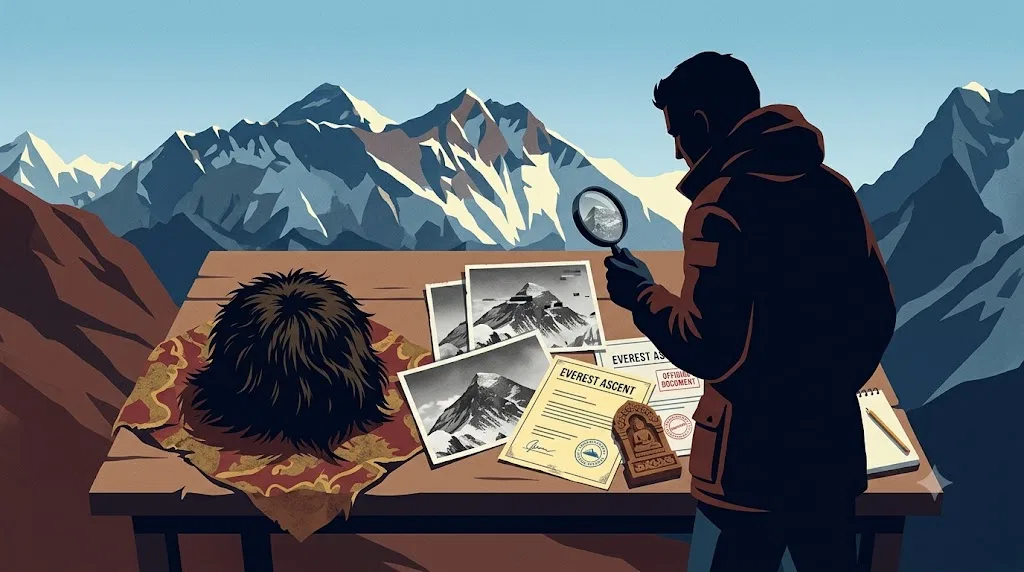
In 2016, Indian police officers Dinesh and Tarakeshwari Rathod claimed that they had reached Everest’s summit together. Nepalese authorities initially issued certificates. Other climbers then noticed problems with the photographs: clothing and equipment appeared inconsistent, and mountaineer Satyarup Siddhanta said that images of his own ascent had been taken and digitally altered to insert the couple.[Sky News]news.sky.comNews Couple's 'Fake' Everest Photos Investigated | World NewsNews Couple's 'Fake' Everest Photos Investigated | World News
An investigation concluded that the summit pictures had been manipulated. Nepal revoked the certificates and barred the couple from climbing in the country for ten years. Their police employer later dismissed them after an internal inquiry found that they had supplied false information and used morphed photographs.[The Guardian]theguardian.comThe Guardian Indian police sack couple for faking climb to Everest summitThe Guardian Indian police sack couple for faking climb to Everest summit
The affair was exposed not by sophisticated software but by comparison. Climbers familiar with the summit recognised repeated backgrounds and questioned visual details; the apparent source photographer supplied unaltered versions. The case demonstrates a recurring weakness in image-based proof: a photograph may show a real place and a real achievement while falsely attaching the wrong people to it.
It also exposed an institutional problem. The claim had already passed through Nepal’s certification system before the public challenge prompted closer scrutiny. The deception therefore depended not only on image editing but on the expectation that an official certificate would end the argument. Once the certificate existed, it became another layer of apparent proof.

The “Buddha Boy” and an untested miracle
Ram Bahadur Bomjon became internationally famous in 2005 as a teenager meditating beneath a tree in southern Nepal. Visitors and followers claimed that he remained in meditation for extraordinarily long periods without food, water or sleep. Tens of thousands travelled to see him, while international reporting amplified comparisons with the Buddha, even though Buddhist figures disputed the identification and Bomjon himself sometimes rejected the title.[Reuters]reuters.comNepal's mystery "Buddha boy" goes missing againNepal's mystery "Buddha boy" goes missing again
The central miracle claim was never established under conditions capable of ruling out hidden food, drink or breaks. Journalists and camera crews watched him for limited periods, sometimes continuously for several days, but that is not equivalent to observing many months under independent medical control. Screens, darkness, restricted access and the management of the site by supporters made the larger assertion difficult to verify. A person sitting motionless when watched does not prove uninterrupted fasting when unobserved.
Money and authority accumulated around the spectacle. Pilgrims arrived, donations were collected, and followers controlled access to the young ascetic. The combination of visible austerity and incomplete observation was persuasive: visitors could personally witness something remarkable, then infer that the unseen portions of the story were equally genuine. Contemporary reporting recorded both devotion and suspicions that the operation around him was benefiting financially.[GQ]gq.comThe Incredible Buddha BoyThe Incredible Buddha Boy
Bomjon’s later history involved serious allegations and criminal proceedings unrelated to whether the original fasting story was staged. He was arrested in January 2024 after years of accusations involving followers. A district court convicted and sentenced him that year for child sexual abuse, although the conviction was subsequently overturned by a higher court in 2025 on limitation grounds, according to later reporting.[apnews.com]apnews.comOpen source on apnews.com.
The safest conclusion is not that the entire meditation episode was conclusively proven fraudulent. Rather, an extraordinary biological claim was promoted far beyond what the available observations could demonstrate. It belongs on the boundary between spiritual devotion, media spectacle and potentially organised deception — precisely the territory in which demands for respectful but independent testing matter most.
The fake rescue economy in the Himalayas
Nepal’s helicopter rescue scandals show a more direct form of fraud. Genuine emergencies are common in high-altitude trekking areas, where altitude sickness, exhaustion and injury may require rapid evacuation. Flights from remote mountain routes are expensive and are commonly paid through international travel insurance. That combination created an opportunity: unnecessary or invented medical emergencies could be turned into large claims.
An investigation publicised in 2018 alleged that some trekking operators, guides, helicopter businesses, hospitals and intermediaries had collaborated to arrange needless evacuations, inflate bills or misrepresent patients’ conditions. Travellers reported being pressured to accept flights, while investigators examined claims that food had sometimes been tampered with to make trekkers ill. The allegations prompted a government review and warnings from insurers that they might stop covering Nepal unless the system changed.[The Guardian]theguardian.comThe Guardian Nepal cracks down on lucrative helicopter rescue scamsThe Guardian Nepal cracks down on lucrative helicopter rescue scams
The alleged scheme was effective because each document appeared to confirm the next. A guide reported symptoms; a helicopter manifest recorded an evacuation; a hospital produced a diagnosis and invoice; an insurer paid because mountain emergencies demanded speed. Individual claims could look plausible even when the wider pattern — repeated rescues, unusually high charges or relationships between the same businesses — suggested coordinated abuse.
The problem did not disappear. In early 2026, Nepal’s Central Investigation Bureau arrested six executives from three travel and rescue operators over alleged fraudulent claims approaching US$20 million between 2022 and 2025. Police said that falsified passenger manifests, medical invoices and hospital reports had been submitted to insurers. According to the bureau’s figures reported by the Associated Press, the investigation covered hundreds of allegedly fabricated rescues; the case was still under investigation, so the allegations should not be treated as final convictions.[AP News]apnews.comOpen source on apnews.com.
Unlike the yeti relics, this was not a clash between folklore and science. It was an alleged commercial system built around authentic dangers. Real altitude sickness made fake cases believable; legitimate helicopter companies and hospitals supplied the infrastructure; and the victim paying the inflated bill was often a distant insurer rather than the traveller being flown. The scandal illustrates how fraud thrives where emergency decisions must be made faster than evidence can be checked.

Rumour after the palace massacre
The killing of King Birendra, Queen Aishwarya and other members of Nepal’s royal family on 1 June 2001 produced a different problem: not a single proven hoax, but an information vacuum in which unsupported stories flourished. The official inquiry blamed Crown Prince Dipendra, who was mortally wounded at the palace and briefly became king while unconscious. Many people distrusted the finding, partly because early official communication was confused and implausible. State radio initially suggested that an automatic weapon had discharged accidentally, a statement that deepened suspicion rather than resolving it.[WIRED]wired.comNepal's New King Clings to LifeNepal's New King Clings to Life
Rumours soon attributed the killings to other royals, foreign intelligence agencies or disguised gunmen. More extreme versions claimed that hundreds of people had died, that bodies were secretly removed under curfew, or that Kathmandu’s water and milk had been poisoned. Researchers studying Nepalese street literature have documented how alternative accounts circulated through pamphlets and popular publications, becoming part of the cultural memory of the massacre.[SOAS Research Online]soas-repository.worktribe.comOpen source on worktribe.com.
It would be wrong to label every doubt about the inquiry a hoax. The investigation was rapid, key witnesses were members of the royal circle, and early palace secrecy gave the public good reason to demand clearer evidence. Yet the absence of confidence did not make every alternative claim equally credible. Many circulated without verifiable witnesses, physical evidence or consistent chronology.
This episode shows why official evasiveness can become a hoax-making machine. When an institution supplies an obviously weak first explanation, later corrections face an audience already primed to believe concealment. Rumour then satisfies needs that an inquiry may not: it identifies villains, explains apparent beneficiaries and transforms a chaotic family catastrophe into an intentional political plot.
Why these stories keep returning
Nepal’s famous deceptions endure because each attaches itself to something that is real and emotionally powerful. The forged relic sits beside authentic archaeology. The supposed yeti specimen draws upon living folklore and real Himalayan animals. The fake summit image uses a genuine Everest photograph. The rescue invoice resembles the paperwork of an actual medical evacuation. The miracle story begins with a real teenager visibly practising severe meditation.
Several recurring forces make such claims persuasive:
- Distant settings limit checking. Monasteries, archaeological sites and high-altitude expeditions are difficult for outsiders to inspect independently.
- Authority transfers credibility. Archaeologists, monks, expedition officials, doctors and government certificates can make a weak claim appear settled.
- Images feel conclusive. Photographs of a scalp, a meditating figure or a climber on Everest seem more direct than written testimony, even when the image’s origin or context is false.
- Commercial incentives hide inside wonder or danger. Tourism, donations, professional status and insurance payments can reward the continuation of a dramatic story.
- Corrections are less memorable. A DNA result identifying bear material rarely travels as widely as the claim that scientists possess part of a yeti.
Nepal’s developing fact-checking organisations now confront the same mechanisms in digital form. During elections and breaking events, manipulated images, shortened videos and material stripped of context can move quickly between social platforms. NepalCheck, founded in 2022, has documented doctored political images and selectively edited clips, while media researchers have identified limited resources and political pressure as challenges for fact-checkers in Nepal and neighbouring countries.[ox.ac.uk]reutersinstitute.politics.ox.ac.uknew nepali site fact checking candidates both local radio and tiktoknew nepali site fact checking candidates both local radio and tiktok
The technology has changed, but the decisive question has not: can the claim be traced to independent evidence? Nepal’s most instructive hoaxes were exposed when investigators stopped admiring the impressive object, photograph or certificate and reconstructed its history — who made it, who controlled access, what had been altered, and who stood to gain.
Amazon book picks
Further Reading
Books and field guides related to How Nepal's Most Famous Hoaxes Were Exposed. Use these as the next step if you want deeper reading beyond the article.
Frauds, Myths, and Mysteries: Science and Pseudoscience in Ar...
Covers how archaeological claims, hoaxes, and false discoveries are investigated and exposed.
The Buddha and Dr. Führer
Examines the archaeological scandal surrounding Alois Anton Führer and Buddhist sites.
The Demon-Haunted World
Rating: 4.5/5 from 43 Google Books ratings
Explains verification, evidence, and critical thinking behind exposing extraordinary claims.
Bad Science
Shows how weak evidence and institutional failures allow false claims to spread.
eBay marketplace picks
Marketplace Samples
Live-tested eBay searches with available results related to this page.



Endnotes
1.
Source: Wikipedia
Title: Alois Anton Führer
Link:https://en.wikipedia.org/wiki/Alois_Anton_F%C3%BChrer
2.
Source: traffickingculture.org
Title: pangboche hand
Link:https://traffickingculture.org/encyclopedia/case-studies/pangboche-hand/
Source snippet
by D Yates — The Pangboche Hand is an alleged Yeti hand, stolen from a Nepali monastery. A finger was stolen in 1958 and smuggled by acto...
3.
Source: Wikipedia
Title: Pangboche Hand
Link:https://en.wikipedia.org/wiki/Pangboche_Hand
4.
Source: eurekalert.org
Title: news releases
Link:https://www.eurekalert.org/news-releases/844761
Source snippet
EurekAlert!study ties DNA samples from purported Yetis to Asian bears28 Nov 2017 — The research, which will be published in Proceedings o...
5.
Source: wired.com
Link:https://www.wired.com/story/yeti-bear-legend-dna-analysis-myth
Source snippet
Un estudio genético de nueve muestras, que incluían patas, cueros cabelludos, huesos y excrementos cuidadosamente preservados en monaster...
6.
Source: news.sky.com
Title: News Couple’s ‘Fake’ Everest Photos Investigated | World News
Link:https://news.sky.com/story/couples-fake-everest-photos-investigated-10412592
7.
Source: reuters.com
Title: Nepal’s mystery “Buddha boy” goes missing again
Link:https://www.reuters.com/article/world/nepals-mystery-buddha-boy-goes-missing-again-idUSB97447/
8.
Source: reuters.com
Link:https://www.reuters.com/world/asia-pacific/nepalese-court-finds-buddha-boy-guilty-child-sexual-abuse-2024-06-25/
9.
Source: reuters.com
Link:https://www.reuters.com/world/asia-pacific/nepal-court-sentences-buddha-boy-10-years-jail-sexual-abuse-2024-07-01/
10.
Source: wired.com
Title: Nepal’s New King Clings to Life
Link:https://www.wired.com/2001/06/nepals-new-king-clings-to-life
11.
Source: reutersinstitute.politics.ox.ac.uk
Title: new nepali site fact checking candidates both local radio and tiktok
Link:https://reutersinstitute.politics.ox.ac.uk/news/new-nepali-site-fact-checking-candidates-both-local-radio-and-tiktok
12.
Source: nepalcheck.org
Link:https://nepalcheck.org/2022/12/12/doctored-images-and-out-of-context-videos-spread-misinformation-during-nepal-elections/
13.
Source: Wikipedia
Title: Archaeological forgery
Link:https://en.wikipedia.org/wiki/Archaeological_forgery
14.
Source: Wikipedia
Title: Charles Sobhraj
Link:https://en.wikipedia.org/wiki/Charles_Sobhraj
15.
Source: Wikipedia
Title: Ram Bahadur Bomjon
Link:https://en.wikipedia.org/wiki/Ram_Bahadur_Bomjon
16.
Source: Wikipedia
Link:https://en.wikipedia.org/wiki/Yeti
17.
Source: Wikipedia
Title: Nepalese royal massacre
Link:https://en.wikipedia.org/wiki/Nepalese_royal_massacre
18.
Source: nepalcheck.org
Link:https://nepalcheck.org/
19.
Source: nepalcheck.org
Link:https://nepalcheck.org/about/
20.
Source: reuters.com
Link:https://www.reuters.com/authors/reuters/
21.
Source: reuters.com
Link:https://www.reuters.com/video/watch/idRW373610092025RP1/
22.
Source: atlasobscura.com
Title: Atlas Obscura Objects of Intrigue: Yeti Scalp
Link:https://www.atlasobscura.com/articles/objects-of-intrigue-yeti-scalp
Source snippet
Atlas ObscuraObjects of Intrigue: Yeti ScalpMay 30, 2013 — 30 May 2013 — Scientists examined them and all concurred that the original yet...
Published: May 30, 2013
23.
Source: atlasobscura.com
Title: saga of the yeti hand
Link:https://www.atlasobscura.com/articles/saga-of-the-yeti-hand
Source snippet
Atlas ObscuraThe Strange Saga of the Stolen Yeti Hand29 May 2013 — Hillary methodically debunked the supposed yeti bones he found in Nepa...
Published: May 2013
24.
Source: royalsociety.org
Title: mysteries of the yeti
Link:https://royalsociety.org/blog/2017/11/mysteries-of-the-yeti/
Source snippet
Royal SocietyMysteries of the yeti29 Nov 2017 — The exact identity of the yeti, an ape-like creature, important to folklore and mythology...
25.
Source: theguardian.com
Title: The Guardian Indian police sack couple for faking climb to Everest summit
Link:https://www.theguardian.com/world/2017/aug/08/indian-police-sack-couple-dinesh-tarakeshwari-rathod-faking-climb-everest-summit
26.
Source: gq.com
Title: The Incredible Buddha Boy
Link:https://www.gq.com/story/ram-bornjon-miracle-meditating
27.
Source: apnews.com
Link:https://apnews.com/article/c22c81357f1ed0c555caf4d871f74145
28.
Source: theguardian.com
Title: The Guardian Nepal cracks down on lucrative helicopter rescue scams
Link:https://www.theguardian.com/world/2018/sep/03/nepal-cracks-down-on-multimillion-dollar-helicopter-rescue-scams
29.
Source: apnews.com
Link:https://apnews.com/article/ca64426bfe3373d7840fdb1d95f93a0a
30.
Source: soas-repository.worktribe.com
Link:https://soas-repository.worktribe.com/OutputFile/432145
31.
Source: abandonedspaces.com
Title: yeti scalp
Link:https://www.abandonedspaces.com/public/yeti-scalp.html
32.
Source: arabnews.com
Link:https://www.arabnews.com/node/977546/world
33.
Source: atlasobscura.com
Link:https://www.atlasobscura.com/places/the-yeti-scalp-of-khumjung-khumjung-nepal
34.
Source: theguardian.com
Link:https://www.theguardian.com/world/2019/jan/07/nepali-police-investigate-buddha-boy-ram-bahadur-bomjan-after-several-devotees-disappear
35.
Source: theguardian.com
Title: yeti scalp nepal edmund hillary
Link:https://www.theguardian.com/world/2009/dec/23/yeti-scalp-nepal-edmund-hillary
36.
Source: scribd.com
Title: Buddha Boy
Link:https://www.scribd.com/document/146033655/Buddha-Boy
37.
Source: cryptidarchives.fandom.com
Link:https://cryptidarchives.fandom.com/wiki/Yeti
Additional References
38.
Source: arxiv.org
Link:https://arxiv.org/abs/1811.01806
39.
Source: youtube.com
Title: 29,000 Feet of Lies: The Everest Fraud That Shamed a Nation
Link:https://www.youtube.com/watch?v=JjGkuojx5Ns
Source snippet
Indian couple accused of lying about scaling Mount Everest...
40.
Source: youtube.com
Title: Indian couple accused of lying about scaling Mount Everest
Link:https://www.youtube.com/watch?v=EGbqMXgq9mc
Source snippet
Nepal's 'Fake Rescue Scam' From 2018 Resurfaces | GRAVITAS...
41.
Source: youtube.com
Link:https://www.youtube.com/watch?v=fZEQL50Dj7A
Source snippet
$20 Million Everest Scam: How Tourists Were Tricked...
42.
Source: facebook.com
Link:https://www.facebook.com/nstonline/posts/nstworld-ram-bahadur-bomjan-known-as-buddha-boy-by-his-devotees-became-famous-as/887488540079386/
43.
Source: academia.edu
Link:https://www.academia.edu/83952744/Examination_of_the_Authenticity_of_Rummindei_Pillar_Inscription_in_the_Light_of_an_Alternate_Interpretation_of_the_Inscription
44.
Source: reddit.com
Link:https://www.reddit.com/r/Nepal/comments/v30bhv/21_years_of_the_royal_massacre_what_are_your/
45.
Source: instagram.com
Link:https://www.instagram.com/reel/DWoa9ovDQBM/?hl=en
46.
Source: instagram.com
Link:https://www.instagram.com/p/DZ4jSBFGnrK/
47.
Source: facebook.com
Link:https://www.facebook.com/indepthstorynepal/posts/a-photo-of-mp-dr-tosima-karki-has-gone-viral-on-social-media-falsely-claiming-sh/1314479754126981/
Topic Tree
Follow this branch
Related pages 192
- Albanian Hoaxes
- Algerian Hoaxes
- Antigua Deceptions
- Argentina Hoaxes
- Armenian Hoaxes
- +187 more in sidebar