Which Congo Stories Were Really True?
The Democratic Republic of the Congo has no single, neat tradition of “national hoaxes”. Its most revealing cases range from colonial propaganda and racist pseudoscience to fabricated monster photographs, bodily-theft panics and lethal medical misinformation.
Page outline Jump by section
Introduction
The clearest pattern is that falsehoods became persuasive when they borrowed authority from institutions: an international exhibition, a zoo, a newspaper photograph, a church platform or an apparently local video. The people promoting them often gained money, status, political protection or attention, while Congolese people carried most of the harm. Just as importantly, several famous Congo stories are not pure hoaxes at all. They sit on the boundary between propaganda, folklore, disputed interpretation and genuine evidence stripped of its proper context.
The colonial illusion sold to Belgium
One of the largest pieces of Congo-related fakery was not a forged document or a trick photograph. It was an entire imaginary colony.
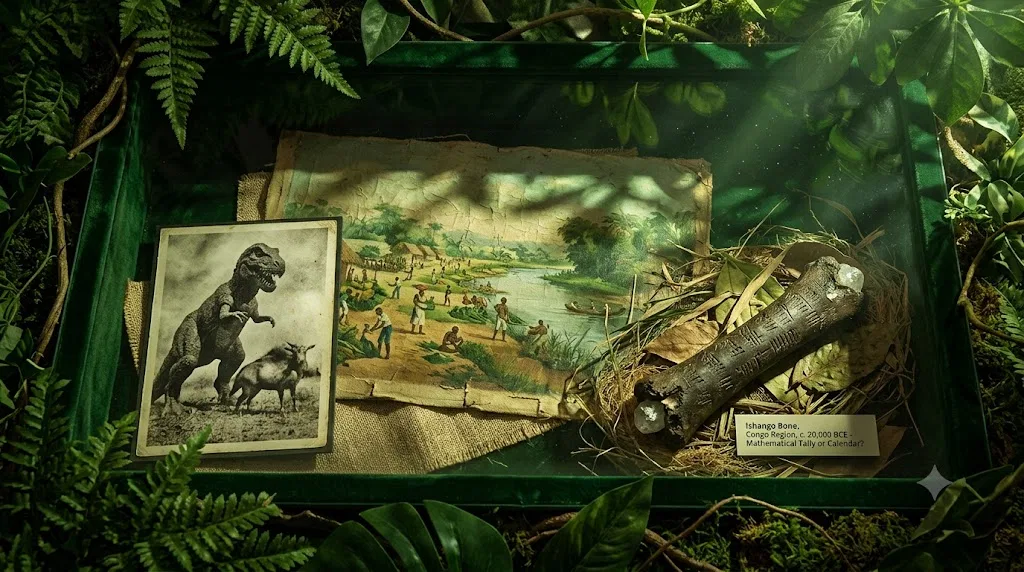
The Congo Panorama, created by Alfred Bastien and Paul Mathieu for the 1913 Ghent International Exposition, was a circular painting about 115 metres long and 14 metres high. Visitors stood inside a purpose-built rotunda and looked out over an idealised Belgian Congo: orderly transport, productive labour, impressive infrastructure and supposedly harmonious relations between colonisers and Congolese people. It presented colonial rule as peaceful progress delivered by a benevolent European state.[filmeu.eu]congopanorama.filmeu.euCommissioned for the 1913 International Exposition in Ghent, Belgium.Read more…
That vision concealed forced labour, violent repression, land seizure and Congolese resistance. Belgium had taken formal control of the territory from King Leopold II only five years earlier, after international exposure of abuses in the Congo Free State. The panorama therefore served a practical political purpose. It separated the new Belgian colonial administration from Leopold’s disgraced regime and reassured the public that Congo had become a respectable “civilising” enterprise. The Royal Museum for Central Africa now describes the work as colonial propaganda and an early equivalent of fake news.[Royal Museum for Central Africa]africamuseum.beRoyal Museum for Central AfricaCurrent exhibitionsThe Congo Panorama 1913. This exhibition reflects on colonial propaganda. an immense pa…
The deception worked partly because panoramas were immersive. A visitor was not merely reading a government claim; they appeared to be looking directly at Congo. Painted detail supplied the emotional force of eyewitness evidence while excluding whatever contradicted the intended message. The format turned a highly selective political argument into something that felt like observation.
This case should not be confused with the genuine atrocity photographs circulated by missionaries and reformers during the campaign against Leopold’s rule. Images made or gathered by figures such as Alice Seeley Harris documented mutilation and coercion and were used to challenge official denial. Their interpretation and circulation still require historical care, but they were not simply fabricated scenes invented by anti-colonial campaigners. The propaganda struggle was instead a battle over which reality the public would see: evidence of violence or an administratively polished colonial idyll.[Humanitarian Atlas]hhr-atlas.ieg-mainz.dede laat congo, 2011). Thompson, T. J. '“Light on the Dark Continent”: The Photography of Alice Seely Harris and the Congo Atrocities of the Early Twe…
Ota Benga and the fraudulent “missing link”
The treatment of Ota Benga shows how a real Congolese person could be forced into a fundamentally false story.
Benga came from the Congo Free State and was taken to the United States by the missionary and businessman Samuel Phillips Verner. He appeared with other Africans at the 1904 St Louis World’s Fair and, in September 1906, was displayed at New York’s Bronx Zoo. A sign identified him as an “African Pygmy”, while his placement in the Monkey House encouraged visitors to view him as an evolutionary link between apes and supposedly “civilised” humanity.[smithsonianmag.com]smithsonianmag.comSmithsonian Magazine The Tragic Tale of the Pygmy in the ZooSmithsonian Magazine The Tragic Tale of the Pygmy in the Zoo
The hoax was not that Benga existed or that his physical appearance had been altered. It was the scientific and theatrical framing imposed on him. Zoo officials and supporters of racial hierarchy presented a captive human being as evidence for a ranking of peoples that placed Africans close to animals. The display exploited contemporary eugenics, popular fascination with evolutionary theory and the prestige of museums and zoos.
Benga’s sharpened teeth were repeatedly treated as proof of an innately savage identity. Yet bodily customs cannot establish a person’s evolutionary status, intelligence or moral character. The bow, the cage and the presence of an orangutan were stage properties in an ideological performance. Visitors were invited to mistake deliberate exhibition design for neutral anthropology.
African-American ministers and newspapers protested almost immediately. Their objections exposed the central fraud: the institution claimed to be educating the public while degrading a man for entertainment. Benga was eventually removed from the zoo, but later accounts frequently softened the responsibility of those who had exploited him, sometimes recasting Verner as his protector or friend. Modern historical work has challenged that sanitised narrative and restored Benga’s captivity, resistance and humanity to the centre of the story.[The Washington Post]washingtonpost.comOpen source on washingtonpost.com.
The Kasai Rex photograph
Among the most colourful Congo monster tales is the Kasai Rex, a giant carnivorous reptile supposedly encountered in the Kasai region of the Belgian Congo in 1932.
Later retellings usually name a Swedish traveller or plantation owner, variously called John Johnson, John Johanson or J. C. Johanson. In the familiar story, he and a companion watched rhinoceroses before an enormous lizard or dinosaur emerged, attacked one of the animals and fed on its body. A dramatic photograph purportedly showed the creature standing over its kill.
The image is not credible evidence. It has been identified in cryptozoological literature as a composite or staged picture, and multiple incompatible photographs have circulated as the supposed original. Even the witness’s name, occupation and details of the encounter shift between versions. The monster has sometimes been described as a tyrannosaur, sometimes as another theropod and sometimes as an abnormally large monitor lizard.[fandom.com]cryptidarchives.fandom.comCryptid Archives Kasai rex | Encyclopaedia of CryptozoologyCryptid Archives Kasai rex | Encyclopaedia of Cryptozoology
The thin documentary trail makes it difficult to reconstruct a reliable original account. Most easily accessible versions come from cryptid catalogues, enthusiast sites and later summaries rather than a securely archived 1932 report. That weakness is itself significant. A striking photograph supplied apparent proof, while repetition gradually added a witness biography, dialogue and zoological detail that could not be firmly traced.
The Kasai Rex endured because it joined several popular ideas: unexplored Africa, prehistoric survival and the authority of the camera. The Congo Basin’s enormous forests made a hidden animal seem plausible to distant audiences, even though a breeding population of giant predators would be expected to leave bodies, bones, tracks, prey remains or consistent ecological evidence. No such evidence has emerged.
It is also important not to merge the Kasai Rex automatically with every Central African monster tradition. Reports of mysterious aquatic or forest creatures may belong to local folklore, spiritual belief, animal misidentification or modern cryptozoology. The fake Kasai Rex photographs do not prove that every story about an unusual Congo Basin animal was created as a deliberate fraud.
The Ishango bone: real object, inflated certainty
The Ishango bone is not a forgery. It is a genuine archaeological object discovered in 1950 near Lake Edward in what is now the Democratic Republic of the Congo. Roughly ten centimetres long, it carries grouped notches in several columns and has a small quartz fragment fixed to one end. The Belgian Institute of Natural Sciences dates it to around 20,000 years ago.[naturalsciences.be]naturalsciences.beOpen source on naturalsciences.be.
What remains uncertain is what the marks mean. Researchers have proposed that they record counting, doubling, multiplication, a base-12 system, a lunar calendar or some combination of mathematical and symbolic ideas. Other scholars warn that visible numerical patterns do not by themselves reveal the maker’s purpose. A tally, grip pattern, notation system and teaching device can leave similar traces when the surrounding cultural evidence is missing.[arXiv]arxiv.orgOpen source on arxiv.org.
Popular descriptions sometimes convert these possibilities into facts, calling the bone the world’s oldest calculator, multiplication table or lunar calendar. Such claims are memorable and understandably attractive, particularly because histories of mathematics have often undervalued African knowledge. But correcting an old bias does not require replacing uncertainty with a new certainty.
The responsible conclusion is more interesting than either dismissal or exaggeration. The structured groups of notches suggest deliberate organisation and may well record numerical thought. Exactly what was being counted, calculated or remembered is still debated. The case illustrates how a genuine artefact can acquire a legendary biography without anyone forging the object itself.
Kinshasa’s 2008 penis-theft panic
In April 2008, Kinshasa experienced a wave of accusations that sorcerers were stealing or shrinking men’s genitals through touch or supernatural means. Police detained 13 alleged perpetrators and supposed accomplices after crowds attacked accused people. Reuters reported that attempted lynchings had followed the spread of the claims.[Reuters]reuters.comLynchings in Congo as penis theft panic hits capitalLynchings in Congo as penis theft panic hits capital
This was not a carefully organised hoax with a known inventor. It was a moral panic: frightening claims circulated as testimony, bodily anxiety was interpreted as physical proof, and accusation created further apparent confirmation. Once people expected danger from a handshake, brush of clothing or encounter with a stranger, ordinary bodily sensations could be re-read as evidence of an attack.
Similar panics have occurred elsewhere in Africa, but broad labels such as “superstition” explain little. Such rumours often flourish amid economic insecurity, mistrust between strangers and beliefs that success or misfortune may involve hidden extraction. In a crowded city, the allegation also provided an immediate culprit for distress that was real even when the supernatural mechanism was not.
The accused stood to lose far more than the claimants. Public humiliation and mob violence could begin before any medical examination or police inquiry. Arresting alleged sorcerers may have calmed crowds temporarily, but it also risked giving official legitimacy to the original premise.
The Kinshasa episode remains a useful warning about the boundary between fraud and sincere error. Some claimants may have been consciously manipulating others, but many participants probably believed something had happened. A false claim does not need a mastermind to become socially powerful.

Ebola rumours with real casualties
During the 2018–20 Ebola epidemic in eastern DRC, misinformation became part of the emergency itself. Rumours claimed that Ebola did not exist, that foreigners had introduced it, that treatment centres were killing patients or that responders profited from prolonging the outbreak. Political exclusion and armed conflict made these claims especially persuasive. Residents were being asked to trust distant authorities and unfamiliar medical teams while living amid insecurity and weak public services.[time.com]time.comrumors spread ebola drcrumors spread ebola drc
Some misinformation was politically useful. The World Health Organization reported that mistrust had been fuelled in part by statements from parliamentary candidates during the 2018 election period. Suspicions intensified after voting was postponed in Ebola-affected areas, encouraging the belief that the disease was an excuse for disenfranchisement.[WHO | Regional Office for Africa]afro.who.intlocal leaders help turn tide ebolalocal leaders help turn tide ebola
The consequences went beyond vaccine refusal. Treatment centres were attacked, responders threatened and a WHO doctor killed in Butembo in April 2019. Research on the epidemic found that violence against healthcare facilities impeded detection, vaccination, contact tracing and treatment, allowing transmission to continue.[PMC]pmc.ncbi.nlm.nih.govOpen source on nih.gov.
Calling every sceptical resident irrational misses the history that gave the rumours traction. People had reasons to distrust political institutions, armed actors and systems that appeared suddenly during an outbreak but had failed to provide routine healthcare. The falsehood lay in the specific claims about an invented disease or murderous treatment centres, not in the broader observation that institutions could be unaccountable.
The most successful response therefore relied on more than issuing corrections. Health teams worked with local leaders, survivors, religious figures and community organisations. Trusted intermediaries could explain why burial practices had changed, show families what happened inside treatment centres and report local concerns back to medical teams. Fact-checking was most effective when joined to visible accountability.
From election clips to miracle-cure videos
DRC’s contemporary misinformation environment combines radio, local news sites, Facebook, WhatsApp, TikTok and face-to-face networks. False material may begin on one platform and gain legitimacy when repeated by another.
During the 2023 election period, fact-checkers documented recycled footage, false captions and invented claims about electoral officials. One widely shared video was said to show the head of the Independent National Electoral Commission being attacked after announcing fraudulent results. The person in the footage was actually a woman, not the commission’s president. The deception depended less on sophisticated editing than on attaching a politically charged caption to unrelated imagery.[dubawa.org]dubawa.orgOpen source on dubawa.org.
Health misinformation has followed a similar path. In late 2025, reports spread in Tshopo province of a mysterious condition that supposedly caused male genital shrinkage or disappearance. Videos showed alleged victims and claims of miraculous cures at churches. Provincial investigators examined reported cases but found no evidence that the supposed illness existed. Reuters reported that the rumours contributed to attacks on health workers and that the World Health Organization-led Africa Infodemic Response Alliance had recorded at least 17 related killings across the country, although Reuters could not independently verify every death.[Reuters]reuters.comFake rumors, real killings: Inside Congo's deadly health misinformation crisisSocial media, local media, and religious leaders, including megachurch pastor Jules Mulindwa and other pastors, played a key role in ampl…
The episode echoed the 2008 Kinshasa panic but moved through a far faster media system. Personal testimony filmed on a church stage looked immediate and local. A clip bearing an organisation’s logo could be mistaken for verification, while large viewing figures created the impression that many independent witnesses existed. In reality, hundreds of thousands of views might lead back to one unsupported allegation.
Those promoting miracle cures could gain followers, authority and publicity. News pages gained engagement, while overseas accounts could circulate the material without bearing its local consequences. The people placed at risk were alleged victims, accused “sorcerers”, medical workers and communities diverted from genuine health threats.
What these cases reveal
DR Congo’s best-documented deception stories do not support the idea that Congolese society is uniquely susceptible to hoaxes. They show familiar human weaknesses operating under particular historical pressures.
Authority can manufacture reality. A museum, colonial exhibition, zoo or church platform changes how an audience judges a claim. People often trust the setting before they examine the evidence.
Pictures require provenance. The Kasai Rex image, the Congo Panorama and falsely captioned election footage all appeared persuasive because visual material feels direct. The crucial questions are who made it, when, where it first appeared and whether independent evidence supports its caption.
Folklore is not automatically fraud. Monster traditions, spiritual explanations and disputed archaeological interpretations may be sincerely held. They become deceptive when promoters invent evidence, suppress uncertainty or market speculation as established fact.
Distrust can be rational even when a rumour is false. Colonial violence, political manipulation and inadequate public services help explain why official denials may fail. Effective debunking must address those experiences rather than merely repeating that experts are correct.
Exposure rarely erases a good story. The fake dinosaur photograph still circulates because it is visually satisfying. Simplified claims about the Ishango bone persist because they offer a proud and memorable origin story. Bodily-theft rumours return because they convert diffuse fear into a concrete attacker.
The enduring lesson is that a hoax succeeds not simply because people fail to check facts. It succeeds because it fits an existing expectation, arrives through a trusted channel and gives its audience a compelling explanation. In DR Congo, as elsewhere, understanding the surrounding history is often the most important part of exposing the falsehood.

Amazon book picks
Further Reading
Books and field guides related to Which Congo Stories Were Really True?. Use these as the next step if you want deeper reading beyond the article.
King Leopold's Ghost
Essential account of Congo myths, propaganda and colonial narratives.
In the Footsteps of Mr Kurtz: Living on the Brink of Disaster...
Explores modern Congo and contested narratives.
The Skeptics' Guide to the Universe
Useful framework for evaluating extraordinary claims.
eBay marketplace picks
Marketplace Samples
Live-tested eBay searches with available results related to this page.

Endnotes
1.
Source: reddit.com
Title: kassaisaurus from congo 1932 johanson hoax
Link:https://www.reddit.com/r/Cryptozoology/comments/1u9eaen/kassaisaurus_from_congo_1932_johanson_hoax/
2.
Source: naturalsciences.be
Link:https://www.naturalsciences.be/en/museum/exhibitions-activities/exhibitions/250-years-of-natural-sciences/the-ishango-bone
3.
Source: arxiv.org
Link:https://arxiv.org/abs/1204.1019
4.
Source: arxiv.org
Title: arXiv Decoding the Ishango Bone: Unveiling Prehistoric Mathematical Art
Link:https://arxiv.org/abs/2504.06412
5.
Source: reuters.com
Title: Lynchings in Congo as penis theft panic hits capital
Link:https://www.reuters.com/article/lifestyle/lynchings-in-congo-as-penis-theft-panic-hits-capital-idUSL22903232/
6.
Source: time.com
Title: rumors spread ebola drc
Link:https://time.com/5609718/rumors-spread-ebola-drc/
7.
Source: afro.who.int
Title: local leaders help turn tide ebola
Link:https://www.afro.who.int/news/local-leaders-help-turn-tide-ebola
8.
Source: pmc.ncbi.nlm.nih.gov
Link:https://pmc.ncbi.nlm.nih.gov/articles/PMC6883813/
9.
Source: dubawa.org
Link:https://dubawa.org/false-woman-attacked-in-viral-congos-election-video-not-ceni-president/
10.
Source: reuters.com
Title: Fake rumors, real killings: Inside Congo’s deadly health misinformation crisis
Link:https://www.reuters.com/business/media-telecom/fake-rumors-real-killings-inside-congos-deadly-health-misinformation-crisis-2026-05-07/
Source snippet
Social media, local media, and religious leaders, including megachurch pastor Jules Mulindwa and other pastors, played a key role in ampl...
11.
Source: facebook.com
Link:https://www.facebook.com/CryptozoologyFacts/posts/the-kasai-rex-is-a-known-hoax-that-is-best-known-through-the-interesting-photogr/1594494412686728/
12.
Source: facebook.com
Title: the initial report of the kasai rex was in 1932 from a swedish plantation owner
Link:https://www.facebook.com/congobd/videos/the-initial-report-of-the-kasai-rex-was-in-1932-from-a-swedish-plantation-owner-/418955447755507/
13.
Source: facebook.com
Link:https://www.facebook.com/tuko.co.ke/posts/nairobi-pastor-confesses-to-faking-miracles-to-deceive-church-followers-for-mone/1390230203249224/
14.
Source: facebook.com
Link:https://www.facebook.com/groups/263408279258052/posts/1183587467240124/
15.
Source: facebook.com
Link:https://www.facebook.com/Historical.Season/posts/congolese-man-ota-benga-was-exhibited-at-the-bronx-zoo-in-1906-ota-benga-was-bor/1474891607533733/
16.
Source: facebook.com
Link:https://www.facebook.com/johanegerkranspublic/posts/kasai-rex-is-a-saurian-cryptid-from-the-kasai-vally-in-the-democratic-republic-o/1410993524161557/
17.
Source: facebook.com
Link:https://www.facebook.com/groups/panoramicphotographers/posts/25855091184108315/
18.
Source: facebook.com
Link:https://www.facebook.com/GAVI/posts/amid-a-growing-ebola-outbreak-in-eastern-drc-health-teams-are-trying-to-do-the-u/1472516418238031/
19.
Source: facebook.com
Title: the belgian institute of natural sciences has called the ishango bone the worlds
Link:https://www.facebook.com/thebulletinmagazine/posts/the-belgian-institute-of-natural-sciences-has-called-the-ishango-bone-the-worlds/4865262633485084/
20.
Source: who.int
Link:https://www.who.int/laos/news/detail-global/200
21.
Source: who.int
Link:https://www.who.int/news-room/headlines/120
22.
Source: afro.who.int
Title: frontline trust day julienne anoko whos ebola community engagement officer drc
Link:https://www.afro.who.int/countries/democratic-republic-of-congo/news/frontline-trust-day-julienne-anoko-whos-ebola-community-engagement-officer-drc
23.
Source: who.int
Link:https://www.who.int/australia/news/releases/398
24.
Source: who.int
Title: ten threats to global health in 2019
Link:https://www.who.int/news-room/spotlight/ten-threats-to-global-health-in-2019
25.
Source: iris.who.int
Title: int Primary health care and health emergencies
Link:https://iris.who.int/bitstream/handle/10665/328105/WHO-HIS-SDS-2018.51-eng.pdf%3Bsequence%3D1
26.
Source: who.int
Title: stronger together milestones that mattered in 2025
Link:https://www.who.int/news-room/spotlight/stronger-together-milestones-that-mattered-in-2025
27.
Source: apps.who.int
Title: GPMB annualreport 2019
Link:https://apps.who.int/gpmb/assets/annual_report/GPMB_annualreport_2019.pdf
28.
Source: cdn.who.int
Link:https://cdn.who.int/media/docs/default-source/globalreportspdffiles/global-who-report-1819-20200831-reduc.pdf
29.
Source: reddit.com
Link:https://www.reddit.com/r/Cryptozoology/comments/1rl9o93/speculative_biology_of_the_mokelembembe_please/
30.
Source: reddit.com
Link:https://www.reddit.com/r/Cryptozoology/comments/131yje0/whether_you_believe_in_it_or_not_the_mokele/
31.
Source: reddit.com
Title: why hasnt there been decent evidence for mokele
Link:https://www.reddit.com/r/Cryptozoology/comments/ngmr9s/why_hasnt_there_been_decent_evidence_for_mokele/
32.
Source: reddit.com
Link:https://www.reddit.com/r/cryptids/comments/p2lpjm/whats_your_thoughts_on_kasai_rex_pictures_in/
33.
Source: reddit.com
Title: ota benga 18831916 was a mtubi man who was forced
Link:https://www.reddit.com/r/SideshowPerformer/comments/1t6oor8/ota_benga_18831916_was_a_mtubi_man_who_was_forced/
34.
Source: reddit.com
Title: in the year 2008 people still believe their
Link:https://www.reddit.com/r/worldnews/comments/6grjj/in_the_year_2008_people_still_believe_their/
35.
Source: reddit.com
Title: the ishango bone a 22000 year old lunar calendar
Link:https://www.reddit.com/r/badhistory/comments/m5hzjw/the_ishango_bone_a_22000_year_old_lunar_calendar/
36.
Source: biblio.naturalsciences.be
Link:https://biblio.naturalsciences.be/associated_publications/anthropologica-prehistorica/anthropologica-et-praehistorica/ap-117/ap117_135-162.pdf
37.
Source: biblio.naturalsciences.be
Link:https://biblio.naturalsciences.be/rbins-publications/institut-des-parcs-nationaux-du-congo/exploration-du-parc-national-albert-exploratie-van-het-nationaal-albert-park-mission-zending-j-de-heinzelin-de-braucourt-1950/4-1959-mission-zending-j-heinzelin-de-braucourt-1950/irscnb_c23709_009a63b_4-part1.pdf
38.
Source: biblio.naturalsciences.be
Link:https://biblio.naturalsciences.be/unit-publications/2016/rbins/%40%40collective.excelexport?excelexport.policy=eea.facetednavigation
39.
Source: biblio.naturalsciences.be
Link:https://biblio.naturalsciences.be/unit-publications/2017/rbins/%40%40collective.excelexport?excelexport.policy=eea.facetednavigation
40.
Source: arxiv.org
Link:https://arxiv.org/html/2504.06412v3
41.
Source: congopanorama.filmeu.eu
Link:https://congopanorama.filmeu.eu/
Source snippet
Commissioned for the 1913 International Exposition in Ghent, Belgium.Read more...
42.
Source: africamuseum.be
Title: The Congo Panorama
Link:https://www.africamuseum.be/en/see_do/agenda/TheCongoPanorama
Source snippet
Colonial illusion exposed28 Nov 2025 — The exhibition The Congo Panorama 1913. Colonial illusion exposed critically examines colonial pro...
43.
Source: press.africamuseum.be
Title: Persdossier ExpoPanoramaCongo 2025 EN WEB
Link:https://press.africamuseum.be/sites/default/files/media/Congo%20Panorama/Persdossier_ExpoPanoramaCongo_2025_EN_WEB.pdf
Source snippet
Africa Museum Presspress kit enWith The Congo Panorama 1913. Colonial illusion exposed, the AfricaMuseum takes a critical look at colonia...
44.
Source: africamuseum.be
Link:https://www.africamuseum.be/en/see_do/temporary_exhibition/current
Source snippet
Royal Museum for Central AfricaCurrent exhibitionsThe Congo Panorama 1913. This exhibition reflects on colonial propaganda. an immense pa...
45.
Source: africamuseum.be
Title: Royal Museum for Central Africa Expo | Royal Museum for Central Africa
Link:https://www.africamuseum.be/en/taxonomy/term/23
Source snippet
Colonial illusion exposed critically examines colonial propaganda and the realities it concealed. Artist Talk...Read more...
46.
Source: africamuseum.be
Title: Instaprondleiding Congopanorama
Link:https://www.africamuseum.be/en/see_do/agenda/InstaprondleidingCongopanorama
Source snippet
Royal Museum for Central AfricaGuided tours for individual visitors30 Nov 2025 — The Congo Panorama 1913. The tour examines what the imag...
47.
Source: hhr-atlas.ieg-mainz.de
Title: de laat congo
Link:https://hhr-atlas.ieg-mainz.de/articles/de_laat-congo
Source snippet
, 2011). Thompson, T. J. '“Light on the Dark Continent”: The Photography of Alice Seely Harris and the Congo Atrocities of the Early Twe...
48.
Source: smithsonianmag.com
Title: Smithsonian Magazine The Tragic Tale of the Pygmy in the Zoo
Link:https://www.smithsonianmag.com/science-nature/the-tragic-tale-of-the-pygmy-in-the-zoo-1-180948043/
49.
Source: nyu.edu
Title: pamela newkirk on ota benga at the bronx zoo
Link:https://www.nyu.edu/about/news-publications/news/2015/august/pamela-newkirk-on-ota-benga-at-the-bronx-zoo.html
50.
Source: washingtonpost.com
Link:https://www.washingtonpost.com/opinions/in-1906-this-congolese-man-was-displayed-in-a-zoo-now-virginia-is-honoring-him/2017/09/22/23e910f4-8e62-11e7-91d5-ab4e4bb76a3a_story.html
51.
Source: cryptidarchives.fandom.com
Title: Cryptid Archives Kasai rex | Encyclopaedia of Cryptozoology
Link:https://cryptidarchives.fandom.com/wiki/Kasai_rex
52.
Source: cryptidz.fandom.com
Title: Cryptid Wiki Kasai Rex
Link:https://cryptidz.fandom.com/wiki/Kasai_Rex
53.
Source: disinfo.africa
Title: drc battles disinformation during 2023 elections 6f3c7e4b8a42
Link:https://disinfo.africa/drc-battles-disinformation-during-2023-elections-6f3c7e4b8a42
54.
Source: Wikipedia
Title: Ota Benga
Link:https://en.wikipedia.org/wiki/Ota_Benga
55.
Source: Wikipedia
Title: Ishango bone
Link:https://en.wikipedia.org/wiki/Ishango_bone
56.
Source: africamuseum.be
Link:https://www.africamuseum.be/de/research/discover/publications/search/pubdetail?pubid=1902
57.
Source: africamuseum.be
Title: Königliches Museum für Zentralafrika
Link:https://www.africamuseum.be/de
58.
Source: africamuseum.be
Title: Royal Museum for Central Africa
Link:https://www.africamuseum.be/
59.
Source: africamuseum.be
Title: Guided tour | Royal Museum for Central Africa
Link:https://www.africamuseum.be/en/taxonomy/term/13
60.
Source: africamuseum.be
Title: Rondleiding Jongeren Congopanorama
Link:https://www.africamuseum.be/en/see_do/agenda/RondleidingJongerenCongopanorama
61.
Source: cryptidarchives.fandom.com
Title: Mokele mbembe
Link:https://cryptidarchives.fandom.com/wiki/Mokele-mbembe
62.
Source: cryptidz.fandom.com
Title: Mokèlé mbèmbé
Link:https://cryptidz.fandom.com/wiki/Mok%C3%A8l%C3%A9-mb%C3%A8mb%C3%A9
63.
Source: cryptozoologycryptids.fandom.com
Title: Kasai Rex
Link:https://cryptozoologycryptids.fandom.com/wiki/Kasai_Rex
64.
Source: dreamchimney.com
Link:https://www.dreamchimney.com/oftheday/sorcerers
65.
Source: math.buffalo.edu
Link:https://www.math.buffalo.edu/mad/Ancient-Africa/ishango.html
66.
Source: pmc.ncbi.nlm.nih.gov
Link:https://pmc.ncbi.nlm.nih.gov/articles/PMC12811040/
67.
Source: revistas.ulusofona.pt
Link:https://revistas.ulusofona.pt/index.php/stereo/article/view/9399
Additional References
68.
Source: youtube.com
Link:https://www.youtube.com/watch?v=xhxE-LSQU7E
Source snippet
SOUNDTRACK TO A COUP D'ETAT Trailer – 2025 New African Film Festival...
69.
Source: youtube.com
Title: Leopold II of Belgium | Historical Tyrants | European History
Link:https://www.youtube.com/watch?v=99dygZ98Krg
Source snippet
“ SACRIFICE: BELGIAN CONGO ” 1954 PROTESTANT MISSIONARIES IN AFRICA RELIGIOUS FILM XD75834...
70.
Source: youtube.com
Title: Artist Talk
Link:https://www.youtube.com/watch?v=ksv2DJAAcoU
Source snippet
Leopold II of Belgium | Historical Tyrants | European History...
71.
Source: academia.edu
Link:https://www.academia.edu/2101124/Ishango_Bone
72.
Source: insecurityinsight.org
Link:https://www.insecurityinsight.org/projects/healthcare/attacks-on-ebola-response
73.
Source: balobakicheck.com
Link:https://balobakicheck.com/en/balobaki-check-is-now-a-signatory-of-the-ifcns-code-of-principle/
74.
Source: cipdh.gob.ar
Link:https://www.cipdh.gob.ar/memorias-situadas/en/lugar-de-memoria/marcador-historico-en-honor-a-ota-benga/
75.
Source: historyofinformation.com
Link:https://www.historyofinformation.com/detail.php?id=2
76.
Source: internews.org
Link:https://internews.org/wp-content/uploads/2024/08/social-media-and-misdisinformation-in-electoral-context_DR_Congo_English.pdf
77.
Source: researchgate.net
Link:https://www.researchgate.net/figure/shango-bone-For-about-70-years-the-meaning-of-the-markings-on-this-bone-found-in-the_fig1_335652897
Topic Tree
Follow this branch
Related pages 192
- Albanian Hoaxes
- Algerian Hoaxes
- Antigua Deceptions
- Argentina Hoaxes
- Armenian Hoaxes
- +187 more in sidebar