How Haiti's Darkest Legends Were Manufactured
Haiti’s most famous “hoaxes” are rarely neat practical jokes with a single inventor and a dramatic confession. More often, they are mixtures of sensational reporting, colonial propaganda, commercial storytelling, disputed science, religious polemic and internet fakery.
Page outline Jump by section
Introduction
These stories mattered far beyond entertainment. Tales of savagery helped portray foreign intervention as necessary; zombie accounts sold books and films; religious legends shifted blame for political and economic hardship onto Haitians themselves; and disaster scams converted sympathy into profit. Some claims were deliberate frauds, while others were exaggerations, misidentifications or sincerely held interpretations. Understanding the difference is essential: Haitian folklore and religion are not themselves hoaxes, but they have repeatedly been distorted into stories that outsiders found profitable or politically useful.[historytoday.com]historytoday.comHistory Today Haiti's Black Legend: Zombies, Cannibals and Werewolvescannibalism a backdrop to the US invasion of 1915… Haiti's Black Legend: Zombies, Cannibals and Werewolves. The…Read more…
How Haiti acquired a manufactured “Black Legend”
After the Haitian Revolution began in 1791, Haiti became the first independent state created by formerly enslaved people and, in 1804, the first independent Black republic of the modern Atlantic world. Its success alarmed slaveholding societies and challenged European ideas about racial hierarchy. Hostile accounts increasingly depicted the country not as a state born from a struggle against slavery, but as a place of uncontrollable violence, sorcery and racial revenge.
The resulting “Black Legend” was not one specific hoax. It was a repeating narrative framework into which dubious stories could be placed. Reports of ritual murder, human sacrifice, cannibal banquets, werewolves and secret cults circulated through travel writing, newspapers and diplomatic discussion. Isolated crimes or rumours were treated as evidence of a national character, while ordinary religious practice was described using the language of devil worship. Historians have argued that this imagery helped make domination of Haiti appear civilising rather than imperial.[historytoday.com]historytoday.comHistory Today Haiti's Black Legend: Zombies, Cannibals and Werewolvescannibalism a backdrop to the US invasion of 1915… Haiti's Black Legend: Zombies, Cannibals and Werewolves. The…Read more…
That context became especially important during the United States occupation of Haiti from 1915 to 1934. The stated reasons for intervention included instability and fears of foreign influence, but the occupation also protected American strategic and financial interests. US authorities took control of Haitian finances, imposed a new security force and pressured the country into constitutional changes that permitted foreign land ownership. Forced labour, censorship and racial segregation contributed to resistance.[Office of the Historian]history.state.govOffice of the Historian U.SInvasion and Occupation of Haiti, 1915–34This occupation continued until 1934. President Woodrow Wilson. The United States Government's i…
Sensational descriptions of Haiti helped soften the contradiction between American claims of democratic purpose and the realities of military rule. If Haitians could be presented as prisoners of superstition or primitive violence, occupation could be sold as rescue. Stories about cannibalism and sorcery therefore operated much like propaganda even when their authors presented them as entertainment or first-hand observation.
The important distinction is that Haitian religious ceremonies, animal sacrifice and beliefs about spiritual power were real cultural practices. The deception lay in collapsing them into lurid claims about human sacrifice, flesh-eating and demonic government. A recognisable pattern emerged: an outsider heard a story, treated folklore as literal testimony, removed its social meaning and published the most shocking version for an audience unable to check it.
The writers who sold the frightening Haiti
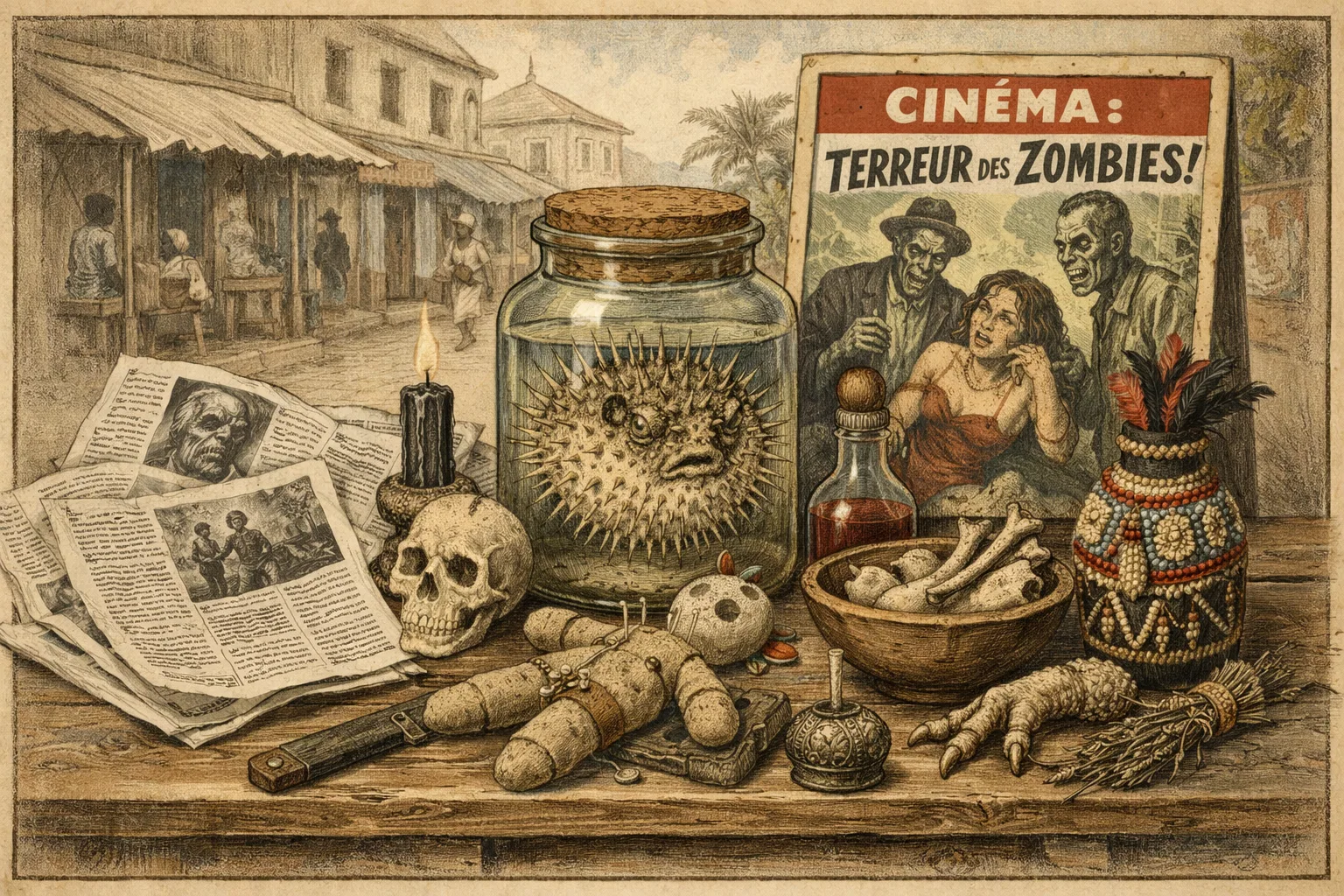
American traveller William Seabrook played a major role in turning Haiti into a commercial supernatural spectacle. His 1929 book The Magic Island described ceremonies, secret knowledge and human beings supposedly reduced to soulless labourers. The book became one of the first widely read English-language treatments of the Haitian zombie and strongly influenced the stage and screen versions that followed, including the 1932 film White Zombie.[si.edu]library.si.eduSmithsonian LibrariesThe Magic IslandThe Magic Island is an illustrated account of William Buehler Seabrook's travels in Haiti… zombie…
Seabrook claimed to have seen zombie labourers working for a sugar company. Yet his account offered no medical examination, verifiable identities or independent evidence that the people were dead bodies restored to movement. Critics accused him of presenting stories and performances as confirmed fact. Later assessments have noted that his writing could appear sympathetic towards individual Haitians while still preserving the larger stereotype of Haiti as irrational, erotic and dangerous.[The Atavist Magazine]magazine.atavist.comThe Atavist Magazine The Zombie KingThe Atavist Magazine The Zombie King
This ambiguity helped the story survive. Seabrook did not simply announce an obvious fabrication. He mixed observation, folklore, hearsay and theatrical prose, making it difficult to separate what he genuinely witnessed from what he embellished. Readers were given enough authentic detail to make the extraordinary material feel documented.
Zora Neale Hurston also reported encountering a woman presented as a zombie during research in Haiti in the 1930s. A photograph associated with the case became famous, but it did not prove that the subject had died and returned. Such episodes belong on the uncertain boundary between mistaken identity, mental illness, community belief and performance for a visiting researcher. They should not be treated as straightforward frauds, but neither do they provide evidence of supernatural resurrection.
Hollywood then removed much of the cultural complexity. The Haitian zombie had originally been associated with enslavement, loss of autonomy and the horror of becoming another person’s property. American films transformed it into a portable monster. Later cinema added contagious hordes and flesh-eating, elements largely unrelated to the older Haitian figure. The result was a curious reversal: imagery shaped by Haiti’s history of slavery became a means of portraying Haitians themselves as threatening and inhuman.[UCLan - University of Central Lancashire]knowledge.lancashire.ac.ukUCLan - University of Central LancashireFigures of terror: The “zombie” and the Haitian Revolutionby R Hoermann · 2016 · Cited by 48 — 31…
Were the Haitian “zombies” poisoned?
The most famous modern case concerned Clairvius Narcisse, who was reported dead in 1962 and recognised alive in Haiti in 1980. Narcisse said that he had remained conscious after being declared dead, was buried, later removed from his grave and forced to work under the control of others. His story attracted psychiatrist Lamarque Douyon and, later, Canadian ethnobotanist Wade Davis.
Davis proposed that a poison containing tetrodotoxin — a powerful nerve toxin associated with pufferfish — could reduce breathing and movement enough to create the appearance of death. After burial and revival, intoxicating substances, trauma and cultural expectation could supposedly leave the victim compliant and confused. Davis described the theory in academic work and in his bestselling 1985 book The Serpent and the Rainbow.[nih.gov]pubmed.ncbi.nlm.nih.govOpen source on nih.gov.
It was an elegant explanation because it joined folklore to pharmacology. It also seemed to convert an impossible supernatural claim into an unusual but natural crime. Yet the scientific case became deeply contested.
Critics questioned whether the powders Davis collected contained enough tetrodotoxin to produce the proposed effect. The quantities varied, some analyses failed to confirm meaningful levels, and an effective dose would have to be strong enough to induce paralysis without killing the victim. Toxicologists Chen-Yuan Kao and Toshio Yasumoto concluded that the widely circulated tetrodotoxin explanation lacked a sound factual foundation. Other critics accused Davis of giving insufficient weight to results that weakened his theory.[PMC]pmc.ncbi.nlm.nih.govPMCRevisiting the Ethnobiology of the Zombie PoisonPMCRevisiting the Ethnobiology of the Zombie Poison
Later medical investigation made the picture more complicated rather than more supernatural. A 1997 study examined three people identified as returned zombies. In at least two cases, DNA testing indicated that the individuals were not the deceased relatives their communities believed them to be. The subjects appeared instead to include vulnerable people with psychiatric or developmental conditions who had been misidentified and absorbed into other families.[Mind Hacks]mindhacks.comMind Hacks A medical study of the Haitian zombieMind Hacks A medical study of the Haitian zombie
These findings do not prove that every Haitian zombie report has the same explanation. Possible mechanisms include mistaken identity, untreated mental illness, brain injury, deliberate poisoning, social exclusion and stories used to explain a person’s unexplained absence or changed behaviour. There may also have been crimes concealed beneath supernatural language. The evidence simply does not support the popular picture of dead bodies chemically resurrected into obedient slaves.
Even Haitian law has been recruited into the legend. Documentaries and popular articles sometimes claim that Haiti’s nineteenth-century penal code explicitly outlawed “making zombies”, supposedly proving the practice was common. The Library of Congress examined the relevant provision and found that it concerned poisoning which produced a lethargic coma resembling death. If the victim was buried, the offence was treated as murder. The law recognised poisoning and premature burial, not magical resurrection.[The Library of Congress]blogs.loc.govdoes the haitian criminal code outlaw making zombiesdoes the haitian criminal code outlaw making zombies
The zombie controversy is therefore not best described as a single hoax. Narcisse’s testimony may have reflected trauma, fraud, poisoning or a story shaped by community belief. Davis’s hypothesis was a genuine scientific proposal, but one publicised more confidently than the evidence warranted. Publishers and filmmakers then presented a disputed theory as if the mystery had been solved.
The supposed pact that “cursed” Haiti
Another persistent falsehood claims that Haiti obtained its independence through a formal pact with Satan and was cursed in return. The story usually refers to a gathering at Bois Caïman shortly before the 1791 uprising against French slavery.
Most historians accept that some form of political and religious assembly probably occurred, although details remain uncertain. There are no surviving contemporary first-hand records of the event. One influential early description was written by French colonist Antoine Dalmas and published years afterwards. Later accounts drew on oral tradition and added speeches, oaths, a storm, animal sacrifice and named participants. The ceremony became an important symbol of collective resistance, but historians continue to debate how much of the familiar narrative is recoverable fact and how much is later national memory.[Sage Journals]journals.sagepub.comOpen source on sagepub.com.
The “Devil pact” interpretation was a much later religious rewriting. It treated African-derived spirits as Christian demons and recast an uprising against enslavement as a bargain with evil. Scholars have traced the idea particularly through strands of evangelical “spiritual warfare” teaching in the late twentieth century. In this version, Haiti’s poverty, disasters and political instability became supernatural punishment inherited by the entire nation.[sagepub.com]journals.sagepub.comBois Caïman ended up doing business with the devil.Read moreSage JournalsFrom Slave Revolt to a Blood Pact with SatanApr 25, 2012 — From Slave Revolt to a Blood Pact with Satan: The Evangelical Rew…
The claim gained international attention after the January 2010 earthquake, when American televangelist Pat Robertson said Haitians had sworn a pact with the Devil in exchange for freedom from French rule. The statement combined confused chronology, sectarian interpretation and a national curse narrative. It was not supported by historical evidence, and it ignored the fact that the idea of a Christian Devil does not map neatly onto Haitian Vodou.[The Washington Post]washingtonpost.comHistorians and scholars, including Yale’s Marlene Daut, refute this as theological and historical nonsense, stressing that Haitian Vodou…
The legend remains attractive because it supplies a simple moral explanation for complex suffering. It erases the economic punishment imposed after independence, including Haiti’s enormous indemnity to France; international isolation; foreign intervention; dictatorship; unequal development; and natural hazards worsened by weak infrastructure. It also transfers responsibility from institutions and political decisions to the supposed spiritual wrongdoing of enslaved people seeking freedom.[Office of the Historian]history.state.govOffice of the Historian U.SInvasion and Occupation of Haiti, 1915–34This occupation continued until 1934. President Woodrow Wilson. The United States Government's i…
Calling the pact story a hoax requires one qualification. Many people who repeat it sincerely believe it. It is therefore better understood as an invented religious tradition and false historical claim than as a centrally organised fraud. Its promoters may not be knowingly lying, but the story itself rests on evidence that does not withstand examination.
Disaster fraud and fake Haiti imagery
The 2010 earthquake created a different class of deception: fast-moving frauds that used Haiti’s suffering as bait. Within days, authorities and security researchers reported emails, websites and online advertisements impersonating genuine charities or inventing plausible-sounding relief organisations. Some messages redirected donors to fraudulent payment systems; others installed malicious software or harvested personal information.[fbi.gov]fbi.govnyfo011910 1nyfo011910 1
These scams worked because the disaster generated urgency. Donors wanted to act before checking unfamiliar organisations, while emotional photographs made requests feel immediate and authentic. Fraudsters benefited from the same features that helped legitimate relief campaigns: rapid sharing, small online payments and public willingness to trust appeals linked to children, medical care and collapsed buildings.
The FBI advised donors to be suspicious of unsolicited messages, avoid opening unknown attachments, verify charities independently and refuse requests to send money to named individuals overseas. Similar warnings were issued internationally as fake charities and copied websites appeared.[FBI]fbi.govnyfo011910 1nyfo011910 1
Photographs created another problem. Images from unrelated disasters could be recaptioned as Haiti, while authentic Haitian images were later detached from their original date and reused to support new claims. This type of “fauxtography” does not always involve digital alteration. A real photograph plus a false caption is often more persuasive than an obviously manipulated image because reverse-image searches reveal that the picture itself is genuine.
The same recycling continues. In 2024, for example, an old video of Sean Combs discussing the 2010 earthquake was falsely described as a message recorded in prison. Reuters traced the clip to its original relief appeal, showing how Haiti can remain in misleading content long after the event that produced the footage.[Reuters]reuters.comSean 'Diddy' Combs video clip not a prison messageSean 'Diddy' Combs video clip not a prison message

Why cannibal stories keep returning
During Haiti’s severe security crisis in 2024, social media accounts revived claims that Haitian gangs were practising widespread cannibalism. Individual acts of extreme violence cannot be ruled out in any conflict, but viral posts offered no reliable evidence for the sweeping claims being made. The stories often relied on old video, unrelated footage, anonymous narration or the nickname of gang leader Jimmy Chérizier, known as “Barbecue”.
The nickname was repeatedly treated as proof of cannibalism, although Chérizier has said it came from his mother’s fried-chicken business. One particularly elaborate fabrication claimed that actor Mel Gibson had released video of Bill and Hillary Clinton eating human flesh with Chérizier. No such video existed; the accompanying collage used unrelated photographs, including a still from a film and an old image of Bill Clinton.[PolitiFact]politifact.comOpen source on politifact.com.
The episode closely resembled the occupation-era Black Legend. A real crisis involving killings, displacement and criminal power was converted into a supernatural or barbaric spectacle. Cannibal imagery travelled faster than documented analysis of gang finances, arms trafficking, political alliances or the collapse of public institutions.
Such claims persist partly because they feel consistent with stories audiences have already heard about Haiti. Zombies, ritual murder, Devil worship and cannibalism form a self-reinforcing archive. A new rumour does not have to prove itself from the beginning; it borrows credibility from a century of earlier sensationalism.
How to judge a Haitian hoax claim
The strongest warning sign is not that a claim concerns religion, folklore or an unusual practice. It is that the evidence remains vague while the conclusion expands to describe an entire country.
A credible investigation should answer several basic questions:
- Can the person, place and date be independently identified? Anonymous missionaries, unnamed villagers and untraceable witnesses are poor foundations for extraordinary claims.
- Is the source describing direct observation or repeating a story? Travel writers have often blurred the difference.
- Does the evidence prove the dramatic interpretation? A photograph of an ill or distressed person does not prove resurrection; a religious ceremony does not prove a Satanic contract.
- Have medical, historical or forensic alternatives been tested? Misidentification, poisoning, mental illness and recycled imagery can explain many apparently uncanny cases.
- Who gains from the frightening version? Publishers, filmmakers, preachers, occupying powers, scammers and political propagandists have all found uses for an exotic or cursed Haiti.
- Is the claim being applied collectively? Moving from a disputed event to statements about “what Haitians believe” or “what Haiti is like” is often where investigation gives way to stereotype.
Haiti’s history of contested truth is revealing precisely because the deceptions were not created by one type of person. Some were sold by adventurers, some by criminals, some by religious campaigners and some by modern social-media accounts. Others began as sincere efforts to interpret difficult cases and became misleading only when uncertainty disappeared in retelling.
The recurring lesson is that the most durable falsehoods preserve a small piece of reality. Haiti does have a rich spiritual tradition; communities have reported people believed to have returned from death; Bois Caïman is associated with the revolution; gangs have committed grave atrocities; and disasters have produced desperate appeals for aid. The hoax takes shape when these truths are rearranged into supernatural proof, racial spectacle or a story too profitable to check.
Amazon book picks
Further Reading
Books and field guides related to How Haiti's Darkest Legends Were Manufactured. Use these as the next step if you want deeper reading beyond the article.
Haiti: The Aftershocks of History
Explains how external narratives shaped perceptions of Haiti.
The Serpent and the Rainbow
Central to discussions of Haitian legends and contested claims.
eBay marketplace picks
Marketplace Samples
Example marketplace items related to this page. Use the search link to explore similar finds on eBay.
Endnotes
1.
Source: history.state.gov
Title: Office of the Historian U.S
Link:https://history.state.gov/milestones/1914-1920/haiti
Source snippet
Invasion and Occupation of Haiti, 1915–34This occupation continued until 1934. President Woodrow Wilson. The United States Government's i...
2.
Source: dash.harvard.edu
Link:https://dash.harvard.edu/bitstreams/0a57fd87-de08-4954-a71c-1a3f2237deca/download
Source snippet
Marine occupation of Haiti, the entry of zombies into U.S. American... elements long associated with voodoo: curses, cannibalism...Rea...
3.
Source: knowledge.lancashire.ac.uk
Link:https://knowledge.lancashire.ac.uk/id/eprint/16036/1/R_Hoermann_Figures%20of%20terror_The%20zombie%20and%20the%20Haitian%20Revolution_clok.pdf
Source snippet
UCLan - University of Central LancashireFigures of terror: The “zombie” and the Haitian Revolutionby R Hoermann · 2016 · Cited by 48 — 31...
4.
Source: history.state.gov
Title: Office of the Historian Haiti
Link:https://history.state.gov/countries/haiti
Source snippet
U.S. military intervention in 1915. Following a 19-year occupation, U.S. military forces were withdrawn in 1934, and Haiti regained sover...
5.
Source: Wikipedia
Title: The Magic Island
Link:https://en.wikipedia.org/wiki/The_Magic_Island
6.
Source: magazine.atavist.com
Title: The Atavist Magazine The Zombie King
Link:https://magazine.atavist.com/2015/the-zombie-king
7.
Source: harpers.org
Link:https://harpers.org/archive/1984/04/the-pharmacology-of-zombies/
8.
Source: Wikipedia
Title: The Serpent and the Rainbow (book)
Link:https://en.wikipedia.org/wiki/The_Serpent_and_the_Rainbow_%28book%29
9.
Source: pmc.ncbi.nlm.nih.gov
Title: PMCRevisiting the Ethnobiology of the Zombie Poison
Link:https://pmc.ncbi.nlm.nih.gov/articles/PMC3184504/
10.
Source: Wikipedia
Title: Clairvius Narcisse
Link:https://en.wikipedia.org/wiki/Clairvius_Narcisse
11.
Source: mdpi.com
Link:https://www.mdpi.com/2077-1444/10/8/464
12.
Source: fbi.gov
Title: nyfo011910 1
Link:https://www.fbi.gov/newyork/press-releases/2010/nyfo011910-1.htm
13.
Source: reuters.com
Title: Sean ‘Diddy’ Combs video clip not a prison message
Link:https://www.reuters.com/fact-check/sean-diddy-combs-video-clip-not-prison-message-2024-09-30/
14.
Source: politifact.com
Link:https://www.politifact.com/factchecks/2024/mar/19/tweets/no-video-of-clintons-engaging-in-cannibalism-with/
15.
Source: Wikipedia
Link:https://en.wikipedia.org/wiki/Haiti
16.
Source: Wikipedia
Title: Bois Caïman
Link:https://en.wikipedia.org/wiki/Bois_Ca%C3%AFman
17.
Source: history.state.gov
Link:https://history.state.gov/historicaldocuments/frus1964-68v32/d341
18.
Source: history.state.gov
Link:https://history.state.gov/historicaldocuments/frus1934v05/d305
19.
Source: history.state.gov
Link:https://history.state.gov/historicaldocuments/frus1969-76ve10/d380
20.
Source: history.state.gov
Link:https://history.state.gov/historicaldocuments/frus1969-76ve11p1/d407
21.
Source: history.state.gov
Link:https://history.state.gov/historicaldocuments/frus1932v05/d738
22.
Source: history.state.gov
Link:https://history.state.gov/historicaldocuments/frus1932v05/d719
23.
Source: history.state.gov
Link:https://history.state.gov/historicaldocuments/frus1951v02/d808
24.
Source: history.state.gov
Link:https://history.state.gov/historicaldocuments/frus1935v04/d720
25.
Source: youtube.com
Title: VODOU is a very strange religion
Link:https://www.youtube.com/watch?v=mbEzHzDZGXs
Source snippet
The Haitian Revolution - Lies - Extra History...
26.
Source: youtube.com
Title: The Haitian Revolution
Link:https://www.youtube.com/watch?v=oOeLmULRaco
Source snippet
Maya Annik Bedward 'Black Zombie' & Haiti's History | SXSW 2026...
27.
Source: historytoday.com
Title: History Today Haiti’s Black Legend: Zombies, Cannibals and Werewolves
Link:https://www.historytoday.com/archive/history-matters/haitis-black-legend-zombies-cannibals-and-werewolves
Source snippet
cannibalism a backdrop to the US invasion of 1915... Haiti's Black Legend: Zombies, Cannibals and Werewolves. The...Read more...
28.
Source: journals.sagepub.com
Title: Bois Caïman ended up doing business with the devil.Read more
Link:https://journals.sagepub.com/doi/10.1177/0008429812441310
Source snippet
Sage JournalsFrom Slave Revolt to a Blood Pact with SatanApr 25, 2012 — From Slave Revolt to a Blood Pact with Satan: The Evangelical Rew...
29.
Source: library.si.edu
Link:https://library.si.edu/donate/adopt-a-book/magic-island
Source snippet
Smithsonian LibrariesThe Magic IslandThe Magic Island is an illustrated account of William Buehler Seabrook's travels in Haiti... zombie...
30.
Source: pubmed.ncbi.nlm.nih.gov
Link:https://pubmed.ncbi.nlm.nih.gov/6668953/
31.
Source: mindhacks.com
Title: Mind Hacks A medical study of the Haitian zombie
Link:https://mindhacks.com/2012/01/11/a-medical-study-of-the-haitian-zombie/
32.
Source: blogs.loc.gov
Title: does the haitian criminal code outlaw making zombies
Link:https://blogs.loc.gov/law/2014/10/does-the-haitian-criminal-code-outlaw-making-zombies/
33.
Source: journals.sagepub.com
Link:https://journals.sagepub.com/doi/abs/10.1177/0008429812441310
34.
Source: washingtonpost.com
Link:https://www.washingtonpost.com/history/2024/03/24/haiti-deal-devil-bois-caiman/
Source snippet
Historians and scholars, including Yale’s Marlene Daut, refute this as theological and historical nonsense, stressing that Haitian Vodou...
35.
Source: abcnews.com
Link:https://abcnews.com/Blotter/HaitiEarthquake/haiti-relief-scam-mail-spammers-line/story?id=9561420
36.
Source: scamwatch.gov.au
Title: haiti crisis scams
Link:https://www.scamwatch.gov.au/about-us/news-and-alerts/haiti-crisis-scams
37.
Source: websites.umich.edu
Link:https://websites.umich.edu/~uncanny/zombies.html
38.
Source: zombie.fandom.com
Title: Clairvius Narcisse
Link:https://zombie.fandom.com/wiki/Clairvius_Narcisse
39.
Source: pubmed.ncbi.nlm.nih.gov
Link:https://pubmed.ncbi.nlm.nih.gov/2728032/
Additional References
40.
Source: youtube.com
Link:https://www.youtube.com/watch?v=jcYb-rfMjm8
Source snippet
Voodoo Zombification | National Geographic...
41.
Source: researchgate.net
Link:https://www.researchgate.net/publication/254731535_From_Slave_Revolt_to_a_Blood_Pact_with_Satan_The_Evangelical_Rewriting_of_Haitian_History
42.
Source: researchgate.net
Link:https://www.researchgate.net/publication/351618659_THE_ZOMBIE_TOXIN_The_Debate_Surrounding_the_Toxicology_of_Wade_Davis%27_Research
43.
Source: facebook.com
Link:https://www.facebook.com/ClevelandClinic/posts/a-clinical-microbiologist-explores-the-science-behind-popular-zombie-lore/713430317498927/
44.
Source: wnycstudios.org
Link:https://www.wnycstudios.org/podcasts/takeaway/segments/13638-e-mail-scams-exploiting-haiti-earthquake-generosity
45.
Source: reddit.com
Link:https://www.reddit.com/r/AskHistorians/comments/q8cb0f/my_childhood_church_taught_that_the_haitian/
46.
Source: facebook.com
Link:https://www.facebook.com/missionhaiti.oas/posts/some-misconceptions-have-been-circulating-about-the-situation-in-haiti-recently-/2881398725421830/
47.
Source: researchgate.net
Link:https://www.researchgate.net/publication/265840837_The_Case_of_William_Seabrook_Documents_Haiti_and_the_Working_Dead
48.
Source: medium.com
Link:https://medium.com/tftunderworld/the-strange-tale-of-clairvius-narcisse-haitis-vodou-zombie-8722ac71f30c
49.
Source: reddit.com
Link:https://www.reddit.com/r/HighStrangeness/comments/1ugxaxi/the_living_death_of_clairvius_narcisse_where/
Topic Tree
Follow this branch
Related pages 192
- Albanian Hoaxes
- Algerian Hoaxes
- Antigua Deceptions
- Argentina Hoaxes
- Armenian Hoaxes
- +187 more in sidebar