Within Marshall Islands
Why Was Bikini Declared Safe Too Soon?
Official approval for resettlement concealed uncertainties that later forced Bikini's returning residents to leave again.
On this page
- The 1968 decision to permit resettlement
- How contaminated food raised radiation exposure
- What the failure reveals about official risk claims
Page outline Jump by section
Introduction
Bikini Atoll’s failed resettlement is one of the most important examples in Marshall Islands history of an official assurance that later proved dangerously premature. After decades of displacement caused by American nuclear weapons testing, Bikini’s people were told in the late 1960s that they could begin returning home because conditions were considered safe. Yet within a few years, scientific monitoring revealed that radioactive contamination was entering residents’ bodies through locally grown food. By 1978, the returning population had to be evacuated again. The episode is not usually described as a classic hoax involving forged evidence or deliberate fakery. Instead, it is a case in which optimistic official claims concealed major uncertainties, creating a promise of safe return that could not be kept. The controversy remains central to debates about government credibility, nuclear risk assessment and the treatment of displaced Marshallese communities.[llnl.gov]marshallislands.llnl.govbikini atollbody burdens of cesium-137 levels…Read more…

Why Was Bikini Declared Safe Too Soon?
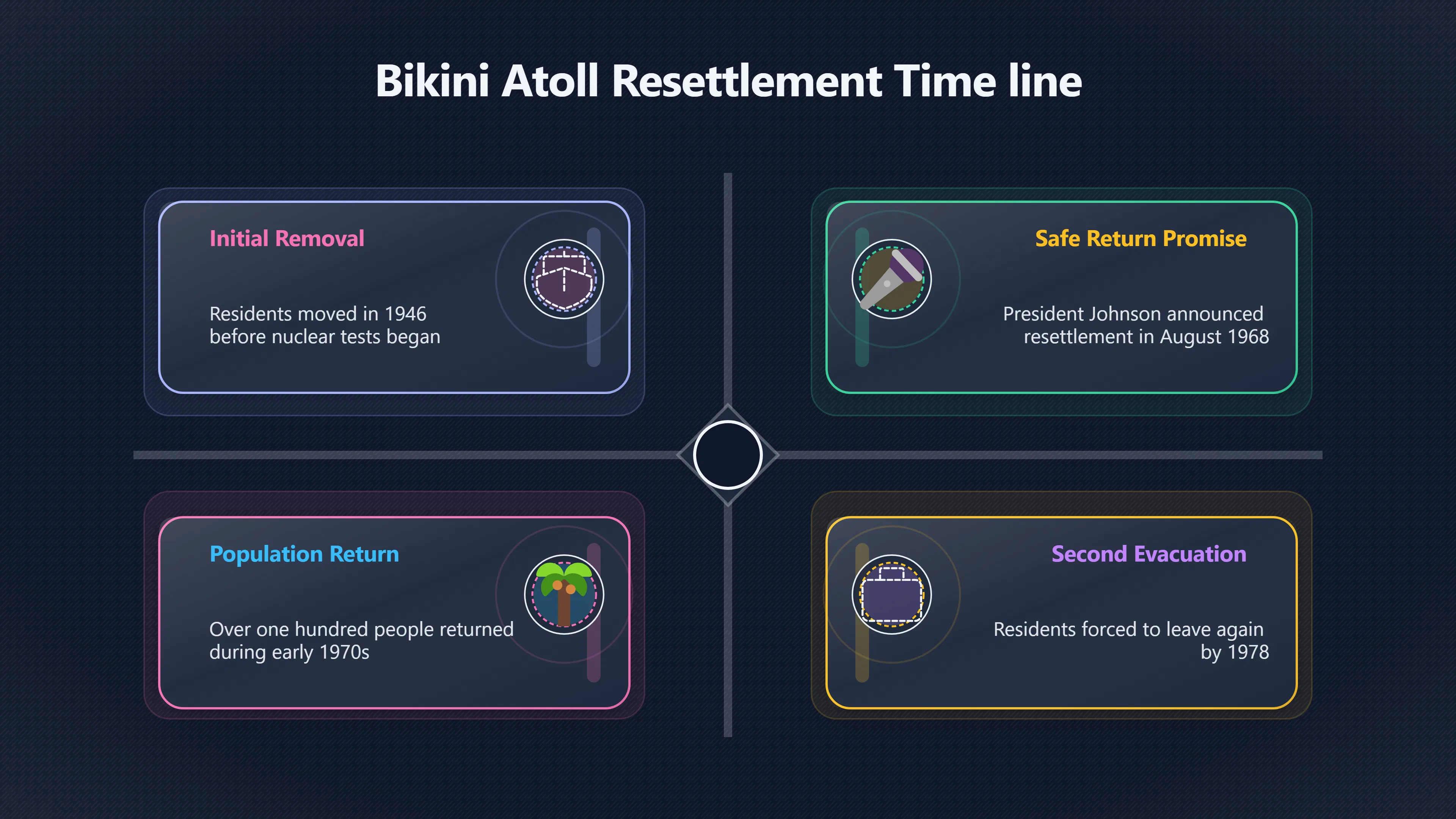
By the late 1960s, American officials were under pressure to address the long displacement of Bikini’s inhabitants. The people of the atoll had been removed in 1946 before nuclear testing began, with repeated assurances that they would eventually be able to return. In August 1968, President Lyndon Johnson publicly announced that Bikini could be resettled, and preparations began for cleanup and rehabilitation work.[marshallislands.llnl.gov]marshallislands.llnl.govbikini atollbody burdens of cesium-137 levels…Read more…
The decision was based on scientific surveys that suggested radiation levels had declined enough to permit habitation. However, those assessments did not fully anticipate how radioactive material remaining in the soil would move through local food chains over time. The focus was often on external radiation and visible cleanup, while the long-term effects of consuming locally grown produce proved more difficult to predict accurately.[IAEA]iaea.orgAtoll was carried out in 1970. Eventually, 139 Bikinians resettled on the Atoll. However, the Bikinian people remained…Read more…
More than a hundred Bikinians eventually returned during the early 1970s. For many families, the move represented the fulfilment of a promise that had shaped their lives for more than two decades. The return was therefore not merely a technical policy decision but a deeply emotional moment linked to identity, land and community.[IAEA]iaea.orgAtoll was carried out in 1970. Eventually, 139 Bikinians resettled on the Atoll. However, the Bikinian people remained…Read more…
How Contaminated Food Raised Radiation Exposure
The central problem emerged not from immediate exposure to obvious radioactive debris but from everyday eating habits.
Radioactive caesium-137 remained in Bikini’s environment and was absorbed by plants growing in contaminated soil. Coconut palms, breadfruit and other local foods accumulated radioactive material. Residents who resumed a traditional island diet gradually absorbed increasing amounts of radiation internally.[bikiniatoll.info]bikiniatoll.infoNational Cancer Benefits Center Marshall Islands Nuclear Testing: The AftermathNational Cancer Benefits CenterMarshall Islands Nuclear Testing: The Aftermath - Bikini, Atoll27 Oct 2023 — Contaminated soil and groundw…
Scientists monitoring the population began detecting troubling trends. Reports recorded sharp increases in caesium-137 body burdens among returning residents. One widely cited finding described an eleven-fold increase among more than one hundred people living on Bikini. Officials became sufficiently concerned that they advised limits on coconut consumption and began shipping food to the island.[bikiniatoll.com]bikiniatoll.comBikini HistoryBikini Atoll… Bikini, recorded an 11-fold increase in the cesium-137 body burdens of the more than 100 people residing on the island. A…
The situation continued to worsen. Investigations found increasing levels of radioactive contamination in residents and evidence that living on the island under normal conditions would exceed recommended radiation exposure limits. What had initially been presented as a successful return now looked increasingly unsustainable.[bikiniatoll.com]bikiniatoll.comOpen source on bikiniatoll.com.
In 1978, the returning population was evacuated once again. Measurements showed substantial rises in radioactive caesium within residents’ bodies, and officials concluded that Bikini could not safely support permanent habitation under existing conditions. The promise of return had effectively collapsed.[wikipedia.org]WikipediaBikini AtollBikini Atoll
How the Failure Changed Public Trust
The second evacuation transformed the meaning of earlier official assurances. What many Bikinians had understood as a guarantee of safety now appeared instead as a judgement based on incomplete knowledge and excessive confidence.
Critics argued that authorities had presented reassuring conclusions more forcefully than the underlying evidence justified. The episode became part of a broader pattern of disputes over transparency, compensation and responsibility in the Marshall Islands’ nuclear history. Later legal claims, compensation efforts and resettlement programmes were shaped by the memory of a return that had failed.[nih.gov]pubmed.ncbi.nlm.nih.govOpen source on nih.gov.
Importantly, the controversy was not simply about whether contamination existed. Scientists already knew radioactive material remained in the environment. The dispute centred on how much risk was acceptable, how uncertainty was communicated and whether displaced people had been given a realistic picture of the dangers associated with resettlement.[IAEA]iaea.orgAtoll was carried out in 1970. Eventually, 139 Bikinians resettled on the Atoll. However, the Bikinian people remained…Read more…
What the Episode Reveals About Official Risk Claims
The Bikini resettlement failure illustrates a recurring problem in environmental and technological policy: authorities often feel pressure to provide clear answers even when scientific uncertainty remains substantial.
Several lessons stand out:
- A place can appear safe while hidden pathways of exposure remain poorly understood. Bikini’s greatest danger came through food consumption rather than obvious radiation sources.[bikiniatoll.com]bikiniatoll.comBikini HistoryBikini Atoll… Bikini, recorded an 11-fold increase in the cesium-137 body burdens of the more than 100 people residing on the island. A…
- Monitoring after a policy decision can reveal problems that pre-decision studies missed. The most alarming evidence emerged only after residents had already returned.[Wikipedia]WikipediaBikini AtollBikini Atoll
- Communities bear the consequences when official optimism proves wrong. Bikini’s people experienced displacement, return and displacement again within a single generation.[PubMed Central]pmc.ncbi.nlm.nih.govby SL Simon · 2010 · Cited by 104 — The Bikini people were evacuated to Rongerik in March, 1946. In March, 1947, they were moved from…
- Trust is difficult to rebuild once assurances fail. Later debates about nuclear contamination elsewhere in the Marshall Islands were inevitably viewed through the experience of Bikini.[PubMed Central]pmc.ncbi.nlm.nih.govPubMed CentralRadioactivity and Rights: Clashes at Bikini Atoll - PMCby RL Guyer · 2001 · Cited by 66 — In 1972, more than 100 people mov…
Within the wider history of contested truths in the Marshall Islands, Bikini Atoll’s failed safe-return promise stands out because the misleading impression did not arise from a forged document, a fake photograph or a sensational legend. It emerged from official confidence that exceeded the available evidence. The result was a policy presented as a successful homecoming that ultimately had to be reversed, leaving a lasting warning about the dangers of declaring a damaged environment safe before the uncertainties are truly understood.[llnl.gov]marshallislands.llnl.govbikini atollbody burdens of cesium-137 levels…Read more…
Amazon book picks
Further Reading
Books and field guides related to Why Was Bikini Declared Safe Too Soon?. Use these as the next step if you want deeper reading beyond the article.
Command and Control
Examines risk, government decisions, and consequences of nuclear programs.
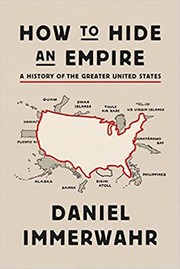
How to Hide an Empire
Provides important context for U.S. administration of Pacific territories.
Atomic Accidents
Relevant to discussions of underestimated risks and official assurances.

eBay marketplace picks
Marketplace Samples
Live-tested eBay searches with available results related to this page.




Endnotes
1.
Source: marshallislands.llnl.gov
Title: bikini atoll
Link:https://marshallislands.llnl.gov/affected-areas/bikini-atoll
Source snippet
body burdens of cesium-137 levels...Read more...
2.
Source: iaea.org
Link:https://www.iaea.org/sites/default/files/publications/magazines/bulletin/bull40-4/40405081517.pdf
Source snippet
Atoll was carried out in 1970. Eventually, 139 Bikinians resettled on the Atoll. However, the Bikinian people remained...Read more...
3.
Source: bikiniatoll.info
Title: National Cancer Benefits Center Marshall Islands Nuclear Testing: The Aftermath
Link:https://www.bikiniatoll.info/marshall-islands-nuclear-testing-the-aftermath/
Source snippet
National Cancer Benefits CenterMarshall Islands Nuclear Testing: The Aftermath - Bikini, Atoll27 Oct 2023 — Contaminated soil and groundw...
4.
Source: bikiniatoll.com
Title: Bikini History
Link:https://www.bikiniatoll.com/history.html
Source snippet
Bikini Atoll... Bikini, recorded an 11-fold increase in the cesium-137 body burdens of the more than 100 people residing on the island. A...
5.
Source: marshall.csu.edu.au
Title: Jack Niedenthal, A Short History of the People of Bikini Atoll
Link:https://marshall.csu.edu.au/Marshalls/html/History_Varia/Bikini_History/Bikini_History.html
Source snippet
cesium-137 body burdens of the more than 100 people residing on the island. Alarmed by these numbers, the DOE told the people living on B...
6.
Source: bikiniatoll.com
Link:https://www.bikiniatoll.com/whatrad.html
7.
Source: Wikipedia
Title: Bikini Atoll
Link:https://en.wikipedia.org/wiki/Bikini_Atoll
8.
Source: Wikipedia
Link:https://en.wikipedia.org/wiki/Bikini
9.
Source: Wikipedia
Title: Nuclear testing at Bikini Atoll
Link:https://en.wikipedia.org/wiki/Nuclear_testing_at_Bikini_Atoll
10.
Source: bikiniatoll.info
Title: Bikini Atoll Today
Link:https://www.bikiniatoll.info/bikini-atoll-today/
11.
Source: bikiniatoll.com
Title: before the nuclear claims tribunal
Link:https://www.bikiniatoll.com/Nuclear%20Claims%20Tribunal%20Dec.pdf
12.
Source: pmc.ncbi.nlm.nih.gov
Link:https://pmc.ncbi.nlm.nih.gov/articles/PMC1446783/
Source snippet
PubMed CentralRadioactivity and Rights: Clashes at Bikini Atoll - PMCby RL Guyer · 2001 · Cited by 66 — In 1972, more than 100 people mov...
13.
Source: ahf.nuclearmuseum.org
Title: Nuclear Museum Marshall Islands
Link:https://ahf.nuclearmuseum.org/ahf/location/marshall-islands/
Source snippet
Nuclear MuseumMarshall Islands - Atomic Heritage FoundationResidents of Bikini Atoll resettled in 1969, but then evacuated in 1978, after...
14.
Source: pmc.ncbi.nlm.nih.gov
Link:https://pmc.ncbi.nlm.nih.gov/articles/PMC4042840/
Source snippet
by SL Simon · 2010 · Cited by 104 — The Bikini people were evacuated to Rongerik in March, 1946. In March, 1947, they were moved from...
15.
Source: pubmed.ncbi.nlm.nih.gov
Link:https://pubmed.ncbi.nlm.nih.gov/9199216/
16.
Source: doi.gov
Title: s 2182
Link:https://www.doi.gov/ocl/s-2182
17.
Source: kulanikinis.com
Link:https://www.kulanikinis.com/collections/all
18.
Source: uvm.edu
Title: Bikini Atoll
Link:https://www.uvm.edu/~shali/BikiniAtoll.pdf
19.
Source: pmc.ncbi.nlm.nih.gov
Link:https://pmc.ncbi.nlm.nih.gov/articles/PMC6681726/
Additional References
20.
Source: osti.gov
Link:https://www.osti.gov/opennet/servlets/purl/16364730.pdf
21.
Source: youtube.com
Title: The Forgotten Nuclear War
Link:https://www.youtube.com/watch?v=NjqoiT-RS4A
Source snippet
Bikini Atoll: The Nuclear Paradise That Was Erased...
22.
Source: asos.com
Link:https://www.asos.com/women/swimwear-beachwear/bikinis/cat/?cid=10117
23.
Source: abercrombie.com
Link:https://www.abercrombie.com/shop/us/womens-swim
24.
Source: instagram.com
Link:https://www.instagram.com/reel/DKVKFerM5iO/
25.
Source: youtube.com
Title: Bikini Atoll: From Paradise to Nuclear Wasteland
Link:https://www.youtube.com/watch?v=x_GbII6cmhs
Source snippet
The Forgotten Nuclear War - Bombs on Bikini Atoll...
26.
Source: youtube.com
Title: Nuked: once a paradise, now a nuclear wasteland
Link:https://www.youtube.com/watch?v=P2ZtmxNoZrQ
Source snippet
Bikini Atoll: From Paradise to Nuclear Wasteland...
27.
Source: facebook.com
Title: the us used this island as a test site and to this day it still cost the us gove
Link:https://www.facebook.com/jose.edwin.chavez.montiel/posts/the-us-used-this-island-as-a-test-site-and-to-this-day-it-still-cost-the-us-gove/591806984648912/
28.
Source: facebook.com
Title: in 1973 three extended families and workers returned to bikini atoll to rebuild
Link:https://www.facebook.com/RiMajolonline/posts/in-1973-three-extended-families-and-workers-returned-to-bikini-atoll-to-rebuild-/1603729594593089/
29.
Source: youtube.com
Link:https://www.youtube.com/shorts/C8hmiiBDWUs
Topic Tree