How Egypt's Most Famous Hoaxes Fooled the World
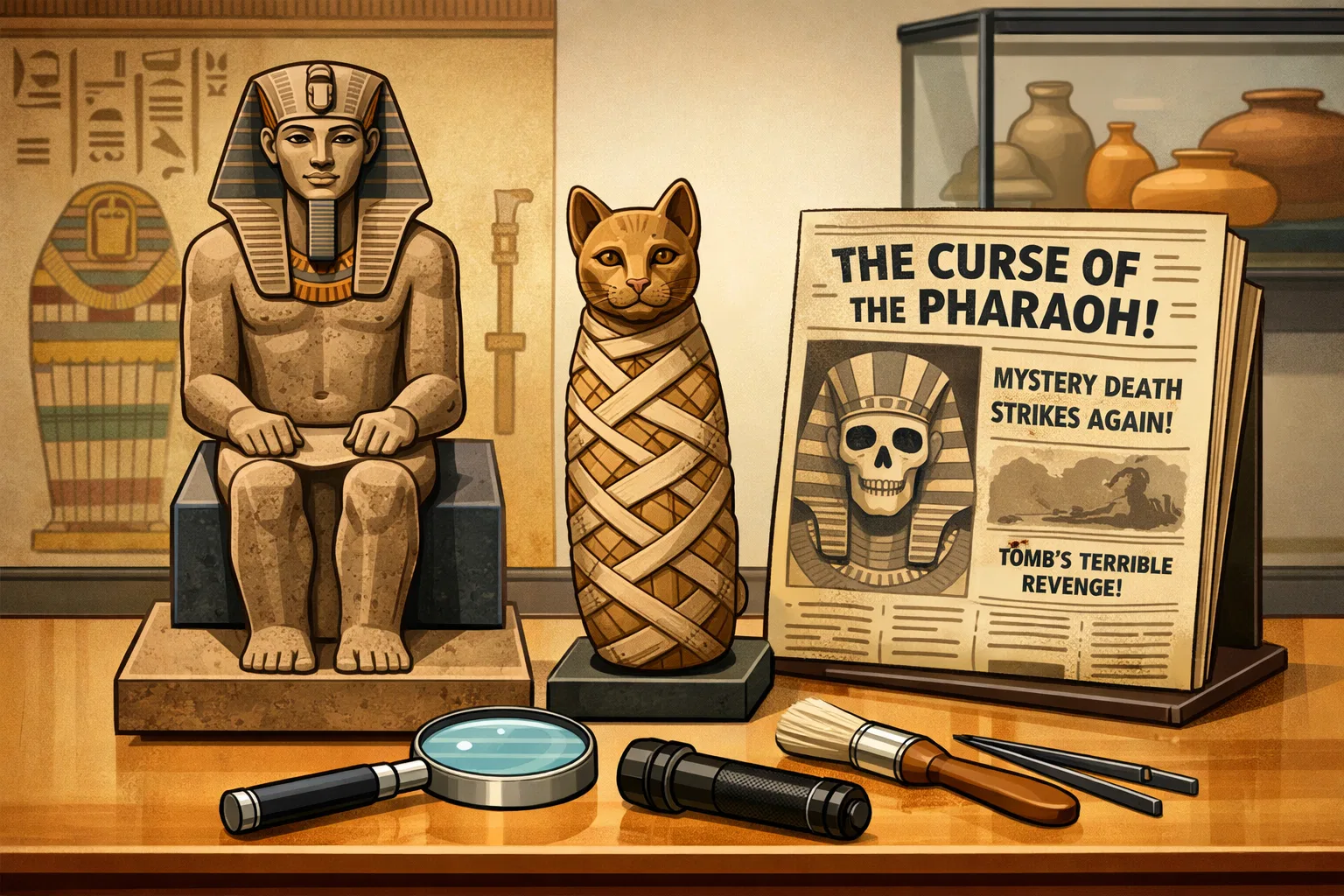
Egypt’s most famous hoaxes are rarely simple jokes. They range from forged antiquities and dubious papyri to newspaper-made curses, supposed ancient aircraft, giant-skeleton photographs and animals mistaken for spies.
Page outline Jump by section
Introduction
Some cases were deliberate frauds, such as the modern “Amarna Princess” sold as an ancient statue. Others began as commercial exaggerations, speculative interpretations or sincere mistakes. The curse of Tutankhamun was largely a media construction, while “empty” animal mummies may reflect ritual conventions rather than cheating. Understanding Egypt’s history of deception therefore means asking not only whether a claim was false, but who framed it, what audiences wanted to believe and what kind of evidence eventually changed the story.
Why Egypt attracts convincing fakes
Ancient Egypt offers unusually fertile ground for forgery and legend. Its monuments are instantly recognisable, yet much of their religious symbolism is unfamiliar to non-specialists. Objects often reach the public through museums, dealers or striking photographs without their full archaeological context. That makes it easy to replace a complicated explanation with a more dramatic one: a ritual image becomes an electric light bulb, a wooden bird becomes an aircraft and an unremarkable coffin board acquires a lethal curse.
The antiquities trade has added another weakness. An artefact removed from its excavation site loses the surrounding evidence that might establish its age and purpose. A plausible family history, old-looking paperwork or a dealer’s assurance can then substitute for secure provenance — the documented chain of ownership and discovery. Modern scientific tests can identify materials and manufacturing methods, but even experts may be misled when a forgery is stylistically convincing and supported by fabricated records.
Egyptian discoveries also entered mass culture at moments when newspapers, museums and entertainment businesses competed intensely for attention. Mummies, curses and secret chambers could be sold as history, horror and spectacle at the same time. That commercial mixture helps explain why exposed stories seldom disappear: the corrected version is usually less memorable than the original marvel.
The antiquities trade and the manufacture of authenticity
The most instructive Egyptian forgeries do not merely imitate old objects. They imitate the paperwork, social history and expert confidence surrounding old objects.
A striking example is the Amarna Princess, a small statue supposedly made during the reign of the pharaoh Akhenaten. Bolton Museum acquired it in 2003 for £440,000 after the Greenhalgh family claimed that an ancestor had bought it at a nineteenth-century country-house sale. Letters were produced to support this history, and a British Museum assessment accepted the statue as approximately 3,300 years old. In reality, Shaun Greenhalgh had made it in modern Britain. Police later found tools, materials and additional versions at the family home. The fraud unravelled after investigators noticed that the same claimed provenance was being used to market another questionable antiquity.[Bolton Council]bolton.gov.ukbolton s master forger returns to bolton museumBolton CouncilBolton's master forger returns to Bolton Museum19 Jul 2019 — Among Mr Greenhalgh's forgeries was the infamous 'Amarna Princ…
The case shows why provenance can matter as much as visual expertise. The statue looked close enough to genuine Amarna art to satisfy knowledgeable observers, but its credibility depended heavily on a fictional ownership story. Once that story collapsed, the object’s apparent authenticity collapsed with it. The museum later displayed the forgery as an educational object — evidence not of ancient Egyptian craftsmanship, but of how modern institutions can be persuaded by a carefully constructed narrative.
A still older trade grew around supposed “mummy wheat” or “pharaoh’s grain”. During the nineteenth century, sellers and promoters claimed that wheat recovered from Egyptian tombs could germinate after thousands of years. The story appealed to Victorian fascination with both Egypt and the expanding science of plant breeding. Experiments repeatedly indicated that genuinely ancient grain could not remain viable for such a period; ordinary modern seed could, however, be passed off as tomb grain and used to stage an impressive “resurrection”. An 1864 report in Scientific American was already treating claims of viable mummy wheat as false.[Scientific American]scientificamerican.comScientific American Fake News: Wheat Buried with Mummies Can GrowScientific AmericanFake News: Wheat Buried with Mummies Can GrowJune 17, 2020 — Originally published in July 1864. Fake News: Wheat Burie…
This was an ideal commercial legend. Buyers could possess a living fragment of pharaonic Egypt, while seed merchants could attach an extraordinary history to an otherwise ordinary crop. The claim survived because successful germination seemed to verify the story, even though it demonstrated only that the planted seed was alive — not that it had come from a mummy’s tomb.
Were ancient animal mummies themselves a fraud?
Millions of animals were mummified in ancient Egypt, particularly as votive offerings purchased by worshippers and dedicated to deities associated with cats, ibises, crocodiles and other creatures. Modern X-rays and computed tomography scans have revealed that some beautifully shaped bundles contain a complete animal, while others contain only fragments, feathers, bones, mud, reeds or pieces of pottery.
It is tempting to describe every incomplete bundle as an ancient scam. Some discoveries do support that possibility. Scans of crocodile-shaped offerings from Hawara found bundles filled largely with straw, mud and rags, and surviving evidence suggests that authorities sometimes tried to regulate the trade in animal offerings. Such findings are consistent with sellers reducing costs while charging worshippers for what appeared to be a complete mummy.[The Guardian]theguardian.comThe Guardian Massive mummy fraud discovered after 2,000 yearsUsing CT scans at Addenbrooke's Hospital as part of a £1.5 million gallery redevelopment, researchers found that two crocodile-shaped mum…
The interpretation remains contested, however. Researchers studying Egyptian votive mummies warn that a bundle did not necessarily need to contain an entire body to be religiously valid. A small bone or feather might symbolically represent the whole animal, while the shape, wrapping and ritual dedication could have carried more importance than anatomical completeness. A University of Manchester-led research project was established specifically to test the assumption that incomplete bundles were automatically “fakes”, noting that deliberate deception had often been asserted rather than demonstrated.[GtR]gtr.ukri.orgAppearance and Reality in Ancient Egyptian Votive Animal…These votive animal mummy bundles containing anything other than a complet…
The distinction matters. A modern customer expects the contents of a package to match its outward appearance literally. Ancient worshippers may have understood sacred representation differently. Some mummy makers were probably dishonest, but scanners cannot by themselves reveal the seller’s promise, the purchaser’s expectations or the theology governing a particular offering. This is a case where new evidence exposed hidden contents without settling whether every mismatch amounted to fraud.

How newspapers created the pharaoh’s curse
The “curse of Tutankhamun” is the best-known deceptive story associated with Egypt, although it was less a planned hoax than a media myth assembled from coincidence, rivalry and selective reporting.
Howard Carter’s team located Tutankhamun’s tomb in the Valley of the Kings in November 1922. Lord Carnarvon, who financed the excavation, died in April 1923 after an infected mosquito bite led to blood poisoning and pneumonia. His death supplied newspapers with an irresistible plot: a wealthy intruder had violated a royal tomb and been punished by supernatural forces.
The story grew through repetition. Journalists linked later deaths to the excavation even when the people involved had only weak connections to the tomb, died from ordinary causes or survived for many years. Carter himself lived until 1939. Newspapers rarely offered equivalent attention to the large number of supposedly “cursed” participants who remained alive.
A historical cohort study published in the British Medical Journal examined 44 Westerners identified as being in Egypt during key stages of the tomb’s opening. Twenty-five were classified as potentially exposed to the curse. Their average age at death was about 70, compared with 75 among those considered unexposed, a difference that was not statistically significant. The study found no association between entering the tomb and dying within the following decade.[PMC]pmc.ncbi.nlm.nih.govPMCThe mummy's curse: historical cohort studyNIHby MR Nelson · 2002 · Cited by 34 — There was no association between potential exposure to the mummy's curse during the excavati…
The curse nevertheless had several powerful promoters. Reporters excluded from The Times’ exclusive arrangement with the excavation had an incentive to find a competing story. Spiritualists and popular writers could present Carnarvon’s death as evidence that ancient powers remained active. Arthur Conan Doyle suggested that an elemental spirit might have guarded the tomb, lending celebrity authority to supernatural speculation.
The myth also borrowed from an older tradition. Long before Tutankhamun’s discovery, Victorian and Edwardian fiction had imagined mummies reviving, taking revenge or carrying contamination into modern homes. The press did not invent fear of Egyptian curses from nothing; it attached an existing Gothic story to a genuine archaeological sensation.
The “Unlucky Mummy” that was neither a mummy nor on the Titanic
Another enduring curse story surrounds British Museum object EA22542, commonly called the Unlucky Mummy. It is not a mummy but a painted inner coffin board associated with a woman from ancient Thebes.
During the late nineteenth and early twentieth centuries, stories claimed that people connected with the object had suffered accidents, financial ruin, illness or death. Later versions placed it aboard the Titanic, suggesting that its curse caused the ship to sink. The British Museum states that none of these tales has a factual basis. The object has remained in the museum since 1889 and was not secretly transported across the Atlantic in 1912.[British Museum]britishmuseum.orgOpen source on britishmuseum.org.
The legend succeeded partly because its details were flexible. Different tellings altered the original purchasers, the sequence of disasters and even the nature of the artefact. Each retelling could add a recently famous calamity, while the absence of a fixed original account made contradictions difficult for casual readers to notice.
Its connection to the Titanic also illustrates how legends merge. A tale about a supposedly cursed Egyptian object became attached to the century’s most famous maritime disaster, giving both stories an extra layer of fatalism. The resulting narrative is emotionally satisfying — ancient pride punishes modern arrogance — even though the museum’s acquisition records rule out its central claim.
A papyrus that made pharaonic Egypt see flying saucers
The Tulli Papyrus is frequently presented as an ancient Egyptian record of unidentified flying objects. According to the story, Alberto Tulli, a former director of the Vatican’s Egyptian collection, encountered a papyrus in a Cairo shop during the 1930s. He supposedly could not afford to purchase it but copied its hieroglyphs. A later translation described fiery discs appearing in the sky during the reign of Thutmose III.
There is no authenticated papyrus to examine. The original object has never been produced, its ownership history cannot be verified and the surviving text exists through copies circulated decades after the alleged encounter. This alone prevents normal archaeological or papyrological testing.
Further investigation found indications that the hieroglyphic transcription had been assembled or adapted from examples in Alan Gardiner’s 1927 Egyptian Grammar. Scholars and sceptical investigators also identified grammatical problems and suspiciously modern features in the story. Gianfranco Nolli, who succeeded Tulli at the Vatican Museums, reportedly believed that Tulli had either been deceived or that the document was false. The 1968 Condon Report on unidentified flying objects cited the episode as an example of ancient-UFO claims repeated through secondary sources without verification.[Wikipedia]WikipediaTulli PapyrusTulli Papyrus
The Tulli story flourished in the 1950s and 1960s, precisely when flying saucers were becoming a major subject of popular culture. Its appeal lay in apparently moving the modern UFO mystery into deep antiquity. A contemporary phenomenon no longer looked like a product of Cold War anxiety, aircraft sightings or new media; it appeared to have been witnessed by royal scribes thousands of years earlier.
This is a classic warning sign in forged-history claims: the ancient text seems uncannily tailored to a modern preoccupation. Instead of clarifying an unfamiliar ancient idea, it appears to confirm exactly what a twentieth-century audience hoped to find.
When genuine artefacts are made to support false technology
Not every misleading claim requires a forged object. A genuine Egyptian artefact can be detached from its inscriptions, religious setting or physical limitations and then promoted as evidence of lost technology.
The Saqqara Bird
The Saqqara Bird is a small wooden object discovered in 1898 and generally dated to around 200 BC. Its swept wings and upright body have encouraged claims that it was a model glider or proof that ancient Egyptians understood powered flight.
The strongest versions of the claim rely on altered reconstructions. Replicas are often made from lighter wood than the original and fitted with a vertical tail surface that the artefact does not possess. A 2023 aerodynamic investigation based on a three-dimensional scan found poor gliding performance, an unstable centre of mass and an asymmetric lift pattern that would make controlled flight impractical. The researchers concluded that its aerodynamic properties did not support the idea that it demonstrated ancient knowledge of aircraft design.[Paradigm]sciendo.comParadigm AERODYNAMIC INVESTIGATION ON THE ARTEFACT “BIRDParadigm AERODYNAMIC INVESTIGATION ON THE ARTEFACT “BIRD
Its precise purpose remains uncertain. It may have been a ritual bird, a toy, a decorative element or part of a sacred boat. “Purpose unknown” does not mean “aircraft”. The leap occurs when uncertainty is treated as evidence for the most technologically dramatic option.
The Dendera “light bulb”
Reliefs in the Temple of Hathor at Dendera depict a snake emerging from a lotus-like form, surrounded by divine and ritual figures. To modern eyes, the elongated shape can resemble the glass envelope of a large electric lamp. Fringe writers have therefore claimed that ancient Egyptian priests possessed electric lighting.
The surrounding inscriptions and parallel images identify the scene within Egyptian creation theology. The snake represents a divine form emerging from a lotus, while other elements — including a supporting pillar, a sacred boat and accompanying deities — belong to the same religious composition. Texts beside the images describe cult statues and their materials rather than electrical apparatus.
No archaeological evidence has been found for the wider system that electric lighting would require: generators, conducting networks, lamp fittings, filaments or quantities of manufactured glass bulbs. The proposed device is produced by visual resemblance alone, while the written evidence beside it points elsewhere.[Wikipedia]WikipediaDendera lightDendera light
These two cases reveal a common pattern. A familiar modern object is mentally projected onto an ancient shape, after which resemblance is treated as technological proof. Missing parts are supplied in reconstructions, ritual texts are ignored and the complete absence of supporting infrastructure is presented as evidence that the technology was secret.
Giant skeletons and the internet’s portable archaeology
Digital image editing created a new type of Egyptian archaeological hoax: the spectacular excavation photograph that arrives without an excavation.
One of the most widely circulated images shows workers uncovering an enormous human skeleton. Captions have variously placed the discovery in Egypt, Saudi Arabia, India and other countries. Some versions claim that the find proves ancient religious accounts of giants; others say that governments or archaeological institutions suppressed the evidence.
The image was created for a 2002 online photo-manipulation competition whose entrants were asked to invent archaeological anomalies. It was later removed from its original context and paired with fabricated news reports. National Geographic investigated the rumour after false versions claimed that the organisation had participated in the discovery.[National Geographic]nationalgeographic.comskeleton giant photo hoaxskeleton giant photo hoax
The hoax works because an excavation photograph carries an aura of documentation. The scale of the workers and tools appears to offer an immediate measurement, while dust, trenches and low image quality make manipulation harder to detect. A caption then supplies the missing location, date and institutional authority.
Its constant geographical movement is especially revealing. The same pixels can “prove” a discovery in Egypt one year and another country the next. The archaeological claim is therefore not anchored to a site, excavation record, museum accession number, scientific paper or physical specimen. The image is not evidence travelling from a discovery; it is a reusable visual prop around which different stories are built.
The spy stork and the difference between panic and hoax
In August 2013, a fisherman in Qena captured a stork carrying an electronic device and handed it to Egyptian authorities, fearing that it might be a foreign surveillance instrument. The device was identified as a wildlife tracker fitted by French researchers to monitor migration. Egyptian veterinary officials confirmed that it was not a camera or spying apparatus.[The Guardian]theguardian.comThe Guardian Eyes on storks? Egyptian fisherman thought bird wasThe Guardian Eyes on storks? Egyptian fisherman thought bird was
This incident is often retold as comic proof of gullibility, but that framing misses its political setting. Egypt was experiencing severe instability and heightened suspicion following the removal of President Mohamed Morsi. Rumours about foreign interference circulated widely, and unfamiliar tracking technology could plausibly look like surveillance equipment to someone who had never encountered wildlife telemetry.
The episode was not a deliberate hoax in the ordinary sense. The fisherman appears to have reported what he sincerely found suspicious, and officials investigated before identifying the equipment correctly. The false claim arose from misidentification amplified by a tense media environment.
Its later life, however, resembles that of a hoax. Headlines stripped away uncertainty, social media compressed the event into “Egypt arrests spy bird”, and the absurdity became more memorable than the correction. It demonstrates how a sincere error can become a durable national legend once it fits an existing story about secrecy, espionage or official paranoia.
Who benefits from Egyptian hoaxes?
The beneficiaries differ from case to case, but the incentives are usually visible once the story is separated from its exotic surface.
Forgers and dealers profit directly when an object gains an ancient Egyptian identity. A convincing provenance can transform inexpensive modern materials into a museum acquisition worth hundreds of thousands of pounds.
Newspapers and broadcasters gain attention from curses, secret chambers and inexplicable deaths. Supernatural danger can keep an archaeological discovery in circulation long after the factual news has become familiar.
Tourist businesses and souvenir sellers benefit from legends that make sites and objects feel personally dangerous or mystical. A cursed tomb is easier to market than a complicated discussion of burial theology.
Pseudohistorical writers gain a striking piece of apparent evidence for a larger theory: lost civilisations, ancient astronauts, suppressed technology or giants. Egypt is especially useful because its genuine achievements are so impressive that invented ones can seem only a small step further.
Audiences also receive something of value, though not necessarily money. Hoaxes provide wonder, fear, humour and the pleasure of possessing knowledge supposedly denied by experts. Some allow readers to imagine that history is more technologically advanced, spiritually active or conspiratorial than conventional accounts suggest.
How the strongest claims were exposed
Egyptian hoaxes have been dismantled through several different forms of evidence. No single test works for every case.
For physical artefacts, investigators examine materials, tool marks, pigments, manufacturing techniques and documented ownership. In the Amarna Princess case, criminal investigation and the collapse of its provenance were decisive. With animal mummies, non-destructive scanning revealed contents hidden beneath elaborate wrappings, although interpretation still required knowledge of ancient ritual.
For legendary documents, the first question is whether an original exists. The absence of the Tulli Papyrus prevents scientific dating, ink analysis or direct examination of the handwriting. Comparison with published hieroglyphic sources then provides evidence that the surviving text may have been assembled in modern times.
For curses and clusters of deaths, basic statistical discipline is more useful than dramatic anecdotes. Investigators must define who was actually exposed, count survivors as well as deaths and compare outcomes with an appropriate group. The Tutankhamun study showed how a seemingly uncanny sequence weakens when the entire population is considered rather than a selected list of tragedies.
For digital photographs, reverse-image tracing and attention to the earliest appearance can be decisive. The giant-skeleton picture ceased to be mysterious once researchers found its origin in a manipulation contest.
For claims about ancient technology, interpretation must account for the whole archaeological record. A shape resembling an aeroplane or lamp is not enough. A persuasive technological claim would also need associated tools, infrastructure, repeated examples, texts describing operation and evidence that reconstructions work without adding missing modern features.
Why the stories continue after debunking
A successful correction must compete with a better story. “A curse killed the excavators” has a clear villain, moral and sequence of events. “A loosely defined group of people died at ordinary rates from unrelated causes” is more accurate but less dramatic. The same imbalance favours an ancient light bulb over a specialised explanation of temple theology.
Egyptian hoaxes also survive through repetition between media. A newspaper anecdote becomes a popular book; the book inspires a documentary; clips from the documentary circulate without its qualifications; social posts then cite the repetition itself as proof. Each new format can conceal the weakness of the original evidence.
Museums and scholars sometimes contribute unintentionally by presenting uncertainty cautiously. Archaeologists may say that an object’s function is unknown, that a ritual practice had several possible meanings or that a forgery cannot be dated precisely. Hoax promoters translate such caution into “experts cannot explain it”. In reality, recognising uncertainty is not the same as treating every explanation as equally likely.
The most useful sceptical question is therefore not simply “Has this been debunked?” It is “What evidence would exist if the claim were true, and is that evidence actually present?” Egypt’s genuine history supplies abundant inscriptions, workshops, tools, human remains, settlement layers and administrative records. Extraordinary claims become less persuasive when they depend on one unprovenanced object, one translated copy, one cropped photograph or one chain of repeated anecdotes.
What these cases reveal about Egypt and its image
The history of Egyptian hoaxes says less about Egyptian credulity than about the international uses of Egypt. European collectors, newspaper proprietors, museum curators, tourists, spiritualists, antiquities dealers and internet creators have all helped turn the country into a screen for outside fantasies.
Colonial-era audiences often imagined Egypt as ancient, mysterious and dangerous but not fully modern. Curse stories converted resentment of tomb excavation into supernatural revenge, while lost-technology theories treated Egyptian achievement as so inexplicable that it required vanished science or extraterrestrial assistance. Both approaches can obscure the real historical actors: Egyptian builders, priests, craftspeople, administrators, excavators and scholars.
Modern Egyptian cases also show the danger of laughing at a correction without examining the conditions that produced the error. The spy-stork incident emerged from political fear and unfamiliar technology, not from an inherent national tendency to believe absurd things. Similar suspicions about tracked animals have appeared in several countries.
The most revealing feature of Egypt’s hoax history is therefore its mixture of genuine wonder and manufactured mystery. The pyramids, mummies, temples and written records do not need invented electricity, giants or alien visitors to be extraordinary. Hoaxes thrive when the real past is stripped of context and repackaged as a simpler marvel. Their exposure restores something more interesting: a history shaped by human skill, commerce, rivalry, religious practice, media competition and the continuing struggle to distinguish a compelling story from a well-supported one.
Amazon book picks
Further Reading
Books and field guides related to How Egypt's Most Famous Hoaxes Fooled the World. Use these as the next step if you want deeper reading beyond the article.
Frauds, Myths, and Mysteries: Science and Pseudoscience in Ar...
Covers archaeological hoaxes, fake discoveries, and how false claims gain credibility.
The Rise and Fall of Ancient Egypt
Provides broad historical grounding for evaluating Egyptian legends and hoaxes.
The Complete Tutankhamun
Helps readers understand one of Egypt's most myth-laden archaeological discoveries.
The Oxford Handbook of Egyptology
Provides the historical context needed to evaluate claims about ancient Egypt.
eBay marketplace picks
Marketplace Samples
Live-tested eBay searches with available results related to this page.

Endnotes
1.
Source: pmc.ncbi.nlm.nih.gov
Title: PMCThe mummy’s curse: historical cohort study
Link:https://pmc.ncbi.nlm.nih.gov/articles/PMC139048/
Source snippet
NIHby MR Nelson · 2002 · Cited by 34 — There was no association between potential exposure to the mummy's curse during the excavati...
2.
Source: Wikipedia
Title: Tulli Papyrus
Link:https://en.wikipedia.org/wiki/Tulli_Papyrus
3.
Source: Wikipedia
Title: Saqqara Bird
Link:https://en.wikipedia.org/wiki/Saqqara_Bird
4.
Source: Wikipedia
Title: Dendera light
Link:https://en.wikipedia.org/wiki/Dendera_light
5.
Source: Wikipedia
Title: Amarna Princess
Link:https://en.wikipedia.org/wiki/Amarna_Princess
6.
Source: Wikipedia
Title: List of reported UFO sightings
Link:https://en.wikipedia.org/wiki/List_of_reported_UFO_sightings
7.
Source: Wikipedia
Title: Shaun Greenhalgh
Link:https://en.wikipedia.org/wiki/Shaun_Greenhalgh
8.
Source: Wikipedia
Title: Curse of the pharaohs
Link:https://en.wikipedia.org/wiki/Curse_of_the_pharaohs
9.
Source: news.sky.com
Title: stork held in egypt on suspicion of spying 10435743
Link:https://news.sky.com/story/stork-held-in-egypt-on-suspicion-of-spying-10435743
10.
Source: creation.com
Title: giant hoax
Link:https://creation.com/en/articles/giant-hoax
11.
Source: time.com
Title: cryptids the saqqara bird
Link:https://time.com/archive/7248668/cryptids-the-saqqara-bird/
12.
Source: history.com
Title: is the curse of king tut real
Link:https://www.history.com/articles/is-the-curse-of-king-tut-real
13.
Source: bolton.gov.uk
Title: bolton s master forger returns to bolton museum
Link:https://www.bolton.gov.uk/news/article/549/bolton-s-master-forger-returns-to-bolton-museum
Source snippet
Bolton CouncilBolton's master forger returns to Bolton Museum19 Jul 2019 — Among Mr Greenhalgh's forgeries was the infamous 'Amarna Princ...
14.
Source: scientificamerican.com
Title: Scientific American Fake News: Wheat Buried with Mummies Can Grow
Link:https://www.scientificamerican.com/article/fake-news-wheat-buried-with-mummies-can-grow/
Source snippet
Scientific AmericanFake News: Wheat Buried with Mummies Can GrowJune 17, 2020 — Originally published in July 1864. Fake News: Wheat Burie...
Published: June 17, 2020
15.
Source: theguardian.com
Title: The Guardian Massive mummy fraud discovered after 2,000 years
Link:https://www.theguardian.com/artanddesign/2006/jun/21/1
Source snippet
Using CT scans at Addenbrooke's Hospital as part of a £1.5 million gallery redevelopment, researchers found that two crocodile-shaped mum...
16.
Source: gtr.ukri.org
Link:https://gtr.ukri.org/projects?ref=AH%2FP005047%2F1
Source snippet
Appearance and Reality in Ancient Egyptian Votive Animal...These votive animal mummy bundles containing anything other than a complet...
17.
Source: pubmed.ncbi.nlm.nih.gov
Link:https://pubmed.ncbi.nlm.nih.gov/12493675/
Source snippet
The mummy's curse: historical cohort studyby MR Nelson · 2002 · Cited by 34 — Results: In the 25 people exposed to the curse the me...
18.
Source: britishmuseum.org
Link:https://www.britishmuseum.org/collection/object/Y_EA22542
19.
Source: sciendo.com
Title: Paradigm AERODYNAMIC INVESTIGATION ON THE ARTEFACT “BIRD
Link:https://sciendo.com/pdf/10.2478/ama
20.
Source: nationalgeographic.com
Title: skeleton giant photo hoax
Link:https://www.nationalgeographic.com/history/article/skeleton-giant-photo-hoax
21.
Source: theguardian.com
Title: The Guardian Eyes on storks? Egyptian fisherman thought bird was
Link:https://www.theguardian.com/world/2013/sep/02/eyes-on-storks-egyptian-fisherman-spy-camera
22.
Source: britishmuseum.org
Link:https://www.britishmuseum.org/sites/default/files/2022-10/podcast_005_transcript.docx
23.
Source: historyegypt.org
Title: Tulli Papyrus
Link:https://historyegypt.org/artifacts/tulli-papyrus
24.
Source: vocal.media
Title: The Tulli Papyrus | History
Link:https://vocal.media/history/the-tulli-papyrus
25.
Source: boingboing.net
Title: national geographic 1
Link:https://boingboing.net/2007/12/20/national-geographic-1.html
26.
Source: venerabilisopus.org
Title: The Tulli Papyrus
Link:https://www.venerabilisopus.org/en/writing/the-tulli-papyrus-thutmosis-iii-ufo-encounter
27.
Source: bolton.gov.uk
Title: an audience with bolton s master art forger
Link:https://www.bolton.gov.uk/news/article/597/an-audience-with-bolton-s-master-art-forger
28.
Source: voynich.fandom.com
Title: Tulli Papyrus
Link:https://voynich.fandom.com/wiki/Tulli_Papyrus
29.
Source: nationalgeographic.com
Link:https://www.nationalgeographic.com/history/article/curse-of-the-mummy
30.
Source: theguardian.com
Link:https://www.theguardian.com/uk/2007/nov/17/artnews.art
Additional References
31.
Source: theartnewspaper.com
Title: boltons fake egyptian princess returns to the duped museum
Link:https://www.theartnewspaper.com/2011/03/01/boltons-fake-egyptian-princess-returns-to-the-duped-museum
Source snippet
Art NewspaperBolton's fake Egyptian princess returns to the duped museum1 Mar 2011 — Following a brief display at the Victoria and Albert...
32.
Source: youtube.com
Title: The Dendera ‘Light Bulbs’: Fact or Fiction?
Link:https://www.youtube.com/watch?v=ZC1xO3YO39k
Source snippet
Dear Joe Rogan, I'm an Archaeologist and the Helicopter Hieroglyphs aren't Real...
33.
Source: youtube.com
Title: Beyond De Nile Lecture Series ~ Fakes and Forgeries in Egyptology
Link:https://www.youtube.com/watch?v=u0aGDZ3nnoY
Source snippet
The Dendera 'Light Bulbs': Fact or Fiction?...
34.
Source: facebook.com
Link:https://www.facebook.com/intellecthubedu/posts/a-groundbreaking-new-discovery-in-al-bahnasa-egypt-archaeologists-have-unearthed/122098652817390114/
35.
Source: ancientegyptonline.co.uk
Link:https://ancientegyptonline.co.uk/denderahlightbulb/
36.
Source: facebook.com
Link:https://www.facebook.com/groups/1331722814218106/posts/1584279428962442/
37.
Source: sarahpickering.co.uk
Link:https://www.sarahpickering.co.uk/works/art-antiquities/
38.
Source: forgingantiquity.com
Link:https://www.forgingantiquity.com/conference2018
39.
Source: facebook.com
Link:https://www.facebook.com/groups/149844915349213/posts/2135916683408683/
40.
Source: facebook.com
Link:https://www.facebook.com/groups/archeologyandcivilizations/posts/9434148306678609/
Topic Tree
Follow this branch
Related pages 192
- Albanian Hoaxes
- Algerian Hoaxes
- Antigua Deceptions
- Argentina Hoaxes
- Armenian Hoaxes
- +187 more in sidebar