Within Honduran Hoaxes
Was Honduras's White City Ever Really Found?
The White City survived because real ruins, explorer tales and shifting folklore kept the possibility of discovery alive.
On this page
- How the hidden city legend developed
- Theodore Morde and the Monkey God claim
- Why the story kept changing
Page outline Jump by section
Introduction
Was Honduras’s White City ever really found? The short answer is that archaeologists have discovered genuine ancient settlements in the remote forests of La Mosquitia, but no expedition has conclusively identified a single legendary “White City” matching the many different versions of the story. The legend survived for centuries because it combined real archaeological remains, Indigenous traditions, explorer reports and repeated claims of imminent discovery. Over time, the White City changed from a rumoured city of white stone into a lost kingdom, a treasure city, a “City of the Monkey God”, and eventually a symbol attached to newly discovered archaeological sites. The story is therefore less a single mystery than a changing collection of claims that evolved with each generation of explorers, journalists and researchers.[Wikipedia]WikipediaLa Ciudad BlancaLa Ciudad Blanca

How the hidden-city legend developed
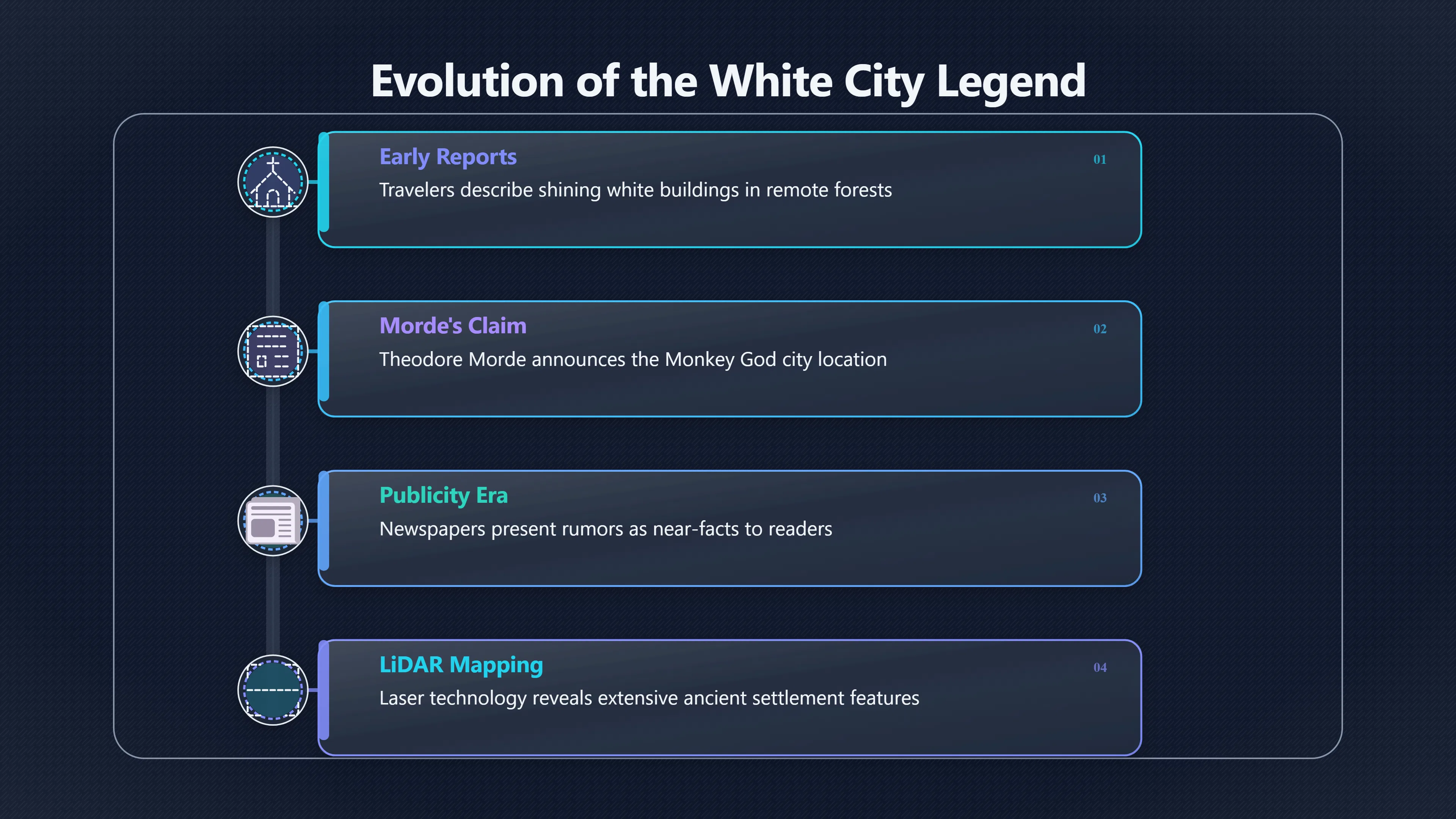
The legend known as the White City emerged from reports about the vast and poorly mapped forests of eastern Honduras. For centuries, travellers, settlers and explorers repeated stories of an abandoned city hidden deep within the region now known as La Mosquitia. Accounts differed considerably. Some described shining white buildings visible from a distance, while others spoke of a wealthy settlement abandoned long before European arrival.[Wikipedia]WikipediaLa Ciudad BlancaLa Ciudad Blanca
One reason the story endured is that it was never tied to a single description. Unlike a specific lost monument with a fixed location, the White City could move, expand and absorb new details. Whenever explorers encountered ruins, earthworks or ancient artefacts, these discoveries could be linked to the legend. The existence of real pre-Columbian settlements made the idea seem plausible even when the more dramatic elements lacked evidence.[National Geographic]nationalgeographic.comIt was indeed an ancient city.Read moreNational GeographicExclusive: Lost City Discovered in the Honduran Rain Forest2 Mar 2015 — The expedition confirmed on the ground all the…
As interest in lost civilizations grew during the nineteenth and twentieth centuries, the White City became part of a wider tradition of hidden-city stories in the Americas. Newspapers and adventure magazines often presented rumours as near-facts, encouraging the belief that a spectacular discovery was just around the corner. The legend increasingly reflected outside expectations about lost kingdoms and treasure cities rather than a single consistent local tradition.[Wikipedia]WikipediaLa Ciudad BlancaLa Ciudad Blanca
Theodore Morde and the Monkey God claim
No individual shaped the modern legend more than American explorer Theodore Morde. In 1940, after an expedition into Honduras, Morde announced that he had located what newspapers called the “Lost City of the Monkey God”. He claimed to have travelled through extremely remote terrain and described ruins connected to stories about a monkey deity worshipped by an ancient civilization. His account included dramatic details such as temples, stairways, stone monkey figures and tales passed on by guides.[Wikipedia]WikipediaLa Ciudad BlancaLa Ciudad Blanca
The announcement attracted enormous publicity. Morde returned with artefacts collected during the expedition and promised to lead a future excavation. Crucially, however, he never revealed the precise location of the city. He repeatedly stated that he would return to investigate properly, but that expedition never took place.[Wikipedia]WikipediaTheodore MordeTheodore Morde
For decades, this secrecy helped transform Morde into a legendary figure. Supporters argued that he had genuinely found the city and was protecting it from looters. Others speculated that hidden interests prevented him from returning. His death in 1954 added further mystery and encouraged conspiracy theories.[Wikipedia]WikipediaTheodore MordeTheodore Morde
Later examination of Morde’s journals significantly changed the picture. Research cited by later authors, including Douglas Preston, argued that Morde had not discovered the lost city he claimed to have found. According to this interpretation, the famous story was largely fabricated for publicity, while the expedition’s real interest may have centred on mineral prospects and placer gold. The journals suggest that key elements of the dramatic narrative were constructed after the expedition rather than documented during it.[Wikipedia]WikipediaLa Ciudad BlancaLa Ciudad Blanca
This does not mean Morde invented everything. He travelled through a real archaeological landscape and collected genuine artefacts. The dispute concerns his extraordinary conclusions and his claim to have found the legendary city itself. The result is a classic mixture of fact, exaggeration and myth-making rather than a straightforward fraud.[Wikipedia]WikipediaLa Ciudad BlancaLa Ciudad Blanca
Why the story kept changing
The White City legend survived because every new discovery could be interpreted as confirmation without actually resolving the mystery.
Several factors encouraged this continual reinvention:
- The landscape remained largely unexplored. Dense rainforest made verification difficult and allowed rumours to flourish.
- Real archaeological remains existed. New sites were repeatedly discovered, giving credibility to claims that something important was hidden in the region.
- The legend lacked a fixed description. A city of white stone, a monkey-god cult centre, a lost kingdom and a forgotten civilization could all be presented as the same place.
- Publicity rewarded dramatic claims. Explorers, writers and media organisations gained attention from announcing possible discoveries.
- Indigenous traditions and outsider interpretations became blended together. Stories that originally had different meanings were often folded into a single narrative about a lost city.[wikipedia.org]WikipediaLa Ciudad BlancaLa Ciudad Blanca
Because the legend constantly absorbed new information, failure to find one version rarely damaged the broader story. Instead, the city simply became something slightly different.
Did modern archaeology finally solve the mystery?
The most important recent development came through LiDAR (Light Detection and Ranging), a laser-mapping technology capable of revealing ancient structures beneath forest canopies. Surveys in La Mosquitia identified extensive archaeological features, and later expeditions confirmed that large ancient settlements existed in valleys previously hidden by dense vegetation.[National Geographic]nationalgeographic.comIt was indeed an ancient city.Read moreNational GeographicExclusive: Lost City Discovered in the Honduran Rain Forest2 Mar 2015 — The expedition confirmed on the ground all the…
Media coverage often portrayed these discoveries as the final discovery of the White City or the City of the Monkey God. Yet many archaeologists rejected that conclusion. Researchers involved in the work emphasised that the findings demonstrated the existence of multiple ancient settlements rather than a single legendary metropolis. Some specialists argued that the White City should be understood as a mythic construct rather than a specific archaeological target.[National Geographic]nationalgeographic.comIt was indeed an ancient city.Read moreNational GeographicExclusive: Lost City Discovered in the Honduran Rain Forest2 Mar 2015 — The expedition confirmed on the ground all the…
Critics also objected to headlines suggesting that a centuries-old mystery had been solved. Archaeologist Rosemary Joyce, among others, argued that the publicity sometimes overstated the evidence and blurred the distinction between legend and archaeology. Even supporters of the LiDAR discoveries generally acknowledged that finding real ruins is not the same as proving a legendary city existed exactly as described in popular accounts.[Wikipedia]WikipediaLa Ciudad BlancaLa Ciudad Blanca
The irony is that the archaeological discoveries may be more significant than the legend itself. Rather than revealing one spectacular lost city, they point to a broader network of settlements and a previously underestimated civilization in eastern Honduras.[National Geographic]nationalgeographic.comIt was indeed an ancient city.Read moreNational GeographicExclusive: Lost City Discovered in the Honduran Rain Forest2 Mar 2015 — The expedition confirmed on the ground all the…
What the White City legend reveals
The White City is best understood as a changing legend anchored to a real landscape. Unlike a conventional hoax created by a single fraudster, it evolved through layers of folklore, speculation, exploration and media storytelling. Morde’s sensational claims became the most famous chapter, but they were only one stage in a much longer process.[Wikipedia]WikipediaLa Ciudad BlancaLa Ciudad Blanca
Its endurance shows how difficult it can be to separate discovery from expectation. Real archaeological remains gave the legend credibility, while the legend encouraged people to interpret every new find as proof that the mystery had finally been solved. As a result, the White City repeatedly shifted shape without ever disappearing.[National Geographic]nationalgeographic.comIt was indeed an ancient city.Read moreNational GeographicExclusive: Lost City Discovered in the Honduran Rain Forest2 Mar 2015 — The expedition confirmed on the ground all the…
In Honduras’s history of contested claims, the White City remains notable not because it was definitively exposed as a hoax or definitively proven true, but because it occupied the ambiguous space between folklore, exploration and archaeology. Each generation inherited the story, modified it and attached it to new evidence, ensuring that the legend continued long after its original form had been forgotten.[Wikipedia]WikipediaLa Ciudad BlancaLa Ciudad Blanca
Amazon book picks
Further Reading
Books and field guides related to Was Honduras's White City Ever Really Found?. Use these as the next step if you want deeper reading beyond the article.
The Lost City of the Monkey God
Directly addresses the White City and Monkey God narratives.
Fingerprints of the Gods
Illustrates how lost-civilization narratives attract enduring audiences.
eBay marketplace picks
Marketplace Samples
Example marketplace items related to this page. Use the search link to explore similar finds on eBay.




Endnotes
1.
Source: Wikipedia
Title: La Ciudad Blanca
Link:https://en.wikipedia.org/wiki/La_Ciudad_Blanca
2.
Source: Wikipedia
Title: Theodore Morde
Link:https://en.wikipedia.org/wiki/Theodore_Morde
3.
Source: youtube.com
Title: The Lost City of the Monkey God with Douglas Preston
Link:https://www.youtube.com/watch?v=ZSe3GLq7zGY
Source snippet
LOST CITY of the Monkey God | Ancient Civilizations...
4.
Source: youtube.com
Title: LOST CITY of the Monkey God | Ancient Civilizations
Link:https://www.youtube.com/watch?v=AfKoJReyAMg
5.
Source: nationalgeographic.com
Title: It was indeed an ancient city.Read more
Link:https://www.nationalgeographic.com/adventure/article/150302-honduras-lost-city-monkey-god-maya-ancient-archaeology
Source snippet
National GeographicExclusive: Lost City Discovered in the Honduran Rain Forest2 Mar 2015 — The expedition confirmed on the ground all the...
Additional References
6.
Source: newyorker.com
Link:https://www.newyorker.com/tech/annals-of-technology/an-ancient-city-emerges-in-a-remote-rain-forest
Source snippet
Archaeologists previously relied on local guides, but this site was uniquely pristine. The expedition faced dense jungle and wildlife whi...
7.
Source: facebook.com
Title: part5 mystery of lord hanuman lost city of the monkeygod foundla ciudad blanca s
Link:https://www.facebook.com/LostTemple7/posts/part5-mystery-of-lord-hanuman-lost-city-of-the-monkeygod-foundla-ciudad-blanca-s/234543437235835/
Source snippet
PART5 Mystery of Lord HanumanThen there's the story of La Ciudad Blanca, which explorer Theodore Morde claimed to have found in 1940s and...
8.
Source: theguardian.com
Title: archaeologists find two lost cities deep in honduras jungle
Link:https://www.theguardian.com/world/2015/mar/06/archaeologists-find-two-lost-cities-deep-in-honduras-jungle
Source snippet
Archaeologists find two 'lost cities' deep in Honduras jungle5 Mar 2015 — Archaeologists have discovered two lost cities in the deep jung...
9.
Source: youtube.com
Link:https://www.youtube.com/watch?v=vWG1MHKb4I0
Source snippet
The Lost City of the Monkey God: Steve Elkins Reveals What They Found in Honduras...
10.
Source: theguardian.com
Title: honduras lost cities open letter national geographic report
Link:https://www.theguardian.com/world/2015/mar/11/honduras-lost-cities-open-letter-national-geographic-report
Source snippet
claimed to have discovered a city in the Honduras jungle around 1940.Read more...
11.
Source: youtube.com
Link:https://www.youtube.com/watch?v=nA_7HistS6A
Source snippet
The Lost City of the Monkey God with Douglas Preston...
12.
Source: youtube.com
Title: Douglas Preston: The Lost City of the Monkey God
Link:https://www.youtube.com/watch?v=FpxJPW9bEKM
Source snippet
Lost civilization in Honduras: What archaeologists discovered scared them | Documentary...
13.
Source: arxiv.org
Title: arXiv Learning and Recognizing Archeological Features from Li DAR Data
Link:https://arxiv.org/abs/2004.02099
14.
Source: reddit.com
Link:https://www.reddit.com/r/Damnthatsinteresting/comments/1ivjnhk/a_lost_city_in_honduras_was_discovered_using/
15.
Source: reddit.com
Link:https://www.reddit.com/r/worldnews/comments/1emlen/archaeologists_have_discovered_a_lost/
Topic Tree