Within Moroccan Hoaxes
How Moroccan Fossils Exposed a Scientific Fraud
Fossils traced to Morocco helped investigators challenge specimens falsely presented as discoveries from the Himalayas.
On this page
- The Himalayan fossil claims
- How specimen origins were questioned
- What the scandal revealed about scientific verification
Page outline Jump by section
Introduction
One of the most revealing scientific fraud cases linked to Morocco did not begin in North Africa at all. It emerged from decades of claims that extraordinary fossil discoveries had been made in the Himalayas. The turning point came when palaeontologists realised that some supposedly Himalayan specimens looked remarkably familiar. Instead of representing unique finds from remote mountain ranges, they appeared to be identical to fossils already known from Morocco. That comparison helped unravel what became known as the Himalayan fossil hoax, a major palaeontological misconduct scandal centred on Indian geologist Vishwa Jit Gupta.[Wikipedia]WikipediaHimalayan fossil hoaxHimalayan fossil hoax

For the history of scientific deception, the Moroccan connection is important because the fossils themselves became evidence. They allowed investigators to test claims about provenance—the documented origin of a specimen—and showed how comparative collections can expose fraud even when the original fieldwork cannot be independently observed.[Wikipedia]WikipediaHimalayan fossil hoaxHimalayan fossil hoax
The Himalayan fossil claims
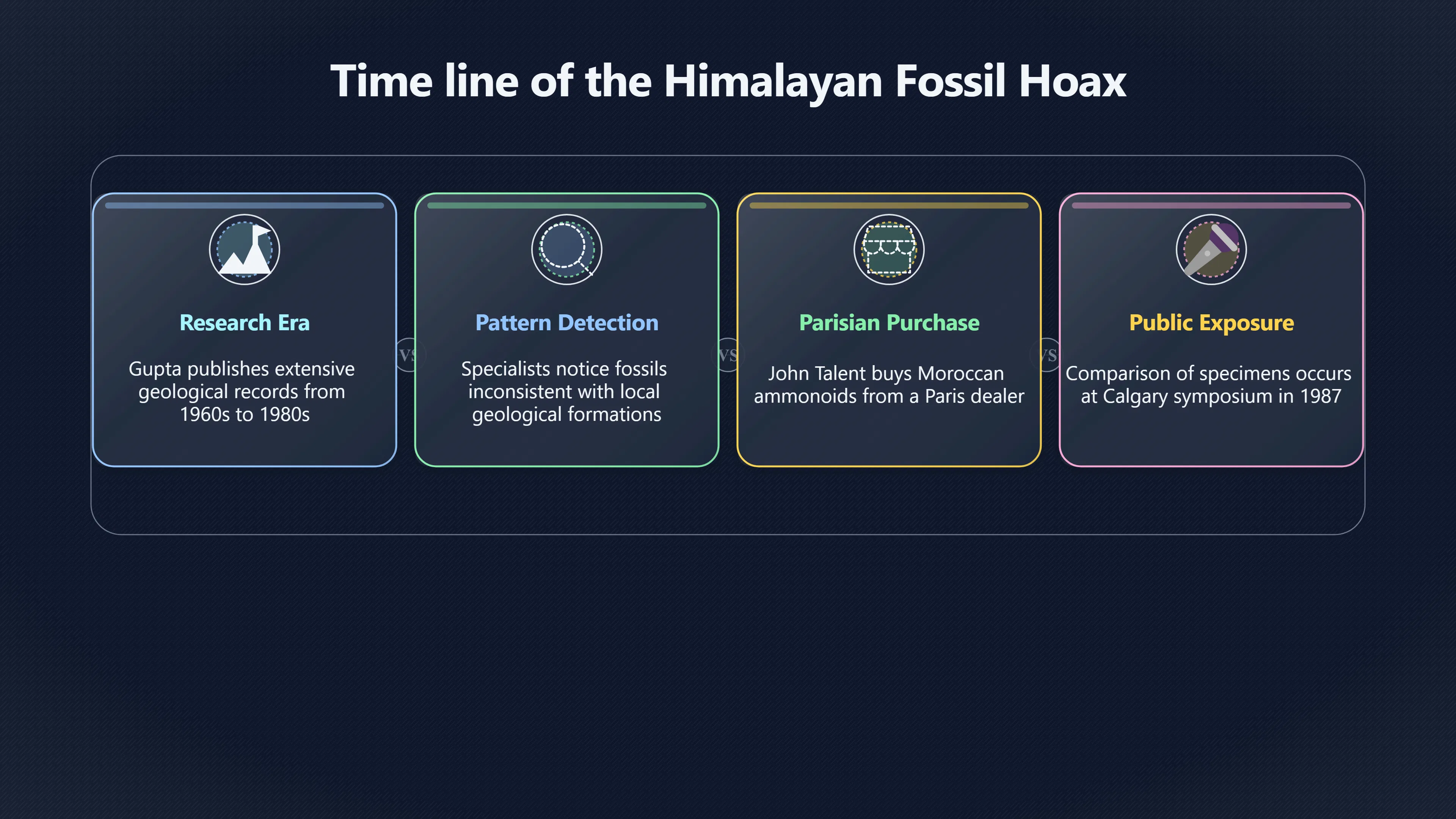
From the 1960s through the 1980s, Vishwa Jit Gupta published an enormous body of research on Himalayan geology and fossil records. His papers described fossils supposedly collected from numerous locations across the mountain system and were widely cited in attempts to reconstruct the geological history of the region. For years, many researchers accepted these discoveries as genuine because the Himalayas were difficult to access and relatively underexplored.[Wikipedia]WikipediaHimalayan fossil hoaxHimalayan fossil hoax
Questions began to emerge when specialists noticed unusual patterns. Some fossils seemed unexpectedly similar to specimens already known from other parts of the world. Certain reported discoveries also appeared inconsistent with the geological formations where they were allegedly found. What initially looked like isolated anomalies gradually developed into a broader suspicion that the fossil record being presented for the Himalayas might not be authentic.[Wikipedia]WikipediaHimalayan fossil hoaxHimalayan fossil hoax
How specimen origins were questioned
The decisive breakthrough came through careful comparison rather than dramatic field discoveries. Australian palaeontologist John Talent examined Gupta’s published fossils and became increasingly concerned that they did not fit their reported Himalayan settings. During a visit to Paris in 1987, Talent purchased fossil ammonoids—extinct marine cephalopods—from a dealer whose stock originated near Erfoud in Morocco, one of the world’s most famous fossil-producing regions.[Wikipedia]WikipediaHimalayan fossil hoaxHimalayan fossil hoax
When Talent compared these Moroccan specimens with fossils illustrated in Gupta’s publications, the resemblance was striking. The specimens appeared not merely similar in species but effectively identical in their preserved details and shapes. Such matches are highly significant in palaeontology because individual fossils often contain distinctive features created by preservation and damage. The probability that separate specimens from distant regions would display the same combination of characteristics was extremely low.[Wikipedia]WikipediaHimalayan fossil hoaxHimalayan fossil hoax
The Moroccan fossils therefore became a form of forensic evidence. If a fossil sold commercially from Morocco matched a specimen claimed to have been collected in the Himalayas, the reported provenance was highly suspect. Investigators concluded that at least some of the Himalayan discoveries were likely imported specimens relabelled as local finds.[Wikipedia]WikipediaHimalayan fossil hoaxHimalayan fossil hoax
The moment the comparison became public
The Moroccan connection moved from private suspicion to public controversy at the International Symposium on the Devonian System in Calgary in 1987. Talent presented images of Gupta’s supposed Himalayan ammonoids alongside Moroccan specimens. According to later accounts, the fossils appeared indistinguishable when displayed side by side.[Wikipedia]WikipediaHimalayan fossil hoaxHimalayan fossil hoax
This was powerful because it transformed an abstract accusation into a visual demonstration. Scientists in the audience could see the comparison for themselves. The issue was no longer simply whether Gupta’s field records were incomplete; it was whether fossils presented as Himalayan discoveries were actually specimens already available through the international fossil trade.[Wikipedia]WikipediaHimalayan fossil hoaxHimalayan fossil hoax
Subsequent investigations expanded the case. Researchers found evidence that fossils had been recycled between publications, attributed to different localities, or borrowed from previously published illustrations. The Moroccan ammonoids became one of the clearest and most memorable examples within a much larger pattern of questionable material.[Wikipedia]WikipediaHimalayan fossil hoaxHimalayan fossil hoax
Why Moroccan fossils were so important
Morocco occupies a special place in palaeontology because it contains exceptionally rich fossil deposits. Regions around Erfoud and other fossil-producing areas have supplied museums, researchers and collectors with large numbers of well-preserved specimens for decades. As a result, many Moroccan fossils are familiar to specialists and often possess distinctive characteristics that make comparisons possible.[Wikipedia]WikipediaHimalayan fossil hoaxHimalayan fossil hoax
In the Himalayan fraud case, Moroccan specimens served three crucial functions:
- Reference material: Researchers already knew what genuine Moroccan fossils looked like and where they came from.[Wikipedia]WikipediaHimalayan fossil hoaxHimalayan fossil hoax
- Commercial traceability: Similar specimens were available through dealers, making it plausible that fossils could be acquired outside scientific fieldwork.[Wikipedia]WikipediaHimalayan fossil hoaxHimalayan fossil hoax
- Independent verification: The comparison did not rely on disputed field notes or personal testimony. The fossils themselves could be examined.[Wikipedia]WikipediaHimalayan fossil hoaxHimalayan fossil hoax
This transformed the investigation from a debate about interpretation into a question of physical evidence.
What the scandal revealed about scientific verification
The exposure of the Himalayan fossil hoax highlighted a basic principle of science: a specimen is only as trustworthy as its documented origin. A fossil’s scientific value depends not merely on what it is, but on where it was found and how that information can be verified.[Wikipedia]WikipediaHimalayan fossil hoaxHimalayan fossil hoax
Investigators later criticised the absence of precise locality information in many of Gupta’s publications and noted that field checks failed to confirm several claimed fossil-bearing sites. Requests for original records and collections often produced no satisfactory documentation. These weaknesses became far more serious once the Moroccan comparisons suggested that some specimens had been mislabelled.[Wikipedia]WikipediaHimalayan fossil hoaxHimalayan fossil hoax
The case also demonstrated the importance of international scrutiny. The fraud was not exposed by a single dramatic discovery but through collaboration among specialists who compared collections, checked geological settings, revisited field localities and examined published images. Moroccan fossils happened to provide one of the most persuasive clues because they offered a direct, tangible comparison against the Himalayan claims.[Wikipedia]WikipediaHimalayan fossil hoaxHimalayan fossil hoax
A Moroccan contribution to exposing fraud
Morocco was not the source of the deception. Its role was that of an unexpected witness. Fossils from Moroccan deposits helped reveal that supposedly Himalayan discoveries had implausible origins and contributed to the unravelling of one of the most notorious scientific misconduct cases in palaeontology.[Wikipedia]WikipediaHimalayan fossil hoaxHimalayan fossil hoax
The episode remains a powerful reminder that scientific fraud can be uncovered through the ordinary tools of research: careful observation, comparison of specimens, scrutiny of provenance and a willingness to question findings that seem too convenient. In this case, fossils from Morocco became the key evidence that helped expose a false geological history thousands of kilometres away in the Himalayas.[Wikipedia]WikipediaHimalayan fossil hoaxHimalayan fossil hoax
Amazon book picks
Further Reading
Books and field guides related to How Moroccan Fossils Exposed a Scientific Fraud. Use these as the next step if you want deeper reading beyond the article.
The Demon-Haunted World
Rating: 4.5/5 from 43 Google Books ratings
Directly addresses scientific skepticism and verification.
Frauds, Myths, and Mysteries: Science and Pseudoscience in Ar...
Focuses on exposing evidence-based scientific frauds.
eBay marketplace picks
Marketplace Samples
Live-tested eBay searches with available results related to this page.


Endnotes
1.
Source: Wikipedia
Title: Himalayan fossil hoax
Link:https://en.wikipedia.org/wiki/Himalayan_fossil_hoax
2.
Source: Wikipedia
Title: Vishwa Jit Gupta
Link:https://en.wikipedia.org/wiki/Vishwa_Jit_Gupta
3.
Source: Wikipedia
Title: Moroccan fossil trade
Link:https://en.wikipedia.org/wiki/Moroccan_fossil_trade
Additional References
4.
Source: facebook.com
Link:https://www.facebook.com/groups/2417144643/posts/10162163582099644/
5.
Source: nhm.ac.uk
Title: oldest known homo sapiens fossils discovered in morocco
Link:https://www.nhm.ac.uk/discover/news/2017/june/oldest-known-homo-sapiens-fossils-discovered-in-morocco.html
Source snippet
Oldest known <i>Homo sapiens</i> fossils discovered in...7 Jun 2017 — Excavations at an archaeological site in Morocco have identified t...
6.
Source: pubmed.ncbi.nlm.nih.gov
Link:https://pubmed.ncbi.nlm.nih.gov/17738290/
Source snippet
The Case of the "Misplaced" Fossilsby R Lewin · 1989 · Cited by 22 — A prominent Australian scientist has examined two decades of w...
7.
Source: depositsmag.com
Title: [fossil fakes]({{ ‘fossil-fakes/’ | relative_url }}) and their recognition
Link:https://depositsmag.com/2015/12/19/fossil-fakes-and-their-recognition/
Source snippet
19 Dec 2015 — Thanks to authenticity controls, fake fossils can only be sold as copies in Germany and not as real fossils, as often happe...
8.
Source: upload.wikimedia.org
Title: Commons Wiki Journal Preprints/The Himalayan fossil hoax
Link:https://upload.wikimedia.org/wikiversity/en/8/8a/WikiJournal_Preprints_The_Himalayan_fossil_hoax_-_Wikiversity.pdf
Source snippet
Gupta had manipulated, faked and plagiarised his data. The Moroccan fossils were...
9.
Source: en.wikiversity.org
Link:https://en.wikiversity.org/wiki/WikiJournal_of_Science/The_Himalayan_fossil_hoax
Source snippet
WikiJournal of Science/The Himalayan fossil hoax5 Jan 2024 — Talent was convinced that Gupta's ammonoid specimens originally c...
10.
Source: academia.edu
Link:https://www.academia.edu/26180496/Fossil_fakes_and_their_recognition
11.
Source: reddit.com
Link:https://www.reddit.com/r/Scams/comments/3nxtlk/a_possibly_unique_scam_surrounding_moroccan/
12.
Source: researchgate.net
Link:https://www.researchgate.net/profile/Juan-Gutierrez-Marco/publication/323298119_Recent_Geoethical_Issues_in_Moroccan_and_Peruvian_Paleontology/links/5ab92479a6fdcc46d3b9ca04/Recent-Geoethical-Issues-in-Moroccan-and-Peruvian-Paleontology.pdf
13.
Source: youtube.com
Link:https://www.youtube.com/watch?v=Lg17T4H_Gmw
Topic Tree