Within Zambian Hoaxes
Was Zambia's Space Programme a Hoax?
Edward Nkoloso's Afronaut project blurred sincere ambition, political theatre and foreign fascination with an apparently impossible dream.
On this page
- What Nkoloso Claimed and Built
- Satire, Ambition and Political Theatre
- How Foreign Media Shaped the Legend
Page outline Jump by section
Introduction
Was Zambia’s space programme a hoax? The shortest answer is that it was neither a straightforward fraud nor a genuine space programme in the engineering sense. Edward Mukuka Nkoloso’s “Afronaut” project of the early 1960s occupied an unusual middle ground between sincere aspiration, political performance, satire and publicity. He publicly claimed that Zambia could beat the United States and the Soviet Union into space, train African astronauts and even establish missions beyond the Moon. Yet the programme lacked the technology, funding and institutional support needed to achieve any of those goals. The enduring fascination of the story comes from that ambiguity. Decades later, historians, journalists and artists still debate whether Nkoloso was an eccentric visionary, a political satirist, a master self-promoter, or all three at once.[newyorker.com]newyorker.comThe New Yorker The Zambian "Afronaut" Who Wanted to Join the Space RaceHis Zambia National Academy of Science, Space Research, and Philosophy began training twelve astronauts, including a 16-year-old girl, th…
What Nkoloso Claimed and Built
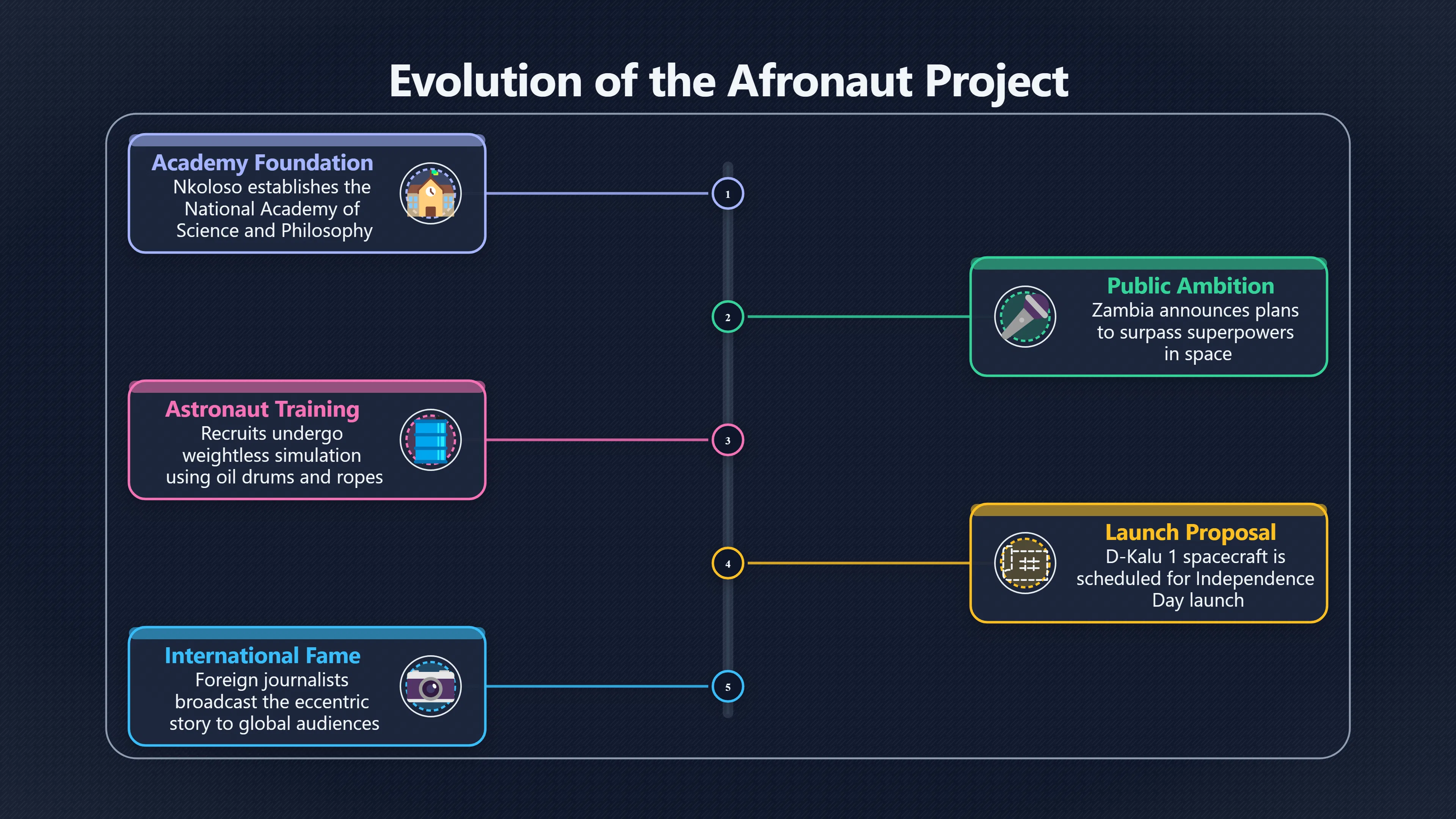
Edward Mukuka Nkoloso was not an anonymous prankster. He was a former teacher, anti-colonial activist and public figure who founded the Zambia National Academy of Science, Space Research and Philosophy around the time Zambia was moving towards independence. From that platform he announced an astonishing goal: Zambia would join the global space race and surpass the superpowers.[The New Yorker]newyorker.comThe New Yorker The Zambian "Afronaut" Who Wanted to Join the Space RaceHis Zambia National Academy of Science, Space Research, and Philosophy began training twelve astronauts, including a 16-year-old girl, th…
His public claims became increasingly extravagant. He proposed sending a young woman, Matha Mwambwa, into space alongside cats and eventually establishing missions to Mars. He described a spacecraft called D-Kalu 1, named partly after Zambia’s first president, Kenneth Kaunda. The craft was presented as a drum-shaped vehicle constructed from aluminium and copper, and Nkoloso spoke confidently about launching it on Zambia’s Independence Day in October 1964.[National Air and Space Museum]airandspace.si.eduThe launch site was to beNational Air and Space MuseumThe Story Behind the Zambian Space Program28 Feb 2025 — Nkoloso promised the press that the first launch wou…
The training methods became legendary. Recruits were reportedly rolled downhill in oil drums and swung from ropes to simulate weightlessness and spaceflight conditions. These exercises were so unusual that they quickly attracted international attention. To many foreign observers they appeared absurd, reinforcing the impression that the entire programme was a joke. Yet the existence of trainees, facilities and repeated public statements suggests that Nkoloso invested real effort in maintaining the project.[The New Yorker]newyorker.comThe New Yorker The Zambian "Afronaut" Who Wanted to Join the Space RaceHis Zambia National Academy of Science, Space Research, and Philosophy began training twelve astronauts, including a 16-year-old girl, th…
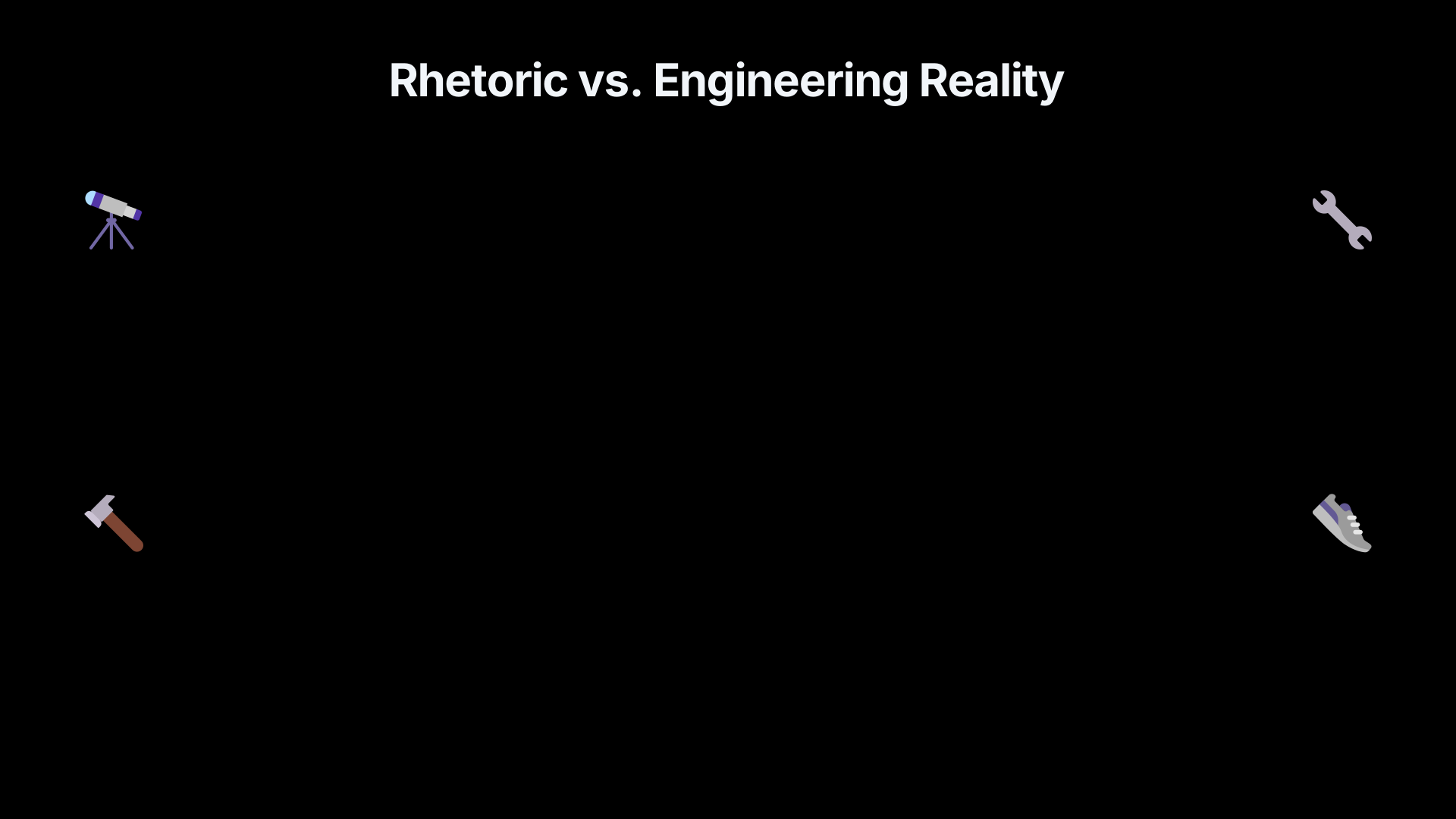
A key point often lost in retellings is that there was no functioning rocket programme behind the publicity. Zambia’s government did not adopt the scheme as a national space agency, and the funding Nkoloso sought never materialised. The gap between rhetoric and capability was enormous.[National Air and Space Museum]airandspace.si.eduThe launch site was to beNational Air and Space MuseumThe Story Behind the Zambian Space Program28 Feb 2025 — Nkoloso promised the press that the first launch wou…
Satire, Ambition and Political Theatre
The reason the Afronaut story remains controversial is that it can be interpreted in more than one way.
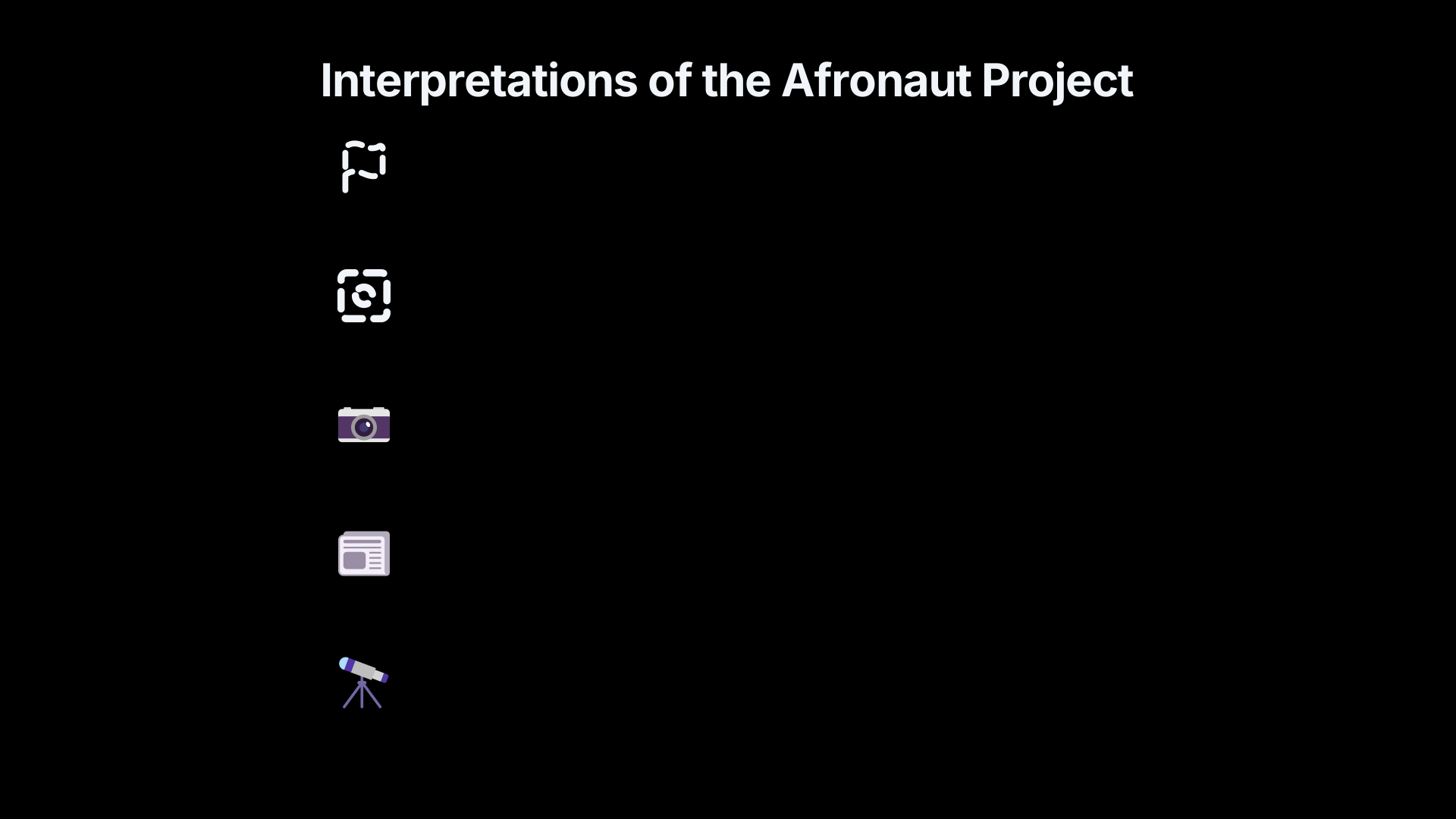
One reading treats Nkoloso as a genuine dreamer. Newly independent African states were entering a world dominated by Cold War competition, and scientific achievement had become a symbol of national prestige. In that context, an African-led space programme, however unrealistic, expressed a desire for technological modernity and international recognition. Nkoloso repeatedly sought funding and spoke as though success remained possible.[The New Yorker]newyorker.comThe New Yorker The Zambian "Afronaut" Who Wanted to Join the Space RaceHis Zambia National Academy of Science, Space Research, and Philosophy began training twelve astronauts, including a 16-year-old girl, th…
Another interpretation sees the project as a form of political theatre. Nkoloso’s claims were often so exaggerated that they seemed designed to provoke laughter. Promising to reach Mars while wealthy superpowers struggled to reach the Moon stretched credibility beyond its limits. His statements mixed scientific language with theatrical flourishes, creating a performance that was difficult to take literally.[The New Yorker]newyorker.comThe New Yorker The Zambian "Afronaut" Who Wanted to Join the Space RaceHis Zambia National Academy of Science, Space Research, and Philosophy began training twelve astronauts, including a 16-year-old girl, th…
Some scholars and commentators have suggested that this exaggeration functioned as satire. Certain details appear almost deliberately crafted to expose colonial assumptions. One famous example involved the proposed missionary travelling to Mars. Nkoloso reportedly insisted that any missionary should not force Christianity upon Martians, a joke that inverted the language of European colonial missions and cast supposedly “civilising” projects in a ridiculous light.[Wikipedia]WikipediaEdward Mukuka NkolosoEdward Mukuka Nkoloso
The ambiguity may have been intentional. A performance could simultaneously express national pride, mock Cold War spectacle and attract publicity. Unlike a classic hoax, which depends on eventually convincing people of a false fact, Nkoloso often operated in a space where audiences could never be entirely sure how seriously they were meant to take him.[The New Yorker]newyorker.comThe New Yorker The Zambian "Afronaut" Who Wanted to Join the Space RaceHis Zambia National Academy of Science, Space Research, and Philosophy began training twelve astronauts, including a 16-year-old girl, th…
Why Foreign Journalists Found the Story Irresistible
The Afronaut programme gained international fame largely because foreign reporters found it impossible to ignore. During the 1960s, Western audiences were already fascinated by the American-Soviet space race. A newly independent African nation apparently attempting to leap ahead of both superpowers offered an irresistible headline.[The New Yorker]newyorker.comThe New Yorker The Zambian "Afronaut" Who Wanted to Join the Space RaceHis Zambia National Academy of Science, Space Research, and Philosophy began training twelve astronauts, including a 16-year-old girl, th…
Many reports focused on the most eccentric details: oil-drum training, teenage astronauts, cats bound for space and ambitious Mars missions. Such elements made excellent copy, but they also encouraged readers to see the story as comic rather than political. The result was a simplified narrative in which Zambia became the setting for an amusing curiosity rather than a country negotiating questions of modernity, independence and global status.[The New Yorker]newyorker.comThe New Yorker The Zambian "Afronaut" Who Wanted to Join the Space RaceHis Zambia National Academy of Science, Space Research, and Philosophy began training twelve astronauts, including a 16-year-old girl, th…
This foreign framing helped shape the programme’s afterlife. Later audiences often encountered Nkoloso through short anecdotes rather than through the broader context of post-independence Zambia. As the story travelled, the distinction between satire, aspiration and publicity became blurred. What may have begun as a complex performance was frequently reduced to a punchline about a “fake” African space programme.[The New Yorker]newyorker.comThe New Yorker The Zambian "Afronaut" Who Wanted to Join the Space RaceHis Zambia National Academy of Science, Space Research, and Philosophy began training twelve astronauts, including a 16-year-old girl, th…
The continuing debate among historians and online commentators reflects this problem. Some argue that the programme was essentially a joke aimed at gullible foreign observers. Others maintain that dismissing it as a joke overlooks genuine hopes for scientific progress and national self-determination.[Reddit]reddit.comwas the zambian space program an elaborate jokeWas the Zambian space program an elaborate joke on…During the 1960s Edward Makuka Nkoloso was the self appointed director of the…
Was It a Hoax?
Calling the Afronaut project a hoax is tempting because its central claims were impossible to fulfil with the resources available. No spacecraft was launched, no astronauts reached orbit and no realistic path existed towards the programme’s stated goals. Measured as aerospace engineering, it failed completely.[National Air and Space Museum]airandspace.si.eduThe launch site was to beNational Air and Space MuseumThe Story Behind the Zambian Space Program28 Feb 2025 — Nkoloso promised the press that the first launch wou…
However, the term “hoax” implies a relatively clear intention to deceive. The evidence for such a straightforward deception is weak. Nkoloso publicly maintained the project for years, actively sought support and presented himself as a champion of science and progress. Even Kenneth Kaunda later characterised the venture as something closer to fun and spectacle than a serious national programme, suggesting that contemporaries did not necessarily view it as a malicious fraud.[Wikipedia]WikipediaEdward Makuka NkolosoEdward Makuka Nkoloso
A more accurate description is that the programme existed in a contested zone between fantasy and reality. It involved real people, real publicity and real ambitions, but also humour, exaggeration and performance. That is why it fits so neatly within the history of famous hoaxes and disputed claims. The question is not simply whether the story was true or false. The more interesting question is why so many people—both supporters and sceptics—found meaning in it.[The New Yorker]newyorker.comThe New Yorker The Zambian "Afronaut" Who Wanted to Join the Space RaceHis Zambia National Academy of Science, Space Research, and Philosophy began training twelve astronauts, including a 16-year-old girl, th…
Why the Legend Endures
The Afronaut story survives because it speaks to several audiences at once. To some readers it is a cautionary tale about impossible promises and media exaggeration. To others it is an early example of African futurism: a refusal to accept that science and space exploration belonged only to powerful nations. Artists, writers and filmmakers have repeatedly returned to the story because its uncertainty invites reinterpretation.[publicbooks.org]publicbooks.orgthe afronaut archives reports from a future zambiaPublic BooksThe Afronaut Archives: Reports from a Future ZambiaMar 28, 2019 — In 1964, in the middle of the space race, Zambia started a…
Its endurance also reflects a broader lesson about famous hoaxes and contested histories. The most memorable cases are often not pure inventions. They blend fact and fiction so effectively that later generations struggle to separate them. Nkoloso’s Afronaut programme remains compelling precisely because it was real enough to happen, impossible enough to seem fictional, and ambiguous enough that no single label—hoax, satire, dream or political performance—fully captures what it was.[newyorker.com]newyorker.comThe New Yorker The Zambian "Afronaut" Who Wanted to Join the Space RaceHis Zambia National Academy of Science, Space Research, and Philosophy began training twelve astronauts, including a 16-year-old girl, th…
Amazon book picks
Further Reading
Books and field guides related to Was Zambia's Space Programme a Hoax?. Use these as the next step if you want deeper reading beyond the article.
Africa Is Not A Country
Helps readers understand how African stories are often framed by outsiders.
The Right Stuff
Rating: 4.5/5 from 8 Google Books ratings
Captures the mythology and publicity surrounding early space exploration.
A Man on the Moon
Provides context for the global space-race environment Nkoloso referenced.
How to Invent Everything
Connects to the tension between imagination, technology and practical reality.
eBay marketplace picks
Marketplace Samples
Live-tested eBay searches with available results related to this page.
Endnotes
1.
Source: Wikipedia
Title: Edward Makuka Nkoloso
Link:https://en.wikipedia.org/wiki/Edward_Makuka_Nkoloso
2.
Source: Wikipedia
Title: Edward Mukuka Nkoloso
Link:https://de.wikipedia.org/wiki/Edward_Mukuka_Nkoloso
3.
Source: Wikipedia
Title: Programa espacial de Zambia
Link:https://es.wikipedia.org/wiki/Programa_espacial_de_Zambia
4.
Source: reddit.com
Title: was the zambian space program an elaborate joke
Link:https://www.reddit.com/r/AskHistorians/comments/15qswam/was_the_zambian_space_program_an_elaborate_joke/
Source snippet
Was the Zambian space program an elaborate joke on...During the 1960s Edward Makuka Nkoloso was the self appointed director of the...
5.
Source: Wikipedia
Link:https://en.wikipedia.org/wiki/Afronauts
6.
Source: Wikipedia
Link:https://en.wikipedia.org/wiki/Zambia
Source snippet
ZambiaZambia officially the Republic of Zambia, is a landlocked country in Southern Africa. It is bordered to the north by the Democra...
7.
Source: newyorker.com
Title: The New Yorker The Zambian “Afronaut” Who Wanted to Join the Space Race
Link:https://www.newyorker.com/culture/culture-desk/the-zambian-afronaut-who-wanted-to-join-the-space-race
Source snippet
His Zambia National Academy of Science, Space Research, and Philosophy began training twelve astronauts, including a 16-year-old girl, th...
8.
Source: airandspace.si.edu
Title: The launch site was to be
Link:https://airandspace.si.edu/stories/editorial/story-behind-zambian-space-program
Source snippet
National Air and Space MuseumThe Story Behind the Zambian Space Program28 Feb 2025 — Nkoloso promised the press that the first launch wou...
9.
Source: publicbooks.org
Title: the afronaut archives reports from a future zambia
Link:https://www.publicbooks.org/the-afronaut-archives-reports-from-a-future-zambia/
Source snippet
Public BooksThe Afronaut Archives: Reports from a Future ZambiaMar 28, 2019 — In 1964, in the middle of the space race, Zambia started a...
10.
Source: dictionary.cambridge.org
Link:https://dictionary.cambridge.org/dictionary/english/national
11.
Source: vocabulary.com
Link:https://www.vocabulary.com/dictionary/national
Additional References
12.
Source: youtube.com
Link:https://www.youtube.com/watch?v=JZBY-Hb-TDw
Source snippet
Zambia's Laughable Space Program | Tales From the Bottle...
13.
Source: youtube.com
Title: The Zambian Science Teacher who Wanted to Send AFRICA to SPACE
Link:https://www.youtube.com/watch?v=2MQVnAeeg1A
Source snippet
Afronauts: Interview with Edward Nkoloso | Head of Zambia's Unofficial Space Programme | Nov. 1964...
14.
Source: youtube.com
Title: AFRONAUTS | short film
Link:https://www.youtube.com/watch?v=lb3pu5jXWHU
Source snippet
Zambia Afronauts Edward Mukuka Nkoloso interview documentary Afronauts: Interview with Edward Nkoloso | Head of Zambia's Unofficial Space...
15.
Source: youtube.com
Title: Zambia’s Laughable Space Program | Tales From the Bottle
Link:https://www.youtube.com/watch?v=QMIgcm2ygTE
Source snippet
The Afronauts: The Lost Tale of the Space Race...
16.
Source: dictionary.com
Link:https://www.dictionary.com/browse/national
17.
Source: merriam-webster.com
Link:https://www.merriam-webster.com/dictionary/national
18.
Source: collinsdictionary.com
Link:https://www.collinsdictionary.com/dictionary/english/national
19.
Source: facebook.com
Link:https://www.facebook.com/AAAZambia/posts/the-national-registration-card-nrc-is-more-than-just-an-id-its-your-key-to-essen/993496946209023/
20.
Source: facebook.com
Link:https://www.facebook.com/walkwithsimon/posts/the-time-zambia-wanted-to-go-to-mars-space/902653762534423/
21.
Source: medium.com
Link:https://medium.com/%40Astrosanderson/the-untold-story-of-the-zambian-afronauts-72f6f26ad84e
Topic Tree