Within Uzbekistan Hoaxes
How Uzbekistan's Cotton Harvests Existed on Paper
Officials invented cotton production on a vast scale because careers, bonuses and political prestige depended on meeting impossible targets.
On this page
- Why impossible quotas rewarded false reporting
- How bribery and duplicated cotton sustained the fraud
- Why Moscow and local officials shared an interest in success
Page outline Jump by section
Introduction
One of the most remarkable frauds in Soviet history was not a forged document, a fake photograph or an invented archaeological discovery. It was a harvest. For years, officials in Soviet Uzbekistan reported vast quantities of cotton that either did not exist or existed only on paper. The deception became known as the Uzbek cotton scandal, and by the 1980s it had grown into one of the largest corruption cases ever uncovered in the Soviet Union. Investigators eventually concluded that production figures had been systematically inflated, allowing local officials to collect rewards, prestige and state funding for cotton that had never been harvested. The affair exposed how political pressure, bureaucratic incentives and corruption could combine to create an alternative reality accepted by both local authorities and leaders in Moscow.[Wikipedia]WikipediaUzbek cotton scandalUzbek cotton scandal
The scandal is important not simply because money was stolen. It demonstrated how an authoritarian planning system could encourage the fabrication of statistics on a massive scale. For years, the Soviet state depended on numbers that many participants knew were unreliable, yet everyone involved had reasons to keep the fiction alive.[Wikipedia]WikipediaUzbek cotton scandalUzbek cotton scandal
Why Impossible Quotas Rewarded False Reporting
The roots of the fraud lay in the Soviet Union’s dependence on Central Asian cotton. By the 1970s, Uzbekistan had become one of the USSR’s most important cotton-producing regions. Nearly all suitable agricultural land had been pushed into cotton cultivation, yet Moscow continued demanding larger harvests. State planners wanted ever-rising production even when agricultural limits had already been reached.[Wikipedia]WikipediaUzbek cotton scandalUzbek cotton scandal
This created a fundamental problem. Officials were expected to deliver results that were often impossible to achieve. Failure could damage careers, reduce bonuses and invite political punishment. Success, by contrast, brought honours, promotions and influence. Under those conditions, reporting a poor harvest became far riskier than reporting an imaginary success.[nomadit.co.uk]nomadit.co.ukNomadIT"Cotton case" in Uzbekistan: Crisis of the Soviet Economic…Oct 21, 2023 — some of the leaders of Uzbekistan, especially the top…
The Soviet planning system relied heavily on reported figures moving up through layers of bureaucracy. Local farm managers reported yields to district authorities, district authorities reported to regional officials, and regional officials reported to Moscow. Once inflated numbers entered the system, they were often repeated and amplified. The result was a form of bureaucratic self-deception in which official statistics became detached from agricultural reality.[Wikipedia]WikipediaUzbek cotton scandalUzbek cotton scandal
How the Paper Harvests Worked
The fraud was not based on a single trick. Instead, it relied on several methods that made production appear larger than it really was.
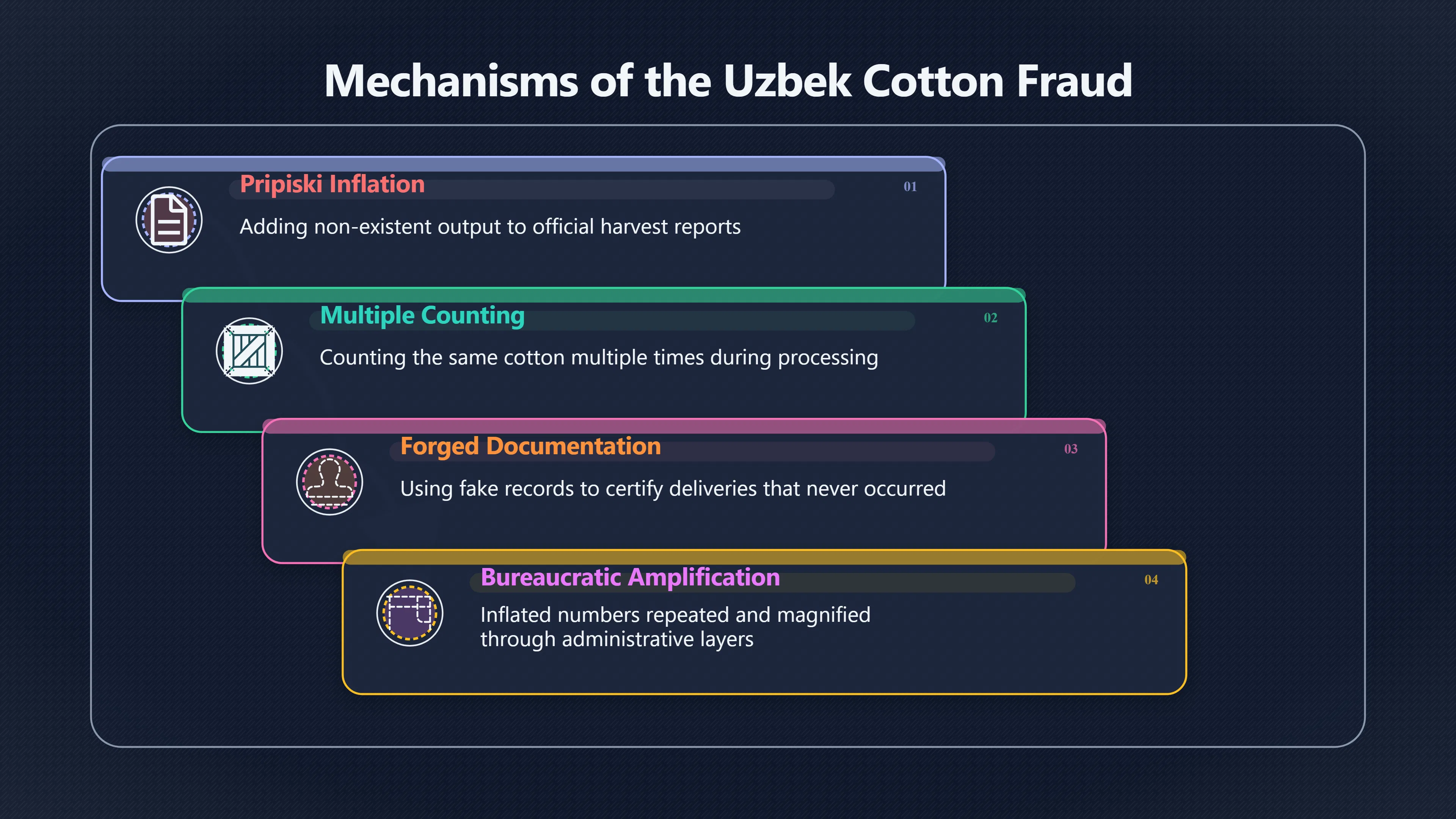
The most important technique was the inflation of harvest figures, known in Soviet administrative language as pripiski—the practice of adding non-existent output to official reports. Cotton that had never been grown could appear in statistics as harvested and delivered. Moscow then paid for these fictional quantities as though they were real. Investigators later concluded that billions of roubles flowed through the system because of these fabricated reports.[wikipedia.org]WikipediaUzbek cotton scandalUzbek cotton scandal
In some cases, cotton was allegedly counted multiple times as it moved through collection and processing systems. Elsewhere, officials used falsified documentation to certify deliveries that never occurred. Because the Soviet economy depended on paperwork, forged records could effectively create cotton on paper even when warehouses and fields could not support the reported totals.[Wikipedia]WikipediaUzbek cotton scandalUzbek cotton scandal
The scale was extraordinary. Soviet investigations later reported that hundreds of thousands of tonnes of cotton had been falsely recorded in a single year. A widely publicised figure from the late stages of the investigation claimed that 981,000 tonnes reported in 1988 did not actually exist, despite substantial state payments being issued on the basis of those reports.[Wikipedia]WikipediaUzbek cotton scandalUzbek cotton scandal
How Bribery Kept the Fiction Alive
False harvest reports alone could not sustain the system. Large-scale bribery helped protect it.
Investigators uncovered networks linking agricultural managers, party officials, police officers and administrators. Money, gifts and favours reportedly flowed through these networks to ensure that unrealistic production claims were accepted rather than challenged. Officials who signed documents or ignored discrepancies benefited from maintaining the illusion.[Wikipedia]WikipediaUzbek cotton scandalUzbek cotton scandal
The corruption extended far beyond individual farms. Senior regional leaders accumulated wealth and influence while presenting themselves as champions of socialist production. Testimony gathered during the investigations described substantial payments to political figures in exchange for awards, titles and protection. Hidden cash and valuables discovered during raids illustrated how profitable the system had become.[Wikipedia]WikipediaUzbek cotton scandalUzbek cotton scandal
The scandal therefore differed from a simple accounting error. It was a self-reinforcing structure in which false statistics generated money and prestige, while bribery helped prevent scrutiny of those same statistics.[Wikipedia]WikipediaUzbek cotton scandalUzbek cotton scandal
Why Moscow and Local Officials Shared an Interest in Success
One reason the fraud lasted so long was that many people benefited from believing it.
For leaders in Uzbekistan, spectacular cotton harvests brought political rewards. The republic was praised as a model of socialist achievement, and successful officials advanced their careers. Sharof Rashidov, the long-serving leader of Soviet Uzbekistan, became closely associated with the image of extraordinary cotton production.[Wikipedia]WikipediaUzbek cotton scandalUzbek cotton scandal
Moscow also had incentives to accept positive reports. The Soviet leadership wanted evidence that central planning was working and that ambitious production targets could be met. Acknowledging that quotas were unrealistic would have exposed weaknesses in the planning system itself. Inflated harvest figures therefore supported official narratives about economic success.[OhioLINK ETD Center]etd.ohiolink.eduOhioLINK ETD CenterThe Cotton Scandal and Uzbek National Consciousnessby DE Peterson · 2013 · Cited by 5 — Rashidov siphoned billions of…
This did not mean every official knowingly participated in fraud. Rather, the structure encouraged selective blindness. Questioning impressive statistics could create political problems, while accepting them often carried few immediate risks. As a result, exaggerated figures could travel through the bureaucracy with surprisingly little resistance.[Tesidottorato]tesidottorato.depositolegale.itUSSR and the features related to corruption and falsification of cotton production data in Uzbekistan. The rise of Andropov and his 'mora…
How the Scandal Was Exposed
The turning point came after the death of Soviet leader Leonid Brezhnev in 1982. His successor, Yuri Andropov, launched anti-corruption investigations aimed at restoring confidence in government institutions. Investigators began examining irregularities in Uzbekistan’s cotton sector and quickly found evidence that the problem extended far beyond isolated cases.[Wikipedia]WikipediaUzbek cotton scandalUzbek cotton scandal
A major investigation led by prosecutors Telman Gdlyan and Nikolai Ivanov expanded through the mid-1980s. Arrests, interrogations and financial inquiries revealed extensive corruption networks and widespread manipulation of production figures. As the inquiry widened, it reached senior party officials and became a national political issue.[Wikipedia]WikipediaUzbek cotton scandalUzbek cotton scandal
The scandal received enormous publicity during the era of glasnost, when Soviet media became more willing to report official wrongdoing. Hundreds of criminal cases followed, and thousands of people were convicted on charges connected to the affair. The investigations became a symbol of both corruption and the Soviet state’s attempt to reform itself during its final years.[Wikipedia]WikipediaUzbek cotton scandalUzbek cotton scandal
What the Paper Harvests Revealed
The Uzbek cotton scandal is often remembered as a corruption case, but it also functioned as a cautionary tale about information. The Soviet economy depended on accurate reporting, yet political incentives encouraged inaccurate reporting. Once enough people relied on false numbers, correcting them became difficult because careers, budgets and official reputations depended on maintaining the fiction.[Tesidottorato]tesidottorato.depositolegale.itUSSR and the features related to corruption and falsification of cotton production data in Uzbekistan. The rise of Andropov and his 'mora…
Unlike folklore or supernatural legends, the cotton fraud was a documented deception with measurable economic consequences. Investigators did not expose a single forged record but an entire system that rewarded fabricated success. The harvests existed in reports, speeches and statistics long before investigators demonstrated that much of the supposed production had never existed in the fields.[Wikipedia]WikipediaUzbek cotton scandalUzbek cotton scandal
Within the wider history of Uzbekistan’s famous deceptions and contested truths, the cotton affair stands out because the illusion was maintained not by mystery or myth but by bureaucracy. It was a paper harvest: a vast agricultural success story created through numbers, signatures and incentives rather than cotton itself.[Wikipedia]WikipediaUzbek cotton scandalUzbek cotton scandal
Amazon book picks
Further Reading
Books and field guides related to How Uzbekistan's Cotton Harvests Existed on Paper. Use these as the next step if you want deeper reading beyond the article.
The Soviet Century
Explains the bureaucratic systems that enabled large-scale falsification.
eBay marketplace picks
Marketplace Samples
Live-tested eBay searches with available results related to this page.



Endnotes
1.
Source: Wikipedia
Title: Uzbek cotton scandal
Link:https://en.wikipedia.org/wiki/Uzbek_cotton_scandal
2.
Source: Wikipedia
Title: Cotton production in Uzbekistan
Link:https://en.wikipedia.org/wiki/Cotton_production_in_Uzbekistan
3.
Source: etd.ohiolink.edu
Link:https://etd.ohiolink.edu/acprod/odb_etd/ws/send_file/send?accession=osu1366199014&disposition=inline
Source snippet
OhioLINK ETD CenterThe Cotton Scandal and Uzbek National Consciousnessby DE Peterson · 2013 · Cited by 5 — Rashidov siphoned billions of...
4.
Source: Wikipedia
Link:https://en.wikipedia.org/wiki/Uzbeks
5.
Source: Wikipedia
Title: Soviet Union
Link:https://en.wikipedia.org/wiki/Soviet_Union
6.
Source: Wikipedia
Title: Uzbek language
Link:https://en.wikipedia.org/wiki/Uzbek_language
7.
Source: Wikipedia
Link:https://en.wikipedia.org/wiki/Uzbekistan
8.
Source: tesidottorato.depositolegale.it
Link:https://tesidottorato.depositolegale.it/handle/20.500.14242/360085
Source snippet
USSR and the features related to corruption and falsification of cotton production data in Uzbekistan. The rise of Andropov and his 'mora...
9.
Source: nomadit.co.uk
Link:https://nomadit.co.uk/conference/cess2023/paper/74358
Source snippet
NomadIT"Cotton case" in Uzbekistan: Crisis of the Soviet Economic...Oct 21, 2023 — some of the leaders of Uzbekistan, especially the top...
10.
Source: nomadit.co.uk
Link:https://nomadit.co.uk/conference/102/paper/67141
Source snippet
Qoralash: The Uzbek Cotton Scandal and the 1980s Soviet...22 Oct 2022 — Investigations revealed that the leaders of the Soviet Un...
11.
Source: celcar.indiana.edu
Link:https://celcar.indiana.edu/materials/language-portal/uzbek.html
Additional References
12.
Source: unipd-centrodirittiumani.it
Title: child labour in uzbekistans cotton sector
Link:https://unipd-centrodirittiumani.it/en/topics/child-labour-in-uzbekistans-cotton-sector
Source snippet
Centro di Ateneo per i Diritti UmaniChild Labour in Uzbekistan's Cotton Sector5 Aug 2025 — Coerced into meeting unrealistic quotas, Uzbek...
13.
Source: latimes.com
Title: la xpm 1988 09 05 mn 1076 story
Link:https://www.latimes.com/archives/la-xpm-1988-09-05-mn-1076-story.html
Source snippet
Los Angeles TimesSoviet 'Cotton Mafia' in Spotlight: Life of Luxury Over, Kin...5 Sept 1988 — According to detailed accounts published...
14.
Source: youtube.com
Title: Corruption Scandal That Shook the USSR
Link:https://www.youtube.com/watch?v=zYwV9Ugk1uM
Source snippet
The Aral Sea: How the USSR Destroyed the World's Largest Lake...
15.
Source: youtube.com
Title: The Aral Sea: How the USSR Destroyed the World’s Largest Lake
Link:https://www.youtube.com/watch?v=uxu3iYQJeW4
Source snippet
Why The USSR Turned A Sea Into A Desert (Documentary)...
16.
Source: youtube.com
Title: Why The USSR Turned A Sea Into A Desert (Documentary)
Link:https://www.youtube.com/watch?v=konlZ-q-EMM
Source snippet
The True Origin Of Cotton | Investigative Documentary...
17.
Source: youtube.com
Title: The True Origin Of Cotton | Investigative Documentary
Link:https://www.youtube.com/watch?v=eFYfP_cKrII
Source snippet
An EJF Film: White Gold - The True Cost Of Cotton...
18.
Source: academia.edu
Link:https://www.academia.edu/36414349/The_Crisis_of_Soviet_Power_in_Central_Asia_The_Uzbek_cotton_affair_19751991
19.
Source: youngpioneertours.com
Link:https://www.youngpioneertours.com/uzbekistan-language-your-complete-guide/
20.
Source: uzinvestigations.org
Link:https://uzinvestigations.org/blogs/a-russian-banking-scandal-taints-uzbekistans-cotton-revolution-and-leads-back-to-switzerland-via-the-uk/
21.
Source: rbth.com
Title: how cotton led to the collapse of the soviet union 815454
Link:https://www.rbth.com/arts/history/2017/08/02/how-cotton-led-to-the-collapse-of-the-soviet-union_815454
Topic Tree