How Belgium's Most Famous Hoaxes Fooled the Public
Belgium’s best-known hoaxes are not a single tradition of trickery but a series of sharply different episodes: a wartime newspaper forged to undermine an occupier, atrocity tales that mixed documented violence with invented horrors, a bestselling false Holocaust memoir, a model UFO photographed as if it were real, and disputed paintings admitted into a...
Page outline Jump by section
Introduction
The decisive question is often not whether a claim looks strange. It is whether publishers, journalists, experts, museums or officials have supplied the signals that normally mean “this has been checked”. Belgium’s hoax history is therefore also a history of verification: genealogists comparing school registers, art specialists demanding provenance, sceptics testing extraordinary claims and investigators separating genuine wartime crimes from propaganda embellishment.
When a fake newspaper told the truth
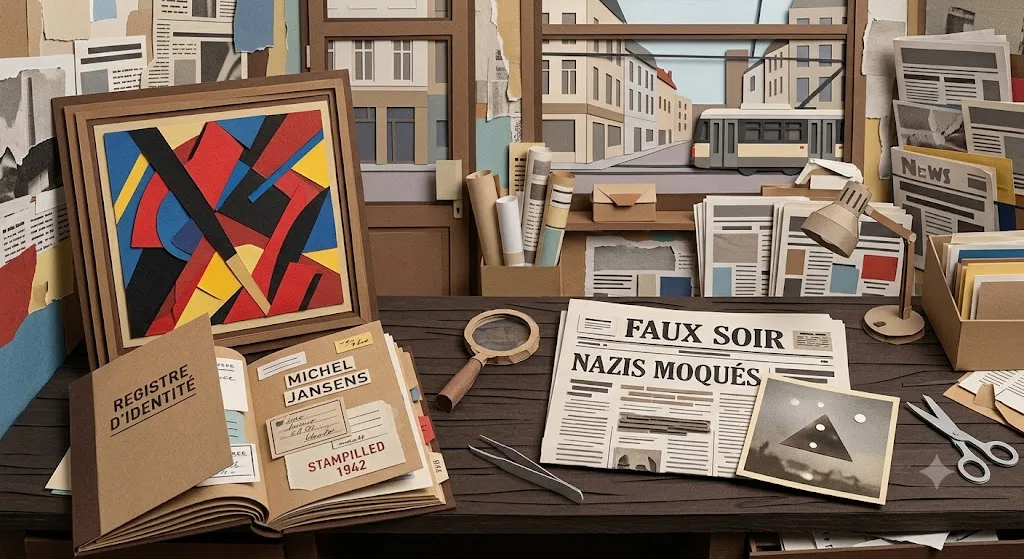
One of Belgium’s most celebrated fakes was never intended to enrich its makers. On 9 November 1943, resistance members distributed a counterfeit edition of the Brussels newspaper Le Soir. It was designed to resemble the German-controlled paper closely enough to reach newsstands at roughly the normal publication time, but its articles, advertisements and notices ridiculed the Nazi occupation and Belgian collaborationists. The operation became known as the Faux Soir, or False Soir.[Brussels Archives]archives.brussels.beBrussels Archivesthe publication of the false Soir, november 9th 1943 | Brussels…The “false Soir” was published on November 9th 1943…
The deception depended on imitation rather than crude parody. Readers had to accept the object as an ordinary newspaper long enough to encounter its subversive contents. The resistance arranged printing, distribution and efforts to delay the genuine edition. Around 50,000 copies are generally reported to have circulated, although precise figures vary between accounts. German authorities reacted with arrests and severe repression against people connected with the production.[Brussels Archives]archives.brussels.beBrussels Archivesthe publication of the false Soir, november 9th 1943 | Brussels…The “false Soir” was published on November 9th 1943…
The Faux Soir matters because it complicates the usual moral picture of forgery. Its creators falsified the appearance and source of a newspaper, but did so to puncture a larger system of coercive propaganda. The occupied version of Le Soir already possessed the external form of journalism while operating under Nazi control. The resistance fake borrowed that authority temporarily in order to expose it.
This was not “fake news” in the modern sense of a fabricated claim passed off indefinitely as fact. The joke became evident inside the paper, and its purpose was political satire rather than sustained impersonation. It belongs to the history of media hoaxes because it exploited readers’ trust in layout, timing and distribution, but it is better understood as an ethical counterfeit: a false object created to challenge an enforced falsehood. The House of European History in Brussels has similarly presented forgery as a tool that can serve very different ends, including resistance and rescue as well as manipulation.[House of European History]historia.europa.euHouse of European HistoryFake for Real | House of European History museumIn this section of the exhibition we explore the types of fakes…
The “Rape of Belgium”: real crimes and invented horrors
Few Belgian stories demonstrate the danger of treating propaganda as either wholly true or wholly false better than the First World War campaign surrounding the “Rape of Belgium”. German forces committed extensive, well-documented violence against Belgian civilians during the invasion of 1914. Towns were burned, civilians were shot and communities were subjected to collective punishment, often because German troops believed — frequently without sound evidence — that civilian fighters were attacking them. Historians have therefore rejected the later claim that the entire atrocity narrative was a British invention.[jstor.org]jstor.orgGrowing.Read moreGerman "Atrocities" and Franco-German Opinion, 1914by J Horne · 1994 · Cited by 91 — Within a few days of the German invasion of Bel…
At the same time, newspapers, propagandists and rumour networks circulated lurid stories for which evidence was poor or absent. Among the most persistent were tales of German soldiers cutting off Belgian children’s hands, mutilating women and committing other ritualised acts of cruelty. Such images travelled well because they condensed the violation of neutral Belgium into memorable scenes of innocence attacked by barbarism. Recruitment posters and press campaigns turned “Belgium” into both a place and a moral symbol.[1914-1918-online.net]encyclopedia.1914-1918-online.netotheringatrocity propagandaotheringatrocity propaganda
The persuasive mechanism was powerful. The stories were attached to genuine invasion, real refugees and authentic massacres. Audiences did not have to believe in an entirely fictional war; they had only to accept sensational additions to a true pattern of violence. Official prestige also mattered. The British government’s Bryce Committee collected testimony and published its report on alleged German outrages in 1915. Its association with respected public figures helped give disputed or uncorroborated accounts an air of settled fact.[1914-1918-Online (WW1) Encyclopedia]encyclopedia.1914-1918-online.netotheringatrocity propagandaotheringatrocity propaganda
After the war, exposure of exaggerated and false atrocity stories encouraged a damaging overcorrection. Some commentators treated the discrediting of particular claims as proof that German crimes in Belgium had largely been invented. Later historical work restored the distinction: atrocities occurred on a significant scale, while propaganda added rumours, stereotypes and claims that could not withstand investigation.[ResearchGate]researchgate.netOpen source on researchgate.net.
That distinction remains important. A debunked detail does not automatically invalidate the broader event to which it was attached. Equally, a real crime does not make every circulating accusation true. The Belgian case is an early and influential example of misinformation thriving inside an authentic crisis, where urgency and moral outrage reduce the appetite for careful discrimination.

The child who supposedly survived with wolves
In the 1990s, a Belgian-born woman using the name Misha Defonseca presented an extraordinary account of childhood survival during the Holocaust. She claimed to have been a Jewish girl whose parents were deported, after which she crossed occupied Europe searching for them, survived in forests and was protected by wolves. Published as Misha: A Mémoire of the Holocaust Years, the story was translated widely and later adapted for film.[The Guardian]theguardian.comThe Guardian Author of fake Holocaust memoir ordered to return $22.5mThe Guardian Author of fake Holocaust memoir ordered to return $22.5m
The narrative was built from elements with immense emotional force: a lost child, the Holocaust, animal rescue and survival against impossible odds. It also benefited from the conventions of testimony. Readers are understandably reluctant to interrogate a survivor’s account with the suspicion they might apply to an adventure novel. That moral hesitation gave the story protection even when critics noticed historical and geographical implausibilities.
The investigation that dismantled it was far less dramatic than the memoir. Genealogical and documentary research identified Defonseca as Monique De Wael, born in Belgium to Catholic parents. A baptismal record and a Brussels-area school register contradicted the claimed identity and timeline. The register indicated that she was attending school in 1943, during the period in which her book placed her wandering through Europe. Belgian Holocaust historian Maxime Steinberg also identified serious historical problems in the narrative.[Wikipedia]WikipediaMisha DefonsecaMisha Defonseca
In February 2008, confronted with the accumulated evidence, Defonseca admitted that the book was not a factual autobiography. Her actual childhood had nevertheless been marked by wartime trauma: her parents were Belgian resistance members who were arrested, and she later carried the stigma of being treated as a collaborator’s child because her father had reportedly given information under interrogation. That history may help explain the emotional construction of the false identity, but it does not transform the memoir into reliable testimony.[Wikipedia]WikipediaMisha DefonsecaMisha Defonseca
Money and publishing disputes helped bring the truth into the open. Defonseca and her ghostwriter had earlier won substantial damages in litigation against the publisher. After the fabrication was established, a Massachusetts court set aside Defonseca’s award on the ground that her false account had corrupted the earlier proceedings. The case’s legal history was complicated because the publisher had also engaged in misconduct; the court stressed that one party’s wrongdoing did not erase the other’s.[justia.com]law.justia.comOpen source on justia.com.
The affair did more than embarrass a publisher. False survivor memoirs borrow authority from real victims and can furnish Holocaust deniers with material for a dishonest argument: if one testimony was fabricated, they suggest, perhaps all testimony is suspect. The proper lesson is the opposite. Historical memory is protected by verification — names, records, dates, transport lists, addresses and corroborating witnesses — rather than by suspending ordinary standards of evidence.
The photograph that defined Belgium’s UFO wave
Between late 1989 and 1990, Belgium experienced a famous wave of reports describing large, dark, often triangular objects in the sky. Witnesses included police officers, and the Belgian Air Force became involved after radar detections and public concern. The episode cannot responsibly be reduced to a single explanation: it included many separate observations, uncertain perceptions, aircraft activity, radar interpretation and later retelling.
One image nevertheless came to dominate the entire wave. The Petit-Rechain photograph appeared to show a dark triangular craft with bright lights at its corners. Because it matched the shape described by many witnesses, it became an iconic illustration in books, documentaries and press reports. Various researchers examined it without reaching a decisive identification, and its anonymous origin did not prevent it from being repeatedly presented as unusually strong UFO evidence.[Wikipedia]WikipediaBelgian UFO waveBelgian UFO wave
In 2011, Patrick Maréchal said that he and others had created the object from painted polystyrene, fitted it with lights, suspended it and photographed it. The confession transformed the most recognisable visual evidence of the Belgian wave into a straightforward model hoax.[Reuters]reuters.comBelgian hit UFO image was polystyrene, says forgerBelgian hit UFO image was polystyrene, says forger
The exposure did not prove that every Belgian witness had lied or that all reports shared the same cause. It demonstrated something narrower but still important: the photograph that came to represent the wave was manufactured. The distinction is frequently lost in later argument. Believers may defend the wider sightings as though that restores the image’s authenticity, while sceptics may treat the fake photograph as though it explains every observation. Neither follows logically.
The case shows how a single image can reorganise public memory. Thousands of words of uncertain testimony are difficult to retain; one dramatic photograph is easy. Once attached to a national mystery, it becomes the visual shorthand through which all the other evidence is interpreted. The image’s fame also encouraged circular reasoning: it looked credible because it resembled the reported triangles, while the reported triangles seemed more tangible because the photograph appeared to show one.
How disputed Russian masterpieces reached a Ghent museum
In 2017, the Museum of Fine Arts in Ghent displayed works attributed to major figures of the Russian avant-garde, including artists such as Wassily Kandinsky, Kazimir Malevich and others. The works came from the collection associated with Igor and Olga Toporovsky and the Dieleghem Foundation. Their presence in an established museum supplied precisely the kind of institutional endorsement that private provenance could not provide.
Specialists soon raised major doubts. An open letter and investigative reporting questioned the works’ provenance, exhibition histories and stylistic credibility. The museum removed the display in January 2018, and Belgian police later searched properties while investigating allegations that counterfeit works had been shown. Museum director Catherine de Zegher was suspended amid disputes over the checks performed before exhibition.[theguardian.com]theguardian.comOpen source on theguardian.com.
The controversy revealed why modernist art is especially vulnerable to forgery. Russian avant-garde works were dispersed, destroyed, hidden or poorly documented during decades of revolution, repression and war. A supposed rediscovery can therefore sound plausible, while the high market value of leading names creates an obvious incentive to manufacture both pictures and provenance. A convincing false history may include labels, ownership stories, photographs, certificates and alleged expert approvals.
In Ghent, some experts whose names had been invoked as supporting the collection publicly distanced themselves from it. That mattered because provenance is not merely a story told about a painting. It is a chain that should be supported by archives, correspondence, catalogues, photographs, sales records and technical findings. When one part of that chain depends on vague assurances or disputed endorsements, museum walls cannot make it reliable.[The Art Newspaper]theartnewspaper.comghent museum director under fire from flemish museumsghent museum director under fire from flemish museums
The legal case has remained active years after the exhibition. As of 2026, reporting described criminal proceedings concerning alleged forged works, sales and financial offences; these are allegations requiring judicial determination, not a licence to treat every disputed object as finally adjudicated. Some works linked to the collection have also resurfaced at auction under cautious descriptions such as works “in the style of” a school rather than firm attributions to famous artists.[The Art Journal]theartjournal.comcurators fears realised after disputed artworks reappear on market as originalscurators fears realised after disputed artworks reappear on market as originals
The lasting lesson is institutional. Museums do not merely exhibit authenticity; they help manufacture public confidence in it. Once an object enters a respected gallery, visitors, journalists and potential purchasers may assume that its history has been settled. The Ghent affair showed how external specialists, transparent provenance research and documented scientific analysis are not optional formalities. They are safeguards against the museum’s own reputation being used as evidence.
Why these stories were believed
The Belgian cases differ in motive and morality, but the successful deceptions shared several practical features.
They copied trusted forms. The Faux Soir looked like an ordinary newspaper. Defonseca’s story used the form of survivor testimony. The Petit-Rechain image resembled documentary photography. The Ghent works appeared inside a museum. In each case, credibility came partly from the container.
They fitted an existing story. Wartime atrocity rumours matched knowledge of an actual invasion. The UFO photograph matched reports of triangular objects. The wolf memoir resembled familiar narratives of persecuted children and miraculous survival. A claim is easier to accept when it confirms the outline of something already believed.
They carried emotional costs for doubters. Questioning wartime atrocity stories could look pro-German. Challenging a supposed Holocaust survivor could appear cruel. Doubting a museum could be dismissed as professional rivalry. Hoaxes often gain time because criticism is socially uncomfortable before it is evidentially secure.
They benefited from repetition. Once a story is translated, filmed, displayed or endlessly reproduced, its circulation begins to substitute for verification. Later writers cite earlier writers, and what started as an unsupported claim acquires the appearance of a documented tradition.
They were exposed by ordinary records. Spectacular claims were undone by mundane evidence: school attendance, baptismal documentation, provenance gaps, inconsistent endorsements and a maker explaining how a model was built. Debunking is rarely as theatrical as deception.
Belgium’s culture of organised scepticism
Belgium has also played an important role in the organised investigation of extraordinary claims. The Belgian committee now known as Comité Para was founded in 1949 to examine alleged paranormal phenomena scientifically. Its origins included controlled testing of practices such as dowsing and concern about clairvoyants exploiting families searching for people missing after the Second World War. It later became an influential model for broader sceptical organisations elsewhere.[hal.science]hal.scienceOpen source on hal.science.
The Flemish organisation SKEPP, founded in 1990, similarly evaluates pseudoscientific and paranormal claims rather than rejecting them merely because they sound unusual. Its public work has included criticism of unsupported medical treatments and demonstrations aimed at explaining the extreme dilution used in homoeopathic products.[Wikipedia]WikipediaOpen source on wikipedia.org.
That tradition is relevant because Belgium’s famous deceptions do not support a simple tale in which clever fraudsters repeatedly fooled a passive public. They show an ongoing contest between assertion and checking. Journalists challenged a museum display; genealogists reconstructed a false memoirist’s identity; historians separated actual crimes from propaganda; and sceptical organisations developed methods for testing claims under controlled conditions.
Modern Belgian and European fact-checking networks continue the same basic work in a faster media environment. Government information pages direct the public towards specialist fact-checking projects, while the European Digital Media Observatory’s Belgian and Luxembourg network brings together journalists, researchers and media-literacy organisations to identify harmful disinformation campaigns.[crisiscenter.be]crisiscenter.beOpen source on crisiscenter.be.
What Belgium’s hoaxes reveal
Belgium’s most instructive hoaxes are stories about borrowed authority. A newspaper’s design, a witness’s moral status, a photograph’s mechanical appearance or a museum’s reputation can all do part of the persuading before the underlying claim is examined.
They also show why “hoax” must be used carefully. The Faux Soir was an intentional fake used against occupation propaganda. The mutilated-child stories of 1914 were false or unverified embellishments attached to genuine atrocities. Defonseca’s memoir was a sustained autobiographical fabrication. The Petit-Rechain photograph was a prank that became evidence in a larger unresolved controversy. The Ghent paintings remain tied to authentication disputes and legal allegations that must be described with precision.
What unites them is not their moral character but their method: each entered public belief through a channel that normally deserves some trust. Their exposure therefore did more than correct a strange story. It forced newspapers, courts, historians, museums and investigators to confront how their own authority had been used — and how it might be earned more carefully next time.
Amazon book picks
Further Reading
Books and field guides related to How Belgium's Most Famous Hoaxes Fooled the Public. Use these as the next step if you want deeper reading beyond the article.
Mistakes Were Made (but Not by Me)
Explains why people continue believing false claims and narratives.
Extraordinary Popular Delusions and the Madness of Crowds
Rating: 4.0/5 from 5 Google Books ratings
Covers famous historical episodes of collective credulity.
The Demon-Haunted World
Rating: 4.5/5 from 43 Google Books ratings
Shows how evidence and verification expose dubious claims.
The Confidence Game
Provides a readable framework for understanding successful hoaxes.
eBay marketplace picks
Marketplace Samples
Live-tested eBay searches with available results related to this page.


Endnotes
1.
Source: archives.brussels.be
Link:https://archives.brussels.be/act-resistance-publication-false-soir-november-9th-1943
Source snippet
Brussels Archivesthe publication of the false Soir, november 9th 1943 | Brussels...The “false Soir” was published on November 9th 1943...
2.
Source: Wikipedia
Title: Faux Soir
Link:https://en.wikipedia.org/wiki/Faux_Soir
3.
Source: jstor.org
Title: Growing.Read more
Link:https://www.jstor.org/stable/2124390
Source snippet
German "Atrocities" and Franco-German Opinion, 1914by J Horne · 1994 · Cited by 91 — Within a few days of the German invasion of Bel...
4.
Source: encyclopedia.1914-1918-online.net
Title: otheringatrocity propaganda
Link:https://encyclopedia.1914-1918-online.net/article/otheringatrocity-propaganda/
5.
Source: Wikipedia
Title: Atrocity propaganda
Link:https://en.wikipedia.org/wiki/Atrocity_propaganda
6.
Source: researchgate.net
Link:https://www.researchgate.net/publication/236715164_The_Rape_of_Belgium_The_Untold_Story_of_World_War_I_and_La_Belgique_et_la_Premiere_Guerre_mondiale_review
7.
Source: Wikipedia
Title: Misha Defonseca
Link:https://en.wikipedia.org/wiki/Misha_Defonseca
8.
Source: law.justia.com
Link:https://law.justia.com/cases/massachusetts/court-of-appeals/2014/13-p-606.html
9.
Source: caselaw.findlaw.com
Link:https://caselaw.findlaw.com/court/ma-court-of-appeals/1664766.html
10.
Source: Wikipedia
Title: Belgian UFO wave
Link:https://en.wikipedia.org/wiki/Belgian_UFO_wave
11.
Source: reuters.com
Title: Belgian hit UFO image was polystyrene, says forger
Link:https://www.reuters.com/article/lifestyle/belgian-hit-ufo-image-was-polystyrene-says-forger-idUSTRE76Q2DE/
12.
Source: hal.science
Link:https://hal.science/hal-05255969/document
13.
Source: revue.comitepara.be
Title: elements dhistoire sur la genese du comite para
Link:https://revue.comitepara.be/2024/04/29/elements-dhistoire-sur-la-genese-du-comite-para/
14.
Source: Wikipedia
Link:https://en.wikipedia.org/wiki/SKEPP
15.
Source: crisiscenter.be
Link:https://crisiscenter.be/en/risks-belgium/security-risks/disinformation/fact-checking
16.
Source: Wikipedia
Link:https://en.wikipedia.org/wiki/Deepfake
17.
Source: Wikipedia
Title: UFO photographs
Link:https://en.wikipedia.org/wiki/UFO_photographs
18.
Source: Wikipedia
Title: Rape of Belgium
Link:https://en.wikipedia.org/wiki/Rape_of_Belgium
19.
Source: Wikipedia
Title: Toporovski collection controversy
Link:https://en.wikipedia.org/wiki/Toporovski_collection_controversy
20.
Source: Wikipedia
Title: Han van Meegeren
Link:https://en.wikipedia.org/wiki/Han_van_Meegeren
21.
Source: Wikipedia
Title: Comité Para
Link:https://en.wikipedia.org/wiki/Comit%C3%A9_Para
22.
Source: Wikipedia
Link:https://en.wikipedia.org/wiki/10%3A23_Campaign
23.
Source: encyclopedia.pub
Link:https://encyclopedia.pub/entry/34659
24.
Source: researchgate.net
Link:https://www.researchgate.net/publication/42804697_Results_of_swallowing_mass_overdose_of_homeopathic_medicines_in_United_Kingdom_scepticism_or_prejudice
25.
Source: encyclopedia.com
Link:https://www.encyclopedia.com/science/encyclopedias-almanacs-transcripts-and-maps/committee-scientific-investigation-claims-paranormal-csicop
26.
Source: historia.europa.eu
Link:https://historia.europa.eu/en/exhibitions-events/temporary-exhibitions/fake-real
Source snippet
House of European HistoryFake for Real | House of European History museumIn this section of the exhibition we explore the types of fakes...
27.
Source: historia.europa.eu
Link:https://historia.europa.eu/en/exhibitions-events/temporary-exhibitions/fake-real-touring-exhibition
Source snippet
House of European HistoryFake For Real Touring Exhibition | House of European History...Fake for Real: A History of Forgery and Falsific...
28.
Source: brusselstimes.com
Title: today in history the rape of belgium
Link:https://www.brusselstimes.com/629825/today-in-history-the-rape-of-belgium
29.
Source: nzhistory.govt.nz
Title: remember belgium recruitment poster
Link:https://nzhistory.govt.nz/media/photo/remember-belgium-recruitment-poster
30.
Source: theguardian.com
Title: The Guardian Author of fake Holocaust memoir ordered to return $22.5m
Link:https://www.theguardian.com/books/2014/may/12/author-fake-holocaust-memoir-to-return-22m
31.
Source: theguardian.com
Link:https://www.theguardian.com/world/2018/mar/20/belgian-police-examine-claims-russian-art-show-full-fakes-ghent
32.
Source: theartnewspaper.com
Title: ghent museum director under fire from flemish museums
Link:https://www.theartnewspaper.com/2018/03/07/ghent-museum-director-under-fire-from-flemish-museums
33.
Source: theartnewspaper.com
Link:https://www.theartnewspaper.com/2018/02/28/russian-art-critics-challenge-director-of-ghent-museum-over-show-of-dubious-russian-avant-garde-works
34.
Source: theartjournal.com
Title: curators fears realised after disputed artworks reappear on market as originals
Link:https://www.theartjournal.com/articles/curators-fears-realised-after-disputed-artworks-reappear-on-market-as-originals
35.
Source: theartjournal.com
Title: auction houses under fire selling works linked to scandal
Link:https://www.theartjournal.com/articles/auction-houses-under-fire-selling-works-linked-to-scandal
36.
Source: disinfo.eu
Link:https://www.disinfo.eu/projects/edmo-belux/
37.
Source: bu.edu
Link:https://www.bu.edu/bostonia/summer09/hoax/
38.
Source: eurojust.europa.eu
Link:https://www.eurojust.europa.eu/news/international-operation-leads-seizure-2-000-fake-works-art-potential-losses-eur-200-million
39.
Source: digital-strategy.ec.europa.eu
Title: eu European Digital Media Observatory
Link:https://digital-strategy.ec.europa.eu/en/policies/european-digital-media-observatory
40.
Source: disinfo.eu
Link:https://www.disinfo.eu/resources/belgium/
41.
Source: meyvaert.com
Title: House of European History
Link:https://www.meyvaert.com/en/references/traveling-exhibition/house-of-european-history-fake-f-or-real
42.
Source: thefunarchaeology.com
Link:https://www.thefunarchaeology.com/object.php?fam=12
43.
Source: teo-exhibitions.com
Title: house of european history – fake for real
Link:https://www.teo-exhibitions.com/wp-content/uploads/2025/03/Reference-sheet-BE-Brussels-HEH-traveling-exhibition-2024-EN-4-pages.pdf
Additional References
44.
Source: tactics4change.org
Link:https://www.tactics4change.org/case-studies/faux-soir/
Source snippet
Faux SoirThe spoof paper mocked the style of Nazi propaganda and made them look absurd. One article mocks Hitler as he has to watch oppos...
45.
Source: instagram.com
Link:https://www.instagram.com/p/DYc2xFjluCD/
46.
Source: facebook.com
Link:https://www.facebook.com/HistoriaEuropa/videos/fake-for-real-a-birds-eye-view/965279604292568/
47.
Source: ebsco.com
Link:https://www.ebsco.com/research-starters/history/analysis-us-report-german-atrocities-belgium
48.
Source: academia.edu
Link:https://www.academia.edu/127108230/Authentic_Fake_or_Mistaken_Identity_Creation_Recreation_Deception_and_Forgery_in_Music
49.
Source: facebook.com
Link:https://www.facebook.com/BrusselsTimes/posts/belgian-authorities-are-investigating-a-sophisticated-scam-using-deepfakes-of-ki/1362144035952831/
50.
Source: belux.edmo.eu
Link:https://belux.edmo.eu/fact-checking/our-approach/
51.
Source: x.com
Link:https://x.com/rosscoulthart/status/1863796156301803656
52.
Source: benedmo.eu
Link:https://benedmo.eu/english/
53.
Source: fondationuniversitaire.be
Link:https://www.fondationuniversitaire.be/en/content/fake-false-and-real-museums-culture-and-society
Topic Tree
Follow this branch
Related pages 192
- Albanian Hoaxes
- Algerian Hoaxes
- Antigua Deceptions
- Argentina Hoaxes
- Armenian Hoaxes
- +187 more in sidebar