Within India Hoaxes
How Relabelled Fossils Rewrote Himalayan Geology
Relabelled fossils and invented field sites distorted Himalayan geology because provenance claims were trusted for decades.
On this page
- How misplaced fossils entered the scientific record
- The comparisons and field checks that exposed the fraud
- Why peer review struggled to detect invented provenance
Page outline Jump by section
Introduction
The Himalayan fossil fraud is one of the most important scientific deception cases associated with India, not because fake fossils were manufactured, but because genuine fossils were given false histories. For more than two decades, palaeontologist Vishwa Jit Gupta published hundreds of papers claiming remarkable fossil discoveries from the Himalayas. These finds were widely accepted and became part of the scientific picture of how the Himalayan mountain belt had formed. The problem was that many of the specimens appear not to have come from the places where they were said to have been found. Some were strikingly similar, and in some cases apparently identical, to fossils known from distant regions such as Morocco, China, New York State and Somalia. When investigators compared the specimens with field evidence, the geological story began to collapse.[Wikipedia]WikipediaHimalayan fossil hoaxHimalayan fossil hoax
The affair became known as the “case of the peripatetic fossils” because the fossils seemed to travel across continents on paper. It remains a powerful lesson in scientific trust: a specimen can be authentic, yet still become fraudulent evidence if its location, age or geological context is invented.[Wikipedia]WikipediaHimalayan fossil hoaxHimalayan fossil hoax
How misplaced fossils entered the scientific record
The Himalayas are among the most complex geological regions on Earth. Understanding their history depends heavily on fossils because particular species can help identify the age of rock layers and reconstruct ancient environments. During the 1960s, 1970s and 1980s, Gupta emerged as one of the leading authorities on Himalayan palaeontology. He published at an extraordinary rate and reported fossils from numerous locations across the mountain chain. Many researchers accepted these reports because the specimens themselves often appeared genuine and because access to remote Himalayan field sites was difficult.[Wikipedia]WikipediaHimalayan fossil hoaxHimalayan fossil hoax
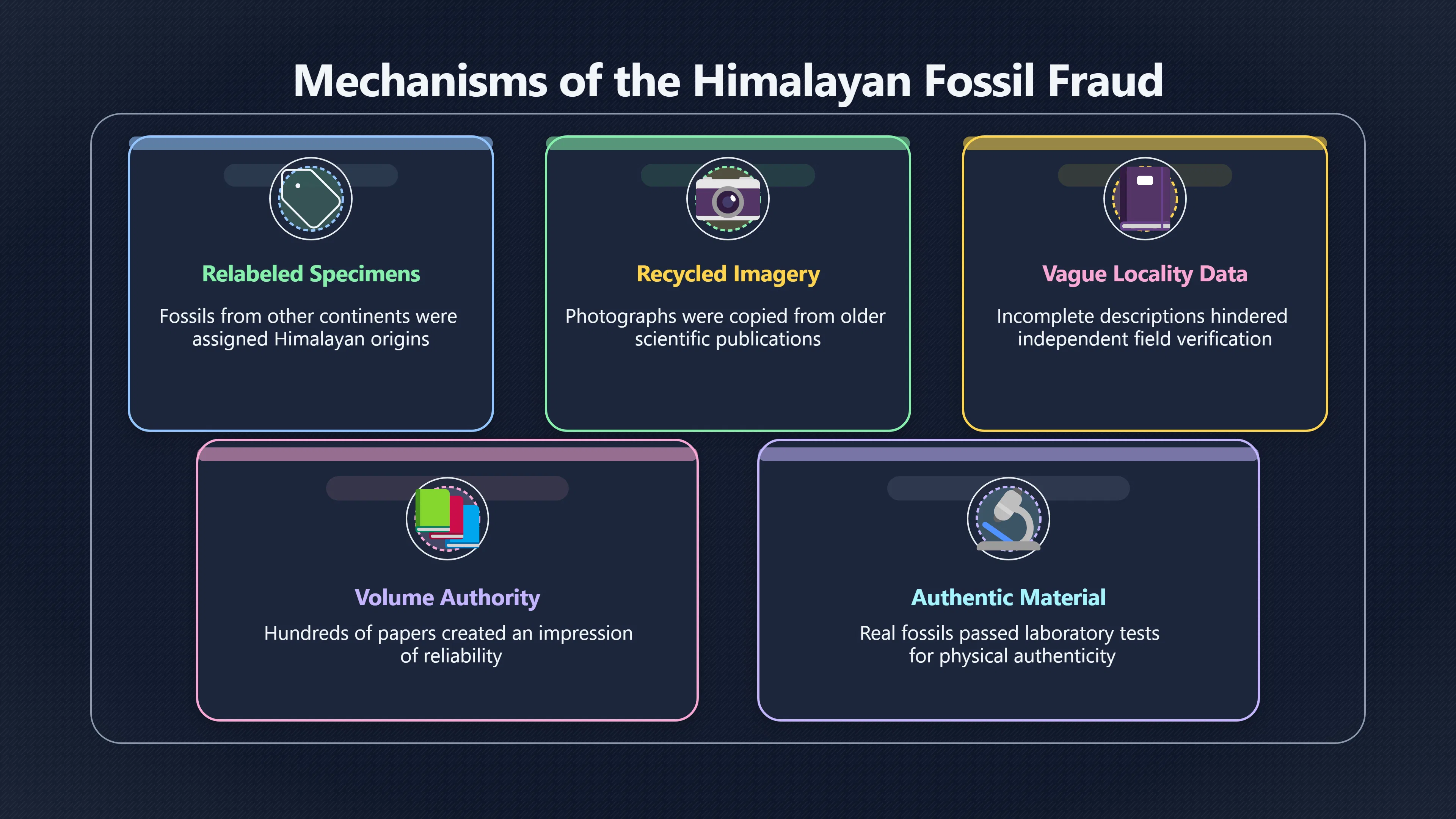
The deception was not primarily a matter of forging specimens. Instead, investigators concluded that fossils from elsewhere were relabelled as Himalayan discoveries. In some cases, fossils already described in earlier scientific literature appeared again under new catalogue numbers and new localities. Researchers later found evidence that photographs of fossils had been copied from older publications and presented as original discoveries.[Wikipedia]WikipediaHimalayan fossil hoaxHimalayan fossil hoax
This distinction matters. A fake fossil can often be detected through laboratory examination. A real fossil assigned to a false location is much harder to expose because the object itself passes authenticity tests. The fraud exploited a basic scientific assumption: that published locality information accurately reflects where a specimen was collected.[Wikipedia]WikipediaHimalayan fossil hoaxHimalayan fossil hoax
The comparisons and field checks that exposed the fraud
Doubts emerged gradually. In the late 1970s, some specialists noticed that fossils reported from the Himalayas looked suspiciously similar to specimens already known from other regions. At first, these concerns appeared to be isolated anomalies. The breakthrough came when Australian geologist John Talent began systematically examining Gupta’s work.[Wikipedia]WikipediaHimalayan fossil hoaxHimalayan fossil hoax
One famous episode involved ammonoid fossils. While visiting a fossil dealer in Paris, Talent encountered Moroccan specimens that closely resembled fossils Gupta had described as Himalayan finds. This observation prompted a much broader investigation. Together with colleagues and former students, Talent compared publications, fossil illustrations, locality descriptions and geological settings across dozens of papers.[Wikipedia]WikipediaHimalayan fossil hoaxHimalayan fossil hoax
The resulting pattern was difficult to dismiss as coincidence:
- Fossils supposedly collected in the Himalayas matched specimens already known from distant countries.
- Identical or near-identical fossils appeared in multiple publications under different provenances.
- Geological formations described in papers could not always be verified in the field.
- Some fossil photographs appeared to have been recycled from older scientific works.
- Locality information was often vague or incomplete, making independent verification difficult.[Wikipedia]WikipediaHimalayan fossil hoaxHimalayan fossil hoax
The strongest evidence came from field investigations. Teams associated with the Geological Survey of India and other institutions revisited several reported fossil localities. In some cases they could not find the fossils. More damagingly, they sometimes could not even confirm the existence of the rock formations that the publications claimed were present. These field checks shifted the debate from suspicion to documented contradiction.[Wikipedia]WikipediaHimalayan fossil hoaxHimalayan fossil hoax

Why peer review struggled to detect invented provenance
A natural question is how such a large distortion of the scientific record could persist for so long.
The answer lies partly in the limits of peer review. Scientific referees usually evaluate whether a paper’s arguments, identifications and methods appear reasonable. They rarely travel to remote field sites to verify every specimen’s origin. In geology and palaeontology, provenance data are often accepted in good faith because independent checking can require expensive expeditions across difficult terrain.[Wikipedia]WikipediaHimalayan fossil hoaxHimalayan fossil hoax
Several other factors helped the claims survive scrutiny:
Geographical remoteness. Many reported sites were located in inaccessible Himalayan regions where few researchers could easily conduct follow-up work.[Wikipedia]WikipediaHimalayan fossil hoaxHimalayan fossil hoax
Authority through volume. Gupta published hundreds of papers. A large body of mutually reinforcing publications can create an impression of reliability even when the underlying data are flawed.[Wikipedia]WikipediaHimalayan fossil hoaxHimalayan fossil hoax
International collaboration. Numerous respected specialists identified or described specimens supplied to them, often assuming that collection data were accurate. Expertise in fossil identification did not necessarily extend to verifying where the fossils originated.[Wikipedia]WikipediaHimalayan fossil hoaxHimalayan fossil hoax
Authentic specimens. Because many fossils themselves were real, conventional checks for fabricated objects offered little protection. The weakness lay in the accompanying documentation.[Wikipedia]WikipediaHimalayan fossil hoaxHimalayan fossil hoax
The scandal demonstrated that provenance can be as important as the specimen itself. A fossil removed from its true geological context loses much of its scientific value.
When the geological story had to be rewritten
The consequences extended beyond one scientist’s reputation. Fossils are used to date rock layers and reconstruct ancient geography. If the fossils are assigned to the wrong place, entire geological interpretations can become unreliable.
Investigators argued that parts of the Himalayan palaeontological database had effectively been “polluted” by incorrect information. Researchers were forced to reassess numerous claims about the age and distribution of rock formations. Some published conclusions had to be treated with caution until independent field evidence could confirm them.[Wikipedia]WikipediaHimalayan fossil hoaxHimalayan fossil hoax
The scandal also created a dilemma for legitimate research. Not every fossil discovery associated with Himalayan studies was false, and not every disputed claim proved fraudulent. Scientists therefore had to separate trustworthy observations from contaminated data rather than reject an entire field of research. This painstaking process took years.[Wikipedia]WikipediaHimalayan fossil hoaxHimalayan fossil hoax
What the affair reveals about scientific trust
The Himalayan fossil fraud is often compared with famous scientific deceptions such as Piltdown Man because both cases influenced scientific thinking for years before being exposed. Yet the Himalayan case highlights a different vulnerability. Piltdown involved fabricated physical evidence; the Himalayan affair centred on falsified context and provenance.[Wikipedia]WikipediaPiltdown ManPiltdown Man
Its lasting significance lies in the lesson that science depends not only on objects and measurements but also on chains of trust. Researchers trust field notes, specimen labels, collection records and published localities. When those links fail, even genuine artefacts can generate false conclusions.[Wikipedia]WikipediaHimalayan fossil hoaxHimalayan fossil hoax
The exposure of the fraud ultimately came from a combination of comparative expertise, sceptical re-examination and old-fashioned fieldwork. Scientists did not solve the mystery through a single dramatic revelation. They compared records, revisited sites, checked specimens against the literature and asked a simple question repeatedly: does the evidence match the place where it is supposed to have been found?[Wikipedia]WikipediaHimalayan fossil hoaxHimalayan fossil hoax
In the wider history of Indian hoaxes and frauds, the Himalayan fossil affair stands as a reminder that deception does not always require forged objects or elaborate trickery. Sometimes changing a label is enough to rewrite an entire scientific landscape—at least until someone returns to the rocks and checks the story for themselves.[Wikipedia]WikipediaHimalayan fossil hoaxHimalayan fossil hoax
Amazon book picks
Further Reading
Books and field guides related to How Relabelled Fossils Rewrote Himalayan Geology. Use these as the next step if you want deeper reading beyond the article.
The Dinosaur Artist
Shows how fossil provenance can become central to fraud controversies.
Frauds, Myths, and Mysteries: Science and Pseudoscience in Ar...
Relevant to fabricated evidence and misleading scientific claims.
The Demon-Haunted World
Rating: 4.5/5 from 43 Google Books ratings
Explores scientific skepticism and error detection.
The Map That Changed the World
Explains geological evidence and the importance of accurate field records.
eBay marketplace picks
Marketplace Samples
Live-tested eBay searches with available results related to this page.
Endnotes
1.
Source: Wikipedia
Title: Himalayan fossil hoax
Link:https://en.wikipedia.org/wiki/Himalayan_fossil_hoax
2.
Source: Wikipedia
Title: Vishwa Jit Gupta
Link:https://en.wikipedia.org/wiki/Vishwa_Jit_Gupta
3.
Source: Wikipedia
Title: Piltdown Man
Link:https://en.wikipedia.org/wiki/Piltdown_Man
Additional References
4.
Source: pubmed.ncbi.nlm.nih.gov
Link:https://pubmed.ncbi.nlm.nih.gov/17738290/
Source snippet
The Case of the "Misplaced" Fossilsby R Lewin · 1989 · Cited by 22 — The Case of the "Misplaced" Fossils: A prominent Australian...
5.
Source: academia.edu
Link:https://www.academia.edu/20759161/Himalayan_fossil_fraud_A_view_from_the_galleries
Source snippet
Academia(PDF) Himalayan fossil fraud: A view from the galleriesThe Himalayan fossil fraud lasted over 25 years, involving numerous unsusp...
6.
Source: scispace.com
Title: the himalayan fossil hoax 71nw6xrkhbw9
Link:https://scispace.com/papers/the-himalayan-fossil-hoax-71nw6xrkhbw9
Source snippet
The Himalayan fossil hoax (2023) | Kholhring LalchhandamaTL;DR: Some geological fakes and frauds are carried out solely for financial gai...
7.
Source: researchgate.net
Title: 385891655 The Himalayan fossil hoax
Link:https://www.researchgate.net/publication/385891655_The_Himalayan_fossil_hoax
Source snippet
(PDF) The Himalayan fossil hoax23 Jun 2026 — The Himalayan fossil hoax, or simply the Himalayan hoax, or the case of the peripatetic foss...
8.
Source: palaeontologicalsociety.in
Link:https://palaeontologicalsociety.in/vol58_14/11.pdf
Source snippet
HIMALAYAN FOSSIL FRAUDby DM BANERJEE · 2013 · Cited by 1 — This apart, the story is about certain brave personalities who were involved i...
9.
Source: upload.wikimedia.org
Title: The Himalayan fossil hoax
Link:https://upload.wikimedia.org/wikiversity/en/1/13/The_Himalayan_fossil_hoax.pdf
Source snippet
Himalayan Fossil Hoax20 Apr 1989 — The Himalayan fossil hoax, or simply the Himalayan hoax, or the case of the peripatetic fossils, was p...
10.
Source: en.wikiversity.org
Link:https://en.wikiversity.org/wiki/WikiJournal_of_Science/The_Himalayan_fossil_hoax
Source snippet
WikiJournal of Science/The Himalayan fossil hoax5 Jan 2024 — "International case studies in forensic geology: fakes and frauds...
11.
Source: researchgate.net
Title: Hunting the fossil frauds.Read more
Link:https://www.researchgate.net/publication/272980706_Himalayan_fossil_fraud_A_view_from_the_galleries
Source snippet
(PDF) Himalayan Fossil Fraud: A View From The Galleries13 May 2015 — Shah of the Palaeontological Society of India published a book Himal...
Published: May 2015
12.
Source: youtube.com
Title: 8 Great Archaeological Discoveries That Turned Out to Be Fake
Link:https://www.youtube.com/watch?v=Nzu_XZqmsrs
Source snippet
Six Of The Biggest Science Hoaxes Of All Time...
13.
Source: youtube.com
Title: 7 Of The Weirdest Fossil Forgeries Ever
Link:https://www.youtube.com/watch?v=LKsbG47rZWM
Source snippet
8 Great Archaeological Discoveries That Turned Out to Be Fake...
Topic Tree