Within Bolivia Hoaxes
Were Pumapunku's Stones Really Impossible to Build?
Claims of lasers, aliens and impossible precision obscure the documented skill and long development of Tiwanaku stoneworking.
On this page
- How the impossible city story spread
- What the stones and quarries reveal
- Why alien explanations remain popular
Page outline Jump by section
Introduction
Pumapunku, part of the wider Tiwanaku archaeological complex in western Bolivia, is often presented online as proof of a lost civilisation, advanced ancient machines, or even extraterrestrial intervention. Videos, documentaries and social-media posts frequently claim that its stone blocks are so precise that they could not have been produced by pre-industrial people. Some versions go further, arguing that the site was built with lasers, diamond tools, anti-gravity technology or knowledge now lost to history.
The reality is more interesting than the myth. Archaeologists do not regard Pumapunku as evidence of impossible technology. Instead, decades of research have identified quarry sources, construction methods, unfinished stones and local architectural predecessors that place the monument firmly within the development of the Tiwanaku civilisation. The enduring mystery lies not in whether humans built it, but in how a remarkable example of Andean engineering became one of the world’s most successful ancient-technology legends.[wikipedia.org]WikipediaOpen source on wikipedia.org.
How the impossible-city story spread
Pumapunku’s reputation as an archaeological enigma grew from a combination of genuine craftsmanship and selective presentation. Photographs often focus on neatly cut andesite blocks featuring straight grooves, right angles and distinctive H-shaped forms. Removed from their wider context, these details can appear surprisingly modern.
During the twentieth century, speculative writers increasingly portrayed the site as an unsolved mystery. Claims circulated that the stones were tens of thousands of years old, that they were cut by unknown machines, or that they belonged to Atlantis. Later, television programmes and internet videos folded Pumapunku into the wider “ancient aliens” genre. According to archaeologist Jeb Card, the site became a fixture of alternative archaeology because its masonry could easily be framed as evidence for lost technology.[Wikipedia]WikipediaOpen source on wikipedia.org.
Several recurring arguments helped the story spread:
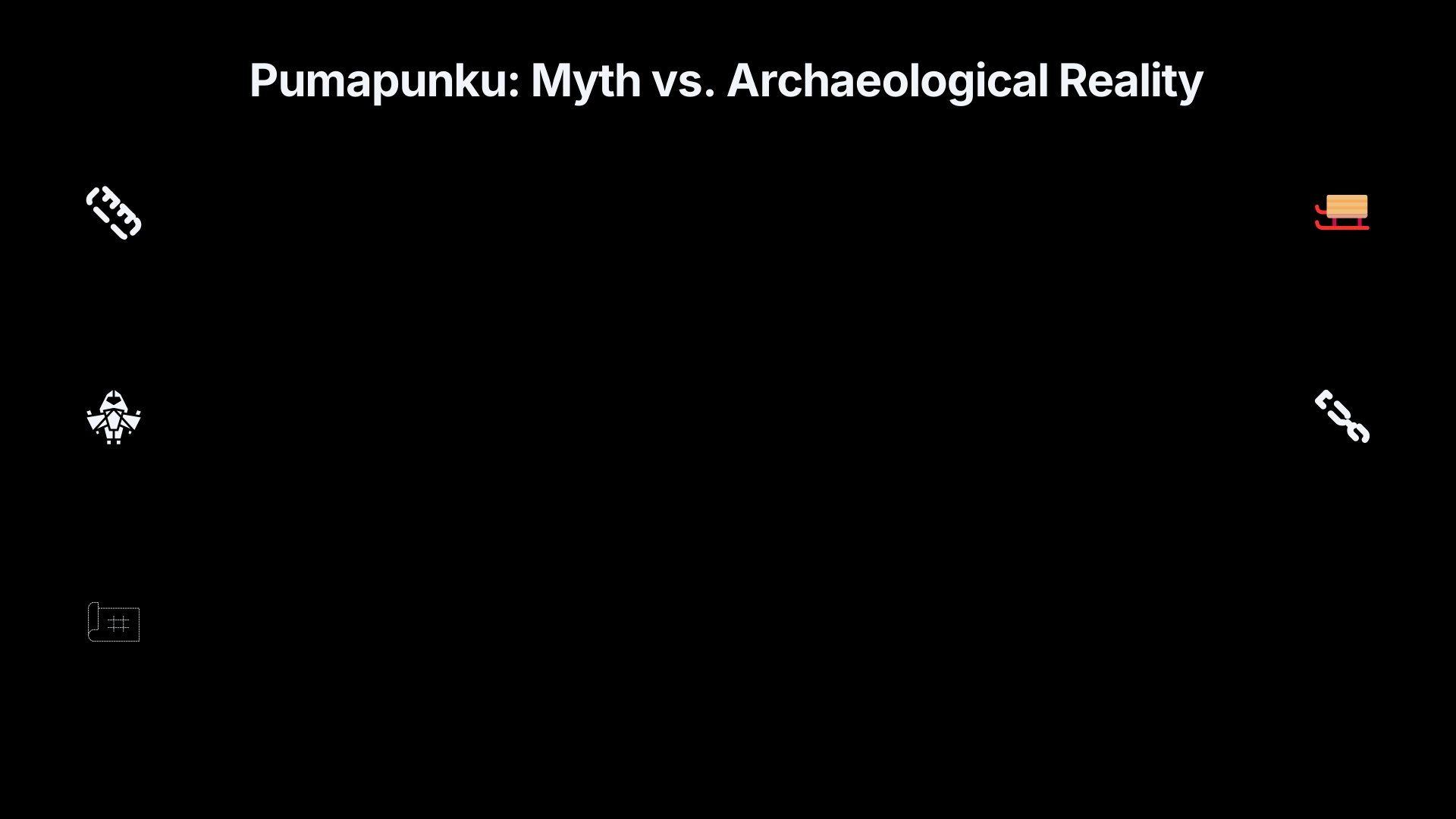
- The stones look machine-made. Close-up photographs emphasise straight lines and sharp corners.
- The blocks are enormous. Some sandstone slabs weigh more than 100 tonnes, creating the impression that ancient transport would have been impossible.
- Many structures are ruined. Because much of Pumapunku survives as scattered blocks rather than intact buildings, it is easier for promoters to speculate about unknown purposes or technologies.
- The site’s high-altitude location seems improbable. The monument stands on the Altiplano near Lake Titicaca, a setting often portrayed as too remote for large-scale construction.
These claims gained traction because they offer a simple dramatic explanation: if the work appears difficult, then perhaps ordinary human societies could not have achieved it. Archaeological research points in the opposite direction.[Wikipedia]WikipediaOpen source on wikipedia.org.
What the stones and quarries reveal
One of the strongest arguments against lost-technology theories is that researchers have traced where many of Pumapunku’s stones came from and how they fit into known Tiwanaku construction practices.
Detailed geological studies have linked the site’s massive red sandstone blocks to quarries near Lake Titicaca, roughly 10 kilometres away. The carved andesite blocks came from more distant sources, including areas around the Copacabana Peninsula across the lake. This evidence demonstrates organised quarrying, transport and planning rather than mysterious material origins.[wikipedia.org]WikipediaOpen source on wikipedia.org.
Research into Tiwanaku stone production also shows that Pumapunku was not an isolated miracle. The civilisation gradually expanded its use of different stone types and quarrying strategies as it developed into a major regional centre. The monument emerged from a long local tradition rather than appearing suddenly without precedent.[ResearchGate]researchgate.netTelluric Transformations in the Lithic Production of Tiwanaku29 Dec 2015 — A shift in lithic materials, sources, and quarryin…
Equally important are the unfinished blocks found at the site. Some stones preserve intermediate stages of carving, allowing archaeologists to reconstruct aspects of the production process. Rather than suggesting impossible manufacturing, these incomplete pieces show work in progress by human craftspeople.[Wikipedia]WikipediaOpen source on wikipedia.org.

Were the cuts really beyond ancient tools?
The sharp geometry of certain carvings is often presented as the strongest evidence for advanced machinery. Archaeologists Jean-Pierre Protzen and Stella Nair documented the remarkable precision of the masonry and acknowledged that some aspects of Tiwanaku stoneworking remain imperfectly understood. However, “not fully understood” is very different from “impossible”.[Wikipedia]WikipediaOpen source on wikipedia.org.
Experimental work has shown that highly accurate carvings can be reproduced using stone tools and patient labour. Nair successfully recreated intricate geometric motifs in hard stone, demonstrating that impressive precision does not require modern machinery. Some details remain challenging to duplicate exactly, but archaeology routinely encounters ancient techniques that are difficult to reconstruct without assuming supernatural or extraterrestrial assistance.[Wikipedia]WikipediaOpen source on wikipedia.org.
The strongest scholarly conclusion is therefore not that lasers were involved, but that Tiwanaku stonemasons possessed sophisticated skills and methods that have not survived in complete detail.[Wikipedia]WikipediaOpen source on wikipedia.org.
Why alien explanations remain popular
The appeal of alien explanations says as much about modern culture as it does about Pumapunku itself.
Ancient-astronaut narratives typically begin with a perceived gap: a monument appears impressive, the construction process is not fully documented, and therefore an extraordinary explanation is proposed. Pumapunku fits this pattern perfectly because many visitors encounter photographs before they encounter archaeological evidence.
Another factor is visual misunderstanding. The famous H-blocks are often depicted as though they were mass-produced machine components. In reality, although the masonry displays standardisation, the blocks are not perfectly identical. Archaeologists have interpreted the precision as evidence of planning, templates and skilled craftsmanship rather than industrial manufacturing.[Wikipedia]WikipediaOpen source on wikipedia.org.
Researchers have also criticised a deeper assumption behind many lost-technology claims: the idea that Indigenous societies of the Andes were incapable of such achievements. Archaeologist Alexei Vranich argues that discoveries of earlier regional monuments and architectural traditions undermine claims that Pumapunku appeared without local precedents. Franco D. Rossi has likewise noted that some ancient-alien narratives implicitly dismiss the capabilities of the people who actually lived in the Titicaca Basin.[Wikipedia]WikipediaOpen source on wikipedia.org.
In this sense, the myth persists because it offers a dramatic story while requiring little engagement with Andean history. A lost civilisation or extraterrestrial visitor can seem more exciting than generations of skilled engineers, quarry workers and artisans.
What archaeology actually says
Modern archaeological dating places Pumapunku within the Tiwanaku cultural tradition that flourished during the first millennium AD rather than in a remote prehistoric age. Recent chronological studies of Tiwanaku continue to refine the timing of the civilisation’s rise and decline, but they do not support claims that the monument is tens of thousands of years old.[PMC]pmc.ncbi.nlm.nih.govA Bayesian chronology for the collapse of Tiwanaku - PMC - NIHby EJ Marsh · 2023 · Cited by 17 — Here we present a generational-scale…
The evidence points toward a large ceremonial and architectural complex created through organised labour, advanced planning and specialised stoneworking. Researchers continue to debate details of construction techniques, transport methods and architectural reconstruction, yet these debates occur within a human historical framework. The central mystery is one of engineering and social organisation, not vanished super-technology.[Wikipedia]WikipediaOpen source on wikipedia.org.
Why the myth matters
Pumapunku is not a classic hoax with a single inventor. It is better understood as a modern myth built from selective evidence, repeated exaggeration and the appeal of extraordinary explanations. The stones are genuinely impressive, but the leap from “impressive” to “impossible” is where the story departs from the evidence.
The site’s enduring popularity illustrates a recurring pattern in the history of pseudoscience. When an ancient monument appears difficult to explain, uncertainty is often treated as proof of hidden knowledge. Yet at Pumapunku, each new archaeological discovery has tended to strengthen the case for human ingenuity rather than weaken it. The monument remains remarkable not because it defies history, but because it demonstrates what the Tiwanaku civilisation was capable of achieving without the need for aliens, lasers or forgotten machines.[wikipedia.org]WikipediaOpen source on wikipedia.org.
Amazon book picks
Further Reading
Books and field guides related to Were Pumapunku's Stones Really Impossible to Build?. Use these as the next step if you want deeper reading beyond the article.
Frauds, Myths, and Mysteries: Science and Pseudoscience in Ar...
Provides tools for evaluating claims of impossible ancient technology.
Ancient Tiwanaku
Provides detailed context for construction techniques and chronology.
Fingerprints of the Gods
Contains themes similar to the lost-technology narratives often attached to Pumapunku.
eBay marketplace picks
Marketplace Samples
Live-tested eBay searches with available results related to this page.




Endnotes
1.
Source: Wikipedia
Link:https://en.wikipedia.org/wiki/Pumapunku
2.
Source: researchgate.net
Link:https://www.researchgate.net/publication/278705727_Building_Taypikala_Telluric_Transformations_in_the_Lithic_Production_of_Tiwanaku
Source snippet
Telluric Transformations in the Lithic Production of Tiwanaku29 Dec 2015 — A shift in lithic materials, sources, and quarryin...
3.
Source: history.com
Link:https://www.history.com/shows/ancient-aliens/season-9/episode-17%C2%A0
Source snippet
Watch Ancient Aliens Season 9 Episode 17Mainstream scientists believe native people used primitive stone tools to construct the si...
4.
Source: researchgate.net
Link:https://www.researchgate.net/figure/Andesite-monolithic-portal-located-in-Pumapunkus-east-portico-The-iconography-of-its_fig6_278705727
Source snippet
We discuss our research on stone quarrying and...Read more...
5.
Source: researchgate.net
Link:https://www.researchgate.net/publication/335699977_Tiahuanaco_monuments_Tiwanaku_Pumapunku_in_Bolivia_are_made_of_geopolymer_artificial_stones_created_1400_years_ago
6.
Source: researchgate.net
Link:https://www.researchgate.net/publication/347982678_Considering_Certain_Lithic_Artifacts_of_Tiahuanaco_Tiwanaku_and_Pumapunku_Bolivia_as_Geopolymer_Constructs
7.
Source: pmc.ncbi.nlm.nih.gov
Link:https://pmc.ncbi.nlm.nih.gov/articles/PMC10664893/
Source snippet
A Bayesian chronology for the collapse of Tiwanaku - PMC - NIHby EJ Marsh · 2023 · Cited by 17 — Here we present a generational-scale...
Additional References
8.
Source: academia.edu
Link:https://www.academia.edu/71925468/_Interdisciplinary_Contributions_to_Archaeology_Mining_and_Quarrying_in_the_Ancient_Andes_Building_Taypikala_Telluric_Transformations_in_the_Lithic_Production_of_Tiwanaku
Source snippet
Academia[Interdisciplinary Contributions to Archaeology] Mining and...Tiwanaku Stone Sourcing: Sandstone and Andesite Previous Stone Sou...
9.
Source: amusingplanet.com
Title: Amusing Planet The Mystery of Puma Punku’s Precise Stonework
Link:https://www.amusingplanet.com/2015/05/the-mystery-of-puma-punkus-precise.html
Source snippet
Amusing PlanetThe Mystery of Puma Punku's Precise StoneworkMay 16, 2015 — The temple's origin is a mystery, but based on carbon dating of...
Published: May 16, 2015
10.
Source: facebook.com
Link:https://www.facebook.com/groups/478956409706716/posts/2122722075330133/
Source snippet
ir interlocking blocks so precisely crafted that not even a razor...Read more...
11.
Source: youtube.com
Title: The Worst Point on Ancient Aliens
Link:http://www.youtube.com/watch?v=8qN7vDeyoeA
Source snippet
Pumapunku ancient aliens debunked lost technology myth “Ancient Aliens or Lost Technology? The Impossible Truth of Puma Punku”...
12.
Source: youtube.com
Title: Not Aliens: The Real Engineering Behind Puma Punku’s H-Blocks
Link:http://www.youtube.com/watch?v=CzB3-4ziUJA
Source snippet
The BIGGEST Lie About Pumapunku's H-Blocks EXPOSED...
13.
Source: facebook.com
Link:https://www.facebook.com/groups/921899805200688/posts/1663969174327077/
14.
Source: reddit.com
Link:https://www.reddit.com/r/AskHistorians/comments/xdcu50/can_anyone_tell_me_more_about_the_mysterious/
15.
Source: reddit.com
Link:https://www.reddit.com/r/AskHistorians/comments/vizk1/i_believe_theres_an_ancient_archaeological_site/
16.
Source: facebook.com
Link:https://www.facebook.com/groups/archeologyandcivilizations/posts/24032023996464465/
17.
Source: facebook.com
Link:https://www.facebook.com/61555920213781/posts/mysteries-of-puma-punkupuma-punku-with-its-huge-stones-and-intricate-puzzle-like/122298356312197340/
Topic Tree