When Liberia's Most Famous Stories Fell Apart
Liberia’s best-known stories of deception are not a single tradition of elaborate practical jokes.
Page outline Jump by section
Introduction
The evidence is uneven. Some popular accounts repeat memorable numbers or dramatic details that vary between sources. The safest approach is therefore to separate what is firmly documented from what has grown through retelling. Liberia’s hoax history is most interesting precisely where those categories overlap: deliberate fraud beside institutional myth-making, honest scientific error and lethal health misinformation.
Matilda Newport and the making of a national legend
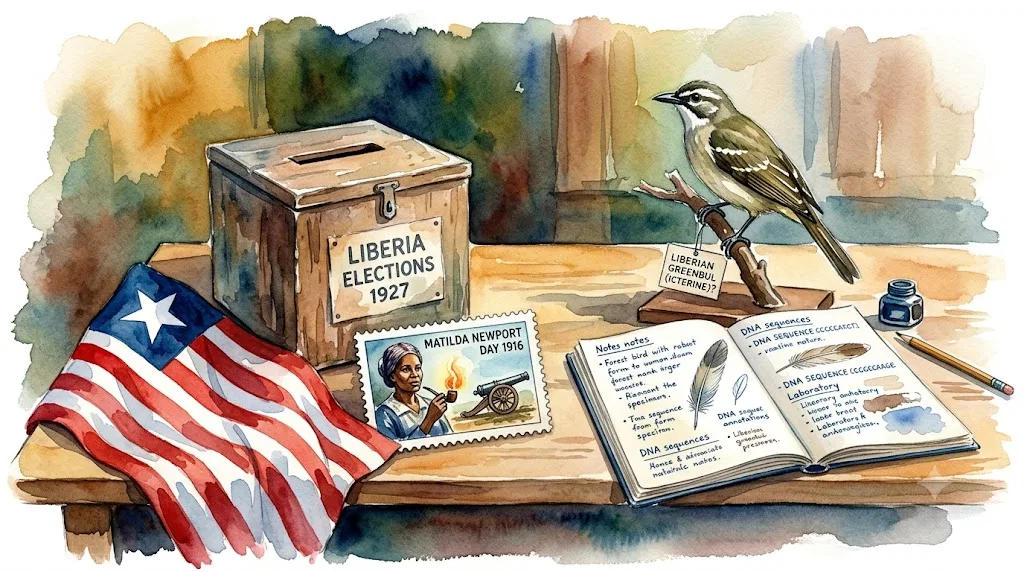
For much of the twentieth century, Liberians were officially encouraged to celebrate Matilda Newport as the woman who saved the struggling settlement at Cape Mesurado in 1822. According to the familiar story, Newport used a glowing coal from her pipe to fire a cannon during an attack by Indigenous forces, turning the battle in favour of the settlers who would establish Monrovia.
The battle itself was real. Newport was also a real settler, born in the United States and brought to West Africa during the American Colonization Society’s early settlement project. What is doubtful is her celebrated battlefield intervention. Researchers examining the story have found no contemporary historical source establishing that she fired the decisive cannon. Her importance appears to have developed later, as oral tradition and patriotic commemoration transformed an uncertain anecdote into a founding narrative.[contestedhistories.org]contestedhistories.orgContested HistoriesLiberia: Matilda Newport Monument, MonroviaWhilst Matilda Newport Day is no longer celebrated, she is still commemorat…
That distinction matters because the legend was not harmless folklore detached from politics. The story presented the settlers as heroic defenders of civilisation while reducing the Indigenous people opposing their expansion to an anonymous attacking force. In 1916, Liberia formally established Matilda Newport Day on 1 December. Public observances included speeches, ceremonies and re-enactments, while monuments, stamps, schools and streets reinforced the tale’s official status.[Wikipedia]WikipediaMatilda NewportMatilda Newport
The celebration reflected the political order of the time. Liberia was dominated by an Americo-Liberian elite descended largely from settlers arriving from the United States and Caribbean. For that ruling community, Newport provided an easily understood national heroine: a resourceful woman defending the colonial settlement at its moment of greatest danger. For many Indigenous Liberians, however, the same story commemorated violence against their ancestors and symbolised their exclusion from the official national narrative.[Contested Histories]contestedhistories.orgContested HistoriesLiberia: Matilda Newport Monument, MonroviaWhilst Matilda Newport Day is no longer celebrated, she is still commemorat…
After the 1980 coup that ended Americo-Liberian political dominance, Matilda Newport Day was abolished. Her monument nevertheless remained in Monrovia, and the story continued to circulate in schools, popular histories and online posts. It survives because it compresses a complicated and painful founding history into a vivid scene: a woman, a pipe, a cannon and a colony saved at the last moment.[Wikipedia]WikipediaMatilda NewportMatilda Newport
It is best described as an invented or heavily embellished national tradition, rather than a conventional hoax created by one identifiable fraudster. The deception arose through repetition and official endorsement. Once a story appears in ceremonies, textbooks, monuments and postage stamps, absence of evidence can become difficult to see.

The election result that exceeded the electorate
Liberia’s 1927 presidential election produced one of the most notorious sets of official results in political history. President Charles D. B. King of the True Whig Party was declared the overwhelming winner over Thomas J. R. Faulkner. Widely repeated figures credit King with roughly 230,000 to 243,000 votes, despite estimates that only about 15,000 to 19,000 Liberians were registered or entitled to vote.[wikipedia.org]Wikipedia1927 Liberian general election1927 Liberian general election
The exact totals vary. Some historical sources give King approximately 234,000 votes; others list 229,527 or 243,000. One American country study suggested the original figure may instead have been about 24,000. That uncertainty should discourage treating any single viral number as unquestionable. What is not seriously disputed is that the election was grossly manipulated and that the official or subsequently reported totals bore little credible relationship to a free count of eligible voters.[Wikipedia]Wikipedia1927 Liberian general election1927 Liberian general election
The result was possible because Liberia was effectively a one-party state. The True Whig Party had controlled national government for decades, while political participation was restricted and much of the Indigenous majority lacked meaningful representation. Election administration was therefore not an independent check on the ruling party but part of the same political system.
The outlandish tally later earned the election descriptions such as “the most fraudulent election in history”, including recognition in editions of the Guinness Book of Records. That label helped the story spread internationally, often as an amusing piece of political trivia. Yet the comic arithmetic can obscure the serious structure behind it. The election was not merely clumsy ballot stuffing. It reflected a system in which an entrenched governing elite could manufacture legitimacy without expecting effective domestic scrutiny.[wikipedia.org]WikipediaCharles D. B. KingCharles D. B. King
Faulkner’s defeat also led into a darker scandal. He accused government officials of coercing Indigenous Liberians into labour and arranging their shipment to the Spanish colony of Fernando Po. A League of Nations-backed international commission subsequently investigated slavery and forced labour in Liberia. Its findings implicated senior officials in abusive labour recruitment, contributing to King’s resignation in 1930.[ilo.org]researchrepository.ilo.orgResearch Repository REPORTS AND ENQUIRIESResearch Repository REPORTS AND ENQUIRIES
The commission did not simply validate every accusation in its most sensational form. It distinguished between legally defined slavery and systems of coercive recruitment, intimidation and forced labour. Nevertheless, it found grave abuses and official involvement. The contrast is striking: an administration that fabricated electoral consent was also denying labour practices later exposed by an international inquiry.[Research Repository]researchrepository.ilo.orgResearch Repository REPORTS AND ENQUIRIESResearch Repository REPORTS AND ENQUIRIES
The 1927 election therefore belongs in Liberian hoax history as state-sponsored political fraud. Unlike the Matilda Newport legend, it was not chiefly a story that grew accidentally in the telling. Its purpose was immediate and practical: to preserve power by presenting a predetermined result as a democratic mandate.
The Liberian greenbul that probably never existed
Not every false Liberian claim involved deliberate dishonesty. The Liberian greenbul offers a classic example of science correcting a plausible mistake.
During fieldwork in the Cavalla Forest in south-eastern Liberia in the early 1980s, German ornithologist Wulf Gatter reported seeing an unfamiliar forest bird. A specimen collected in 1984 possessed distinctive pale markings on its wings. It was eventually described as a separate species, the Liberian greenbul, and became one of the world’s rarest and most elusive birds.[African Bird Club]africanbirdclub.org2012 Liberian Greenbul2012 Liberian Greenbul
The claim was persuasive for several reasons. Liberia’s forests support remarkable biodiversity, and closely related forest birds can be extremely difficult to distinguish. Only one physical specimen existed, but additional reported sightings seemed to support the idea that a tiny population survived in a restricted habitat. Repeated expeditions failed to find another example, reinforcing its reputation as critically endangered rather than immediately disproving its existence.[African Bird Club]africanbirdclub.org2012 Liberian Greenbul2012 Liberian Greenbul
Researchers eventually tested DNA from the specimen in two independent laboratories. The genetic evidence showed that it was essentially an icterine greenbul, a known species found across parts of West and Central Africa, rather than a separate evolutionary lineage. The unusual feathers were probably an individual plumage abnormality, perhaps associated with nutritional or developmental factors.[springer.com]link.springer.comOpen source on springer.com.
The investigation did not prove that anyone had invented sightings or falsified a specimen. The original classification was a reasonable scientific judgement based on visible anatomy and the limited methods available at the time. DNA analysis changed the balance of evidence. The Liberian greenbul was consequently treated not as a lost species but as an unusual form of the icterine greenbul.[Springer Nature Link]link.springer.comOpen source on springer.com.
This case is often retold with headlines saying scientists spent decades hunting a bird that “never existed”. That wording is memorable but slightly misleading. The individual bird certainly existed; what probably did not exist was the species category assigned to it. The difference illustrates how science works at its best. A mistaken interpretation is not necessarily fraud, and correcting it does not make the original researchers hoaxers.
There was also an important conservation warning. Removing the Liberian greenbul from the list of valid species did not make the Cavalla Forest unimportant. The researchers stressed that the region still contained valuable and threatened habitat. A scientific mystery had disappeared, but the need to protect Liberia’s forests had not.[Springer Nature Link]link.springer.comOpen source on springer.com.
Ebola rumours, fake cures and the zombie photograph
Liberia’s 2014 Ebola crisis created ideal conditions for misinformation: a terrifying and poorly understood disease, overwhelmed hospitals, inconsistent official messaging, widespread distrust and rapidly expanding use of mobile phones and social media. Falsehoods did not spread because Liberians were uniquely credulous. They spread because people were trying to interpret events that were frightening, unfamiliar and often hidden behind protective clothing, quarantine barriers and emergency regulations.
Some communities believed that Ebola treatment centres were places where patients were taken to die, or that health workers were spreading the disease. Such claims were wrong, but they were strengthened by visible realities. Many sick people entered treatment units and never returned; families could not follow normal caregiving or burial practices; and early public messages sometimes emphasised that there was “no cure” without explaining that supportive medical care could greatly improve a patient’s chances.[Time]time.comFear and Rumors Fueling the Spread of EbolaFear and Rumors Fueling the Spread of Ebola
Other claims were more clearly fabricated or reckless. An article published by the Liberian Observer argued that Ebola and HIV had been created as biological weapons against Africans. The allegation circulated internationally and became part of a wider collection of conspiracy theories about laboratories, population control and foreign intervention. No credible genetic or epidemiological evidence supported the claim.[Wikipedia]WikipediaEbola misinformationEbola misinformation
Bogus treatments also flourished. Across West Africa and online markets elsewhere, messages promoted salt water, herbs, oils, silver products and other supposed preventatives or cures. Some promoters may have believed their own advice; others exploited panic commercially. The danger was not merely that the products failed. False reassurance could delay treatment, expose carers to infection or encourage dangerous consumption.[nih.gov]pmc.ncbi.nlm.nih.govOpen source on nih.gov.
The strangest fabrication was the claim that Ebola victims in Liberia were rising from the dead. Reports originating in sensational or satirical outlets described two women in Nimba County supposedly returning to life. A doctored “zombie” photograph then spread online. Investigators traced the image to promotional material from the film World War Z, altered and presented as if it showed an infected African patient.[The Independent]independent.co.ukThe Independent Ebola 'risen from the dead' zombie story is a complete hoaxThe Independent Ebola 'risen from the dead' zombie story is a complete hoax
The zombie story had little connection to actual Liberian reporting beyond borrowing the epidemic and a Liberian location to lend itself urgency. Its most successful versions were designed for international clicks, combining Western horror imagery with fear of an African disease outbreak. It was therefore both a digital hoax and an example of how distant audiences could turn a real humanitarian catastrophe into entertainment.
The more locally influential Ebola rumours were less theatrical and more consequential. Distrust discouraged reporting of symptoms, contact tracing, isolation and safe burial—all essential measures for interrupting transmission. Research and contemporary reporting repeatedly found that behaviour, treatment capacity and public confidence were central to controlling Liberia’s epidemic.[arXiv]arxiv.orgarXiv Ebola cases and health system demand in LiberiaarXiv Ebola cases and health system demand in Liberia
Ebola misinformation also demonstrates why simple ridicule is an ineffective response. A rumour that treatment centres kill patients cannot be defeated merely by calling it foolish when local people have watched relatives disappear behind fences. Effective correction required survivors, health workers, religious figures and community leaders who could explain what happened inside the centres, show that recovery was possible and acknowledge legitimate reasons for distrust.
Why these stories endure
Liberia’s most persistent false stories succeeded for different reasons, but each acquired support from an institution or communications system larger than the original claim.
- The Matilda Newport legend was strengthened by schools, public ceremonies, monuments and government recognition.
- The 1927 election result was backed by the machinery of a dominant political party and a state with few effective democratic restraints.
- The Liberian greenbul gained credibility through accepted scientific classification and the genuine difficulty of studying remote forest wildlife.
- Ebola misinformation travelled through newspapers, personal networks, mobile messages and global click-driven websites during an emergency.
Their exposure also followed different paths. Historians tested a heroic legend against contemporary records. International investigators examined political denials and coerced labour. Geneticists compared DNA rather than relying only on feathers. Journalists and fact-checkers traced a frightening photograph back to a Hollywood film.
These distinctions prevent “hoax” from becoming a lazy label. Matilda Newport is a case of national myth-making; the 1927 election was intentional fraud; the greenbul was probably sincere scientific error; Ebola rumours ranged from understandable misunderstanding to conspiracy publishing, commercial quackery and manufactured clickbait.
The common lesson is that falsehood rarely survives on content alone. It survives because it serves an existing need: legitimacy for a ruling class, certainty for scientists confronting an unusual specimen, an explanation for frightening medical procedures, or attention and advertising revenue for publishers. Liberia’s history of contested truth is therefore not a catalogue of national gullibility. It is a history of how authority, fear, identity and media can make a doubtful claim feel more dependable than the incomplete reality it replaces.
Amazon book picks
Further Reading
Books and field guides related to When Liberia's Most Famous Stories Fell Apart. Use these as the next step if you want deeper reading beyond the article.
The house at Sugar Beach
Provides accessible context for how national narratives and collective memory develop in Liberia.
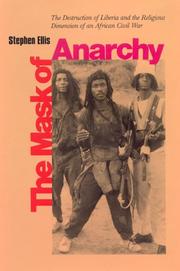
The mask of anarchy
Shows how narratives, rumours and politics interacted during crises.
Imagined Communities
Helps explain the creation of national legends and shared historical myths.
A History of Modern Liberia
Covers political and historical episodes behind several famous Liberian stories.
eBay marketplace picks
Marketplace Samples
Live-tested eBay searches with available results related to this page.

Endnotes
1.
Source: Wikipedia
Title: Matilda Newport
Link:https://en.wikipedia.org/wiki/Matilda_Newport
2.
Source: Wikipedia
Title: 1927 Liberian general election
Link:https://en.wikipedia.org/wiki/1927_Liberian_general_election
3.
Source: africanews.com
Link:https://www.africanews.com/2017/10/08/elections-history-in-africa-s-oldest-democratic-republic-liberia
Source snippet
Elections history in Africa's oldest democratic republic: Liberia13 Aug 2024 — With only about 15,000 registered voters, the in...
4.
Source: Wikipedia
Title: Charles D. B. King
Link:https://en.wikipedia.org/wiki/Charles_D._B._King
5.
Source: history.state.gov
Title: Office of the Historian Historical Documents
Link:https://history.state.gov/historicaldocuments/frus1930v03/d335
6.
Source: link.springer.com
Link:https://link.springer.com/article/10.1007/s10336
7.
Source: sciencealert.com
Title: one of world s rarest songbirds never actually existed strange science
Link:https://www.sciencealert.com/one-of-world-s-rarest-songbirds-never-actually-existed-strange-science
8.
Source: time.com
Title: Fear and Rumors Fueling the Spread of Ebola
Link:https://time.com/3092855/ebola-fear-rumors/
9.
Source: time.com
Link:https://time.com/3387845/harrowing-images-of-liberias-ebola-outbreak/
10.
Source: Wikipedia
Title: Ebola misinformation
Link:https://en.wikipedia.org/wiki/Ebola_misinformation
11.
Source: pmc.ncbi.nlm.nih.gov
Link:https://pmc.ncbi.nlm.nih.gov/articles/PMC9027331/
12.
Source: arxiv.org
Title: arXiv Ebola cases and health system demand in Liberia
Link:https://arxiv.org/abs/1410.8564
13.
Source: arxiv.org
Link:https://arxiv.org/abs/1409.4607
14.
Source: Wikipedia
Title: Icterine greenbul
Link:https://en.wikipedia.org/wiki/Icterine_greenbul
15.
Source: contestedhistories.org
Link:https://contestedhistories.org/wp-content/uploads/Liberia_-Matilda-Newport-Monument-Monrovia.pdf
Source snippet
Contested HistoriesLiberia: Matilda Newport Monument, MonroviaWhilst Matilda Newport Day is no longer celebrated, she is still commemorat...
16.
Source: nationalgeographic.com
Title: liberia america colonial history
Link:https://www.nationalgeographic.com/history/article/liberia-america-colonial-history
Source snippet
MATILDA NEWPORT DAY, once celebrated by the Liberian elite, was named for the settler who lit a cannon...Read more...
17.
Source: popsci.com
Title: weirdest thing election fraud facts
Link:https://www.popsci.com/story/science/weirdest-thing-election-fraud-facts/
Source snippet
1927 presidential elections in Liberia. Incumbent President Charles D.B. King won in a landslide of 234,000 to 9,000—despite there only...
18.
Source: researchrepository.ilo.org
Title: Research Repository REPORTS AND ENQUIRIES
Link:https://researchrepository.ilo.org/view/pdfCoverPage?download=true&filePid=13116762660002676&instCode=41ILO_INST
19.
Source: africanbirdclub.org
Title: 2012 Liberian Greenbul
Link:https://www.africanbirdclub.org/sites/default/files/2012_Liberian_Greenbul.pdf
20.
Source: independent.co.uk
Title: The Independent Ebola ‘risen from the dead’ zombie story is a complete hoax
Link:https://www.independent.co.uk/news/weird-news/ebola-risen-from-the-dead-viral-zombie-story-is-a-complete-hoax-9777916.html
21.
Source: revistas.unav.edu
Link:https://revistas.unav.edu/index.php/communication-and-society/article/download/54185/43134/168815
22.
Source: pmc.ncbi.nlm.nih.gov
Link:https://pmc.ncbi.nlm.nih.gov/articles/PMC4527704/
23.
Source: abcnews.com
Link:https://abcnews.com/International/african-mans-gold-scheme-cost-american-victims-millions/story?id=52610439
24.
Source: wiki.wikirank.net
Title: 1927 Liberian general election
Link:https://wiki.wikirank.net/en/1927_Liberian_general_election
25.
Source: repository.up.ac.za
Link:https://repository.up.ac.za/bitstreams/72ed0f82-d666-4f17-94b0-21c28368f58f/download
26.
Source: scispace.com
Title: Liberian greenbul | 1 Publications | Top Authors
Link:https://scispace.com/topics/liberian-greenbul-2b7uqykg
Additional References
27.
Source: youtube.com
Link:https://www.youtube.com/watch?v=g4FEtQ9ozLI
Source snippet
Liberian Greenbul bird Extremely Rare World's Most Elusive Bird May Not Have Existed "Liberian Greenbul" creative india...
28.
Source: liberiapastandpresent.org
Link:https://www.liberiapastandpresent.org/23/
Source snippet
Liberia Past and PresentMatilda Newport (1822) and the civil war |1 Dec 2008 — Matilda Newport, as the story goes, was a settler-woman, w...
29.
Source: youtube.com
Title: The Most Rigged Election in History | 1,680% Voter Turnout Rate
Link:https://www.youtube.com/watch?v=9rTTh7u5CeQ
Source snippet
Extremely Rare World's Most Elusive Bird May Not Have Existed "Liberian Greenbul"...
30.
Source: loc.gov
Link:https://www.loc.gov/aba/publications/Archived-LCC2020/LCC_H2020TEXT.pdf
31.
Source: youtube.com
Title: The Stream
Link:https://www.youtube.com/watch?v=DRTD0p7sm_g
Source snippet
Exploring Liberia's Past: Rare Footage Of Former Presidents Charles D. B. King And Edwin Barclay...
32.
Source: youtube.com
Link:https://www.youtube.com/watch?v=3Fp90aHwdHE
Source snippet
The Most Rigged Election in History | 1,680% Voter Turnout Rate...
33.
Source: researchgate.net
Link:https://www.researchgate.net/publication/347390878_Fakes_and_Forgeries_of_Written_Artefacts_from_Ancient_Mesopotamia_to_Modern_China
34.
Source: researchgate.net
Link:https://www.researchgate.net/publication/318384781_Taxonomic_status_of_the_Liberian_Greenbul_Phyllastrephus_leucolepis_and_the_conservation_importance_of_the_Cavalla_Forest_Liberia
35.
Source: jstor.org
Link:https://www.jstor.org/content/pdf/oa_book_monograph/10.3366/jj.32850410.pdf
36.
Source: datazone.birdlife.org
Link:https://datazone.birdlife.org/species/factsheet/icterine-greenbul-phyllastrephus-icterinus
Topic Tree
Follow this branch
Related pages 192
- Albanian Hoaxes
- Algerian Hoaxes
- Antigua Deceptions
- Argentina Hoaxes
- Armenian Hoaxes
- +187 more in sidebar