When Official Claims Became Turkmenistan's Reality
Turkmenistan has no famous catalogue of forged monsters, fake photographs or archaeological impostures comparable with some countries.
Page outline Jump by section
Introduction
These episodes are best understood not as evidence that Turkmen people were unusually credulous, but as products of an exceptionally controlled information system. When the state dominates broadcasting, education and public statistics, an official claim does not need to convince everyone privately. It succeeds if institutions repeat it, businesses accommodate it and alternative accounts become dangerous or difficult to obtain. Research has found extensive internet censorship alongside the country’s longstanding restrictions on independent journalism, making even obvious contradictions unusually hard to test from within Turkmenistan.[arXiv]arxiv.orgMeasuring and Evading Turkmenistan's Internet Censorship: A Case Study in Large-Scale Measurements of a Low-Penetration CountryApril…
The Ruhnama turned invention into official history
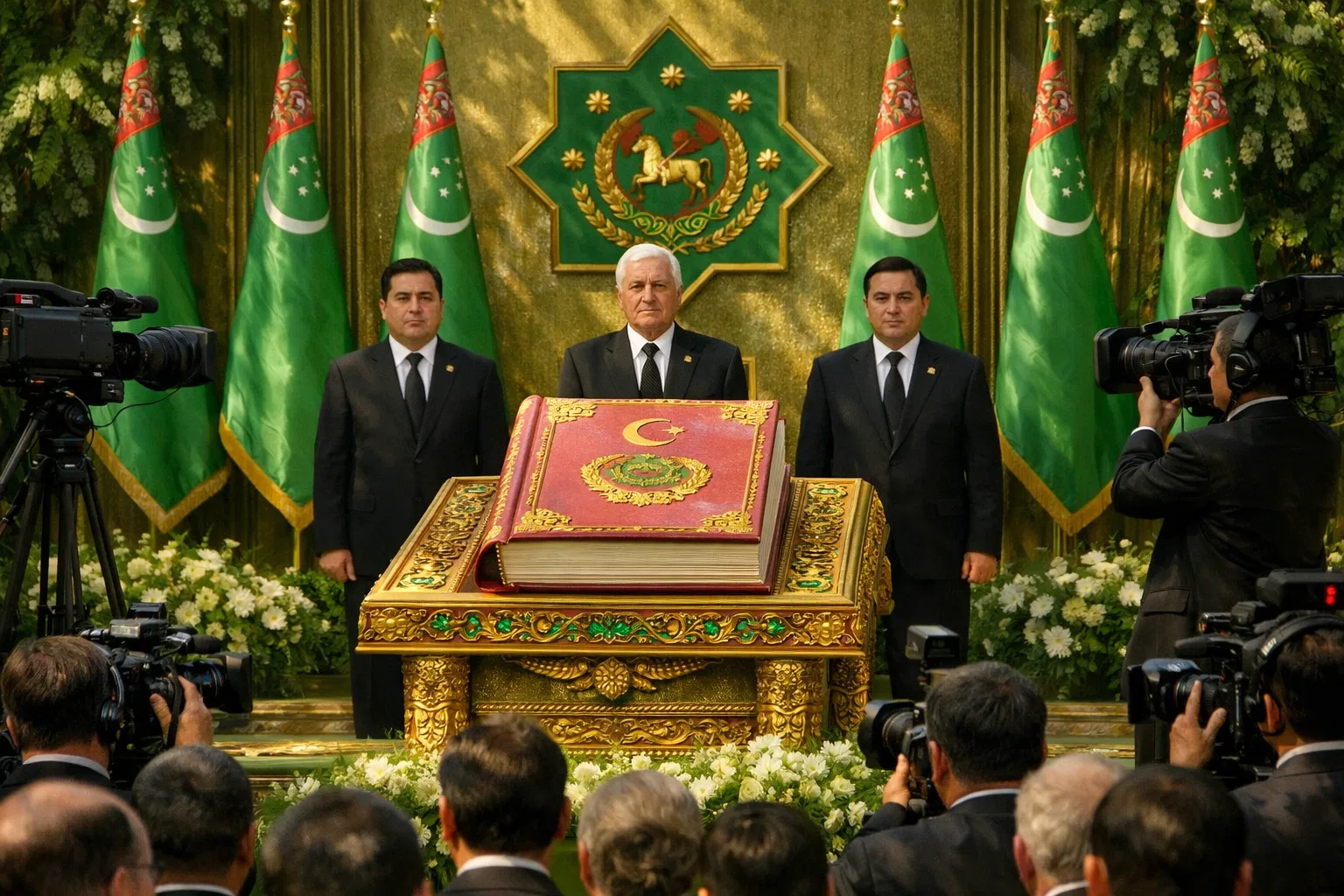
The clearest Turkmen example of manufactured belief is the Ruhnama, the two-volume work associated with President Saparmurat Niyazov, who ruled from independence until his death in 2006. It mixed autobiography, moral advice, poetry, folklore, religious language and a sweeping account of Turkmen history. Niyazov presented it not merely as his opinion but as a guide to national identity and spiritual life. Scholars have described it as pseudo-history and as an exercise in “inventing tradition”: selecting legends, erasing awkward periods and linking the modern state to an immense, heroic past centred increasingly on the president himself.[Wiley Online Library]onlinelibrary.wiley.comWiley Online LibraryArticulating national identity in Turkmenistan: inventing…15 Jun 2014 — Ruhnama was President Nyýazow's pseudo-his…
The historical claims were expansive. The book associated Turkmen ancestry with ancient states and civilisations across a vast span of time, while reducing Persian influence, the eighteenth and nineteenth centuries and much of the Soviet period to whatever best supported the new official narrative. Niyazov’s own life then appeared as the culmination of this history. The result was not a conventional forgery, because no single counterfeit manuscript or artefact was offered as proof. It was closer to state-sponsored pseudo-history: a mosaic of genuine traditions, selective facts, unsupported assertions and political autobiography presented with the authority of a national textbook.[Wikipedia]WikipediaOpen source on wikipedia.org.
What made the deception effective was compulsion rather than subtlety. The Ruhnama entered schools, universities, state offices and public ceremonies. Knowledge of it was reportedly tested in university entrance procedures, government employment and even driving-licence requirements. Institutions devoted courses and conferences to the book while independent historical scholarship was tightly restricted. A story repeatedly taught, examined and ceremonially performed can become socially unavoidable even when many participants recognise its absurdities.[Wikipedia]WikipediaOpen source on wikipedia.org.
The most extraordinary spiritual claim attributed to Niyazov was that reading the book three times would help secure entry to heaven. Whether every listener accepted that literally mattered less than the comparison it encouraged between presidential writing and sacred authority. Mosques were pressured to display the book, and public presentations treated it with an almost devotional reverence. This deliberately blurred the boundary between patriotic instruction, religious promise and personal cult.[centralasiaforum.org]centralasiaforum.orgThe Age of Maturity for the Turkmen Spirit': The RuhnamaNovember 5, 2023 — 5 Nov 2023 — Most boldly of all, Niyazov declared that reading the Ruhnama three times would guarantee believers entry…
Foreign companies also helped the performance travel. Research and the documentary Shadow of the Holy Book examined companies that financed translations, praised the work or cultivated its author while seeking contracts in Turkmenistan. Academic analysis has linked translations sponsored by major international firms with access to state business. The precise motives and arrangements differed, but the broader exchange was clear: ceremonial validation of the ruler’s book could function as commercial diplomacy. The beneficiaries were therefore not limited to the regime. Foreign businesses could also profit by behaving as though the imposed literary cult deserved serious respect.[Sage Journals]journals.sagepub.comOpen source on sagepub.com.
After Niyazov’s death, the Ruhnama gradually lost much of its compulsory status. Its decline exposed how dependent its supposed authority had been on institutions rather than evidence or widespread voluntary devotion. Yet it remains important because it demonstrates a distinctive form of hoax-like power: not persuading an audience with one brilliant fake, but forcing an entire bureaucracy to treat invention as settled knowledge.
Perfect elections as political theatre
Turkmenistan’s official election results belong to a related category. They are not simply disputed statistics; they form part of a recurring performance in which extremely high turnout and overwhelming support are used to suggest national unanimity. In the 2012 presidential election, for example, the electoral commission reported that Gurbanguly Berdimuhamedow won 97 per cent of the vote. The Organization for Security and Co-operation in Europe did not send a full observation mission, citing the absence of genuine political competition.[Reuters]reuters.comTurkmen president wins 97 pct of vote in electionTurkmen president wins 97 pct of vote in election
The central deception is larger than possible ballot tampering. Opposition, news coverage, candidate selection and public discussion are so restricted that the final count cannot be separated from the controlled environment that produced it. A formally accurate tally would not by itself demonstrate a free choice if meaningful rivals could not organise, voters lacked independent information and institutions were subordinate to the leadership.
This helps explain the persistence of implausibly unanimous figures. Their principal audience is not an independent statistician attempting to estimate public opinion. The numbers announce that organised disagreement is absent, futile or invisible. Officials, state employees and local administrators are rewarded for delivering the expected picture, while journalists and monitors have little practical access with which to challenge it. The result resembles a staged photograph: its individual elements may be real people and real ballot boxes, but the frame has been arranged to exclude whatever would spoil the intended image.
Calling every Turkmen election result a proven numerical forgery would go beyond the publicly available evidence. The more defensible conclusion is that the elections lack the conditions needed for trustworthy verification. Their spectacular percentages should therefore be read as claims made by the state about itself, not as independently established measurements of public enthusiasm.
The country with officially no COVID-19
The most consequential disputed claim came during the coronavirus pandemic. Turkmenistan reported no confirmed cases of COVID-19, even as the virus spread through neighbouring states and across the world. Officials insisted that they were not concealing infections and pointed to quarantine arrangements and other preventive measures. The absence of acknowledged cases remained part of international datasets because those datasets depended on government reporting.[Wikipedia]WikipediaCOVID-19 pandemic in TurkmenistanCOVID-19 pandemic in Turkmenistan
Independent reports, medical analysis and accounts from outside the official system made the zero-case position extremely difficult to accept. A review published in a medical journal described the policy as COVID-19 denial and noted reports of people experiencing characteristic symptoms, hospitals treating suspected cases under alternative diagnoses and authorities suppressing discussion of the disease. Precise infection and death totals could not be reconstructed, because reliable testing data and transparent mortality statistics were unavailable.[PMC]pmc.ncbi.nlm.nih.govOpen source on nih.gov.
This distinction matters. Investigators could not produce a complete alternative case count, but failure to calculate the true total is not evidence that the official total was credible. The very controls that protected the zero-case claim also prevented normal verification. Doctors, families and journalists could observe fragments of the outbreak while lacking the freedom or data needed to assemble a national picture.
The claim worked through administrative language. Illness could be attributed to pneumonia or other respiratory conditions; official media could avoid reporting transmission; and international bodies could record only what the government formally supplied. Unlike a rumour spreading spontaneously online, this was denial maintained through control over diagnosis, statistics and speech.
Who benefited was straightforward. A country with no declared outbreak could be portrayed as exceptionally well governed and protected by presidential foresight. Acknowledging widespread transmission would have contradicted that image and invited questions about hospital capacity, public-health policy and the reliability of earlier statements. The cost fell on ordinary people, who were denied clear information about risk and could not openly discuss what they were seeing.

Record-breaking spectacle without an outright fake
Turkmenistan’s enthusiasm for Guinness World Records illustrates a subtler boundary between genuine achievement and deceptive presentation. Ashgabat and state-organised events have received records for such things as the density of white marble-clad buildings, the number of fountain pools and mass musical performances. These records were not necessarily fabricated: participants could be counted, buildings measured and rules formally satisfied.
The misleading element lies in how the records were used. Large events organised through ministries, schools and workplaces were presented as evidence of spontaneous unity, cultural vitality or exceptional national success. The state could mobilise people and resources unavailable to ordinary applicants, then use an external brand to authenticate the resulting spectacle. Critics have accused Guinness World Records of helping authoritarian governments polish their public image; its editor has since expressed regret about aspects of the organisation’s work with Gurbanguly Berdimuhamedow’s government and distinguished ordinary local attempts from projects directed by senior state institutions.[The Times]thetimes.co.ukThe Times Guinness World Records accused of whitewashing repressive regimesThe Times Guinness World Records accused of whitewashing repressive regimes
This was therefore not a simple case of fake certificates. The measurements could be correct while the implied message remained artificial. “Most people performing an activity at once” does not demonstrate that those people volunteered enthusiastically, that the activity has deep cultural importance or that the government enjoys genuine popularity. It proves only that a highly centralised state successfully arranged a record attempt.
The same mechanism appears throughout political publicity: isolate a measurable feature, maximise it with government resources and allow the resulting superlative to stand in for broader qualities that were never measured. A marble-building record becomes modernity; a mass song becomes social harmony; a vast ceremony becomes popular affection. The facts within the frame can be accurate while the frame itself deceives.
The Darvaza crater and the legend that hardened into fact
The burning Darvaza gas crater, often marketed as the “Door to Hell”, is a different kind of case. The crater is real, but its familiar origin story is less secure than countless travel articles suggest. The standard version says that Soviet geologists drilling in 1971 broke into an underground gas cavern, causing the ground and equipment to collapse. Engineers supposedly set the escaping gas alight, expecting it to burn for only a short time.
No accessible contemporary record has firmly established that complete sequence. Accounts disagree over both the date and the circumstances. Some place the collapse in the 1950s or 1960s and the ignition later; others repeat the precise 1971 narrative. Even publications describing the popular story acknowledge that official documentation is absent, inaccessible or inconclusive.[Discover Wildlife]discoverwildlife.comOpen source on discoverwildlife.com.
Darvaza is therefore better described as a contested industrial legend than a proven hoax. There may have been no original deceiver. A plausible explanation was repeated by guides, journalists and tourism writers until uncertain details acquired the smoothness of established history. The tale contains everything a memorable legend needs: Soviet secrecy, reckless scientists, a drilling rig swallowed by the earth and a fire expected to last weeks that instead burned for decades.
Its persistence shows how factual gaps invite narrative completion. Turkmenistan’s closed archives and controlled media make checking difficult, while the crater’s dramatic appearance encourages writers to favour a vivid origin over an unresolved one. Repetition then becomes a substitute for documentation. The careful version is less satisfying but more accurate: Soviet gas exploration probably played a central role, yet the exact date, accident and decision to ignite the site remain uncertain.

Why implausible stories survive
Turkmenistan’s best-known deceptions share a common environment rather than a single technique. The Ruhnama used schools and ritual; election figures used official statistics; COVID denial used control over medical reporting; record attempts borrowed external certification; and the Darvaza story grew in the space left by missing records.
Several forces repeatedly strengthened these claims:
- Information scarcity: independent journalists, researchers and citizens have faced severe limits on publishing, travelling and contacting outside audiences.
- Institutional repetition: a claim printed in textbooks, broadcast on state television or built into an examination gains practical authority regardless of its evidential quality.
- Personal risk: openly contradicting official narratives can threaten employment, education or personal safety.
- Foreign accommodation: companies, record organisations and international institutions may repeat or legitimise official claims when doing so preserves access.
- The appeal of a complete story: outsiders also contribute by repeating colourful tales about eccentric rulers or desert mysteries without checking whether the details are documented.
The last point is especially important. Turkmenistan has often been presented abroad as a collection of bizarre bans, golden statues and theatrical presidential exploits. Some reports are well documented; others have been distorted in retelling. A New Yorker investigation, for example, noted that foreign newspapers had claimed Niyazov renamed bread after his mother, while people interviewed in Ashgabat did not recognise the story. That does not make the wider personality cult imaginary, but it shows how easily a genuinely strange political system attracts additional, weakly sourced legends.[The New Yorker]newyorker.comthe golden manHe treated the country as his private domain, monopolizing its resources and employing repressive measures. His reign was marked by bizar…
The most useful sceptical approach is therefore symmetrical. Official claims require independent evidence, but so do amusing stories circulated by foreign media and tourists. In a country where verification is unusually difficult, disbelief alone is not investigation. The strongest accounts distinguish what is documented, what is highly probable, what remains disputed and what may simply be a good story repeated too many times.
Amazon book picks
Further Reading
Books and field guides related to When Official Claims Became Turkmenistan's Reality. Use these as the next step if you want deeper reading beyond the article.
Dictators Without Borders
Explores how authoritarian systems maintain power and narratives.
Turkmenistan: Power, Politics and Petro-Authoritarianism
Explains the political system behind official narratives and controlled information.
eBay marketplace picks
Marketplace Samples
Live-tested eBay searches with available results related to this page.
Endnotes
1.
Source: arxiv.org
Link:https://arxiv.org/abs/2304.04835
Source snippet
Measuring and Evading Turkmenistan's Internet Censorship: A Case Study in Large-Scale Measurements of a Low-Penetration CountryApril...
2.
Source: onlinelibrary.wiley.com
Link:https://onlinelibrary.wiley.com/doi/10.1111/nana.12052
Source snippet
Wiley Online LibraryArticulating national identity in Turkmenistan: inventing...15 Jun 2014 — Ruhnama was President Nyýazow's pseudo-his...
3.
Source: Wikipedia
Link:https://en.wikipedia.org/wiki/Ruhnama
4.
Source: centralasiaforum.org
Title: ‘The Age of Maturity for the Turkmen Spirit’: The Ruhnama
Link:https://centralasiaforum.org/2023/11/05/the-age-of-maturity-for-the-turkmen-spirit-the-ruhnama-and-identity-production-in-post-soviet-turkmenistan/
Source snippet
November 5, 2023 — 5 Nov 2023 — Most boldly of all, Niyazov declared that reading the Ruhnama three times would guarantee believers entry...
Published: November 5, 2023
5.
Source: reuters.com
Title: Turkmen president wins 97 pct of vote in election
Link:https://www.reuters.com/article/idUSL5E8DD08H/
6.
Source: Wikipedia
Title: COVID-19 pandemic in Turkmenistan
Link:https://en.wikipedia.org/wiki/COVID-19_pandemic_in_Turkmenistan
7.
Source: Wikipedia
Title: Electoral fraud
Link:https://en.wikipedia.org/wiki/Electoral_fraud
8.
Source: Wikipedia
Title: Archaeological forgery
Link:https://en.wikipedia.org/wiki/Archaeological_forgery
9.
Source: Wikipedia
Link:https://en.wikipedia.org/wiki/Misinformation
10.
Source: Wikipedia
Title: List of Olympic Games scandals, controversies and incidents
Link:https://en.wikipedia.org/wiki/List_of_Olympic_Games_scandals%2C_controversies_and_incidents
11.
Source: Wikipedia
Link:https://en.wikipedia.org/wiki/Turkmenistan
12.
Source: Wikipedia
Title: Darvaza gas crater
Link:https://en.wikipedia.org/wiki/Darvaza_gas_crater
13.
Source: state.gov
Link:https://www.state.gov/report/custom/2147d67f5e
14.
Source: newyorker.com
Title: the golden man
Link:https://www.newyorker.com/magazine/2007/05/28/the-golden-man
Source snippet
He treated the country as his private domain, monopolizing its resources and employing repressive measures. His reign was marked by bizar...
15.
Source: newyorker.com
Link:https://www.newyorker.com/books/page-turner/shadow-of-the-ruhnama
Source snippet
Under Niyazov, also known as the president-for-life, Turkmenistan saw enforced worship of the Ruhnama, with its presence required in scho...
16.
Source: journals.sagepub.com
Link:https://journals.sagepub.com/doi/10.1177/10564926211005030
17.
Source: pmc.ncbi.nlm.nih.gov
Link:https://pmc.ncbi.nlm.nih.gov/articles/PMC8724746/
18.
Source: thetimes.co.uk
Title: The Times Guinness World Records accused of whitewashing repressive regimes
Link:https://www.thetimes.co.uk/article/guinness-world-records-accused-of-whitewashing-repressive-regimes-images-9bmrg9p6c
19.
Source: thetimes.com
Link:https://www.thetimes.com/world/europe/article/guinness-world-records-accused-of-helping-turkmenistan-tyrant-berdimuhamedow-polish-his-image-vvm606mvq
20.
Source: discoverwildlife.com
Link:https://www.discoverwildlife.com/environment/darvaza-gas-crater-turkmenistan
21.
Source: hrw.org
Link:https://www.hrw.org/world-report/2021/country-chapters/turkmenistan
22.
Source: pmc.ncbi.nlm.nih.gov
Link:https://pmc.ncbi.nlm.nih.gov/articles/PMC7762906/
Additional References
23.
Source: hrw.org
Link:https://www.hrw.org/news/2011/04/26/turkmenistan-briefing-note-european-parliament-foreign-affairs-committee-and-central
Source snippet
Human Rights WatchTurkmenistan: Briefing Note for the European Parliament...26 Apr 2011 — Following President Niyazov's death, his notor...
24.
Source: youtube.com
Link:https://www.youtube.com/watch?v=se3PZ5R328k
Source snippet
Turkmenistan: The World's Strangest Dictatorship...
25.
Source: youtube.com
Title: How the Soviets accidentally discovered the ‘Gates of Hell’
Link:https://www.youtube.com/watch?v=cWUoAoeJb08
Source snippet
The Crater That Was Supposed to Burn Out — 50 Years Later, It Still Burns...
26.
Source: youtube.com
Title: The Strangest Dictatorship You’ve Never Heard Of | Inside Turkmenistan
Link:https://www.youtube.com/watch?v=69PjXvbczAk
Source snippet
How the Soviets accidentally discovered the 'Gates of Hell' - BBC REEL...
27.
Source: youtube.com
Title: Turkmenistan: The World’s Strangest Dictatorship
Link:https://www.youtube.com/watch?v=EZXK1O0OLFM
Source snippet
The Strangest Dictatorship You've Never Heard Of | Inside Turkmenistan...
28.
Source: academia.edu
Link:https://www.academia.edu/8751864/Articulating_National_Identity_in_Turkmenistan_inventing_tradition_through_myth_cult_and_language
29.
Source: historysnob.com
Link:https://www.historysnob.com/eras/20-archaeological-hoaxes-that-fooled-people-for-way-too-long
30.
Source: facebook.com
Link:https://www.facebook.com/ndtv/posts/according-to-separate-who-pages-on-the-covid-situation-in-turkmenistan-and-north/562317535933852/
31.
Source: researchgate.net
Link:https://www.researchgate.net/publication/7990329_Antiquities_fraud_Reality_check
32.
Source: youngpioneertours.com
Link:https://www.youngpioneertours.com/ashgabat-the-worlds-most-guinness-world-record-holding-capital/
Topic Tree
Follow this branch
Related pages 192
- Albanian Hoaxes
- Algerian Hoaxes
- Antigua Deceptions
- Argentina Hoaxes
- Armenian Hoaxes
- +187 more in sidebar