Within Micronesian Mysteries
Did a Lost Civilisation Build Nan Madol?
Archaeology links Nan Madol to Pohnpeian builders, despite enduring claims about Mu, Atlantis and unknown ancient outsiders.
On this page
- What the lost civilisation stories claim
- How dating and stone sourcing test the claims
- Why the outsider builder myth still circulates
Page outline Jump by section
Introduction
Did a lost civilisation build Nan Madol? The short answer is no. The famous stone ruins on Pohnpei in the Federated States of Micronesia are real, impressive and still not fully understood in every detail, but the archaeological evidence points to construction by the ancestors of modern Pohnpeians rather than by Atlanteans, refugees from a vanished continent, or an unknown Ice Age super-culture. The site has become a recurring fixture in pseudoarchaeology because its basalt walls appear almost impossible at first glance. Yet the more researchers have dated the structures, traced the stone sources and surveyed the surrounding landscape, the less room remains for claims of mysterious outsider builders.[UNESCO World Heritage Centre]whc.unesco.orgUNESCO World Heritage CentreNan Madol: Ceremonial Centre of Eastern MicronesiaNan Madol is a series of more than 100 islets off the south…
Nan Madol therefore occupies an unusual place in the history of disputed claims. It is not a forged site or a deliberate hoax. Instead, it is a genuine archaeological monument repeatedly repackaged as evidence for ideas that the available evidence does not support. The tension between extraordinary appearance and ordinary archaeological explanation is precisely what keeps the story alive.
What the Lost-Civilisation Stories Claim
Lost-civilisation theories surrounding Nan Madol usually begin with a simple argument: the site looks too difficult to have been built by the people who are known to have lived on Pohnpei.
Writers promoting these ideas have linked Nan Madol to:
- Atlantis or other vanished global civilisations.
- Mu, a supposed lost Pacific continent popularised by James Churchward in the early twentieth century.
- Advanced seafaring outsiders who allegedly reached Micronesia long before recorded history.
- Ice Age cultures claimed to possess knowledge or technology beyond that of later societies.
- Submerged prehistoric cities supposedly hidden beneath nearby waters.
These narratives often emphasise the size of the basalt columns, the absence of metal tools, and the logistical challenge of transporting stone across water. From there, they leap to the conclusion that conventional archaeology cannot explain the site.[Wikipedia]WikipediaNan MadolNan Madol
The problem is that this argument depends more on perceived improbability than on positive evidence. Demonstrating that a construction project was difficult is not the same as demonstrating that it required a vanished civilisation.
How Dating Tests the Claims
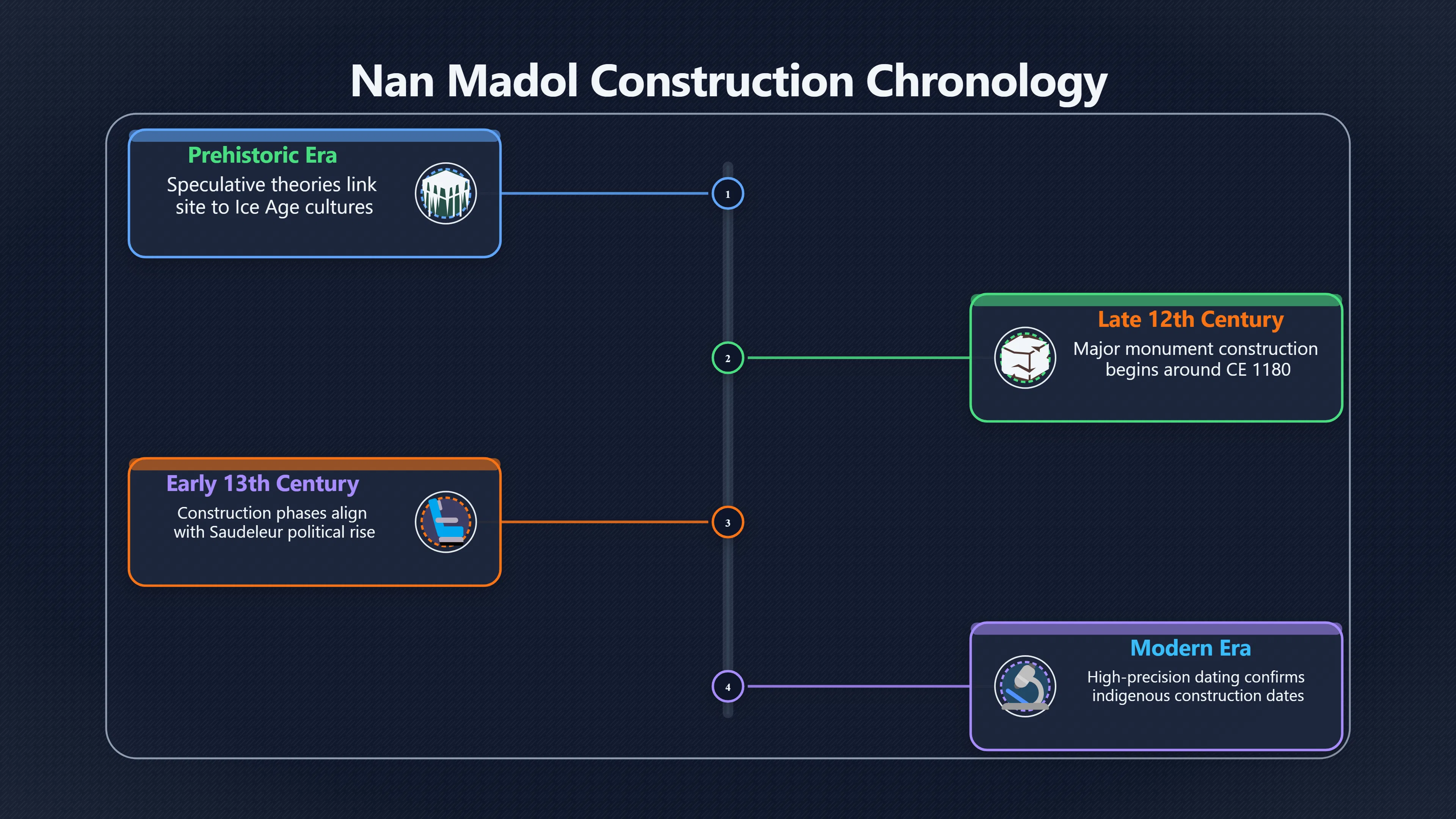
One of the strongest ways to evaluate lost-civilisation theories is to establish when major construction actually occurred.
For many years, speculative writers benefited from uncertainty about Nan Madol’s chronology. If the site could be imagined as thousands of years old, it became easier to connect it to mythical continents or Ice Age societies. Archaeological dating has narrowed that uncertainty considerably.
Researchers used high-precision uranium-thorium dating on coral incorporated into the royal mortuary complex at Nandauwas, one of Nan Madol’s most important structures. The results indicate major monument construction around the late twelfth and early thirteenth centuries CE. One widely cited estimate places the earliest monumental architecture at approximately CE 1180–1200.[researchgate.net]researchgate.netEarliest direct evidence of monument building at the…October 1, 2016 — 230 Th dating on coral that was live harvested as c…
Subsequent research has refined the chronology further, identifying major construction phases associated with the rise of the Saudeleur political system rather than with remote prehistory. The dates place Nan Madol firmly within the known development of complex Pacific Island societies.[PMC]pmc.ncbi.nlm.nih.govby CC Shen · 2024 · Cited by 7 — Architectural coral 230Th dates and charcoal 14C ages reveal two major construction phases for Nan Ma…
This matters because the lost-civilisation narrative often depends on the assumption that the site is vastly older than archaeologists claim. Direct dating evidence removes much of that foundation.
How Stone Sourcing Tests the Claims
Dating addresses when Nan Madol was built. Stone sourcing addresses who built it and where the materials came from.
A common pseudoarchaeological suggestion is that the basalt originated from unknown builders, vanished cultures or distant civilisations. Geochemical analysis provides a much more grounded answer.
Researchers used portable X-ray fluorescence and related geochemical techniques to compare the basalt used in Nan Madol’s architecture with volcanic sources on Pohnpei. The results indicate that builders selected basalt from identifiable local geological formations on the island rather than importing mysterious materials from elsewhere in the Pacific.[pacificarchaeology.org]pacificarchaeology.orgOpen source on pacificarchaeology.org.
The sourcing evidence does not solve every engineering question. Archaeologists still debate the exact transport methods used to move massive basalt columns. Rafts, coordinated labour, ropes, leverage systems and exploitation of tides have all been proposed. However, uncertainty about transport techniques is very different from uncertainty about the origin of the stone itself. The material can be traced to local sources, which strongly supports construction by people operating within the Pohnpeian cultural landscape.[pacificarchaeology.org]pacificarchaeology.orgOpen source on pacificarchaeology.org.
In other words, the evidence points toward a remarkable indigenous engineering achievement, not an unexplained intrusion from a vanished civilisation.
What About the Supposed Underwater City?
Claims about submerged ruins have helped keep Nan Madol in alternative-history books and documentaries.
Stories often focus on reports of underwater columns, alleged streets beneath the sea, or legendary drowned cities associated with local traditions. Such claims gained attention because divers did encounter column-like features offshore. At first glance, these appeared to support speculation about a lost settlement swallowed by catastrophe.[Wikipedia]WikipediaNan MadolNan Madol
Later investigations produced a different picture.
Archaeological teams examining the underwater features found that some apparent pillars were natural coral formations rather than deliberately erected stone structures. Surveys also identified fallen or discarded basalt columns that could plausibly be related to construction activities at Nan Madol itself. More recent sonar and diving investigations found no convincing evidence of a submerged city built from arranged basalt architecture. Researchers likewise concluded that the nearby blue hole frequently invoked in mystery narratives is a natural geological feature rather than the collapsed centre of a drowned metropolis.[Wikipedia]WikipediaNan MadolNan Madol
The underwater discoveries are therefore interesting, but they do not provide support for the existence of a forgotten advanced civilisation.
Why the Outsider-Builder Myth Still Circulates
The persistence of lost-civilisation claims is not mainly a problem of missing evidence. It is a problem of storytelling.
Several factors make Nan Madol especially attractive to speculative writers:
Its appearance is genuinely extraordinary. Massive basalt columns stacked into monumental walls create an immediate sense of mystery.
Many engineering details remain debated. Archaeologists know far more about the site’s age and development than about every practical step involved in construction. Gaps in knowledge are easily exaggerated into claims that no explanation exists.
Popular media rewards mystery. Television documentaries, adventure books and internet videos attract larger audiences when they promise hidden histories rather than careful archaeological interpretation.
The site is geographically remote for many viewers. Few people can visit Pohnpei themselves, making dramatic retellings harder to challenge.
Older colonial-era assumptions linger. Some scholars and Indigenous commentators have noted that outsider-builder theories often rest on an implicit belief that Pacific Islanders could not have created such monuments on their own. Critics argue that these narratives undervalue local knowledge and achievement while attributing success to hypothetical outsiders.[Wikipedia]WikipediaNan MadolNan Madol
The result is a recurring pattern: a genuine archaeological wonder becomes framed as evidence against the people who actually built it.
What the Evidence Supports
The strongest current evidence paints a coherent picture.
Nan Madol was a monumental ceremonial and political centre associated with the Saudeleur dynasty on Pohnpei. Major construction occurred during the late first and early second millennia CE, not in a forgotten Ice Age. Basalt used in the architecture can be linked to sources on Pohnpei itself. Archaeological surveys of nearby underwater features have not uncovered the drowned city often described in alternative-history accounts.[unesco.org]whc.unesco.orgUNESCO World Heritage CentreNan Madol: Ceremonial Centre of Eastern MicronesiaNan Madol is a series of more than 100 islets off the south…
What remains impressive is not that Nan Madol defies explanation, but that a Pacific Island society organised the labour, transport and political authority necessary to create one of Oceania’s most remarkable architectural landscapes. The real achievement is already extraordinary; it does not require Atlantis, Mu or a vanished super-civilisation to make it so.
Amazon book picks
Further Reading
Books and field guides related to Did a Lost Civilisation Build Nan Madol?. Use these as the next step if you want deeper reading beyond the article.
Frauds, Myths, and Mysteries: Science and Pseudoscience in Ar...
Counters pseudoarchaeological explanations with evidence.
Fingerprints of the Gods
Represents the type of alternative-history thinking often linked to sites like Nan Madol.

eBay marketplace picks
Marketplace Samples
Live-tested eBay searches with available results related to this page.



Endnotes
1.
Source: whc.unesco.org
Link:https://whc.unesco.org/en/list/1503/
Source snippet
UNESCO World Heritage CentreNan Madol: Ceremonial Centre of Eastern MicronesiaNan Madol is a series of more than 100 islets off the south...
2.
Source: sciencedirect.com
Link:https://www.sciencedirect.com/science/article/abs/pii/S0033589416300436
Source snippet
Earliest direct evidence of monument building at the...by MD McCoy · 2016 · Cited by 36 — We report new interdisciplinary r...
3.
Source: Wikipedia
Title: Nan Madol
Link:https://en.wikipedia.org/wiki/Nan_Madol
4.
Source: researchgate.net
Link:https://www.researchgate.net/publication/308978355_Earliest_direct_evidence_of_monument_building_at_the_archaeological_site_of_Nan_Madol_Pohnpei_Micronesia_identified_using_230ThU_coral_dating_and_geochemical_sourcing_of_megalithic_architectural_stone
Source snippet
Earliest direct evidence of monument building at the...October 1, 2016 — 230 Th dating on coral that was live harvested as c...
Published: October 1, 2016
5.
Source: pmc.ncbi.nlm.nih.gov
Link:https://pmc.ncbi.nlm.nih.gov/articles/PMC11443547/
Source snippet
by CC Shen · 2024 · Cited by 7 — Architectural coral 230Th dates and charcoal 14C ages reveal two major construction phases for Nan Ma...
6.
Source: pacificarchaeology.org
Link:https://pacificarchaeology.org/index.php/journal/article/view/68
7.
Source: smarthistory.org
Title: nan madol
Link:https://smarthistory.org/nan-madol/
8.
Source: Wikipedia
Link:https://en.wikipedia.org/wiki/NaN
9.
Source: researchgate.net
Link:https://www.researchgate.net/publication/282372773_The_Archaeology_of_Nan_Madol_and_Temwen_Island_Pohnpei_Site_Distribution_Architecture_and_Early_Agricultural_Features_Pohnpei_Federated_States_of_Micronesia
10.
Source: researchgate.net
Link:https://www.researchgate.net/publication/282734600_Archaeological_Remains_at_Angeir-Karian_Nan_Madol_Pohnpei_Federated_States_of_Micronesia
11.
Source: nach.gov.fm
Link:https://nach.gov.fm/wp-content/uploads/2019/01/earliest_direct_evidence_of_monument_building_at_the_archaeological_site_of_nan_madol_pohnpei_micronesia_identified_using_230thu_coral_dating_an.pdf
Source snippet
Micronesia. High-precision uranium series dating of coral from the tomb of the...Read more...
12.
Source: nach.gov.fm
Link:https://nach.gov.fm/nan-madol/
Additional References
13.
Source: ui.adsabs.harvard.edu
Title: Astrophysics Data System Dating a world-unique Pacific ruin: Nan Madol
Link:https://ui.adsabs.harvard.edu/abs/2023EGUGA..25..123R/abstract
Source snippet
Astrophysics Data SystemDating a world-unique Pacific ruin: Nan Madol - ADSby F Beardsley · 2023 — Our study shows that Nan Madol constru...
14.
Source: discoveryuk.com
Title: Discovery UKWhat Lies Beneath?
Link:https://www.discoveryuk.com/mysteries/what-lies-beneath-the-nan-madol-mystery-and-the-ruins-that-defy-science/
Source snippet
The Nan Madol Mystery and the Ruins...6 days ago — The basalt columns don't originate at the site itself – their source lies many kilome...
15.
Source: youtube.com
Title: Marine Archaeology Is Rewriting Nan Madol’s Mysterious Ruins
Link:https://www.youtube.com/watch?v=qxPaYCHBD4Y
Source snippet
What Have We Learned About Nan Madol? | Ep.18...
16.
Source: academia.edu
Link:https://www.academia.edu/29301216/Earliest_direct_evidence_of_monument_building_at_the_archaeological_site_of_Nan_Madol_Pohnpei_Micronesia_identified_using_230_Th_U_coral_dating_and_geochemical_sourcing_of_megalithic_architectural_stone
17.
Source: iarii.org
Link:https://iarii.org/research/monumental-architecture-of-nan-madol/
18.
Source: facebook.com
Link:https://www.facebook.com/100090372200308/posts/nan-madol-a-900-year-old-city-off-pohnpei-in-micronesia-was-built-on-artificial-/762704093418657/
19.
Source: khanacademy.org
Link:https://www.khanacademy.org/humanities/ap-art-history/pacific-apah/micronesia-apah/a/nan-madol-in-the-space-between-things
20.
Source: facebook.com
Link:https://www.facebook.com/NatGeoHistory/posts/only-fragments-of-nan-madol-remainbut-thats-enough-to-convey-the-incredible-scal/1475811150572002/
21.
Source: youtube.com
Title: Remote Sensing Discoveries at Nan Madol | Ep.17
Link:https://www.youtube.com/watch?v=nj2yGkuqvDQ
Source snippet
Nan Madol: The Megalithic Island City of the Pacific...
22.
Source: sydney.edu.au
Link:https://www.sydney.edu.au/news-opinion/news/2026/03/26/tropical-archaeology-advanced-dating-method-reveals-age-of-pacific-coral-architecture.html
Topic Tree