Within Swiss Hoaxes
How Bern's Monks Manufactured a Miracle
The Jetzer affair shows how religious authority, theatrical effects and doctrinal rivalry turned fabricated miracles into a public spectacle.
On this page
- What Hans Jetzer claimed to see
- How the apparitions were staged
- What the trial can and cannot prove
Page outline Jump by section
Introduction
The Jetzer Affair is one of the most striking examples of a manufactured miracle in Swiss history. Between 1507 and 1509, a series of visions, stigmata, weeping statues and supernatural messages appeared to unfold around a young lay brother named Hans Jetzer in a Dominican monastery in Bern. At first these events seemed to confirm a major religious claim about the Virgin Mary. Crowds gathered, reports spread, and the apparent miracles carried political and theological weight. Yet investigations eventually concluded that many of the wonders had been staged by members of the monastery itself. The resulting scandal led to sensational trials, accusations of poisoning, torture, and the execution of four Dominican friars.[Swiss History Blog]blog.nationalmuseum.chthe jetzer affairin Bern was an out-and-out scandal worthy of a modern-day thriller.Read more…

As a case study in deception, the affair is remarkable not because it involved simple trickery, but because it combined religious authority, theatrical effects, doctrinal rivalry and public spectacle. It shows how apparently supernatural evidence could be manufactured to settle a disputed question and how difficult it can be to untangle truth from coercion when investigations rely heavily on confessions extracted under torture.[Wikipedia]WikipediaJetzer affairJetzer affair
What Hans Jetzer Claimed to See
Hans Jetzer was a young tailor’s assistant who entered the Dominican monastery in Bern as a lay brother around 1507. Soon afterwards he reported extraordinary experiences. According to accounts recorded during the subsequent investigations, he encountered the ghost of a long-dead prior, received visits from the Virgin Mary and various saints, and developed wounds resembling Christ’s stigmata. These visions carried a clear theological message: they appeared to support the Dominican position in an ongoing dispute over the doctrine of the Immaculate Conception.[Wikipedia]WikipediaJetzer affairJetzer affair
The dispute mattered because Franciscans and Dominicans disagreed over whether Mary had been conceived free from original sin. Miraculous signs were powerful weapons in such arguments. If heaven itself seemed to speak through visions, bleeding wounds or divine apparitions, ordinary debate could be bypassed. The miracles associated with Jetzer appeared to provide exactly that sort of supernatural endorsement.[Wikipedia]WikipediaJetzer affairJetzer affair
The claims expanded over time. Reports described apparitions delivering messages, a communion wafer apparently turning blood-red, and a statue of the Virgin Mary shedding bloody tears. These events attracted public attention well beyond the monastery walls and transformed a private religious experience into a civic spectacle.[Wikipedia]WikipediaJetzer affairJetzer affair
How the Apparitions Were Staged
The affair became famous because investigators concluded that many of the miracles had been carefully engineered.
According to trial testimony and later historical research, members of the monastery used costumes, hidden mechanisms and visual effects to create apparitions. One account describes friars disguising themselves as Mary and angels while appearing before Jetzer. In another episode, figures were reportedly moved into view using a beam or staging apparatus concealed within the monastery buildings. Construction work in parts of the monastery during this period has been cited by historians as evidence that physical alterations were made to support such performances.[Wikipedia]WikipediaJetzer affairJetzer affair
The weeping Madonna was one of the most dramatic elements of the scheme. Bloody tears were painted onto a statue of the Virgin Mary, creating the impression that the image itself was responding to the theological controversy. The statue’s tears were interpreted as a heavenly protest against claims about Mary’s conception and generated intense public interest.[Wikipedia]WikipediaJetzer affairJetzer affair
Jetzer’s stigmata also played a central role. Witnesses saw wounds on his body and watched him perform highly emotional displays of suffering. Trial records later alleged that these wounds had been artificially produced and that substances were administered to Jetzer to influence his behaviour. Some accounts even include allegations that he was poisoned when he became a threat to the conspiracy after recognising the supposed heavenly visitors as disguised friars.[Wikipedia]WikipediaJetzer affairJetzer affair
What made the deception effective was not any single trick. The miracle narrative worked because multiple signs reinforced one another. Apparitions supported the stigmata, the stigmata supported the prophecies, and the prophecies were validated by the weeping statue. Together they created a self-confirming system that appeared difficult to doubt.[Wikipedia]WikipediaJetzer affairJetzer affair
Why People Found the Miracles Convincing
Modern readers sometimes imagine that a fabricated miracle would be immediately exposed. The Jetzer Affair shows why that assumption is too simple.
First, the claims came from a religious setting that many people regarded as trustworthy. Monasteries were centres of learning and spiritual authority. Reports emerging from such institutions carried a credibility that rumours from elsewhere would not have enjoyed.[White Rose Research Online]eprints.whiterose.ac.ukMiracles in the Monastic CultureWithout trying…Read more…
Second, the miracles appeared to fit existing expectations. Medieval and early modern Europeans were familiar with stories of saints receiving visions, wounds or divine messages. The events around Jetzer were unusual, but they were not outside the range of what many believers thought possible.[White Rose Research Online]eprints.whiterose.ac.ukMiracles in the Monastic CultureWithout trying…Read more…
Third, the affair unfolded publicly. Large numbers of people witnessed aspects of the spectacle, including Jetzer’s apparent suffering. Public observation can sometimes strengthen belief rather than weaken it, especially when observers assume that someone else has already verified the claim.[Wikipedia]WikipediaJetzer affairJetzer affair
Finally, the miracles served a purpose. They appeared to resolve a theological controversy by providing divine evidence. For supporters of one side in the dispute, the signs offered reassurance that heaven itself had taken a position.[Wikipedia]WikipediaJetzer affairJetzer affair
How the Fraud Unravelled
The turning point came when Jetzer reportedly recognised some of the supposed supernatural visitors as members of the monastery in disguise. Once suspicion entered the story, the miracles became vulnerable to investigation.[Wikipedia]WikipediaJetzer affairJetzer affair
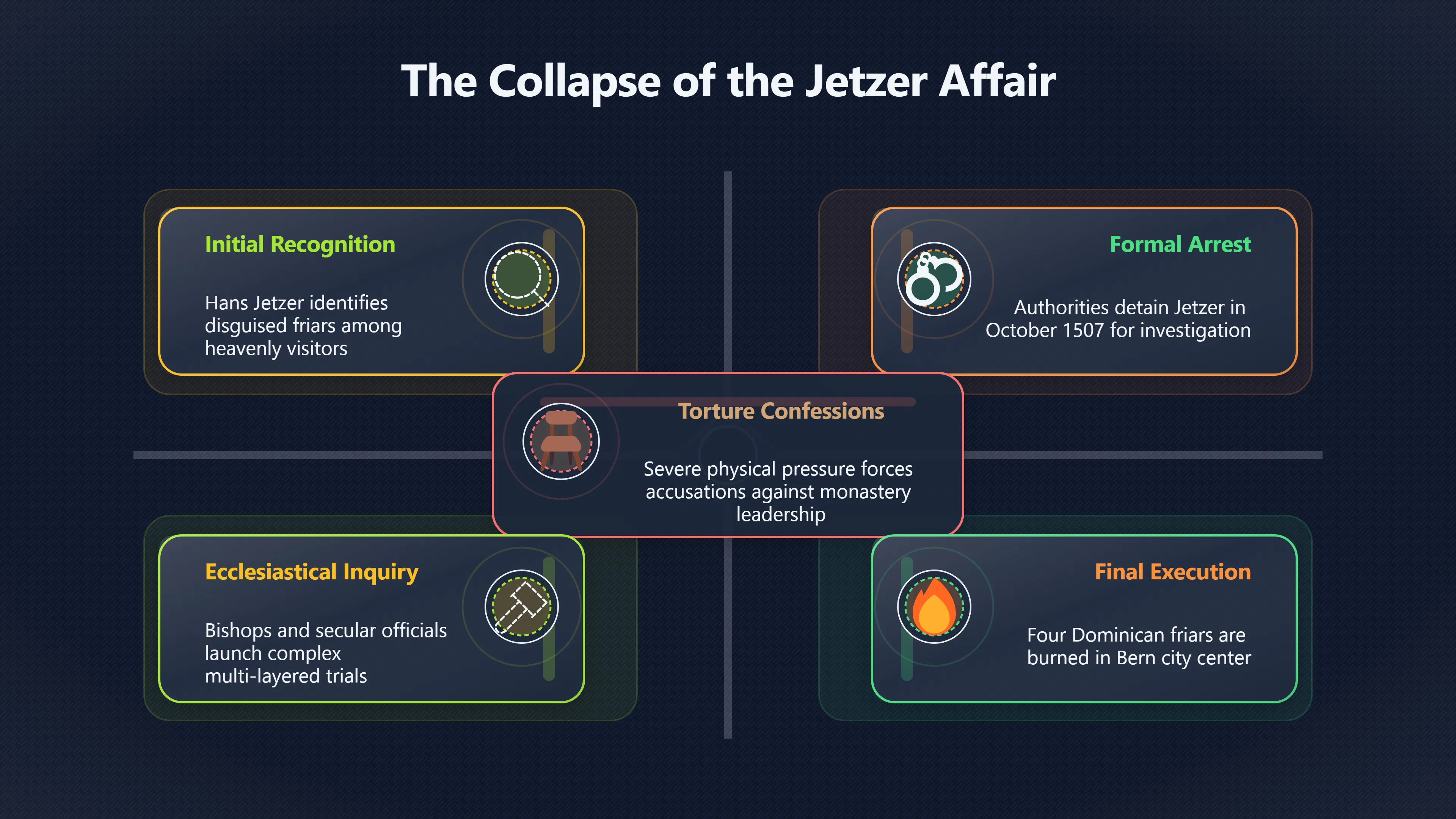
Authorities arrested Jetzer in October 1507. Initially he was treated as the likely fraudster. During questioning and torture he accused senior friars of organising the apparitions. Those accusations triggered a much larger inquiry that eventually focused on the monastery’s leadership.[Wikipedia]WikipediaJetzer affairJetzer affair
The ensuing proceedings were unusually complex because members of a religious order could not simply be tried in the same way as ordinary citizens. Bishops, church authorities and secular officials all became involved. Separate trials examined the roles of Jetzer and the Dominican friars, while the controversy spread across the Swiss Confederation through chronicles and printed accounts.[Wikipedia]WikipediaJetzer affairJetzer affair
The scandal grew beyond the question of whether miracles had occurred. Investigators examined allegations of sacrilege, forgery of sacred signs, poisoning attempts and deliberate manipulation of religious belief. By the end of the process, four Dominican friars had been convicted and handed over to secular authorities for execution. They were burned in Bern in 1509.[Wikipedia]WikipediaJetzer affairJetzer affair

What the Trial Can and Cannot Prove
The Jetzer Affair is often presented as a straightforward case of monks inventing miracles. The broad outline is well supported, but the details require caution.
A major problem is that the investigations relied heavily on torture. Jetzer was tortured, and the accused friars were tortured as well. Historians therefore cannot treat every confession as automatically reliable. Statements extracted under extreme pressure may contain truth, exaggeration, distortion or attempts to satisfy interrogators.[Wikipedia]WikipediaJetzer affairJetzer affair
Even so, many scholars conclude that the central finding—that miracles were deliberately staged—is convincing. The surviving records describe elaborate schemes that would have been difficult for Jetzer alone to organise. The theological sophistication of the messages, the evidence of physical preparations within the monastery and the consistency of multiple strands of testimony all point towards organised deception rather than a lone fraud by an illiterate lay brother.[Wikipedia]WikipediaJetzer affairJetzer affair
The greatest uncertainty concerns Jetzer himself. Was he a willing participant, an opportunist, a victim of manipulation, or all three at different moments? Historians continue to debate the extent of his involvement. Modern scholarship generally leans towards viewing him primarily as someone used by more powerful figures, but absolute certainty is impossible because the evidence comes through the filter of coercive legal procedures.[Wikipedia]WikipediaJetzer affairJetzer affair
Why the Affair Still Matters
The Jetzer Affair remains one of Switzerland’s most revealing stories of staged miracles because it exposes the mechanics of manufactured belief. The deception did not rely on a single forged object or isolated trick. It succeeded by combining respected institutions, persuasive performances, emotional spectacle and a controversy that people desperately wanted resolved.[Swiss History Blog]blog.nationalmuseum.chthe jetzer affairin Bern was an out-and-out scandal worthy of a modern-day thriller.Read more…
The case also illustrates an enduring lesson in the history of hoaxes. Extraordinary claims become especially persuasive when they appear to come from trusted authorities and when they provide convenient answers to disputed questions. In Bern, apparent messages from heaven seemed to settle a theological argument. Only later did investigators conclude that the miracles themselves had been engineered.[Wikipedia]WikipediaJetzer affairJetzer affair
For the wider history of Swiss deception and contested truth, the Jetzer Affair stands as an early and unusually well-documented example of how theatrical effects, institutional power and public belief can combine to turn a manufactured spectacle into accepted reality—at least for a time.[Swiss History Blog]blog.nationalmuseum.chthe jetzer affairin Bern was an out-and-out scandal worthy of a modern-day thriller.Read more…
Amazon book picks
Further Reading
Books and field guides related to How Bern's Monks Manufactured a Miracle. Use these as the next step if you want deeper reading beyond the article.
Why People Believe Weird Things
Explains belief formation around miraculous and extraordinary claims.
The Pope Who Quit
Appeals to readers interested in church history and religious controversies.
The Reformation
Provides essential context for the theological conflicts surrounding the Jetzer affair.
eBay marketplace picks
Marketplace Samples
Live-tested eBay searches with available results related to this page.

Endnotes
1.
Source: Wikipedia
Title: Jetzer affair
Link:https://en.wikipedia.org/wiki/Jetzer_affair
2.
Source: Wikipedia
Title: Dominican Order
Link:https://en.wikipedia.org/wiki/Dominican_Order
Source snippet
Dominican Order - WikipediaJetzer affair - Wikipedia...
3.
Source: Wikipedia
Title: Marian apparition
Link:https://en.wikipedia.org/wiki/Marian_apparition
Source snippet
Marian apparitionAs punishment for this scandal, four Dominicans were burned at... The majority of investigated apparitions are rejec...
4.
Source: blog.nationalmuseum.ch
Title: the jetzer affair
Link:https://blog.nationalmuseum.ch/en/2023/03/the-jetzer-affair/
Source snippet
in Bern was an out-and-out scandal worthy of a modern-day thriller.Read more...
5.
Source: eprints.whiterose.ac.uk
Title: Miracles in the Monastic Culture
Link:https://eprints.whiterose.ac.uk/id/eprint/163812/3/Miracles%20in%20the%20Monastic%20Culture.pdf
Source snippet
Without trying...Read more...
Additional References
6.
Source: link.springer.com
Link:https://link.springer.com/content/pdf/10.1057/9781137447494_10
Source snippet
Page 14. Genuine and Fraudulent Stigmatics in the Sixteenth Century 155 whose forged...Read more...
7.
Source: differentvisions.org
Title: Different Visions Sculpture in the Deceptive Mode?
Link:https://differentvisions.org/sculpture-in-the-deceptive-mode/
Source snippet
The Shifting Social...... Jetzer was arrested on October 1, 1507. While under torture during his trial, he accused his Dominican superio...
Published: October 1, 1507
8.
Source: academic.oup.com
Link:https://academic.oup.com/jts/article/75/1/250/7493433
Source snippet
OUP AcademicWarum Maria blutige Tränen weinte: Der Jetzerhandel und die...by C Methuen · 2024 — At the latest by August accusations were...
9.
Source: youtube.com
Title: Trent Horn
Link:https://www.youtube.com/watch?v=GwH8pK3RkF0
Source snippet
Abandoned Medieval Mansion With A Dark Religious Secret...
10.
Source: youtube.com
Title: Cessationism 11 (Miracles in the Middle Ages) Daniel Kolenda: Off The Record
Link:https://www.youtube.com/watch?v=TLpNCKE88nI
Source snippet
The Mystery of the Stigmata (Guest: Paul Kengor)...
11.
Source: youtube.com
Title: Abandoned Medieval Mansion With A Dark Religious Secret
Link:https://www.youtube.com/watch?v=Bn6rzkQaBBk
Source snippet
Cessationism 11 (Miracles in the Middle Ages) Daniel Kolenda: Off The Record...
12.
Source: youtube.com
Title: Immaculate Conception: From controversy to dogma
Link:https://www.youtube.com/watch?v=-02ECgJ-DRw
Source snippet
Trent Horn - Is the Doctrine of the Immaculate Conception a Catholic Invention?...
13.
Source: instagram.com
Link:https://www.instagram.com/p/Dar_uy6I76G/
14.
Source: academia.edu
Link:https://www.academia.edu/39134350/Ghosts_of_Place_and_Spirits_of_War_Spectral_Belief_in_Early_Modern_England_and_Protestant_Germany
15.
Source: instagram.com
Link:https://www.instagram.com/reel/DXM8WUrDDME/
Topic Tree