Within Tunisia
Did Carthage Really Sacrifice Its Children?
Ancient accusations, cremated remains and disputed inscriptions make Carthage's child-sacrifice story neither proven myth nor settled fact.
On this page
- What Greek and Roman Writers Claimed
- What the Burial Site Actually Contained
- Why the Evidence Still Divides Researchers
Page outline Jump by section
Introduction
Few ancient claims linked to modern Tunisia have generated as much argument as the accusation that the Carthaginians sacrificed their own children. For centuries, many historians dismissed the story as enemy propaganda. Greek and Roman writers portrayed Carthage as uniquely cruel, and because those accounts came largely from rivals and conquerors, sceptics suspected exaggeration or invention. The discovery of a remarkable burial precinct at Carthage, however, transformed the debate. Archaeologists uncovered thousands of urns containing cremated remains of infants and very young children, often accompanied by animal bones and inscribed monuments. The question then changed from “Did the accusation exist?” to “What do these remains actually mean?” Today the dispute remains one of the most controversial issues in Mediterranean archaeology. The evidence is substantial, but its interpretation is fiercely contested.[cambridge.org]cambridge.orgCambridge University Press & AssessmentTwo tales of one city: data, inference and Carthaginian…by JH Schwartz · 2017 · Cited by 37 — R…
Did Carthage Really Sacrifice Its Children?
The short answer is that scholars disagree about the scale and nature of the practice, but many no longer regard the ancient accusations as pure fiction.
Classical authors including Diodorus Siculus, Plutarch and other Greek and Roman writers described Carthaginians offering children to deities during times of crisis. These accounts often depicted elite families sacrificing sons and daughters to secure divine favour in war, famine or political emergencies. Because the surviving literary evidence comes from outsiders rather than Carthaginians themselves, historians long treated the stories with caution. Critics argued that portraying an enemy as child-killers was a powerful form of wartime propaganda.[wikipedia.org]WikipediaAncient CarthageAncient Carthage
For much of the twentieth century, a common interpretation held that the accusations served a political purpose. Rome ultimately destroyed Carthage in 146 BCE, and depicting the city as morally depraved helped justify hostility toward a major rival. In this reading, later writers repeated and amplified earlier rumours until they became accepted history.[Wikipedia]WikipediaOpen source on wikipedia.org.
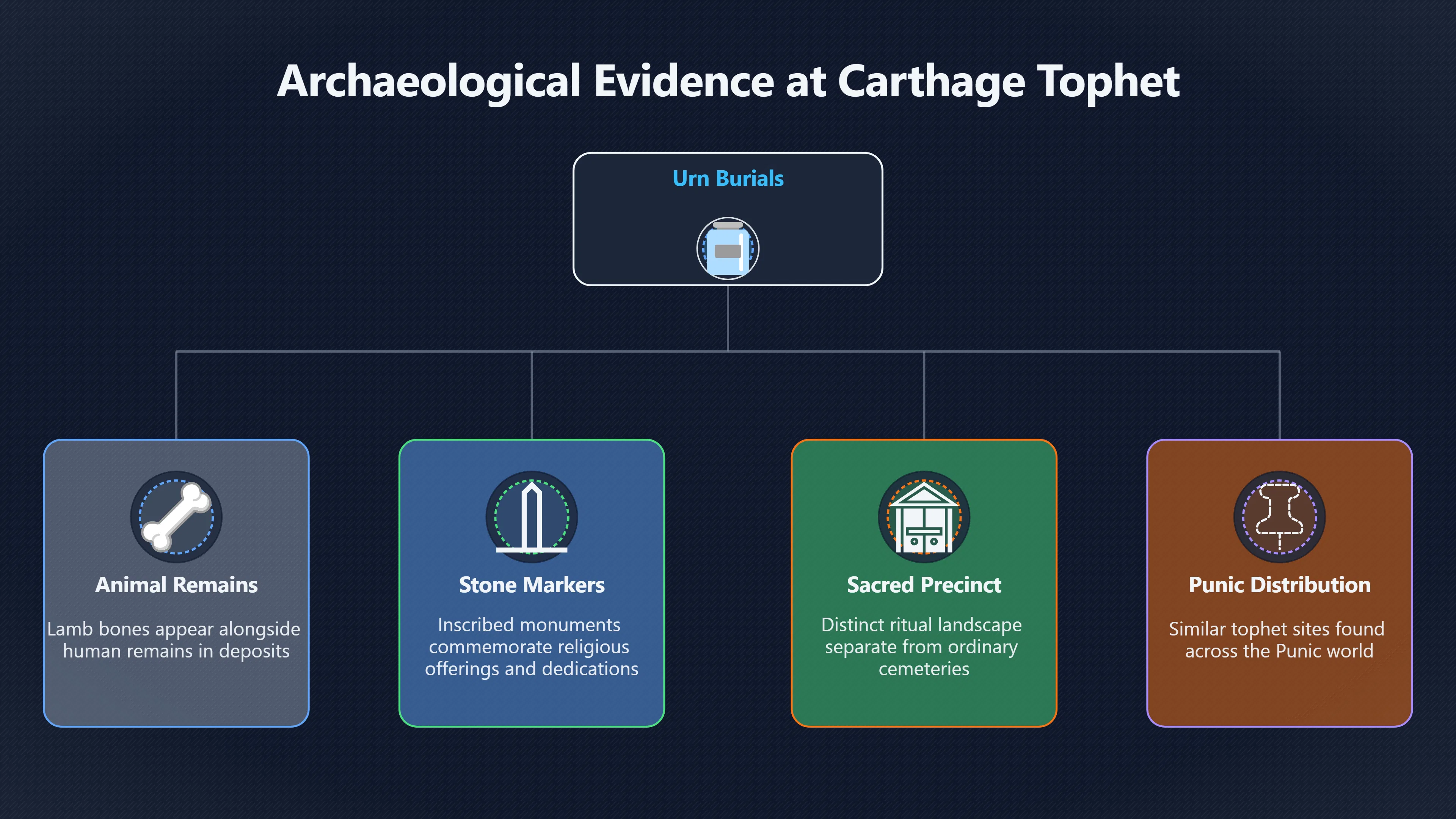
The archaeological discoveries at Carthage complicated that neat explanation. Excavations in the Salammbô district revealed a specialised sacred precinct, conventionally called a “tophet”, containing thousands of urn burials dating across centuries of Carthaginian history. The remains were not found in an ordinary cemetery. Instead, they appeared in a distinct ritual setting associated with religious monuments and inscriptions.[Wikipedia]WikipediaAncient CarthageAncient Carthage
What Greek and Roman Writers Claimed
Ancient accounts did not merely claim that children died; they claimed that children were deliberately offered to the gods.
According to several classical authors, Carthaginians performed sacrifices to deities commonly identified by modern scholars as Baal Hammon and Tanit. Some descriptions portray rituals carried out during national emergencies, when military defeat or disaster threatened the city. Diodorus, writing centuries after some of the events he described, claimed that hundreds of children were sacrificed during a crisis. Other writers presented similar stories, although details varied significantly between sources.[wikipedia.org]WikipediaAncient CarthageAncient Carthage
Those variations are one reason the texts remain controversial. The authors were not eyewitnesses. Their accounts sometimes contradict one another regarding how the rituals were conducted and the ages of the victims. Some describe older children, whereas the archaeological remains largely belong to infants, newborns and foetuses. These inconsistencies have led critics to question how much of the literary tradition reflects reality and how much reflects hostile storytelling.[Wikipedia]WikipediaOpen source on wikipedia.org.
Yet the texts cannot simply be dismissed. Independent authors writing in different periods preserved broadly similar accusations, and some historians argue that enemy propaganda can still contain genuine information. The challenge is determining which parts of the tradition reflect real practices and which parts represent exaggeration.[Cambridge University Press & Assessment]cambridge.orgCambridge University Press & AssessmentTwo tales of one city: data, inference and Carthaginian…by JH Schwartz · 2017 · Cited by 37 — R…
What the Burial Site Actually Contained
The archaeological evidence is the reason the debate remains alive.
The Carthage tophet contained thousands of urns holding cremated human remains, usually from very young individuals. Many urns also contained animal bones, especially lambs. Above the burials stood stone markers, some bearing inscriptions associated with offerings and religious dedications. The site was used repeatedly over centuries, creating a large and distinctive ritual landscape.[Wikipedia]WikipediaAncient CarthageAncient Carthage
Several features have convinced many archaeologists that the site was not merely a cemetery for infants who died naturally:
- The burials occurred in a specialised sacred precinct rather than a conventional graveyard.
- Some inscriptions appear to commemorate offerings made to deities.
- Animal remains occur alongside human remains in ways that resemble ritual deposits.
- Similar tophet sites have been found elsewhere in the Punic world, suggesting a wider religious institution rather than a local burial custom.[wikipedia.org]WikipediaOpen source on wikipedia.org.
Researchers supporting the sacrifice interpretation also point out that the number of burials is far lower than would be expected if the site contained all infant deaths from a major city over several centuries. They argue that the tophet appears selective, which is more consistent with ritual offerings than ordinary infant burial.[Wikipedia]WikipediaOpen source on wikipedia.org.
In 2014, a group of scholars argued that the cumulative archaeological evidence overwhelmingly supported the reality of child sacrifice. Their work attracted widespread attention because it challenged decades of scholarship that had emphasised propaganda explanations.[Oxford University]ox.ac.uk2014 01 23 ancient carthaginians really did sacrifice their childrenford UniversityAncient Carthaginians really did sacrifice their children23 Jan 2014 — Oxford University, suggests that Carthaginian par…
Why the Evidence Still Divides Researchers
Despite dramatic headlines, the archaeological evidence does not provide a straightforward answer.
One major difficulty is that cremation destroys information. Burned infant bones are fragile, fragmented and difficult to analyse. Determining precise age at death is challenging, and identifying cause of death is usually impossible. Archaeologists therefore cannot simply examine a skeleton and conclude whether a child died naturally or was deliberately killed.[PubMed]pubmed.ncbi.nlm.nih.govSkeletal remains from Punic Carthage do not support…by JH Schwartz · 2010 · Cited by 130 — Our diverse approaches to analyzing t…
This limitation lies at the centre of the dispute. A prominent study published in 2010 concluded that the age distribution of the remains resembled patterns expected from natural perinatal and infant mortality. The authors argued that the tophet functioned as a cemetery for children who died shortly before or after birth rather than as evidence of systematic sacrifice.[PubMed]pubmed.ncbi.nlm.nih.govSkeletal remains from Punic Carthage do not support…by JH Schwartz · 2010 · Cited by 130 — Our diverse approaches to analyzing t…
Other researchers strongly disagreed. Subsequent analyses argued that the ages had been estimated incorrectly and that the remains included older infants than the cemetery interpretation would predict. These scholars maintained that the archaeological pattern fits ritual sacrifice better than natural mortality. The disagreement became a methodological argument about how to interpret damaged cremated bones rather than a simple dispute over facts.[researchgate.net]researchgate.netAge estimations attest to infant sacrifice at the Carthage TophetMacchiarelli: Two tales of one city: data, inference and Carthaginian infant sacrifice. Antiquity 91: 442–54; the following page…Read…
The debate also extends to inscriptions. Some specialists view the texts as direct evidence of offerings made to deities. Others argue that a child who died naturally could still be symbolically offered to a god during burial, meaning the inscriptions do not automatically prove sacrificial killing.[Wikipedia]WikipediaOpen source on wikipedia.org.
Propaganda, Misunderstanding or Partial Truth?
The dispute persists because neither extreme position fully explains all the evidence.
The strongest sceptical argument is that ancient enemies had every incentive to portray Carthage as barbaric. Similar accusations have often appeared in political and religious conflicts throughout history. It is therefore plausible that some classical stories exaggerated the scale, frequency or nature of Carthaginian rituals.[Wikipedia]WikipediaOpen source on wikipedia.org.
The strongest argument against the “pure propaganda” explanation is that archaeology uncovered exactly the kind of unusual infant cremation precinct that ancient writers described. Even scholars who reject large-scale sacrifice must explain why these distinctive sites existed and why they combined infant remains, animal remains, religious inscriptions and ritual monuments.[wikipedia.org]WikipediaAncient CarthageAncient Carthage
As a result, many modern researchers occupy a middle ground. They accept that ritual sacrifice probably occurred at least occasionally, while remaining sceptical of the most sensational ancient stories. Others continue to favour the cemetery interpretation but acknowledge that the archaeological context is difficult to reconcile with a normal burial ground.[cambridge.org]cambridge.orgCambridge University Press & AssessmentTwo tales of one city: data, inference and Carthaginian…by JH Schwartz · 2017 · Cited by 37 — R…
Why the Carthage Debate Matters
The Carthaginian child-sacrifice controversy is relevant to the history of contested truth because it demonstrates how difficult it can be to separate propaganda from reality.
Unlike many famous historical myths, this dispute has never produced a decisive moment of exposure. Archaeology did not simply confirm the ancient accusations, nor did it completely disprove them. Instead, each new study has generated fresh arguments about data, methods and interpretation.[cambridge.org]cambridge.orgCambridge University Press & AssessmentTwo tales of one city: data, inference and Carthaginian…by JH Schwartz · 2017 · Cited by 37 — R…
For Tunisia’s history of disputed claims, the case is especially revealing. A story once dismissed by many scholars as enemy slander gained new credibility through archaeological discoveries, yet those discoveries themselves remain open to competing interpretations. The result is not a solved mystery but a continuing debate over how historians should weigh hostile testimony, fragmentary physical evidence and the limits of scientific reconstruction. Carthage’s infant burials therefore occupy a rare position in historical scholarship: they are neither a proven hoax nor a settled fact, but one of the ancient world’s most enduring arguments about what really happened.[cambridge.org]cambridge.orgCambridge University Press & AssessmentTwo tales of one city: data, inference and Carthaginian…by JH Schwartz · 2017 · Cited by 37 — R…
Amazon book picks
Further Reading
Books and field guides related to Did Carthage Really Sacrifice Its Children?. Use these as the next step if you want deeper reading beyond the article.
In Search of the Phoenicians
Provides broader context for Phoenician and Carthaginian societies.
The Archaeology of Knowledge
Encourages critical examination of how historical interpretations are formed.
eBay marketplace picks
Marketplace Samples
Live-tested eBay searches with available results related to this page.
Endnotes
1.
Source: cambridge.org
Link:https://www.cambridge.org/core/journals/antiquity/article/two-tales-of-one-city-data-inference-and-carthaginian-infant-sacrifice/5006E240CB75A1E324B3230F6DA17389
Source snippet
Cambridge University Press & AssessmentTwo tales of one city: data, inference and Carthaginian...by JH Schwartz · 2017 · Cited by 37 — R...
2.
Source: Wikipedia
Link:https://en.wikipedia.org/wiki/Tophet
3.
Source: Wikipedia
Title: Ancient Carthage
Link:https://en.wikipedia.org/wiki/Ancient_Carthage
4.
Source: armstronginstitute.org
Link:https://armstronginstitute.org/1182-the-tophet-where-israelites-sacrificed-their-children
Source snippet
Lopez and...Read more...
5.
Source: researchgate.net
Title: Age estimations attest to infant sacrifice at the Carthage Tophet
Link:https://www.researchgate.net/profile/Patricia-Smith-28/publication/285856523_Age_estimations_attest_to_infant_sacrifice_at_the_Carthage_Tophet/links/6432e228609c170a1304d358/Age-estimations-attest-to-infant-sacrifice-at-the-Carthage-Tophet.pdf
Source snippet
Macchiarelli: Two tales of one city: data, inference and Carthaginian infant sacrifice. Antiquity 91: 442–54; the following page...Read...
6.
Source: researchgate.net
Title: 315982662 Two tales of one city Data inference and Carthaginian infant sacrifice
Link:https://www.researchgate.net/publication/315982662_Two_tales_of_one_city_Data_inference_and_Carthaginian_infant_sacrifice
7.
Source: researchgate.net
Link:https://www.researchgate.net/publication/323045176_Two_tales_of_one_city_data_inference_and_Carthaginian_infant_sacrifice-CORRIGENDUM
8.
Source: researchgate.net
Title: 285856523 Age estimations attest to infant sacrifice at the Carthage Tophet
Link:https://www.researchgate.net/publication/285856523_Age_estimations_attest_to_infant_sacrifice_at_the_Carthage_Tophet
9.
Source: cambridge.org
Link:https://www.cambridge.org/core/journals/antiquity/article/two-tales-of-one-city-data-inference-and-carthaginian-infant-sacrificecorrigendum/540750F4FA3B7868BD11F4096DD54B25
10.
Source: cambridge.org
Link:https://www.cambridge.org/core/journals/antiquity/article/cemetery-or-sacrifice-infant-burials-at-the-carthage-tophet/DAC7C386CD20F5C280C9DB41E5184A2E
11.
Source: Wikipedia
Link:https://en.wikipedia.org/wiki/Oxford
12.
Source: Wikipedia
Title: Carthage tophet
Link:https://en.wikipedia.org/wiki/Carthage_tophet
13.
Source: biblicalarchaeology.org
Title: did the carthaginians really practice infant sacrifice
Link:https://www.biblicalarchaeology.org/daily/ancient-cultures/did-the-carthaginians-really-practice-infant-sacrifice/
Source snippet
Biblical Archaeology SocietyDid the Carthaginians Really Practice Infant Sacrifice?5 Feb 2014 — Plutarch and other ancient Greek and Roma...
14.
Source: ox.ac.uk
Title: 2014 01 23 ancient carthaginians really did sacrifice their children
Link:https://www.ox.ac.uk/news/2014-01-23-ancient-carthaginians-really-did-sacrifice-their-children
Source snippet
ford UniversityAncient Carthaginians really did sacrifice their children23 Jan 2014 — Oxford University, suggests that Carthaginian par...
15.
Source: pubmed.ncbi.nlm.nih.gov
Link:https://pubmed.ncbi.nlm.nih.gov/20174667/
Source snippet
Skeletal remains from Punic Carthage do not support...by JH Schwartz · 2010 · Cited by 130 — Our diverse approaches to analyzing t...
16.
Source: oup.com.au
Link:https://www.oup.com.au/
17.
Source: ox.ac.uk
Link:https://www.ox.ac.uk/
18.
Source: theschoollocker.com.au
Link:https://theschoollocker.com.au/oxford-university-press-australian-school-oxford-dictionary-7th-edition
19.
Source: facebook.com
Link:https://www.facebook.com/oupanz/
20.
Source: historicmysteries.com
Title: carthage tophet
Link:https://www.historicmysteries.com/archaeology/carthage-tophet/22738/
21.
Source: pmc.ncbi.nlm.nih.gov
Link:https://pmc.ncbi.nlm.nih.gov/articles/PMC2822869/
Additional References
22.
Source: youtube.com
Title: Did the Carthaginians sacrifice children?
Link:https://www.youtube.com/watch?v=39Vx7HospeA
Source snippet
Child Sacrifice, Abortion, and the Bible (Part Two): Digging for Truth-Episode 39...
23.
Source: academia.edu
Link:https://www.academia.edu/12347210/The_background_to_and_current_debate_on_the_issue_of_Carthaginian_child_sacrifice
24.
Source: academia.edu
Link:https://www.academia.edu/34254750/Two_Tales_of_One_City_suppl_age_distributions_pdf_Supplemental_material
25.
Source: amazon.com.au
Link:https://www.amazon.com.au/oxford-dictionary/s?k=oxford+dictionary&tag=searcht-20
26.
Source: facebook.com
Link:https://www.facebook.com/groups/historicalmarvels/posts/1574244460524361/
27.
Source: phoenicia.org
Link:https://phoenicia.org/childsacrifice
28.
Source: medium.com
Link:https://medium.com/teatime-history/did-an-advanced-ancient-culture-practice-child-sacrifice-cd03e4dad2f6
29.
Source: reddit.com
Link:https://www.reddit.com/r/AskHistory/comments/1f185ez/did_the_carthaginians_and_phoenicians_actually/
30.
Source: reddit.com
Link:https://www.reddit.com/r/PhoeniciaHistoryFacts/comments/1q4o2ap/on_the_subject_of_child_sacrifice_in_phoenicia/
31.
Source: oxforddigital.com.au
Link:https://www.oxforddigital.com.au/
Topic Tree