Within Argentina Hoaxes
How Did Patagonia Become a Land of Giants?
The giant Patagonians story shows how distance, repetition and commercial publishing turned uncertain observations into accepted fact.
On this page
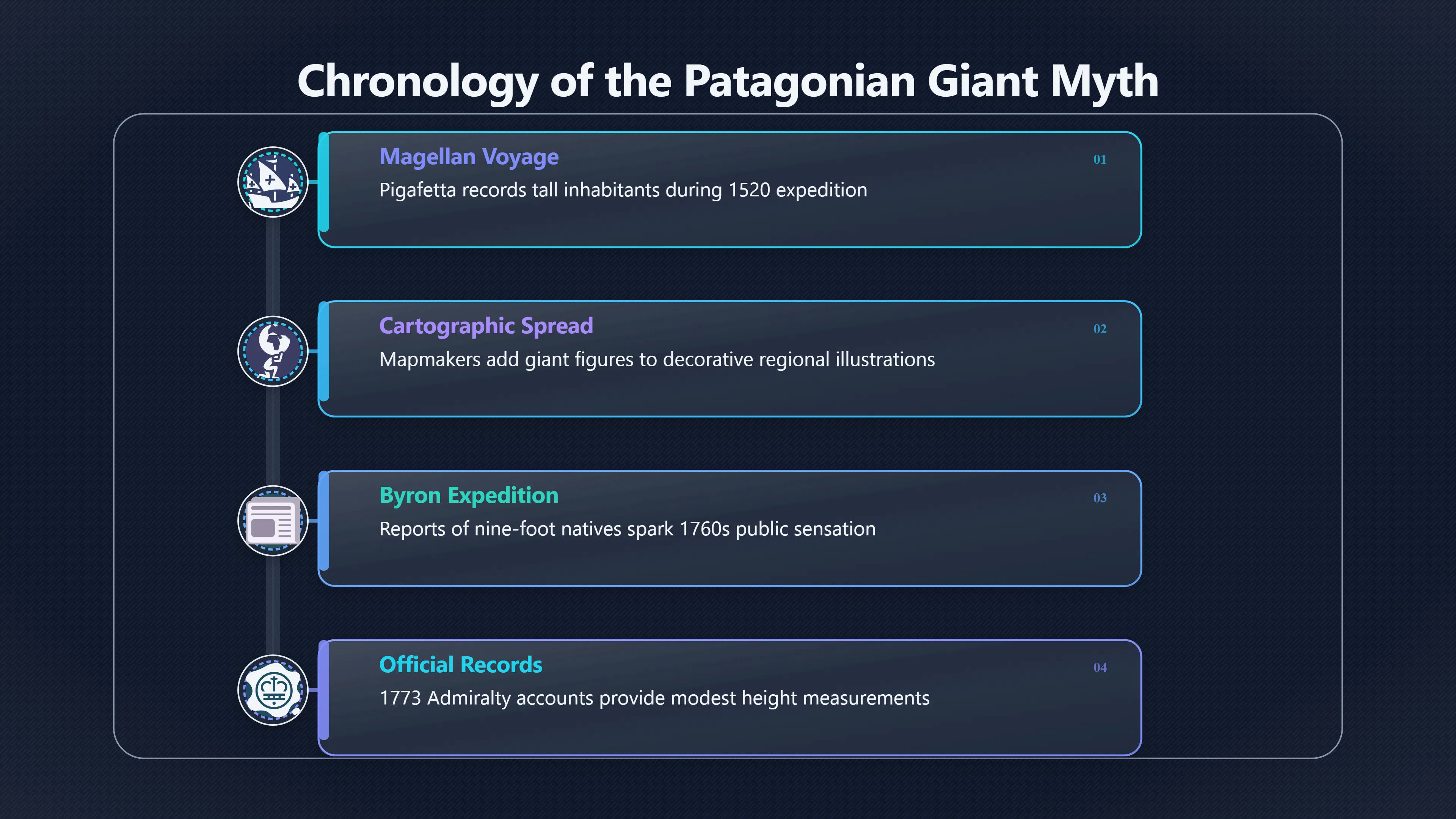
- Magellan and the earliest reports
- Publishers, maps and exaggeration
- Why the legend survived so long
Page outline Jump by section
Introduction
For more than two centuries, many Europeans believed that Patagonia, in what is now southern Argentina and Chile, was inhabited by giants. The claim was never based on a single deliberate fraud. Instead, it emerged from a mixture of genuine encounters, cultural misunderstandings, travellers’ tales, commercial publishing and the difficulty of verifying information from distant lands. By the seventeenth and eighteenth centuries, maps, books and illustrations routinely presented Patagonia as a place where extraordinary people lived, turning a fleeting observation into one of the most durable colonial myths of the early modern world.[static-prod.lib.princeton.edu]static-prod.lib.princeton.eduPatagonian GiantsThe myth of the Patagonian Giants, like other stories about remote, exotic places, captured the European imagination for…

The story matters because it shows how misinformation could spread long before modern mass media. A report written by a handful of sailors became accepted fact through repetition. Each retelling made the giants seem more real, while the people actually encountered in Patagonia disappeared behind a European fantasy of marvels at the edge of the known world.[static-prod.lib.princeton.edu]static-prod.lib.princeton.eduPatagonian GiantsThe myth of the Patagonian Giants, like other stories about remote, exotic places, captured the European imagination for…
Magellan and the earliest reports
The legend began during Ferdinand Magellan’s expedition of 1520. While wintering at Puerto San Julián, the expedition encountered Indigenous inhabitants of Patagonia, probably belonging to Tehuelche groups. Antonio Pigafetta, the voyage’s chronicler, described one man as exceptionally tall, claiming that the Europeans reached only to his waist. Later readers interpreted this as evidence that the region was populated by giants.[princeton.edu]static-prod.lib.princeton.eduPatagonian GiantsThe myth of the Patagonian Giants, like other stories about remote, exotic places, captured the European imagination for…
Modern historians generally view the account as an exaggeration rather than an outright invention. Sixteenth-century European sailors were often shorter than modern people, and many Patagonian Indigenous people were notably tall by European standards. Clothing made from animal skins, large guanaco-hide footwear and the unfamiliar setting may have enhanced the impression. What began as a description of unusual height gradually became a claim about an entire race of gigantic humans.[cascada.travel]cascada.travelThe Truth About Patagonia's GiantsSeptember 30, 2014 — Patagonia may thus mean 'land of the bigfoot', the native people were far taller than any Europeans the crew had see…
The naming of Patagonia itself became entangled with the myth. For centuries many people assumed the name referred to large feet and therefore to giant inhabitants. Researchers now generally favour a different explanation: Magellan may have borrowed the name from “Patagón”, a wild character in a popular chivalric romance that was widely read in his era. Even the region’s name therefore reflects how literary imagination shaped European perceptions of Patagonia from the beginning.[Wikipedia]WikipediaOpen source on wikipedia.org.
Publishers, maps and exaggeration
The giant story survived because it moved beyond eyewitness testimony and entered the commercial world of print. Once Pigafetta’s account circulated, later explorers often interpreted what they saw through the lens of existing expectations. Reports by Francis Drake’s expedition, Dutch navigators and other travellers appeared to confirm that Patagonia contained unusually large people, even when the descriptions varied widely.[Wikipedia]WikipediaOpen source on wikipedia.org.
Mapmakers played a crucial role. Early modern maps frequently included illustrations, monsters and marvels alongside geographical information. Patagonia was sometimes labelled as a “region of giants”, and giant figures appeared in decorative cartouches and illustrations. These images gave visual authority to stories that few readers could independently verify. A claim repeated on maps seemed less like rumour and more like established knowledge.[Wikipedia]WikipediaOpen source on wikipedia.org.
Publishing incentives encouraged further embellishment. Exotic discoveries sold books. Readers in Europe expected travel literature to reveal wonders from distant continents, and accounts of giant Patagonians fit perfectly into that market. The more remote Patagonia appeared, the harder it was to challenge sensational descriptions. Distance itself became part of the myth-making machinery.[static-prod.lib.princeton.edu]static-prod.lib.princeton.eduPatagonian GiantsThe myth of the Patagonian Giants, like other stories about remote, exotic places, captured the European imagination for…
A striking example came in the 1760s after Commodore John Byron’s voyage aboard HMS Dolphin. Reports spread across Britain and Europe that Byron’s crew had encountered natives nine feet tall. Newspapers and popular accounts amplified the claim, triggering renewed excitement about Patagonian giants. The story became a publishing sensation precisely because it seemed to confirm a belief that had already existed for generations.[hoaxes.org]hoaxes.orgthe patagonian giants1766)The rumor of Patagonian giants was only definitively proven to be fictitious when the official account of Byron's voyage appeared i…
Why people believed the giants existed
The legend flourished because it fit broader European ideas about unexplored territories. Early modern readers often expected distant regions to contain extraordinary peoples, strange animals and natural wonders. Medieval and Renaissance traditions were filled with stories of monstrous races living at the edges of the world, and Patagonia became a convenient location for those expectations.[static-prod.lib.princeton.edu]static-prod.lib.princeton.eduPatagonian GiantsThe myth of the Patagonian Giants, like other stories about remote, exotic places, captured the European imagination for…
Several factors reinforced belief:
- Geographical remoteness: Few Europeans could travel to Patagonia and check the claims for themselves.[static-prod.lib.princeton.edu]static-prod.lib.princeton.eduPatagonian GiantsThe myth of the Patagonian Giants, like other stories about remote, exotic places, captured the European imagination for…
- Authority of explorers: Accounts came from respected navigators whose reports were treated as reliable evidence.[Wikipedia]WikipediaOpen source on wikipedia.org.
- Repetition across media: Books, maps, illustrations and newspapers repeated the same story until it appeared established.[princeton.edu]static-prod.lib.princeton.eduPatagonian GiantsThe myth of the Patagonian Giants, like other stories about remote, exotic places, captured the European imagination for…
- Visible kernels of truth: Patagonian peoples were often taller than contemporary Europeans, making the exaggeration seem plausible.[Explorersweb]explorersweb.comexploration mysteries the giants of patagoniaExploration Mysteries: The Giants of Patagonia9 Jun 2024 — While exploring Patagonia in the 1500s, Ferdinand Magellan claimed…
The myth therefore occupied an ambiguous space between observation and fantasy. It was not entirely invented from nothing, yet neither was it supported by accurate measurement.
How the giant story was challenged
By the eighteenth century, explorers increasingly relied on systematic observation and measurement rather than anecdote. This shift gradually undermined the giant narrative.
French explorer Louis Antoine de Bougainville and other navigators measured the height of Patagonian people they encountered and found them tall but entirely within the normal human range. Similar observations by British and Spanish expeditions produced comparable results. Rather than towering monsters, the inhabitants were generally between about six and six and a half feet tall—impressive for the period but not gigantic.[Wikipedia]WikipediaOpen source on wikipedia.org.
The decisive blow came from the publication of more complete official records. Sensational reports associated with Byron’s voyage had described giants approaching nine feet in height, but the Admiralty-sponsored account published in 1773 presented a far more modest reality. The discrepancy revealed how rumours, selective reporting and commercial enthusiasm had inflated the original observations.[hoaxes.org]hoaxes.orgthe patagonian giants1766)The rumor of Patagonian giants was only definitively proven to be fictitious when the official account of Byron's voyage appeared i…
Importantly, the myth did not collapse overnight. Many readers preferred the exciting version of the story. Even after scholars and explorers challenged the giant claims, images of giant Patagonians continued to appear in popular culture, travel literature and exhibitions.[ResearchGate]researchgate.netResearchGate(PDF) "Patagonian Giants, Frankenstein's Creature, and…'Patagonian' explorer of Europe highlights the cataclysmic nature o…

Why the legend survived so long
The persistence of the Patagonian giants reveals how colonial myths are created. Once an idea becomes embedded in maps, books and public imagination, correcting it can be difficult. Later evidence must compete not only with the original claim but also with centuries of repetition.
The legend also served symbolic purposes. For European audiences, Patagonia represented one of the furthest and least familiar regions of the world. Filling it with giants transformed a distant landscape into a stage for wonder and adventure. The myth helped present exploration as a journey into a realm of marvels rather than an encounter with real Indigenous societies.[static-prod.lib.princeton.edu]static-prod.lib.princeton.eduPatagonian GiantsThe myth of the Patagonian Giants, like other stories about remote, exotic places, captured the European imagination for…
In that sense, the story belongs less to the history of giants than to the history of information. It demonstrates how observation becomes exaggeration, exaggeration becomes accepted knowledge, and accepted knowledge can survive long after the evidence has disappeared. Patagonia did not become a land of giants because giants existed there. It became a land of giants because early reports, commercial publishing and colonial imagination combined to create a story that people wanted to believe.[hoaxes.org]hoaxes.orgthe patagonian giants1766)The rumor of Patagonian giants was only definitively proven to be fictitious when the official account of Byron's voyage appeared i…
Amazon book picks
Further Reading
Books and field guides related to How Did Patagonia Become a Land of Giants?. Use these as the next step if you want deeper reading beyond the article.
Over the Edge of the World
Covers the expedition linked to the origins of the Patagonian giants legend.
Extraordinary Popular Delusions and the Madness of Crowds
Rating: 4.0/5 from 5 Google Books ratings
Illustrates how repeated stories can become accepted truth.
The Last Imaginary Place
Shows how remote regions become canvases for exaggerated stories.
eBay marketplace picks
Marketplace Samples
Live-tested eBay searches with available results related to this page.



Endnotes
1.
Source: static-prod.lib.princeton.edu
Link:https://static-prod.lib.princeton.edu/visual_materials/maps/websites/pacific/magellan-strait/patgonian-giants.html
Source snippet
Patagonian GiantsThe myth of the Patagonian Giants, like other stories about remote, exotic places, captured the European imagination for...
2.
Source: Wikipedia
Link:https://en.wikipedia.org/wiki/Patagons
3.
Source: Wikipedia
Link:https://en.wikipedia.org/wiki/Patagonia
4.
Source: cascada.travel
Title: The Truth About Patagonia’s Giants
Link:https://www.cascada.travel/blog/the-truth-about-patagonia-s-giants
Source snippet
September 30, 2014 — Patagonia may thus mean 'land of the bigfoot', the native people were far taller than any Europeans the crew had see...
Published: September 30, 2014
5.
Source: explorersweb.com
Title: exploration mysteries the giants of patagonia
Link:https://explorersweb.com/exploration-mysteries-the-giants-of-patagonia/
Source snippet
Exploration Mysteries: The Giants of Patagonia9 Jun 2024 — While exploring Patagonia in the 1500s, Ferdinand Magellan claimed...
6.
Source: Wikipedia
Title: Americae Sive Quartae Orbis Partis Nova Et Exactissima Descriptio
Link:https://en.wikipedia.org/wiki/Americae_Sive_Quartae_Orbis_Partis_Nova_Et_Exactissima_Descriptio
7.
Source: hoaxes.org
Title: the patagonian giants
Link:https://hoaxes.org/archive/permalink/the_patagonian_giants
Source snippet
(1766)The rumor of Patagonian giants was only definitively proven to be fictitious when the official account of Byron's voyage appeared i...
8.
Source: researchgate.net
Link:https://www.researchgate.net/publication/264336777_Patagonian_Giants_Frankenstein%27s_Creature_and_Contact_Zone_Catastrophe_Prisms_Essays_in_Romanticism_Forthcoming_2014
Source snippet
ResearchGate(PDF) "Patagonian Giants, Frankenstein's Creature, and...'Patagonian' explorer of Europe highlights the cataclysmic nature o...
9.
Source: patlibros.org
Link:https://patlibros.org/frm/index.php?fun=myth
Source snippet
Finally, in 1773, an official account of Byron's voyage was published; now a more credible picture emerged. The concept of...Read more...
10.
Source: facebook.com
Link:https://www.facebook.com/groups/1832536467232553/posts/2150500922102771/
11.
Source: scribd.com
Title: The Patagonian Giants
Link:https://www.scribd.com/document/883490415/The-Patagonian-Giants
Additional References
12.
Source: youtube.com
Link:https://www.youtube.com/watch?v=zKdSWTbbLlo
Source snippet
Antonio Pigafetta: The First Voyage Around the World...
13.
Source: youtube.com
Title: Myths of Magellan’s Death And His Secrets You Didn’t Know
Link:https://www.youtube.com/watch?v=MnEF-QMrDN4
Source snippet
The Mystery of the Patagonian Giants: Myth or Reality? The Definitive Investigation...
14.
Source: youtube.com
Title: Giants of Patagonia: Legends of the New World | History Documentary
Link:https://www.youtube.com/watch?v=ebadnPUHuls
Source snippet
Patagonia: the myth of the giants that never existed...
15.
Source: youtube.com
Title: Patagonia: the myth of the giants that never existed
Link:https://www.youtube.com/watch?v=QlHd46AyiG0
Source snippet
Myths of Magellan's Death And His Secrets You Didn't Know...
16.
Source: reddit.com
Link:https://www.reddit.com/r/wikipedia/comments/1cb4f64/the_patagones_were_a_race_of_giant_humans/
17.
Source: facebook.com
Link:https://www.facebook.com/100086006835545/posts/the-existence-of-giants-here-is-confirmed-dr-matthew-maty-secretary-of-the-briti/923202323889987/
18.
Source: instagram.com
Link:https://www.instagram.com/p/DSk0P__jBl3/
19.
Source: reddit.com
Title: when ferdinand magellan circumnavigated the earth
Link:https://www.reddit.com/r/AskHistorians/comments/6vjxgm/when_ferdinand_magellan_circumnavigated_the_earth/
20.
Source: youtube.com
Title: Antonio Pigafetta: The First Voyage Around the World
Link:https://www.youtube.com/watch?v=rN1RKoWFK18
21.
Source: thatjoescott.com
Title: real historical accounts of giants
Link:https://thatjoescott.com/2023/10/02/real-historical-accounts-of-giants/
Topic Tree