How False Stories Changed Uruguay's History
Uruguay does not have a single world-famous hoax comparable with Britain’s Piltdown Man or the United States’ Cardiff Giant.
Page outline Jump by section
Introduction
These cases did not all begin as jokes or deliberate public hoaxes. Some were military deception, organised fraud or political misinformation; others were simplified historical claims repeated until they acquired the authority of common knowledge. Together, however, they show the same basic mechanism. A false story succeeds when it fits what its audience already expects, travels through trusted channels and is difficult to check quickly. Uruguay’s experience also shows how deception is exposed: through documentary records, forensic investigation, demographic and genetic research, collaborative journalism and patient comparison with official data.
The bluff that sank the Graf Spee
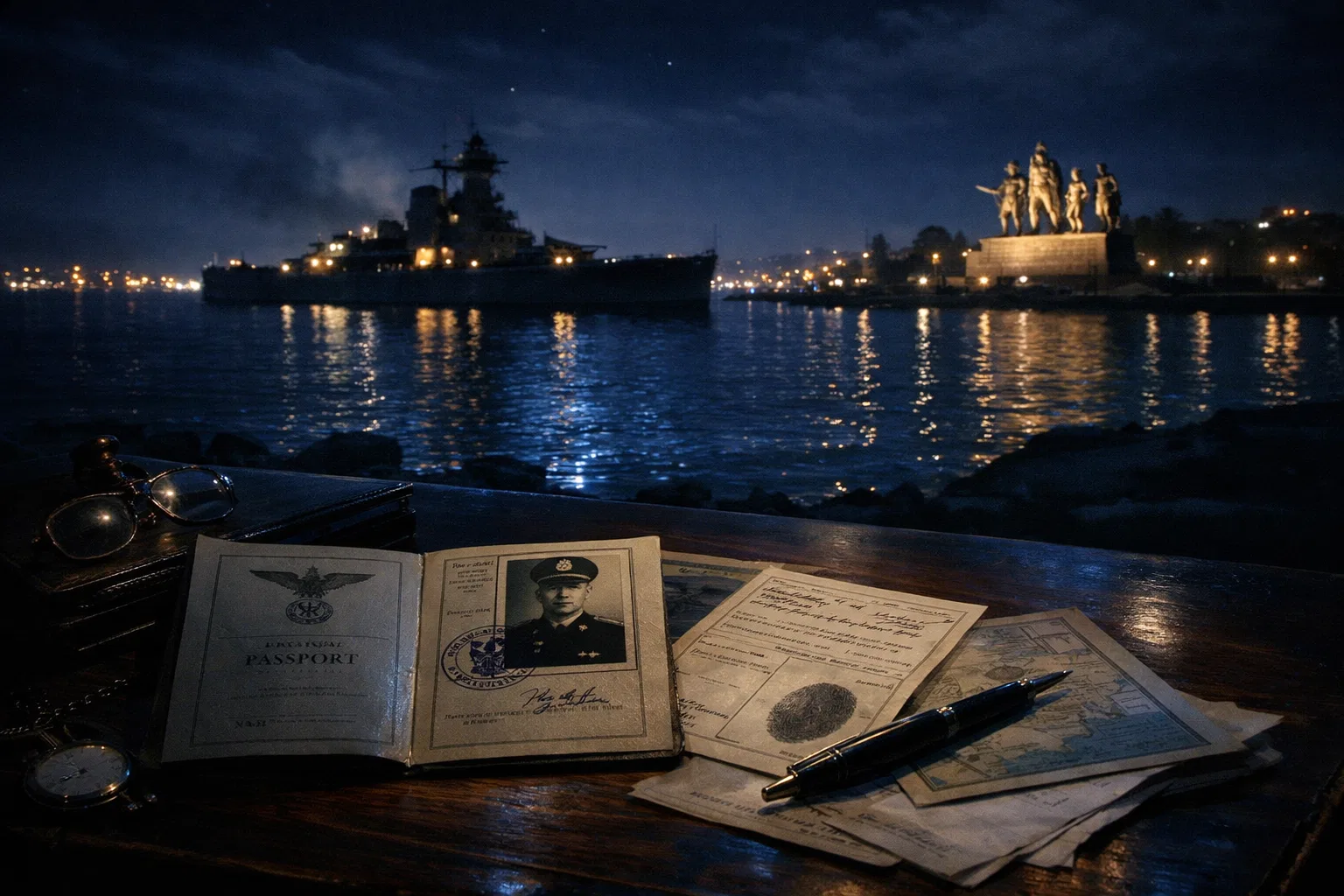
One of the most consequential deceptions associated with Uruguay occurred during the first months of the Second World War. After fighting three British cruisers at the Battle of the River Plate on 13 December 1939, the damaged German warship Admiral Graf Spee entered neutral Montevideo. International law gave its commander, Captain Hans Langsdorff, only limited time to make repairs before leaving, accepting internment or destroying the vessel.
The British ships outside the estuary were not strong enough to guarantee victory if the Graf Spee attempted a breakout. British intelligence therefore tried to make Langsdorff believe that much more powerful forces, including an aircraft carrier and a battlecruiser, were approaching. Agents reportedly circulated rumours around Montevideo’s docks, while misleading information was passed over telephone lines that the British expected German representatives to monitor.[History Hit]historyhit.comHistory HitThe Battle of the River Plate: How Britain Tamed the Graf…British set about deceiving the Graf Spee into believing that a h…
The bluff worked partly because it reinforced Langsdorff’s existing fears. His ship was damaged, ammunition was limited and German diplomats could not offer reliable intelligence about British movements. On 17 December, watched by crowds along the Uruguayan coast, the Graf Spee sailed into the River Plate and was deliberately blown up by its own crew. The superior British squadron that Langsdorff feared was not waiting for him.[Wikipedia]WikipediaGerman cruiser Admiral Graf SpeeJuly 14, 2002 — Convinced by false reports of superior British naval forces gathering, Hans Langsdorff, commander of the ship, ordered th…
This episode is sometimes reduced to a clever trick that single-handedly defeated the ship. That overstates the case. Damage from the battle, diplomatic pressure, fuel and ammunition problems, the danger to the crew and Langsdorff’s interpretation of his orders all mattered. The deception was effective because it altered a difficult decision rather than creating the difficulty from nothing.
It remains an unusually clear example of how misinformation can become a weapon. The British did not need to forge a battleship or produce a convincing photograph. They needed only to plant a believable picture of forces just beyond sight. Montevideo’s docks, newspapers, diplomats and telephone networks became part of the battlefield.
Were the four captives really the “last Charrúas”?
A different kind of falsehood became embedded in Uruguay’s national story: the claim that the Charrúa people disappeared completely in the nineteenth century. The phrase “the last Charrúas” was applied to Vaimaca Pirú, Senaqué, Tacuabé and Guyunusa, four Indigenous captives transported to France in 1833 and exhibited before paying audiences. A prominent monument in Montevideo later fixed the four in public memory as the final representatives of an extinct people. Uruguay’s museum service acknowledges that this “last” description became established in national and international literature.[museos.uy]museos.uyPoco a poco estos "últimos charrúas" fueron enfermando y muriendo. Primero Senaqué, luego…Read more…
The underlying history was real and brutal. In 1831, government forces attacked Charrúa groups at Salsipuedes after summoning leaders under deceptive pretences. Survivors were killed in later operations, dispersed, forced into domestic service or absorbed into rural society. The four taken to France suffered another form of exploitation: presented as ethnographic curiosities, they were observed, measured and displayed rather than treated as free travellers.
What became misleading was the leap from military defeat and cultural suppression to total biological and social extinction. For generations, official narratives commonly described Uruguay as a country created almost entirely by European immigrants. Charrúa identity survived largely as a symbol detached from living Indigenous people, most famously in the sporting expression “Charrúa spirit”.[El País]elpais.comEl País Uruguay: Un país sin indios | Planeta Futuro | EL PAÍSEl País Uruguay: Un país sin indios | Planeta Futuro | EL PAÍS
Research and renewed self-identification have made that picture untenable. Uruguay’s 2011 census found that nearly 5 per cent of the population identified Indigenous ancestry, while biological-anthropology research reported substantially higher levels of Indigenous ancestry through maternal lines. Such genetic findings cannot identify every ancestor as Charrúa, nor do they determine cultural identity, but they contradict the simpler claim that Indigenous descent vanished from Uruguay.[El País]elpais.comEl País Uruguay: Un país sin indios | Planeta Futuro | EL PAÍSEl País Uruguay: Un país sin indios | Planeta Futuro | EL PAÍS
Calling the extinction story a deliberate hoax would be too crude. It was closer to a national legend produced by violence, assimilation and selective memory. Some families concealed Indigenous ancestry to avoid discrimination; officials and historians treated cultural visibility as proof of biological disappearance; and public monuments elevated four named captives while making less visible the many survivors who entered the wider population.
The correction matters because the old story shaped more than historical trivia. If Indigenous people were assumed to have vanished, the state faced fewer questions about recognition, cultural continuity, responsibility for nineteenth-century violence or the political status of present-day communities. The debunking has therefore come not from one dramatic confession but from family histories, archival research, census responses, Indigenous organising and scientific evidence accumulated over decades.
The passport identities built from false ancestors
The Astesiano affair exposed a more conventional fraud: the manufacture of fictitious Uruguayan family connections for foreign clients. Alejandro Astesiano, who served as head of security to President Luis Lacalle Pou, was arrested in September 2022 during an investigation into a network that helped Russian citizens obtain Uruguayan identity documents.
The central deception exploited citizenship by descent. The network created or used false birth records claiming that a Russian applicant had a Uruguayan parent or other qualifying ancestor. Once the invented relationship entered the documentary chain, the applicant could seek genuine identity cards and passports. The final passport was therefore not necessarily a crude counterfeit: it could be an authentic state document issued on the basis of fraudulent civil records.[Reuters]reuters.comTop guard to Uruguay president detained in RussianTop guard to Uruguay president detained in Russian
This distinction explains why the scheme was potentially so effective. A forged passport may fail under inspection because of faulty printing, security features or numbering. A genuine passport produced through a false biography is much harder for border officials to identify. The deception had been moved upstream, into the records used to establish who the applicant supposedly was.
Investigators relied on suspicious applications, document examination, telephone data, messages and links between facilitators and public institutions. Reporting on the case showed that members of the organisation met in the Executive Tower, where the presidency is based. Astesiano eventually received a four-and-a-half-year prison sentence for offences including influence peddling, disclosure of confidential information and combining public duties with private interests.[latamjournalismreview.org]latamjournalismreview.orgOpen source on latamjournalismreview.org.
The affair became politically explosive because Astesiano was not an obscure street-level forger. His position gave him proximity to state information and the appearance of authority. That did not prove that the presidency directed the passport operation, but it demonstrated how criminal deception can benefit from access, institutional familiarity and the prestige of official surroundings.
It also illustrates a recurring feature of successful document fraud: the lie is rarely confined to one piece of paper. It is supported by a chain of mutually reinforcing records, intermediaries and procedures. Investigators must reconstruct that chain rather than simply asking whether the passport itself looks real.
How election falsehoods changed form online
Uruguay’s 2019 presidential election produced neither evidence of a vast foreign disinformation operation nor an overwhelming flood of fabricated news. It did, however, offer a useful picture of how modern political falsehoods circulate in a relatively trusted media environment.
Verificado Uruguay, a collaboration involving news organisations, civil-society groups and universities, monitored campaign statements and rumours. An academic study of its work identified 57 new checks published during the campaign period; more than 70 per cent of the verifications appeared in October and November as voting approached. Facebook accounted for roughly 44 per cent of the categorised distribution channels, followed by Twitter and WhatsApp.[SciELO]scielo.clOpen source on scielo.cl.
The misleading material ranged from incorrect statistics spoken by candidates to fabricated screenshots and genuine material placed in a false setting. One image might originate in Spain, be relabelled for an Argentine audience and later appear in Uruguay with yet another invented explanation. This recycling worked because an authentic-looking photograph carried emotional force even after its original context had been stripped away.[SciELO]scielo.clOpen source on scielo.cl.
Some prominent corrections concerned claims made during presidential debates. Daniel Martínez incorrectly stated that unemployment had been 20 per cent in 2005; official statistics put the annual average at 12.2 per cent. Luis Lacalle Pou made a separate false claim about levels of health monitoring for children and pregnant women. These were not anonymous internet inventions, but inaccurate statements delivered through the authority of televised political debate.[SciELO]scielo.clOpen source on scielo.cl.
Other examples were closer to familiar online hoaxes. False screenshots made it appear that candidates or public figures had posted offensive or absurd remarks. A message written by an Argentine user about alleged computerised electoral fraud was recirculated as though it had described events in Uruguay. Anonymous accounts disappeared after spreading claims, making the original source difficult to trace.[SciELO]scielo.clOpen source on scielo.cl.
The research found no evidence that Uruguay had developed a powerful alternative media ecosystem dedicated to sustained disinformation, and the main presidential candidates did not rely principally on extreme polarisation. That restraint is important: false content existed, but describing the election as wholly captured by fake news would itself be misleading.[SciELO]scielo.clOpen source on scielo.cl.
What did change was the speed and structure of exposure. Older hoaxes often required a newspaper editor, showman or official institution to reach a large audience. A false screenshot can now move through private messaging groups without a visible publisher. Collaborative verification became necessary because no single newsroom could easily monitor televised assertions, open social networks and encrypted conversations at the same time.
Why these stories were believed
Uruguay’s best-documented deception stories differ sharply in scale and purpose, yet several common conditions made them persuasive.
They fitted an existing expectation. Langsdorff already expected British reinforcements. The extinction narrative matched Uruguay’s preferred image as a European immigrant nation. Russian clients knew that genuine ancestry could unlock citizenship. Election rumours appealed to partisan suspicion.
They borrowed authority. Wartime gossip appeared to rest on intelligence. The “last Charrúas” label entered textbooks, monuments and official memory. Passport fraud manipulated civil registries and state procedures. Online falsehoods copied the visual design of news sites and social-media accounts.
They mixed truth with invention. The Graf Spee had genuinely been damaged. Charrúa communities had suffered catastrophic violence. Some political posts used real photographs or genuine quotations. Fraud is often more convincing when the false element is attached to an authentic event, document or image.
They exploited delays in verification. A naval commander had hours to decide. Marginalised families lacked the institutional influence to correct a national history. Border authorities trusted documents produced by another branch of government. Social-media claims could be shared thousands of times before journalists located the original source.
The exposures also followed a pattern. Investigators compared claims with records that had not been controlled by the storyteller: naval positions, census results, genetic studies, original civil documents, telephone messages and official statistics. No single method works for every deception, but independent evidence repeatedly proved more valuable than confidence, repetition or institutional prestige.
A history of contested truth rather than national gullibility
These episodes do not suggest that Uruguayans are unusually susceptible to fraud. Every society produces stories that reward patriotism, fear, profit, political loyalty or the desire for a tidy past. Uruguay’s history is distinctive mainly in the forms those stories took: a neutral port used as a stage for wartime psychological operations, an immigrant national identity built partly through Indigenous erasure, a respected passport system exploited through invented genealogy, and a compact media sphere developing collaborative defences against digital misinformation.
The most important distinction is between different kinds of untruth. The Graf Spee operation was deliberate military deception. The passport network was criminal fraud. Fabricated tweets were hoaxes or propaganda. The supposed extinction of the Charrúas was a historical myth sustained by state violence, assimilation and repetition rather than a single identifiable trickster.
Treating them all simply as “fake news” would hide what makes each case instructive. Their shared lesson is narrower and more useful: false stories become durable when institutions, technologies and expectations give them somewhere to attach. They begin to weaken when evidence is preserved, authority can be questioned and investigators reconstruct not only whether a claim was false, but how it acquired the appearance of truth.
Amazon book picks
Further Reading
Books and field guides related to How False Stories Changed Uruguay's History. Use these as the next step if you want deeper reading beyond the article.
The Demon-Haunted World
Rating: 4.5/5 from 43 Google Books ratings
Addresses belief, evidence, and public misconceptions.
The Art of Deception
Provides a framework for understanding how false stories succeed.
eBay marketplace picks
Marketplace Samples
Live-tested eBay searches with available results related to this page.
Endnotes
1.
Source: Wikipedia
Title: German cruiser Admiral Graf Spee
Link:https://en.wikipedia.org/wiki/German_cruiser_Admiral_Graf_Spee
Source snippet
July 14, 2002 — Convinced by false reports of superior British naval forces gathering, Hans Langsdorff, commander of the ship, ordered th...
Published: July 14, 2002
2.
Source: museos.uy
Link:https://museos.uy/index.php/component/k2/item/1719-guyunusa
Source snippet
Poco a poco estos "últimos charrúas" fueron enfermando y muriendo. Primero Senaqué, luego...Read more...
3.
Source: reuters.com
Title: Top guard to Uruguay president detained in Russian
Link:https://www.reuters.com/world/americas/uruguay-presidents-security-chief-arrested-2022-09-26/
4.
Source: latamjournalismreview.org
Link:https://latamjournalismreview.org/articles/the-astesiano-case-how-the-press-covered-one-of-the-most-talked-about-criminal-cases-of-recent-times-in-uruguayan-politics/
5.
Source: scielo.cl
Link:https://www.scielo.cl/scielo.php?pid=S0718-48672021000100089&script=sci_arttext
6.
Source: facebook.com
Title: el último charrúa de uruguay
Link:https://www.facebook.com/soytribu/posts/el-%C3%BAltimo-charr%C3%BAa-de-uruguay/1515794136575776/
7.
Source: facebook.com
Link:https://www.facebook.com/groups/1378054975842763/posts/2094176874230566/
8.
Source: facebook.com
Link:https://www.facebook.com/uruguayosinfronteras/videos/los-%C3%BAltimos-charr%C3%BAas-que-terminaron-en-un-zool%C3%B3gico-urudatos-uruguay/979385811812216/
9.
Source: facebook.com
Link:https://www.facebook.com/marcoaviles99/posts/uruguay-qued%C3%B3-fuera-del-mundial-y-como-la-memoria-es-fr%C3%A1gil-apenas-unos-d%C3%ADas-des/10239009293464265/
10.
Source: facebook.com
Link:https://www.facebook.com/groups/59780257994/posts/10166208853977995/
11.
Source: facebook.com
Link:https://www.facebook.com/groups/59780257994/posts/10164161420037995/
12.
Source: facebook.com
Link:https://www.facebook.com/100064592386589/posts/46-aniversario-de-la-comisi%C3%B3n-receptora-e-investigadora-de-denuncias-ovnila-comi/1162101059286296/
13.
Source: facebook.com
Link:https://www.facebook.com/Progresotv.uy/posts/et-en-maldonado-una-fotograf%C3%ADa-tomada-por-un-fiscalizador-de-la-intendencia-ayer/708880103141465/
14.
Source: facebook.com
Link:https://www.facebook.com/unetvhn/posts/difunden-la-mejor-foto-de-un-ovni-oculta-durante-30-a%C3%B1osdespu%C3%A9s-de-tres-d%C3%A9cadas-/5353321874796483/
15.
Source: facebook.com
Link:https://www.facebook.com/61552531735600/posts/graf-spee-scuttled-after-deception-and-impossible-oddsafter-the-battle-of-the-ri/122267797580084391/
16.
Source: facebook.com
Link:https://www.facebook.com/groups/311571940535154/posts/1289285426097129/
17.
Source: facebook.com
Link:https://www.facebook.com/ladiaria/posts/se-lanz%C3%B3-verificado-una-coalici%C3%B3n-period%C3%ADstica-para-combatir-la-mentira-durante-/10157461604776182/?locale=pt_BR
18.
Source: latamjournalismreview.org
Link:https://latamjournalismreview.org/articles/uruguayan-congressmen-create-bill-to-penalize-creation-and-dissemination-of-false-news-during-election-season/
19.
Source: Wikipedia
Title: Unusual articles
Link:https://en.wikipedia.org/wiki/Wikipedia%3AUnusual_articles
20.
Source: Wikipedia
Title: Los últimos charrúas
Link:https://es.wikipedia.org/wiki/Los_%C3%BAltimos_charr%C3%BAas
21.
Source: Wikipedia
Title: 2019 Uruguayan general election
Link:https://en.wikipedia.org/wiki/2019_Uruguayan_general_election
22.
Source: historyhit.com
Link:https://www.historyhit.com/1939-battle-river-plate/
Source snippet
History HitThe Battle of the River Plate: How Britain Tamed the Graf...British set about deceiving the Graf Spee into believing that a h...
23.
Source: elpais.com
Title: El País Uruguay: Un país sin indios | Planeta Futuro | EL PAÍS
Link:https://elpais.com/elpais/2017/10/13/planeta_futuro/1507902270_613238.html
24.
Source: elpais.com
Link:https://elpais.com/internacional/2019/06/21/america/1561136386_900824.html
Additional References
25.
Source: welt.de
Link:https://www.welt.de/255261796
Source snippet
Am 13. Dezember 1939 wurde die „Graf Spee“ nach einem Gefecht mit drei britischen Schiffen vor Montevideo schwer beschädigt und suchte Sc...
26.
Source: instagram.com
Link:https://www.instagram.com/reel/DW7N9c-COSV/
Source snippet
Un documental que aborda la compleja temática indígena en...Uruguay antes de los españoles estaba habitado por pueblos indígena...
27.
Source: usni.org
Title: battle badly fought
Link:https://www.usni.org/magazines/naval-history-magazine/2019/august/battle-badly-fought
Source snippet
Naval InstituteA Battle Badly Fought | Naval History MagazineThe Graf Spee's self-destruction eliminated a powerful commerce raider, givi...
28.
Source: youtube.com
Title: Scuttling the Admiral Graf Spee: Twilight of a Steel god
Link:https://www.youtube.com/watch?v=B4u8EYYuLJA
Source snippet
13th December 1939: Battle of the River Plate takes place off as the first major naval battle of WW2...
Published: December 1939
29.
Source: cia.gov
Link:https://www.cia.gov/readingroom/document/cia-rdp81r00560r000100010001-0
30.
Source: youtube.com
Link:https://www.youtube.com/watch?v=uCZte6_d6v8
Source snippet
Scuttling the Admiral Graf Spee: Twilight of a Steel god...
31.
Source: youtube.com
Link:https://www.youtube.com/watch?v=lXYzzvgESl8
Source snippet
Admiral Graf Spee: Raising the Wreck After the 1939 Scuttling...
32.
Source: youtube.com
Title: Why One British Bluff Cost Germany The Mighty Graf Spee
Link:https://www.youtube.com/watch?v=6yjniqF43es
Source snippet
3 British Cruisers vs Graf Spee — River Plate 1939...
33.
Source: researchgate.net
Link:https://www.researchgate.net/publication/353175047_DESINFORMACION_Y_FACT-CHECKING_EN_LAS_ELECCIONES_URUGUAYAS_DE_2019_EL_CASO_DE_VERIFICADO_URUGUAY
34.
Source: afi.com
Link:https://www.afi.com/afis-100-years-100-movie-quotes/
Topic Tree
Follow this branch
Related pages 192
- Albanian Hoaxes
- Algerian Hoaxes
- Antigua Deceptions
- Argentina Hoaxes
- Armenian Hoaxes
- +187 more in sidebar