Within Rwanda Hoaxes
When Fake Attacks Made Repression Look Defensive
Fabricated assaults in Kigali and Bigogwe turned wartime fear into a pretext for arrests, reprisals and collective punishment.
On this page
- The staged Kigali attack of 1990
- Bigogwe and the targeting of Bagogwe civilians
- How manufactured threats enabled collective punishment
Page outline Jump by section
Introduction
During Rwanda’s civil war, some of the most influential deceptions were not forged documents or fabricated rumours but alleged security incidents that were presented as proof of a hidden internal enemy. Human-rights investigators, journalists and later historians concluded that certain attacks reported by authorities in the early 1990s were either staged or deliberately manipulated to create the appearance of widespread collaboration between civilians and the rebel Rwandan Patriotic Front (RPF). These incidents helped justify arrests, reprisals and collective punishment while allowing officials to portray repression as self-defence rather than political violence. The significance of these cases lies not only in the attacks themselves but in the way they transformed fear into a political tool.[Human Rights Watch]hrw.orgAttack… assault members of the opposition or to burn and pillage their houses. Seeing the power of the state used for partisan ends, a…

The Staged Kigali Attack of 1990
The civil war began in October 1990 when the RPF invaded Rwanda from Uganda. The invasion was real, and it created genuine insecurity for the government of President Juvénal Habyarimana. Yet investigators later concluded that authorities exploited this atmosphere of fear by manufacturing evidence of a broader internal conspiracy.[Human Rights Watch]hrw.orgHuman Rights WatchThe Immediate Crises: Internal Opposition and WarIn October 1990 the Rwandan Patriotic Front (RPF), a movement led by c…
According to accounts assembled by Human Rights Watch and other researchers, government forces organised a supposed attack in Kigali shortly after the RPF invasion. Gunfire and military activity convinced many residents that rebel collaborators were operating inside the capital. The incident was then used to justify sweeping arrests of people accused of supporting the RPF. Hundreds, and eventually thousands, of suspected opponents, Tutsi civilians and political critics were detained. The alleged attack created a sense of emergency that made extraordinary measures appear necessary.[Human Rights Watch]hrw.orgAttack… assault members of the opposition or to burn and pillage their houses. Seeing the power of the state used for partisan ends, a…
What made the deception effective was that it did not require inventing a war from nothing. A genuine conflict was already under way. By blending a real external threat with a manufactured internal one, authorities encouraged citizens to view broad sections of the population as potential enemies. The distinction between armed rebels and ordinary civilians became increasingly blurred.[Human Rights Watch]hrw.orgHuman Rights WatchHow It Was Prepared: Genocide: Ideology and OrganizationAmong the false ideas drawn on by political leaders and propag…
Bigogwe and the Targeting of Bagogwe Civilians
A second and even more consequential example emerged in the north-western region around Bigogwe after renewed RPF military activity in early 1991.
The Bagogwe, a small Tutsi pastoralist community living in the area, became targets of suspicion. Authorities claimed that local civilians were assisting the rebels. Human Rights Watch researchers later reported evidence that soldiers staged or manipulated an apparent attack on the military camp at Bigogwe and used the incident to reinforce accusations that nearby Tutsi communities were collaborating with the RPF.[Human Rights Watch]hrw.orgHuman Rights WatchLeave None to Tell the Story: Genocide in Rwanda, March…who do not let themselves be invaded, who refuse to be scorn…
Once the story of civilian collaboration took hold, violence followed. Soldiers, local officials and allied groups carried out arrests, killings and persecution directed at Bagogwe civilians. Many victims had no demonstrated connection to the rebels. The alleged security threat nevertheless provided a justification for treating an entire community as suspect.[Human Rights Watch]hrw.orgHuman Rights WatchRWANDA27 Feb 1992 — Just as the first RPF attack in October 1990 was followed by the Kibirira killings, the brief RPF s…
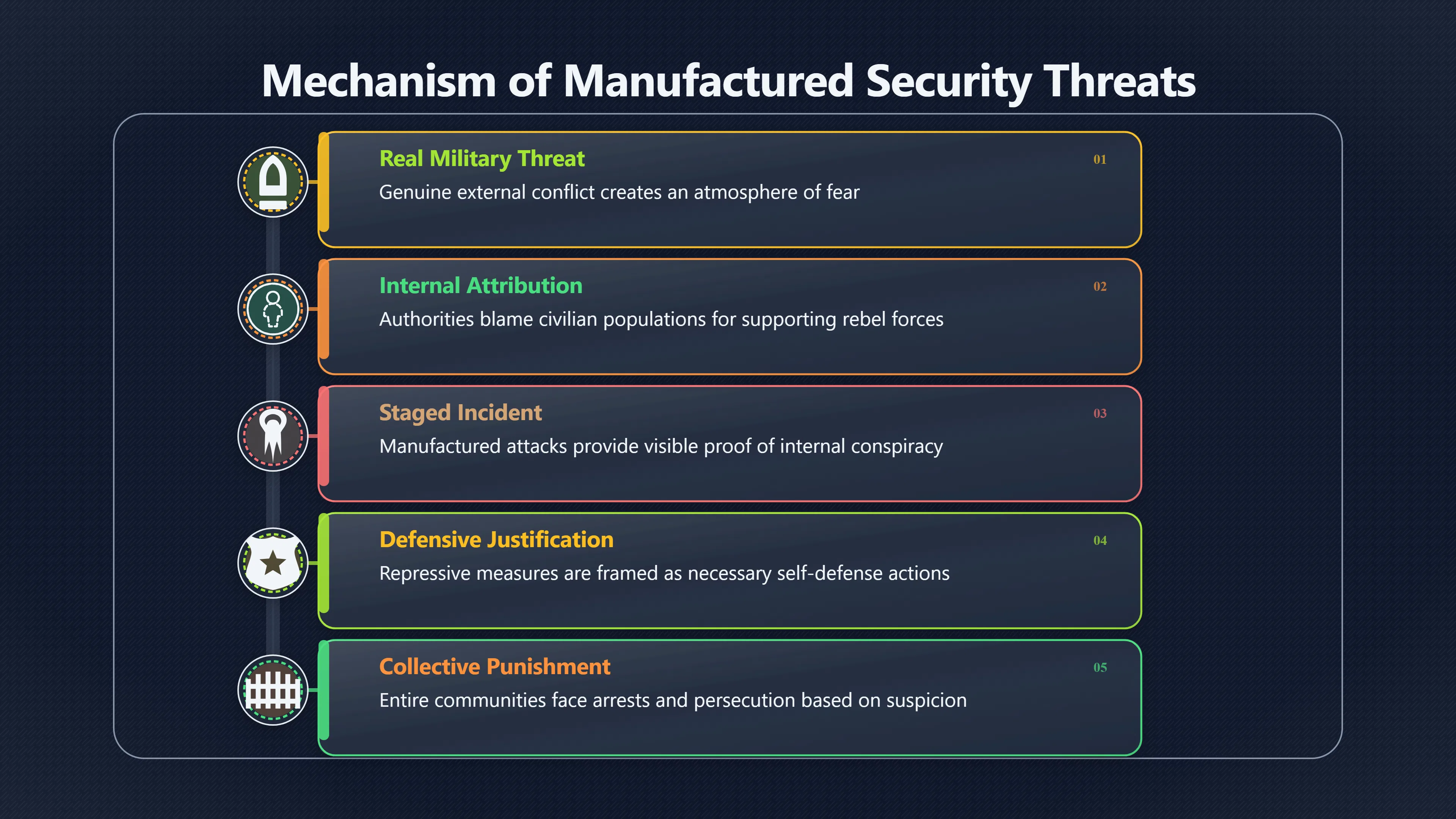
The Bigogwe case illustrates a recurring pattern in Rwanda’s political violence of the period:
- A real military threat existed.
- Authorities attributed rebel support to a civilian population.
- A dramatic security incident appeared to confirm the accusation.
- Repressive measures were presented as defensive necessities.
- Collective punishment followed.
Because the accusation seemed to be backed by visible evidence, many observers initially accepted it. Only later investigations reconstructed how the narrative had been created and disseminated.[Human Rights Watch]hrw.orgHuman Rights WatchLeave None to Tell the Story: Genocide in Rwanda, March…who do not let themselves be invaded, who refuse to be scorn…
How Manufactured Threats Enabled Collective Punishment
The importance of these incidents goes beyond the immediate victims. They demonstrated how a government could use carefully managed security scares to reshape public perceptions.
Rather than targeting specific individuals on the basis of proven actions, officials increasingly described entire categories of people as potential accomplices. Tutsi civilians, opposition activists and critics of the ruling party were portrayed as extensions of the military threat posed by the RPF. Once that association became accepted, measures that would otherwise have appeared abusive could be presented as protective.[Human Rights Watch]hrw.orgHuman Rights WatchHow It Was Prepared: Genocide: Ideology and OrganizationAmong the false ideas drawn on by political leaders and propag…
Researchers of genocide propaganda have linked these tactics to what later became known as “accusation in a mirror”: portraying intended victims as aggressors and claiming that violence against them is merely pre-emptive self-defence. The technique does not depend on completely fabricated events. Instead, it combines genuine fears with exaggerated or invented evidence, making repression appear reasonable to people who might otherwise reject it.[France Genocide Tutsi]francegenocidetutsi.orgFrance Genocide Tutsi Accusation in a Mirror15. William A. Schabas, Hate Speech in Rwanda: The Road to Genocide, 46 MCGILL L.J.. 141, 149 (2000)…
In Rwanda, staged or manipulated attacks helped establish a framework in which collective punishment could be justified politically and emotionally. Communities were encouraged to see neighbours not as civilians but as hidden participants in a national emergency. That shift in perception became one of the most dangerous consequences of the deception.[Human Rights Watch]hrw.orgAttack… assault members of the opposition or to burn and pillage their houses. Seeing the power of the state used for partisan ends, a…
The wider consequences of Staged Attacks
The Kigali and Bigogwe incidents remain important because they show how political violence can be normalised through manufactured evidence. Unlike later propaganda broadcasts or inflammatory speeches, these episodes relied on physical events that appeared to provide proof of official claims. The deception therefore carried unusual persuasive power.
For historians of Rwanda, these cases are significant not because they were isolated tricks but because they reveal a broader mechanism by which fear was converted into policy. A staged attack did not merely mislead the public for a day. It created a narrative of hidden enemies, justified mass arrests and helped legitimise violence against civilians who were portrayed as threats rather than citizens.[Human Rights Watch]hrw.orgAttack… assault members of the opposition or to burn and pillage their houses. Seeing the power of the state used for partisan ends, a…
Within the history of deception in Rwanda, these incidents stand as some of the clearest examples of fabricated or manipulated security threats being used to make repression appear defensive. Their legacy is a reminder that political violence is often preceded not only by hatred but also by carefully constructed stories about who supposedly attacked first.[France Genocide Tutsi]francegenocidetutsi.orgFrance Genocide Tutsi Accusation in a Mirror15. William A. Schabas, Hate Speech in Rwanda: The Road to Genocide, 46 MCGILL L.J.. 141, 149 (2000)…
Amazon book picks
Further Reading
Books and field guides related to When Fake Attacks Made Repression Look Defensive. Use these as the next step if you want deeper reading beyond the article.
"Leave None to Tell the Story"
Directly addresses manipulated threats and state violence.
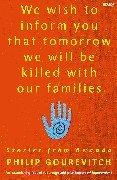
We wish to inform you that tomorrow we will be killed with ou...
Explains how fear and misinformation supported repression.
eBay marketplace picks
Marketplace Samples
Live-tested eBay searches with available results related to this page.


Endnotes
1.
Source: hrw.org
Link:https://www.hrw.org/reports/pdfs/r/rwanda/rwanda993.pdf
Source snippet
Attack... assault members of the opposition or to burn and pillage their houses. Seeing the power of the state used for partisan ends, a...
2.
Source: hrw.org
Link:https://www.hrw.org/legacy/backgrounder/africa/rwanda0406/2.htm
Source snippet
Human Rights WatchThe Immediate Crises: Internal Opposition and WarIn October 1990 the Rwandan Patriotic Front (RPF), a movement led by c...
Published: October 1990
3.
Source: hrw.org
Link:https://www.hrw.org/legacy/backgrounder/africa/rwanda0406/4.htm
Source snippet
Human Rights WatchHow It Was Prepared: Genocide: Ideology and OrganizationAmong the false ideas drawn on by political leaders and propag...
4.
Source: hrw.org
Link:https://www.hrw.org/reports/1999/rwanda/Geno1-3-10.htm
Source snippet
Human Rights WatchLeave None to Tell the Story: Genocide in Rwanda, March...who do not let themselves be invaded, who refuse to be scorn...
5.
Source: hrw.org
Link:https://www.hrw.org/reports/pdfs/r/rwanda/rwanda922.pdf
Source snippet
Human Rights WatchRWANDA27 Feb 1992 — Just as the first RPF attack in October 1990 was followed by the Kibirira killings, the brief RPF s...
Published: October 1990
6.
Source: francegenocidetutsi.org
Title: France Genocide Tutsi Accusation in a Mirror
Link:https://francegenocidetutsi.org/marcus_mirror_accusation.pdf
Source snippet
15. William A. Schabas, Hate Speech in Rwanda: The Road to Genocide, 46 MCGILL L.J.. 141, 149 (2000)...
7.
Source: refworld.org
Link:https://www.refworld.org/reference/annualreport/hrw/1994/93184
8.
Source: hrw.org
Title: AFW 07
Link:https://www.hrw.org/reports/1992/WR92/AFW-07.htm
9.
Source: hrw.org
Link:https://www.hrw.org/world-report/2026/country-chapters/rwanda
10.
Source: hrw.org
Title: human rights watch rwanda archives
Link:https://www.hrw.org/news/2024/04/02/human-rights-watch-rwanda-archives
11.
Source: hrw.org
Link:https://www.hrw.org/reports/1994/WR94/Africa-06.htm
12.
Source: hrw.org
Title: rwanda justice after genocide 20 years
Link:https://www.hrw.org/news/2014/03/28/rwanda-justice-after-genocide-20-years
13.
Source: hrw.org
Link:https://www.hrw.org/sites/default/files/reports/RWANDA941.PDF
14.
Source: hrw.org
Link:https://www.hrw.org/reports/1995/Rwanda1.htm
15.
Source: hrw.org
Link:https://www.hrw.org/reports/1995/General.htm
16.
Source: hrw.org
Link:https://www.hrw.org/reports/1999/rwanda/Geno4-7-04.htm
17.
Source: cla.umn.edu
Link:https://cla.umn.edu/chgs/holocaust-genocide-education/resource-guides/rwanda
Additional References
18.
Source: refworld.org
Link:https://www.refworld.org/reference/countryrep/hrw/1999/97537
Source snippet
Leave None to Tell the Story: Genocide in RwandaFrom the start, those in power were prepared use physical attacks as well as verb...
19.
Source: refworld.org
Title: Talking Peace and Waging War
Link:https://www.refworld.org/reference/countryrep/hrw/1992/en/20426
Source snippet
Rwanda. The October 1990 Crisis. On October 1, 1990, the military arm of the RPF invaded Rwanda from Uganda with roughly seven thousand s...
Published: October 1, 1990
20.
Source: youtube.com
Title: Operation Himmler
Link:https://www.youtube.com/watch?v=1MaKmC_r7bk
Source snippet
POINT OF NO RETURN: How America Stumbled into the Vietnam War (1964-1965)...
21.
Source: youtube.com
Link:https://www.youtube.com/watch?v=hRLa9_cqRuI
Source snippet
The Japanese Invasion of Manchuria of 1931 | Operation Jinzhou...
22.
Source: researchgate.net
Link:https://www.researchgate.net/publication/398492997_The_Role_of_Hate_Speech_in_Inciting_Genocide_A_Case_Study_of_Radio_Television_Libre_des_Mille_Collines_in_Rwanda
23.
Source: x.com
Link:https://x.com/KARANGWASewase/status/2062126628205899949
24.
Source: irb-cisr.gc.ca
Link:https://www.irb-cisr.gc.ca/en/country-information/rir/Pages/index.aspx?doc=458414
25.
Source: peaceau.org
Link:https://www.peaceau.org/uploads/report-rowanda-genocide.pdf
26.
Source: journals.lib.unb.ca
Link:https://journals.lib.unb.ca/index.php/JCS/article/download/4333/4968?inline=1
27.
Source: truthcommissions.humanities.mcmaster.ca
Link:https://truthcommissions.humanities.mcmaster.ca/wp-content/uploads/2019/07/Rwanda-1993.pdf
Topic Tree