Within Peru Hoaxes
How Fake Peruvian Antiquities Enter the Market
Forged and looted artefacts thrive when sellers can replace documented provenance with convincing stories of discovery.
On this page
- How replicas become fraudulent antiquities
- Why provenance matters to museums and buyers
- How forgery and looting reinforce each other
Page outline Jump by section
Introduction
Peru’s reputation as one of the world’s great archaeological landscapes has created an uncomfortable side effect: a thriving market for objects that are either looted, forged, or a mixture of both. The problem is not simply that fake artefacts deceive collectors. In practice, forgery and looting often reinforce one another. Looted objects arrive on the market without documented excavation records, making it easier to invent stories about where they came from. At the same time, skilled forgers can create convincing “ancient” pieces and hide them among genuine but undocumented material. The result is a trade in which authenticity becomes difficult to verify and where false histories can be as valuable as the objects themselves.[cambridge.org]cambridge.orgCambridge University Press & AssessmentModern Antiquities: The Looted and the Fakedby DA Scott · 2013 · Cited by 15 — This article discus…

In Peru, this dynamic has affected tourists, private collectors, dealers, museums and researchers. It has also damaged archaeological sites, encouraged illegal digging, and complicated efforts to understand the country’s past. The market demonstrates a central lesson of cultural heritage protection: an artefact without reliable provenance—the documented history of where it was found and how it changed hands—may be impossible to evaluate with confidence.[icom.museum]icom.museumInternational Council of MuseumsRed-List-Peru-English.pdfMuseums has published this Red List of. Peruvian Antiquities at Risk to assist l…
How Replicas Become Fraudulent Antiquities
Not every replica is a fake. Peru has a long tradition of producing legitimate reproductions for educational displays, museums and tourism. The problem begins when a modern reproduction is presented as an ancient discovery.
A forged antiquity usually acquires credibility through a story rather than through scientific evidence. A seller may claim that an object was recovered from an undocumented tomb, inherited from a local family, or discovered decades ago before modern regulations existed. Because many archaeological objects in circulation already lack secure excavation records, such claims can be difficult to disprove.[Trafficking Culture]traffickingculture.orgTrafficking CultureLaw/Illicit AntiquitiesIllicit antiquities are often sold by reputa- ble vendors without any public indication of owne…
Forgers often exploit features that buyers expect to see:
- Artificial ageing to imitate centuries of wear.
- Surface deposits or stains that resemble burial conditions.
- Designs copied from authentic museum pieces or archaeological publications.
- Invented paperwork suggesting legal export or old ownership histories.
- Claims linking an object to famous cultures such as the Moche, Nazca or Inca.[Enlighten Publications]eprints.gla.ac.ukYet the value of authenticity in the antiquities market is so great that looting and trafficking photos are not…Read more…
The most successful fakes do not look obviously extraordinary. Instead, they resemble genuine artefacts closely enough to fit expectations. Objects that seem merely plausible often pass more easily through the market than spectacular inventions.
Why Weak Provenance Creates Opportunity
For archaeologists, the value of an artefact lies partly in its context. The precise location, depth, surrounding materials and excavation records can reveal when and how it was used. Looting destroys that context.
Once an object has been removed from a site illegally, much of its historical information disappears forever. A dealer can then supply a replacement narrative. This is where forgery and looting overlap: both depend on gaps in documentation. A buyer may be unable to distinguish between a genuine object from an illegal excavation and a modern imitation accompanied by a convincing story.[Trafficking Culture]traffickingculture.orgTrafficking CultureLaw/Illicit AntiquitiesIllicit antiquities are often sold by reputa- ble vendors without any public indication of owne…
Researchers studying the antiquities trade have noted that forged documentation often accompanies questionable artefacts. Provenance records can themselves become commodities, creating an appearance of legitimacy that increases market value.[Enlighten Publications]eprints.gla.ac.ukYet the value of authenticity in the antiquities market is so great that looting and trafficking photos are not…Read more…
This helps explain why museums and auction houses have increasingly tightened acquisition standards. The issue is not merely legal ownership but whether an object’s history can be independently verified.
How Looting Feeds the Market
Peru contains thousands of archaeological sites spread across deserts, mountains and remote valleys. Many remain insufficiently protected. Looters, often known locally as grave robbers or tomb raiders, target sites because international demand creates a ready market for cultural objects.[insightcrime.org]insightcrime.orgIn Sight Crime Criminals Set Their Sights on Peru's Cultural LegacyInSight CrimeCriminals Set Their Sights on Peru's Cultural LegacySeptember 27, 2024 — 27 Sept 2024 — The looting of archaeological herita…
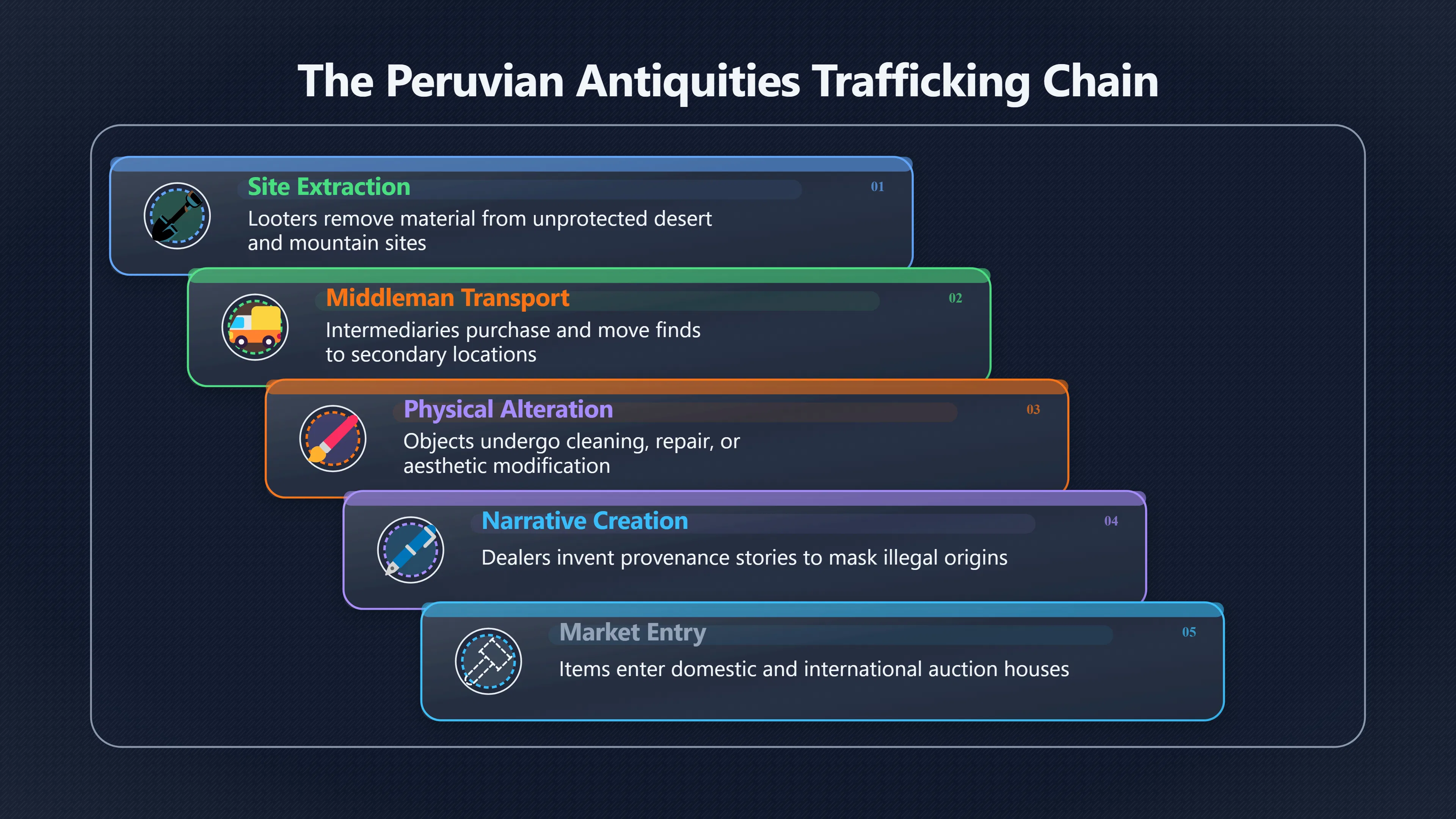
The process typically follows a chain:
- Archaeological material is removed from a site.
- Middlemen purchase and transport the finds.
- Objects are cleaned, repaired or altered.
- Provenance stories are created or embellished.
- Pieces enter domestic or international markets.
Studies of looting in Peru have found that the greatest profits are usually captured by intermediaries and dealers rather than by the individuals who physically excavate sites. Researchers have also documented that experienced looters often develop considerable knowledge of artefact styles and can even identify or produce convincing imitations.[Academia]academia.eduPDF) Fear and Looting in PeruPDF) Fear and Looting in Peru
The destruction extends beyond the removal of individual objects. Looted tombs and settlements lose archaeological information that can never be reconstructed, even if the artefacts themselves are later recovered.

When Genuine Materials Become Fake Artefacts
One of the most damaging forms of forgery involves recycling authentic ancient materials.
Investigations of trafficking and forgery have documented cases where genuine fragments from archaeological contexts are combined, altered or reassembled into more marketable objects. Ancient textiles, wood, bone and other materials may be incorporated into composite creations that appear more valuable than the original remains.[obs-traffic.museum]obs-traffic.museumOpen source on obs-traffic.museum.
This creates a particularly difficult challenge for experts. Scientific tests may confirm that some components are ancient while missing the fact that the overall object was assembled recently. Such hybrid creations blur the line between forgery and alteration and can mislead buyers who assume that ancient materials guarantee authenticity.
The same problem has appeared in recent controversies involving manipulated human remains and supposedly extraordinary discoveries. Specialists examining suspicious objects have repeatedly warned that genuine archaeological materials can be rearranged into fabricated specimens intended to attract publicity or commercial interest.[Reuters]reuters.comAlien fever dreams fuel Peruvian grave robbingsAlien fever dreams fuel Peruvian grave robbings
Why Museums and Collectors Now Focus on Provenance
For much of the twentieth century, museums often acquired antiquities with limited documentation. That approach has changed substantially as awareness of looting and forgery has grown. International agreements, including the UNESCO framework on cultural property, encouraged institutions to scrutinise ownership histories more carefully.[Cambridge University Press & Assessment]cambridge.orgCambridge University Press & AssessmentModern Antiquities: The Looted and the Fakedby DA Scott · 2013 · Cited by 15 — This article discus…
Today, warning systems such as the International Council of Museums (ICOM) Red List for Peruvian antiquities highlight categories of objects that are particularly vulnerable to trafficking. The aim is not to declare every object suspicious but to help customs officials, museums and collectors recognise material that may require additional investigation.[International Council of Museums]icom.museumInternational Council of MuseumsRed-List-Peru-English.pdfMuseums has published this Red List of. Peruvian Antiquities at Risk to assist l…
Modern due diligence commonly asks:
- Is there evidence of legal excavation or export?
- Can ownership be traced through documented transactions?
- Does the object appear in old publications or collections?
- Does its style match known archaeological examples?
- Have scientific examinations supported its claimed origin?
The more complete the answers, the lower the risk that a piece is looted or forged.
The Online Era and New Markets for Old Deceptions
The internet has transformed the antiquities trade. Social media platforms, online marketplaces and encrypted communication channels have expanded opportunities for both traffickers and forgers. UNESCO specialists and investigators have reported that cultural-property trafficking increased online during and after the COVID-19 period, when sellers and buyers shifted away from traditional in-person networks.[Reuters]reuters.comAlien fever dreams fuel Peruvian grave robbingsAlien fever dreams fuel Peruvian grave robbings
Digital platforms allow dubious objects to reach international audiences rapidly. A dramatic story about a newly discovered relic can circulate long before experts examine it. Photographs, claims of secret discoveries and fabricated ownership histories can be shared widely, making later corrections less visible than the original sensational claim.
At the same time, investigators increasingly use technology to combat the problem. Satellite imagery has been employed to identify looting damage at Peruvian archaeological sites, while databases of stolen cultural property help researchers and authorities trace suspicious objects appearing on the market.[ScienceDirect]sciencedirect.comInvestigating archaeological looting using satellite images…by R Lasaponara · 2014 · Cited by 112 — In this paper we focu…
What the Market Reveals About Authenticity
The story of fake Peruvian antiquities is not primarily about clever counterfeiters. It is about incentives. Archaeological objects acquire financial value when buyers desire a connection to an ancient civilisation, and that value creates pressure to supply artefacts whether genuine discoveries are available or not.
In such an environment, forged objects, invented provenance documents and looted artefacts become part of the same ecosystem. Each benefits from uncertainty about origins. A convincing story can raise the price of a forgery, while the absence of documentation can conceal the illicit origin of a genuine artefact.[gla.ac.uk]eprints.gla.ac.ukYet the value of authenticity in the antiquities market is so great that looting and trafficking photos are not…Read more…
For Peru, the lasting lesson is that cultural heritage depends as much on context as on objects themselves. An artefact removed from its archaeological setting may still be beautiful, but without trustworthy provenance its historical meaning becomes harder to prove—and easier to invent.[uri.edu]digitalcommons.uri.eduDigitalCommons@URIPeruvian Antiquities and the Collecting of Cultural Goodsby TH Witkowski · 2017 · Cited by 3 — This article investigate…
Amazon book picks
Further Reading
Books and field guides related to How Fake Peruvian Antiquities Enter the Market. Use these as the next step if you want deeper reading beyond the article.
Frauds, Myths, and Mysteries: Science and Pseudoscience in Ar...
Covers forged artifacts and false archaeological claims.
The Archaeology of Knowledge
Useful for thinking about how narratives acquire authority.
eBay marketplace picks
Marketplace Samples
Live-tested eBay searches with available results related to this page.




Endnotes
1.
Source: cambridge.org
Link:https://www.cambridge.org/core/journals/international-journal-of-cultural-property/article/modern-antiquities-the-looted-and-the-faked/847CCB50D0D4936B009F22FB32312551
Source snippet
Cambridge University Press & AssessmentModern Antiquities: The Looted and the Fakedby DA Scott · 2013 · Cited by 15 — This article discus...
2.
Source: digitalcommons.uri.edu
Link:https://digitalcommons.uri.edu/mgdr/vol2/iss4/3/
Source snippet
DigitalCommons@URIPeruvian Antiquities and the Collecting of Cultural Goodsby TH Witkowski · 2017 · Cited by 3 — This article investigate...
3.
Source: icom.museum
Link:https://icom.museum/wp-content/uploads/2019/03/Red-List-Peru-English.pdf
Source snippet
International Council of MuseumsRed-List-Peru-English.pdfMuseums has published this Red List of. Peruvian Antiquities at Risk to assist l...
4.
Source: sciencedirect.com
Link:https://www.sciencedirect.com/science/article/abs/pii/S0305440313003798
Source snippet
Investigating archaeological looting using satellite images...by R Lasaponara · 2014 · Cited by 112 — In this paper we focu...
5.
Source: academia.edu
Title: (PDF) Fear and Looting in Peru
Link:https://www.academia.edu/34773080/Fear_and_Looting_in_Peru
6.
Source: obs-traffic.museum
Link:https://www.obs-traffic.museum/sites/default/files/ressources/files/Alva_destruction_looting_traffic_0.pdf
7.
Source: reuters.com
Title: Alien fever dreams fuel Peruvian grave robbings
Link:https://www.reuters.com/world/americas/alien-fever-dreams-fuel-peruvian-grave-robbings-2024-04-06/
8.
Source: traffickingculture.org
Link:https://traffickingculture.org/uploads/2012/07/2007-Illicit-antiquities.pdf
Source snippet
Trafficking CultureLaw/Illicit AntiquitiesIllicit antiquities are often sold by reputa- ble vendors without any public indication of owne...
9.
Source: eprints.gla.ac.uk
Link:https://eprints.gla.ac.uk/108811/7/108811.pdf
Source snippet
Yet the value of authenticity in the antiquities market is so great that looting and trafficking photos are not...Read more...
10.
Source: insightcrime.org
Title: In Sight Crime Criminals Set Their Sights on Peru’s Cultural Legacy
Link:https://insightcrime.org/news/criminals-set-their-sights-on-perus-cultural-legacy/
Source snippet
InSight CrimeCriminals Set Their Sights on Peru's Cultural LegacySeptember 27, 2024 — 27 Sept 2024 — The looting of archaeological herita...
Published: September 27, 2024
Additional References
11.
Source: youtube.com
Title: Ancient gold relic looted 20 years ago returns to Peru
Link:https://www.youtube.com/watch?v=HXRUVzwmJYA
Source snippet
Peru antiquities looting market fake artifacts PERU: STOLEN ANCIENT ARTEFACT RETURNED FROM THE USA AP Archive...
12.
Source: youtube.com
Title: PERU: PRE-HISPANIC GRAVES ARE BEING LOOTED FOR TEXTILES & CERAMICS
Link:https://www.youtube.com/watch?v=o5B_fyyuLag
Source snippet
The Scourge of Looting: Trafficking Antiquities, from Temple to Museum...
13.
Source: youtube.com
Title: The Scourge of Looting: Trafficking Antiquities, from Temple to Museum
Link:https://www.youtube.com/watch?v=4SSVRByUZYI
Source snippet
Ancient gold relic looted 20 years ago returns to Peru...
14.
Source: acthinktank.scholasticahq.com
Link:https://acthinktank.scholasticahq.com/article/144406-how-can-we-fund-the-fight-against-antiquities-looting-and-trafficking-a-pollution-tax-on-the-antiquities-trade
15.
Source: scispace.com
Link:https://scispace.com/pdf/peruvian-antiquities-and-the-collecting-of-cultural-goods-1ewfdaz8zo.pdf
16.
Source: facebook.com
Link:https://www.facebook.com/jakpost/posts/weak-oversight-and-opaque-rules-on-provenance-in-the-international-antiquities-m/1430818995740578/
17.
Source: wired.com
Link:https://www.wired.com/story/trafficking-latin-american-artefacts-peru-investigation
18.
Source: chasingaphrodite.com
Link:https://chasingaphrodite.com/2013/04/10/the-peruvian-connection-federal-agents-bust-alleged-antiquities-smugglers-network-in-utah/
19.
Source: youtube.com
Title: PERU: BLACK MARKET IN ARTEFACTS
Link:https://www.youtube.com/watch?v=INe5g3vdae8
Source snippet
PERU: PRE-HISPANIC GRAVES ARE BEING LOOTED FOR TEXTILES & CERAMICS...
20.
Source: youtube.com
Link:https://www.youtube.com/watch?v=e7maVmLl7Cc
Topic Tree