Within Nauru
How Paper Banks Borrowed the Authority of a State
Hundreds of licensed banks used sovereign paperwork, secrecy and remote control to resemble institutions with far stronger oversight.
On this page
- Why Nauru Licensed Hundreds of Offshore Banks
- How Genuine Licences Created a Misleading Impression
- Blacklisting, Abolition and the End of the Shell Bank Sector
Page outline Jump by section
Introduction
Nauru’s offshore banking boom was not built on forged documents or imaginary institutions. Its most important deception was subtler: genuine banking licences issued by a sovereign state created the appearance of credibility that many banks did not earn through normal supervision, staffing or physical operations. In effect, Nauru’s shell-bank sector transformed official recognition into a commercial product. A bank could point to a real licence, a real jurisdiction and real incorporation papers while operating far from Nauru and often beyond meaningful regulatory scrutiny. The result was a powerful illusion of legitimacy that attracted clients, intermediaries and, in some cases, criminal money flows on a scale vastly larger than Nauru’s own economy.[U.S. Department of the Treasury]home.treasury.govDepartment of the TreasuryImposition of Special Measures Against the Country of NauruConsequently, these offshore shell banks have no app…
The story matters because it shows how authority can be borrowed rather than earned. The banks were often not pretending to be licensed. Instead, they relied on outsiders assuming that a licence meant the same thing in Nauru as it did in heavily regulated financial centres. That gap between legal appearance and practical reality became the core mechanism of the system.[FATF]fatf-gafi.org1999 2000 NCCT ENGFATFFinancial Action Task Force on Money Laundering22 Jun 2000 — It has licensed approximately 400 offshore “banks”, which are prohibited…
Why Nauru Licensed Hundreds of Offshore Banks
After phosphate wealth declined, Nauru searched for new revenue sources. Offshore finance appeared attractive because a small state could sell licences and corporate registrations without needing a large domestic banking market. By the late 1990s and early 2000s, international regulators reported that Nauru had licensed roughly 400 offshore banks, an extraordinary number for a country with a tiny population and limited financial infrastructure.[FATF]fatf-gafi.org1999 2000 NCCT ENGFATFFinancial Action Task Force on Money Laundering22 Jun 2000 — It has licensed approximately 400 offshore “banks”, which are prohibited…
The business model depended on a simple proposition. Foreign operators wanted access to the prestige and legal status associated with being a bank. Nauru could provide that status quickly and at relatively low cost. The value being sold was not a customer base in Nauru or participation in the island’s economy. It was the right to present an institution as a licensed bank operating under the authority of a recognised state.[U.S. Department of the Treasury]home.treasury.govDepartment of the TreasuryImposition of Special Measures Against the Country of NauruConsequently, these offshore shell banks have no app…
International investigators later noted that many of these institutions had little or no genuine connection to Nauru itself. The licensing system allowed banks to exist largely on paper while conducting business elsewhere. According to US Treasury findings, only one offshore bank appeared to have any significant physical presence in Nauru, despite the large number of licences issued.[U.S. Department of the Treasury]home.treasury.govDepartment of the TreasuryImposition of Special Measures Against the Country of NauruConsequently, these offshore shell banks have no app…
How Genuine Licences Created a Misleading Impression
The effectiveness of the system depended on a crucial misunderstanding. In most countries, the word “bank” implies a substantial regulatory framework: inspections, record-keeping requirements, customer identification rules, reporting obligations and ongoing oversight. Many Nauru-licensed institutions benefited from those assumptions even when the underlying safeguards were weak or absent.[FinCEN.gov]fincen.govFin CEN.gov Fin CE N AdvisoryFinCEN Advisory - Issue 211 Jul 2000 — Offshore banks licensed by Nauru are not required to maintain customer identification or transacti…
This was not usually a matter of forging credentials. The licences themselves were genuine. The misleading element was the impression that the licence guaranteed standards comparable to those expected in major financial centres.
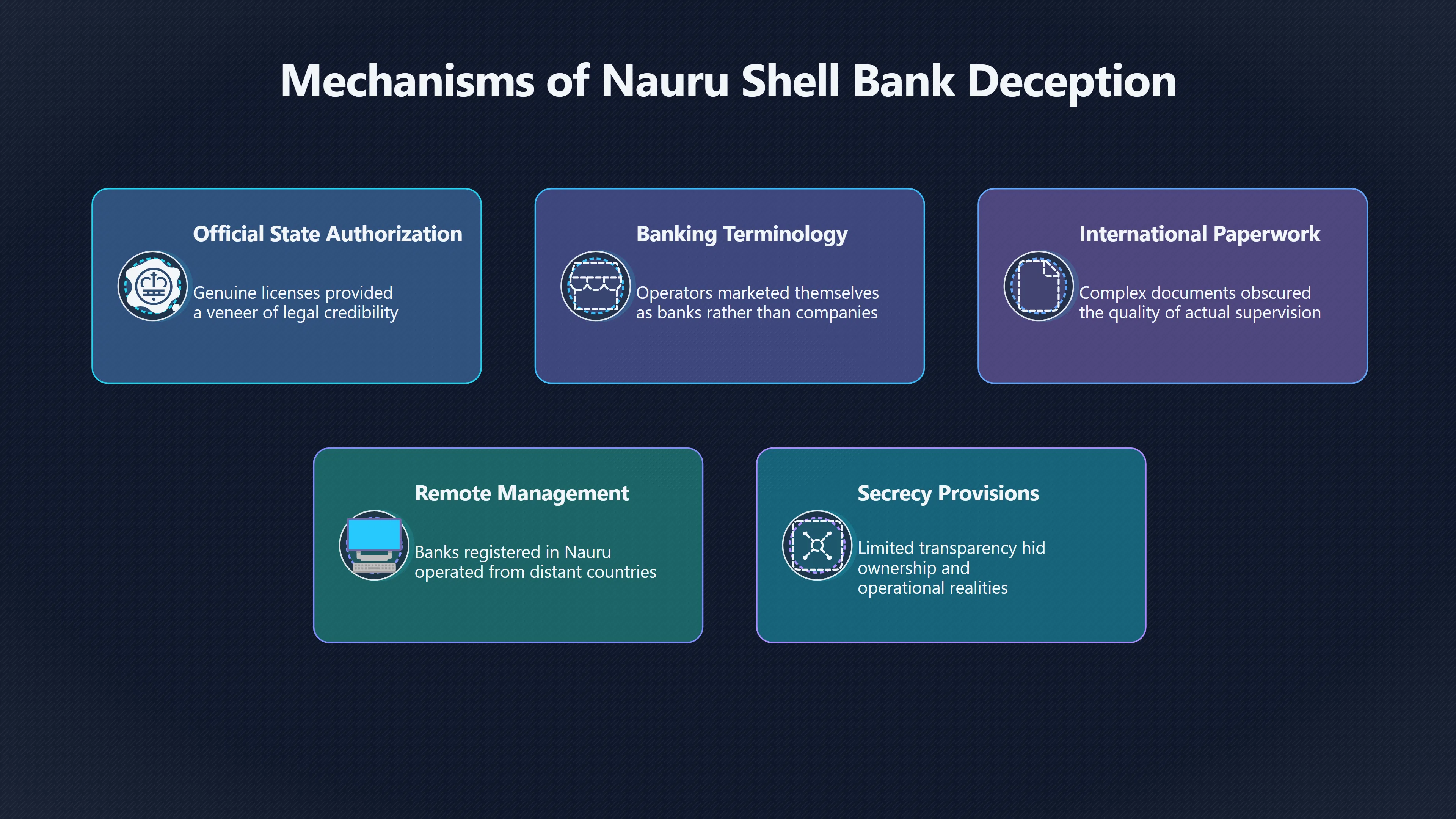
Several features helped manufacture that impression:
- Official state authorisation gave institutions a legal identity that appeared trustworthy.
- Banking terminology allowed operators to market themselves as banks rather than ordinary companies.
- International paperwork made it difficult for distant customers and counterparties to assess the quality of supervision.
- Secrecy provisions and limited transparency obscured ownership structures and operational realities.
- Remote management meant a bank could be registered in Nauru while effectively operating from another country.[treasury.gov]home.treasury.govDepartment of the TreasuryImposition of Special Measures Against the Country of NauruConsequently, these offshore shell banks have no app…
The distinction is important. A shell bank could display authentic legal credentials while lacking the institutional substance that most people associated with those credentials. The deception lay in exploiting assumptions about what official recognition meant.

The Role of Correspondent Banking and International Networks
A banking licence by itself was not enough. To participate in global finance, institutions needed access to correspondent banking relationships—arrangements through which one bank uses another bank’s infrastructure to move money internationally. These relationships are central to cross-border payments and give institutions access to the wider financial system.[GovDelivery]content.govdelivery.comNovember 2024, Issue #58 - GovDelivery - Granicus15 Nov 2024 — A correspondent banking agreement occurs between two respondent…
For shell banks, correspondent relationships could further strengthen the appearance of legitimacy. If a Nauru-licensed institution could connect to established financial networks, outsiders might assume it had already passed rigorous scrutiny. In reality, regulators increasingly worried that shell banks were using such connections to gain access to international finance without meeting the standards expected elsewhere.[FATF]fatf-gafi.orgs no physical presence in the country in which it is incorporated and…Read more…
This concern became so significant that international anti-money-laundering standards eventually moved toward prohibiting correspondent relationships with shell banks. The core problem was not merely secrecy. It was that institutions lacking a genuine physical presence and effective supervision could use the reputation of regulated banking networks to enhance their own credibility.[FATF]fatf-gafi.orgs no physical presence in the country in which it is incorporated and…Read more…
Why Regulators Became Alarmed
Nauru’s offshore sector drew growing international criticism because the mechanisms that created legitimacy also reduced accountability. Regulators highlighted major weaknesses, including inadequate customer-identification requirements, limited record-keeping obligations, weak suspicious-transaction reporting requirements and the absence of key anti-money-laundering controls.[FinCEN.gov]fincen.govFin CEN.gov Fin CE N AdvisoryFinCEN Advisory - Issue 211 Jul 2000 — Offshore banks licensed by Nauru are not required to maintain customer identification or transacti…
The Financial Action Task Force (FATF), the international body that coordinates anti-money-laundering standards, identified Nauru as a non-cooperative jurisdiction in 2000. Its reports specifically highlighted the existence of approximately 400 offshore banks and concerns about supervision.[FATF]fatf-gafi.org1999 2000 NCCT ENGFATFFinancial Action Task Force on Money Laundering22 Jun 2000 — It has licensed approximately 400 offshore “banks”, which are prohibited…
The issue gained additional attention because of allegations that enormous sums of money, including funds linked to Russian criminal networks and illicit financial flows, had passed through Nauru-linked institutions. While estimates varied, the sheer scale of the reported transactions reinforced the perception that shell banks were being used as conduits rather than as conventional financial institutions serving a domestic economy.[International Compliance Association]int-comp.orgtop 5 money laundering cases of the last 30 yearstop 5 money laundering cases of the last 30 years
Blacklisting, Abolition and the End of the Shell-Bank Sector
International pressure steadily increased. The FATF urged Nauru to eliminate offshore shell banks, while the United States moved to impose special measures against the country because of concerns about money laundering risks. US authorities specifically cited the practice of licensing offshore shell banks and questioned whether many of these institutions had any legitimate economic connection to Nauru.[Federal Register]federalregister.govOpen source on federalregister.gov.
The response eventually reshaped the sector. Nauru introduced legislative reforms, revoked offshore banking licences and moved to abolish shell banks. International organisations welcomed these changes, describing them as efforts to eliminate the shell-bank model that had attracted criticism.[oecd.org]one.oecd.orgOpen source on oecd.org.
Public reports from the period noted the revocation of large numbers of offshore banking licences. Nauru’s government announced the cancellation of 139 licences in 2003, and subsequent reforms imposed physical-presence requirements that effectively ended the system of hundreds of paper banks. OECD reporting later described the reforms as abolishing roughly 400 shell banks.[ABC News]abc.net.aunauru struck off tax haven blacklistnauru struck off tax haven blacklist
The international response gradually softened as reforms took effect. FATF countermeasures were withdrawn, and later assessments recognised that Nauru had dismantled the shell-bank sector that had made it a symbol of offshore financial opacity.[oecd.org]one.oecd.orgOpen source on oecd.org.
What the Episode Reveals About Manufactured Credibility
The Nauru shell-bank story illustrates a recurring pattern in financial history: legitimacy is often inferred from symbols rather than verified through investigation. A banking licence, a government registration number and a recognised jurisdiction can create powerful confidence even when the institution behind them lacks the features people normally associate with a bank.
What made Nauru distinctive was the scale of the mismatch. Hundreds of institutions were able to draw authority from a sovereign licensing system while operating with minimal local presence and limited oversight. The banks did not need to invent legitimacy from scratch. They borrowed it from the international respect generally granted to state-issued credentials.[treasury.gov]home.treasury.govDepartment of the TreasuryImposition of Special Measures Against the Country of NauruConsequently, these offshore shell banks have no app…
For historians of deception, this is an important distinction. The episode was not primarily about counterfeit documents or fictional companies. It was about how authentic legal recognition could be used to create a misleading impression of safety, scrutiny and trustworthiness. The paperwork was real. The confidence it inspired was often the illusion.
eBay marketplace picks
Marketplace Samples
Live-tested eBay searches with available results related to this page.




Endnotes
1.
Source: home.treasury.gov
Link:https://home.treasury.gov/system/files/246/js1941.pdf
Source snippet
Department of the TreasuryImposition of Special Measures Against the Country of NauruConsequently, these offshore shell banks have no app...
2.
Source: fincen.gov
Title: Fin CEN.gov Federal Register/Vol
Link:https://www.fincen.gov/system/files/shared/finding_nauru.pdf
Source snippet
67, No. 248/Thursday, December 26...26 Dec 2002 — The Financial Crimes Enforcement. Network has recently reported that 400 offshore ban...
3.
Source: fatf-gafi.org
Title: 1999 2000 NCCT ENG
Link:https://www.fatf-gafi.org/content/dam/fatf/documents/reports/1999%202000%20NCCT%20ENG.pdf
Source snippet
FATFFinancial Action Task Force on Money Laundering22 Jun 2000 — It has licensed approximately 400 offshore “banks”, which are prohibited...
4.
Source: fincen.gov
Title: Fin CEN.gov Fin CE N Advisory
Link:https://www.fincen.gov/resources/advisories/fincen-advisory-issue-21
Source snippet
FinCEN Advisory - Issue 211 Jul 2000 — Offshore banks licensed by Nauru are not required to maintain customer identification or transacti...
5.
Source: content.govdelivery.com
Link:https://content.govdelivery.com/accounts/USDHS/bulletins/3c1661f
Source snippet
November 2024, Issue #58 - GovDelivery - Granicus15 Nov 2024 — A correspondent banking agreement occurs between two respondent...
Published: November 2024
6.
Source: fincen.gov
Title: Fin CEN.gov Advisory Updated
Link:https://www.fincen.gov/resources/advisories/advisory-updated-issue-21a
Source snippet
Advisory Updated - Issue 21A1 Jan 2002 — A shell bank is a bank with neither a physical presence in any jurisdiction nor an appropriate a...
7.
Source: one.oecd.org
Link:https://one.oecd.org/document/PAC/COM/NEWS%282003%2924/en/pdf
8.
Source: oecd.org
Title: 9789264191846 en
Link:https://www.oecd.org/content/dam/oecd/en/publications/reports/2013/04/global-forum-on-transparency-and-exchange-of-information-for-tax-purposes-peer-reviews-nauru-2013_g1g2a0b7/9789264191846-en.pdf
9.
Source: one.oecd.org
Link:https://one.oecd.org/document/PAC/COM/NEWS%282004%2930/en/pdf
10.
Source: fincen.gov
Link:https://www.fincen.gov/resources/advisories/fincen-advisory-fin-2008-a005
11.
Source: one.oecd.org
Link:https://one.oecd.org/document/PAC/COM/NEWS%282004%2928/en/pdf
12.
Source: 2009-2017.state.gov
Link:https://2009-2017.state.gov/j/inl/rls/nrcrpt/2008/vol2/html/100800.htm
13.
Source: fatf-gafi.org
Link:https://www.fatf-gafi.org/content/dam/fatf-gafi/guidance/Guidance-Correspondent-Banking-Services.pdf
Source snippet
s no physical presence in the country in which it is incorporated and...Read more...
14.
Source: fatf-gafi.org
Link:https://www.fatf-gafi.org/en/countries/black-and-grey-lists.html
15.
Source: int-comp.org
Title: top 5 money laundering cases of the last 30 years
Link:https://www.int-comp.org/insight/top-5-money-laundering-cases-of-the-last-30-years/
16.
Source: federalregister.gov
Link:https://www.federalregister.gov/documents/2003/04/17/03-9410/financial-crimes-enforcement-network-imposition-of-special-measures-against-the-country-of-nauru
17.
Source: fatf-gafi.org
Link:https://www.fatf-gafi.org/content/dam/fatf-gafi/annual-reports/2004%202005%20NCCT%20ENG.pdf
18.
Source: abc.net.au
Title: nauru struck off tax haven blacklist
Link:https://www.abc.net.au/news/2003-12-13/nauru-struck-off-tax-haven-blacklist/105070
19.
Source: fatf-gafi.org
Link:https://www.fatf-gafi.org/en/countries/detail/Nauru.html
20.
Source: fatf-gafi.org
Title: Nauru MER APG November 2024.pdf.coredownload.inline
Link:https://www.fatf-gafi.org/content/dam/fatf-gafi/fsrb-mer/Nauru-MER-APG-November-2024.pdf.coredownload.inline.pdf
Published: November 2024
21.
Source: federalregister.gov
Link:https://www.federalregister.gov/documents/2002/12/26/02-32571/departmental-offices-designation-of-nauru-and-ukraine-as-primary-money-laundering-concerns
22.
Source: amlnetwork.org
Link:https://amlnetwork.org/watchdog-database/corporate-laundering/nauru/
Additional References
23.
Source: emerald.com
Link:https://www.emerald.com/jmlc/article-pdf/7/1/75/1590280/13685200410809797.pdf
Source snippet
The Anti-Money Laundering Regime in the Republic of Nauruby TJ Roule · 2004 · Cited by 6 — Most notably, the Nauruan legislation d...
24.
Source: youtube.com
Link:https://www.youtube.com/watch?v=wf0LorFUUx4
Source snippet
The Russian Mafia laundered billions through this tiny Pacific island | 60 Minutes Australia...
25.
Source: govinfo.gov
Link:https://www.govinfo.gov/content/pkg/CHRG-107shrg71166/html/CHRG-107shrg71166.htm
26.
Source: youtube.com
Title: How the World’s Richest Country Lost 90% of its GDP
Link:https://www.youtube.com/watch?v=Fe88ckTWyTU
Source snippet
From Riches to Rags: The Economic Collapse of Nauru...
27.
Source: bpi.com
Link:https://bpi.com/wp-content/uploads/2018/07/20160216-tch-aml-correspondent-banking-guiding-principles.pdf
28.
Source: knowyourcountry.com
Link:https://www.knowyourcountry.com/country-reports/nauru/
29.
Source: adb.org
Link:https://www.adb.org/publications/pacific-finance-sector-nauru
30.
Source: finance.ec.europa.eu
Link:https://finance.ec.europa.eu/financial-crime/anti-money-laundering-and-countering-financing-terrorism-international-level_en
31.
Source: canada.ca
Link:https://www.canada.ca/en/news/archive/2005/10/financial-action-task-force-money-laundering-fatf-releases-update-list-non-cooperative-countries-territories-ncct-.html
32.
Source: bsaaml.ffiec.gov
Title: Assessing Compliance With BSARegulatory Requirements
Link:https://bsaaml.ffiec.gov/manual/AssessingComplianceWithBSARegulatoryRequirements/12
Topic Tree