Within Syrian Hoaxes
When War Made Fake Antiquities Easier to Sell
War made missing provenance seem plausible, allowing modern forgeries to travel beside genuine looted objects.
On this page
- How the wartime market blurred fakes and genuine loot
- Why missing provenance became part of the sales story
- How experts, customs officers and museums detect fraud
Page outline Jump by section
Introduction
The Syrian civil war created one of the most unusual conditions in the modern antiquities trade: a market in which genuine looted artefacts, modern forgeries and completely invented ownership histories could circulate side by side. For collectors, dealers and smugglers, the destruction of archaeological sites and museums made almost any undocumented object seem plausible. A missing paper trail was no longer automatically suspicious. It could be explained away as a consequence of war.[The Independent]independent.co.ukThe Independent Fake antiquities flood out of Syria as smugglers fail to stealThe IndependentFake antiquities flood out of Syria as smugglers fail to steal…September 7, 2016 — 7 Sept 2016 — These look like impres…
This did not simply encourage the sale of stolen antiquities. It also encouraged the manufacture of fake ones. As demand grew for supposedly rescued treasures from Palmyra, Aleppo and other famous sites, workshops inside Syria and neighbouring countries produced counterfeit artefacts designed to exploit international fascination with endangered heritage. The result was a wartime market in which buyers were often purchasing a story as much as an object.[The Independent]independent.co.ukThe Independent Fake antiquities flood out of Syria as smugglers fail to stealThe IndependentFake antiquities flood out of Syria as smugglers fail to steal…September 7, 2016 — 7 Sept 2016 — These look like impres…
How the Wartime Market Blurred Fakes and Genuine Loot
In most legal antiquities markets, provenance—the documented ownership history of an object—is crucial. It helps establish authenticity and legality. The Syrian conflict disrupted that system.
Archaeological sites were damaged, museums evacuated collections, borders became porous and large quantities of genuine artefacts disappeared from public view. Against that background, an undocumented statue, coin hoard or manuscript could be presented as a plausible survivor of wartime chaos. Buyers often had little ability to verify the claim independently.[ResearchGate]researchgate.netIllicit trafficking of Syrian cultural property | Request PDFHeritage protection legislation and international treaties prohi…
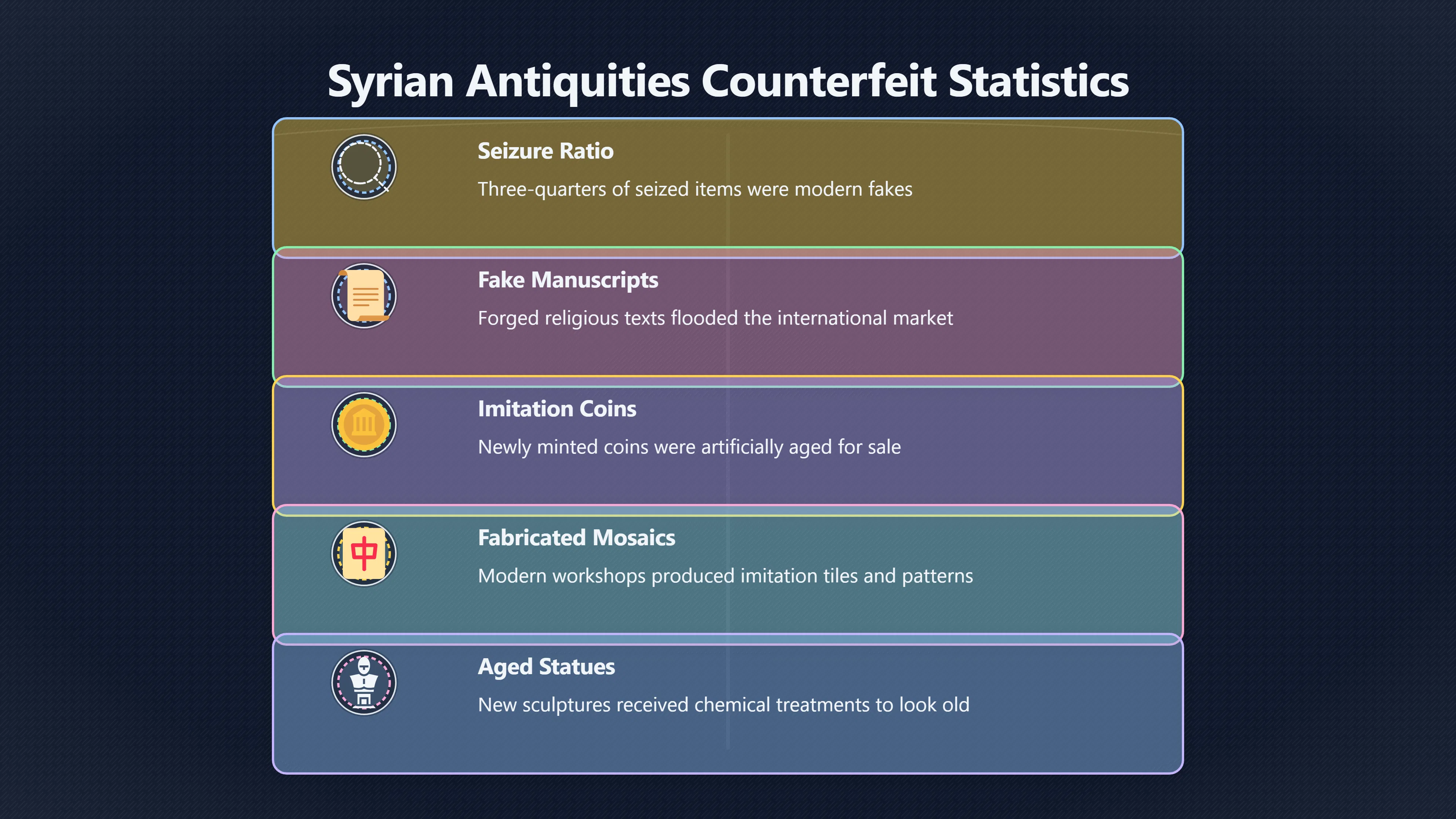
Counterfeiters quickly recognised the opportunity. According to Syria’s Directorate-General of Antiquities and Museums, a remarkably high proportion of objects seized during anti-smuggling operations turned out to be modern fakes rather than genuine antiquities. In 2016, antiquities officials reported that roughly three-quarters of seized items in Syria and neighbouring Lebanon were counterfeit. Seizures included fake ancient Bibles, forged manuscripts, imitation coins, fabricated mosaics and newly made statues artificially aged to resemble archaeological finds.[Art Newspaper]theartnewspaper.comfakes, Syria's antiquities chief Maamoun Abdulkarim tells The Art Newspaper…. Objects seized by police in Damascus include 30 fake anc…
The existence of large numbers of fakes created a paradox. Genuine looting remained a serious problem, but the flood of counterfeits made it harder for investigators, customs officials and collectors to know what was real. Researchers studying trafficking networks have noted that fake and genuine objects often moved through the same channels, sometimes passing through the same intermediaries and online marketplaces.[traffickingculture.org]traffickingculture.orgd internally were fake, compared to about 30 per cent at the start of the conflict (Cockburn…
Why Missing Provenance Became Part of the Sales Story
Under normal circumstances, the absence of ownership records reduces an artefact’s value and credibility. During the Syrian war, missing provenance could become a selling point.
A dealer might claim that paperwork had been destroyed in fighting, that an object had been secretly removed from a threatened site, or that a family had hidden it for years before deciding to sell. Such stories were difficult to verify but easy to believe because they matched widely reported realities of the conflict.[The Independent]independent.co.ukThe Independent Fake antiquities flood out of Syria as smugglers fail to stealThe IndependentFake antiquities flood out of Syria as smugglers fail to steal…September 7, 2016 — 7 Sept 2016 — These look like impres…
Several recurring narratives appeared in the market:
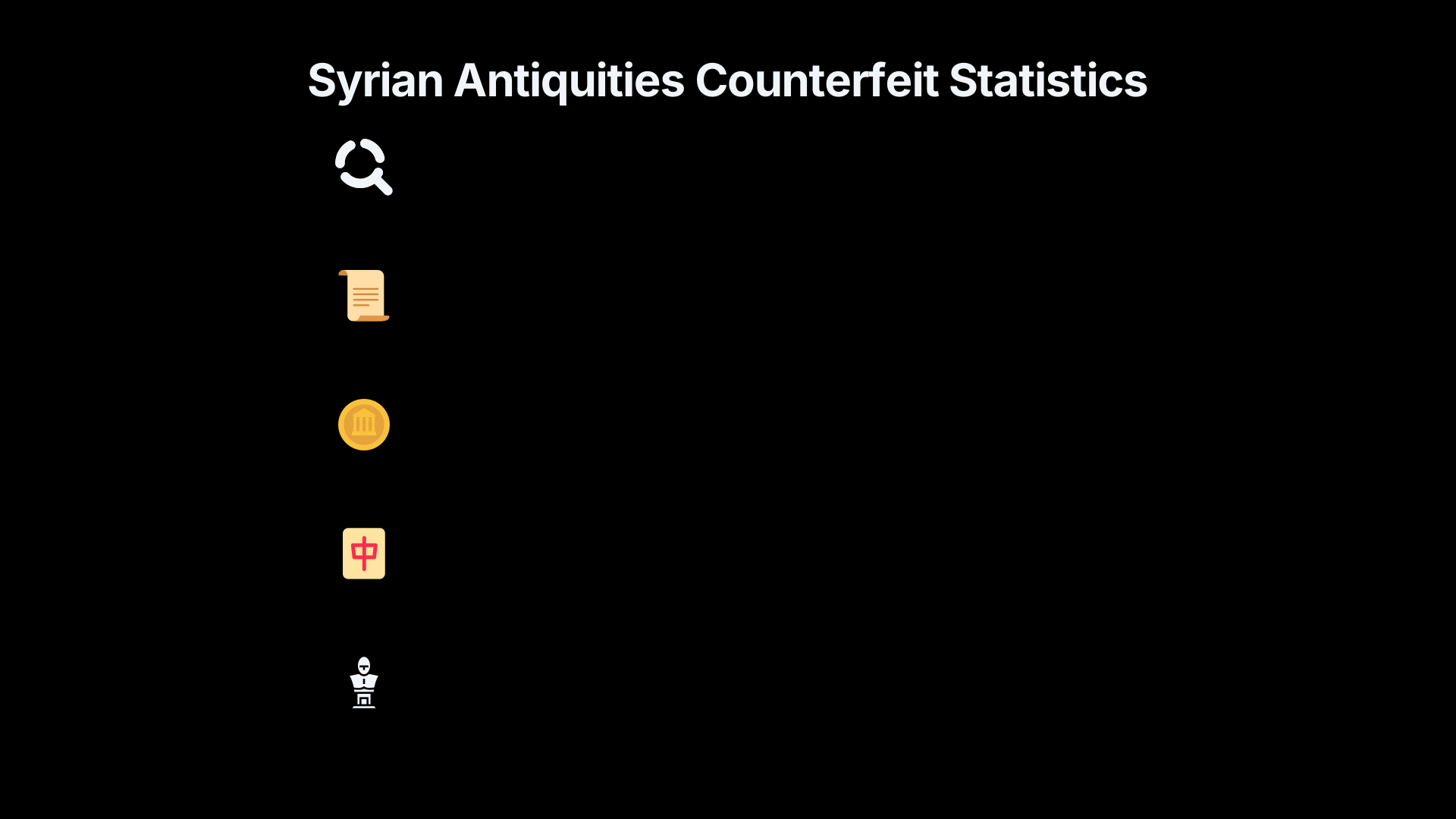
- The artefact had supposedly been rescued from destruction by armed groups.
- It had allegedly been smuggled out shortly before a site was damaged.
- It came from a private family collection whose records were lost during the war.
- It was being sold to fund escape, migration or survival during the conflict.
Each explanation transformed a weakness—the lack of documentation—into evidence of authenticity. The more chaotic the circumstances appeared, the easier it became to excuse gaps that would normally raise alarm.[traffickingculture.org]traffickingculture.orgd internally were fake, compared to about 30 per cent at the start of the conflict (Cockburn…
This mechanism was especially effective because international media coverage frequently showed damaged monuments, looted sites and destroyed museums. Those reports were accurate, but they also created a background narrative that counterfeiters could exploit. A forged artefact accompanied by a believable war story could appear more convincing than it would have in peacetime.[UNESCO]unesco.orgcultural heritage objects stake armed conflictscultural heritage objects stake armed conflicts
The Business of Manufacturing the Past
The fake-antiquities trade was not limited to crude souvenirs. Some workshops specialised in producing objects specifically tailored to international demand.
Investigations reported workshops in cities including Damascus and Aleppo manufacturing artefacts for export. Counterfeiters copied styles associated with Roman, Byzantine, Islamic and ancient Near Eastern cultures, sometimes using genuine old materials or fragments to increase credibility. Artificial weathering, deliberate breakage and chemical treatments could make new objects appear centuries old.[The Independent]independent.co.ukThe Independent Fake antiquities flood out of Syria as smugglers fail to stealThe IndependentFake antiquities flood out of Syria as smugglers fail to steal…September 7, 2016 — 7 Sept 2016 — These look like impres…
Manuscripts became a particularly attractive target. Reports from researchers and heritage investigators described recurring waves of supposedly ancient religious texts appearing on the market, many of which proved to be modern creations or heavily altered objects. The appeal was obvious: manuscripts are often unique, difficult for non-specialists to authenticate and capable of attracting high prices if linked to dramatic historical narratives.[traffickingculture.org]traffickingculture.orgd internally were fake, compared to about 30 per cent at the start of the conflict (Cockburn…
The profitability of these operations reflected a basic economic reality. Producing a convincing fake could be far cheaper and less risky than organising a genuine archaeological theft. War supplied both the cover story and the customer demand.[Los Angeles Times]latimes.comla fg syria fake antiquities 2016 storyLos Angeles TimesAfter Islamic State institutionalized looting in Syria, the…31 Dec 2016 — The rising market in fake antiquities is ma…
How Experts, Customs Officers and Museums Detect Fraud
Because forged artefacts increasingly travelled alongside genuine looted objects, investigators developed methods that focus not only on the object itself but also on its documented history.
The first warning sign is often provenance. Museums, customs agencies and auction houses increasingly demand records showing where an artefact was located before the Syrian conflict began. Under European restrictions and broader international standards, objects claimed to come from Syria require careful scrutiny of export histories and ownership documentation.[saving-antiquities.org]en.saving-antiquities.orgOpen source on saving-antiquities.org.
Specialists also use scientific and stylistic analysis:
- Tool marks can reveal modern manufacturing techniques.
- Chemical testing may expose recently applied ageing treatments.
- Stone, metal or clay compositions can be compared with known archaeological materials.
- Inscriptions can be checked for linguistic mistakes or historically impossible combinations.
- Artistic styles can be compared with authenticated examples from excavated contexts.
A convincing appearance alone is rarely enough. Archaeologists frequently note that an object removed from its archaeological context loses much of the information that gives it historical value. Context can therefore be as important as physical authenticity.[ResearchGate]researchgate.netIllicit trafficking of Syrian cultural property | Request PDFHeritage protection legislation and international treaties prohi…
International organisations have also emphasised information-sharing between museums, police agencies, customs services and heritage authorities. Databases of stolen objects, import controls and provenance research are intended to stop both genuine loot and counterfeit material from entering legitimate collections.[unesco.org]unesco.orgcultural heritage objects stake armed conflictscultural heritage objects stake armed conflicts
Why the Problem Still Matters
The wartime fake-antiquities market was not merely a side effect of looting. It altered how the entire trade in Syrian heritage was understood.
Counterfeits complicated efforts to estimate the scale of real looting, confused buyers and investigators, and created opportunities for criminals to launder uncertainty into profit. A forged object could generate revenue just as effectively as a stolen one, while requiring far less access to archaeological sites.[traffickingculture.org]traffickingculture.orgd internally were fake, compared to about 30 per cent at the start of the conflict (Cockburn…
The problem has not entirely disappeared with changes in Syria’s political situation. Heritage researchers continue to monitor illicit online sales, social-media marketplaces and trafficking routes, warning that instability and demand still create opportunities for both looters and counterfeiters. The same conditions that once helped fake artefacts enter the market can continue to blur the line between genuine cultural heritage and manufactured deception.[theguardian.com]theguardian.comOpen source on theguardian.com.
For the history of hoaxes and frauds in Syria, the lesson is striking. The most successful fake antiquities were not necessarily the most skilfully made. They were the ones attached to the most believable wartime stories. In a market shaped by destruction, displacement and uncertainty, the missing evidence itself became part of the sales pitch.[The Independent]independent.co.ukThe Independent Fake antiquities flood out of Syria as smugglers fail to stealThe IndependentFake antiquities flood out of Syria as smugglers fail to steal…September 7, 2016 — 7 Sept 2016 — These look like impres…
Amazon book picks
Further Reading
Books and field guides related to When War Made Fake Antiquities Easier to Sell. Use these as the next step if you want deeper reading beyond the article.
The Medici Conspiracy
Explains how undocumented artefacts enter international collections.
eBay marketplace picks
Marketplace Samples
Live-tested eBay searches with available results related to this page.

Endnotes
1.
Source: traffickingculture.org
Link:https://traffickingculture.org/uploads/2024/07/Brodie-2022-Looting-Trafficking-Syria.pdf
Source snippet
d internally were fake, compared to about 30 per cent at the start of the conflict (Cockburn...
2.
Source: researchgate.net
Link:https://www.researchgate.net/publication/288072907_Illicit_trafficking_of_Syrian_cultural_property
Source snippet
Illicit trafficking of Syrian cultural property | Request PDFHeritage protection legislation and international treaties prohi...
3.
Source: time.com
Title: syrias looted past how ancient artifacts are being traded for guns
Link:https://time.com/archive/7152799/syrias-looted-past-how-ancient-artifacts-are-being-traded-for-guns/
Source snippet
Syria: How Ancient Artifacts Are Being Traded for Guns12 Sept 2012 — The sheer diversity of Syrian antiquities—everything from Mesopo...
4.
Source: en.saving-antiquities.org
Link:https://en.saving-antiquities.org/country-information/syria/
5.
Source: unesco.org
Title: cultural heritage objects stake armed conflicts
Link:https://www.unesco.org/en/articles/cultural-heritage-objects-stake-armed-conflicts
6.
Source: traffickingculture.org
Title: Brodie Syria Neighbours
Link:https://traffickingculture.org/uploads/2015/10/Brodie-Syria-Neighbours.pdf
7.
Source: unesdoc.unesco.org
Link:https://unesdoc.unesco.org/ark%3A/48223/pf0000387932
8.
Source: time.com
Link:https://time.com/7332920/ancient-artefacts-stolen-heist-national-museum-damascus/
Source snippet
This incident is part of a broader issue of cultural heritage theft in Syria, where a black market for antiquities has surged amidst ongo...
9.
Source: independent.co.uk
Title: The Independent Fake antiquities flood out of Syria as smugglers fail to steal
Link:https://www.independent.co.uk/news/world/middle-east/syria-isis-civil-war-antiquities-fakes-palmyra-a7228336.html
Source snippet
The IndependentFake antiquities flood out of Syria as smugglers fail to steal...September 7, 2016 — 7 Sept 2016 — These look like impres...
Published: September 7, 2016
10.
Source: latimes.com
Title: la fg syria fake antiquities 2016 story
Link:https://www.latimes.com/world/middleeast/la-fg-syria-fake-antiquities-2016-story.html
Source snippet
Los Angeles TimesAfter Islamic State institutionalized looting in Syria, the...31 Dec 2016 — The rising market in fake antiquities is ma...
11.
Source: theartnewspaper.com
Link:https://www.theartnewspaper.com/2016/08/24/almost-70percent-of-smuggled-objects-seized-in-syria-and-lebanon-are-fakes-antiquities-chief-says
Source snippet
fakes, Syria's antiquities chief Maamoun Abdulkarim tells The Art Newspaper.... Objects seized by police in Damascus include 30 fake anc...
12.
Source: ec.europa.eu
Link:https://ec.europa.eu/commission/presscorner/detail/et/memo
13.
Source: theguardian.com
Link:https://www.theguardian.com/world/2025/jun/08/looted-from-syria-sold-on-facebook-antiquities-smuggling-surges-after-fall-of-assad
14.
Source: facebook.com
Link:https://www.facebook.com/ArabNews/posts/spotlight-recovering-syrias-stolen-antiquities-requires-rapid-reporting-document/1397952605703083/?locale=en_GB
15.
Source: art-law.org
Title: UNESCO Report SUBMITTED 27.02.2018
Link:https://art-law.org/application/files/1915/9342/2620/UNESCO_Report_-_SUBMITTED_27.02.2018.pdf
Additional References
16.
Source: artobserved.com
Title: syrian antiquities says three quarters of seized antiquities in country are fake
Link:https://artobserved.com/2016/08/syrian-antiquities-says-three-quarters-of-seized-antiquities-in-country-are-fake/
Source snippet
Syrian Antiquities Says Three-Quarters of Seized...24 Aug 2016 — Three quarters of artifacts seized in smuggling raids at the borders of...
17.
Source: apnews.com
Link:https://apnews.com/article/51a041b63de8c25e9506ba2cf50ac5a9
Source snippet
Security had been strengthened at the museum during the war, including the installation of metal gates and surveillance systems, and many...
18.
Source: culturalpropertynews.org
Link:https://culturalpropertynews.org/pdf/Bearing-False-Witness-The-Media-ISIS-and-Antiquities.pdf
19.
Source: qna.org.qa
Link:https://qna.org.qa/en/News-Area/News/2026-7/7/damascus-announces-recovery-of-23-artifacts-from-arab-world-institute-in-paris
20.
Source: ft.com
Link:https://www.ft.com/content/9a35cde6-c5f1-4a72-8795-59410f04753a
21.
Source: cfj.org
Link:https://cfj.org/the-docket/antiquities/need-for-prosecutions/
22.
Source: obs-traffic.museum
Link:https://www.obs-traffic.museum/sites/default/files/ressources/files/UNESCO_fight_information_kit.pdf
23.
Source: euphratespost.net
Link:https://euphratespost.net/en/the-story-of-plundering-syrian-antiquities-and-the-most-prominent-actors-euphrates-post-opens-the-file/
24.
Source: syrianobserver.com
Link:https://syrianobserver.com/foreign-actors/antiquities_directorate_prepares_file_about_stolen_antiquities_be_submitted_to_unesco_interpol.html
25.
Source: law.kuleuven.be
Link:https://www.law.kuleuven.be/iir/nl/info/wp236-marieterlinden-draft3.pdf
Topic Tree