Which Eswatini Stories Were Actually True?
Eswatini has no well-documented tradition of spectacular forged relics or elaborate monster hoaxes comparable with those associated with some larger countries.
Page outline Jump by section
Introduction
The most persistent examples work because they attach inventions to real features of the country. King Mswati III is a polygamous monarch; Eswatini does regulate its airspace; traditional beliefs remain socially significant; political information can be difficult to verify; and the country has faced a severe HIV epidemic. False stories take one of these truths, add an outrageous detail, and rely on foreign readers finding it plausible enough not to check. The result is not merely harmless oddity. Some fabrications reinforce stereotypes about African societies, while crisis rumours can deepen fear and mistrust inside Eswatini itself.
The imaginary order to marry more wives
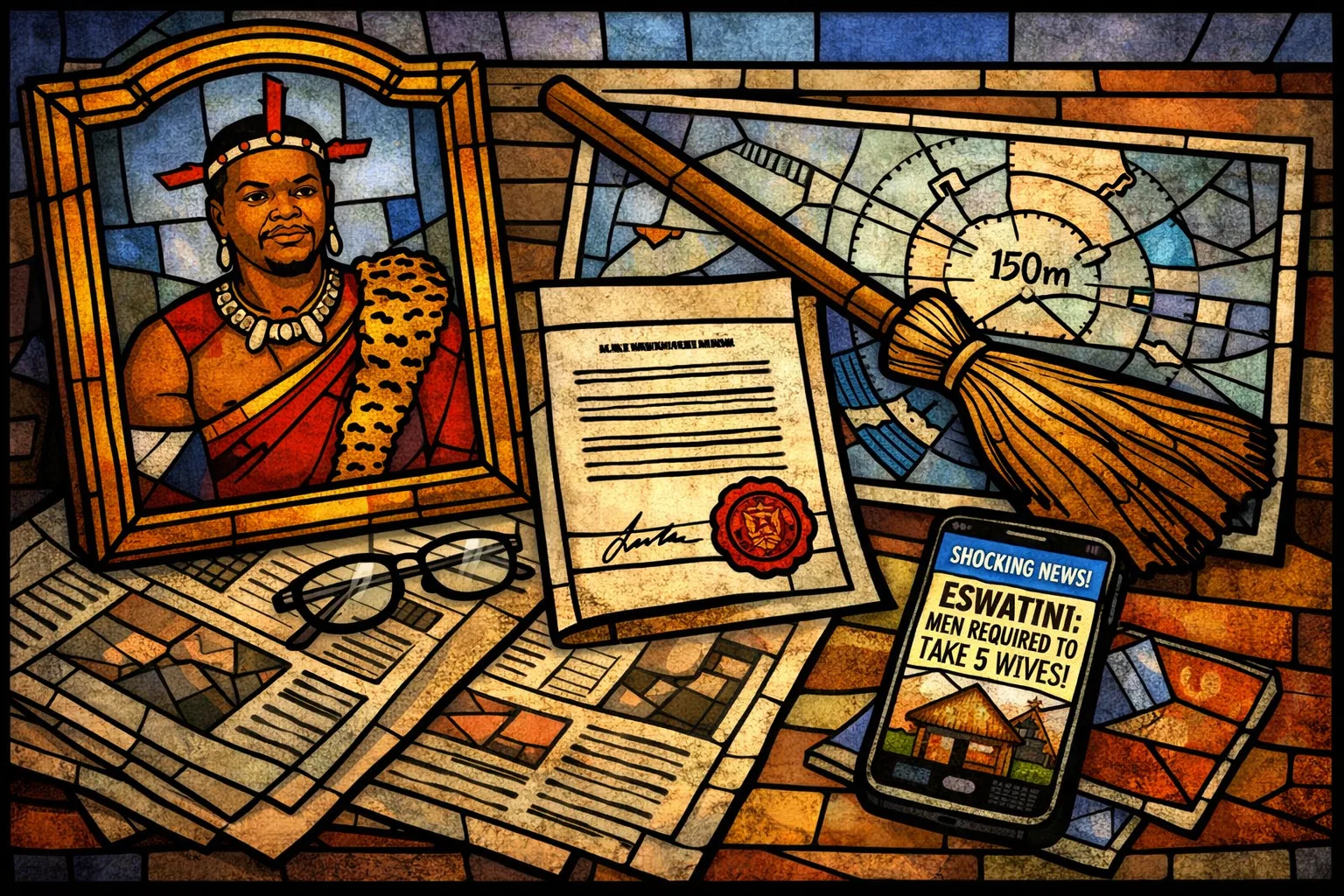
The most successful Eswatini hoax claimed that King Mswati III had ordered every man in the country to take at least two wives—or, in later versions, five wives—or face imprisonment. Some reports added that the government would pay for weddings and provide houses. The supposed decree was said to take effect in June 2019.
No such order existed. The claim was traced through online publications and social-media posts, including a report carried by the Zambian Observer and copied by other sites. Eswatini’s government denounced it as malicious and insulting, while Africa Check, AFP and PesaCheck found no decree, law or credible official announcement supporting it.[afp.com]factcheck.afp.comeswatini says fake polygamy story insult king and countrySwazi men would have to marry several wives starting from June.Read more…
The fabrication was persuasive because it combined three recognisable facts with an invented conclusion. Eswatini is a monarchy; the king has multiple wives; and polygamous marriage exists within the country. A reader unfamiliar with Eswatini’s legal and social institutions might therefore accept the leap from “the king practises polygamy” to “the king has made polygamy compulsory”.
The tale also used familiar clickbait techniques. It attached an extraordinary command to a famous ruler, included a threat of imprisonment and gave the story a precise starting date. Those details created the appearance of official policy without supplying the elements that genuine legislation would leave behind: a gazette notice, parliamentary record, statutory text or identifiable government department responsible for implementation.
The hoax proved unusually durable. By 2024 and 2025, new versions claimed that Eswatini was inviting foreign men to immigrate and marry local women because the kingdom supposedly had a severe shortage of men. Fact-checkers again found that the purported royal letter and immigration offer were fabricated.[pesacheck.org]pesacheck.orgFAKE: King Mswati III has not appealed to men…14 Mar 2024 — FAKE: King Mswati III has not appealed to men to immigrate and ma…
Its longevity reveals how false stories mutate rather than disappear. The original “marry more wives or go to prison” narrative became a fantasy immigration scheme, but the underlying mechanism stayed the same: royal authority, polygamy and gender stereotypes were blended into a story designed for rapid sharing.

The invented law about 14-year-old brides
A related fabrication appeared in 2018, when a website masquerading as a legitimate African news outlet claimed that Eswatini’s parliament had passed a law allowing King Mswati III to marry girls aged 14. The accompanying photograph and references to royal marriage customs made the article appear connected to genuine controversy.
Both Africa Check and AFP found no evidence that such a law existed. A government spokesperson rejected the claim, and fact-checkers noted that the country had recently enacted the Sexual Offences and Domestic Violence Act, which strengthened legal protection for minors rather than creating the reported exemption.[Africa Check]africacheck.orgno eswatini hasnt passed law let its king marry 14 year oldAfrica CheckNo, eSwatini hasn't passed a law to let its king marry '14-…12 Dec 2018 — No, eSwatini hasn't passed a law to let its king…
This case requires careful distinction between fabrication and legitimate criticism. Eswatini has faced serious scrutiny over women’s rights, royal marriage practices and the relationship between customary authority and civil law. Past disputes involving young women selected as royal brides were real and prompted legal and human-rights challenges. Those genuine concerns, however, do not prove the existence of the invented 2018 statute. A false article can exploit a credible area of controversy while still being false in its central claim.
That mixture is one reason the story travelled. Readers who already knew that the king had several wives, or had encountered reporting about disputed royal courtship practices, could mistake plausibility for evidence. The fake report benefited from existing criticism of the monarchy, while its publishers gained attention and advertising traffic from a headline likely to provoke outrage.
Did Eswatini really restrict broomstick flights?
Perhaps the strangest international story associated with Eswatini appeared in 2013: witches, it was reported, had been forbidden from flying broomsticks more than 150 metres above the ground. Anyone breaking the limit supposedly faced arrest and a fine of 500,000 rand.
The claim was repeated by numerous news outlets as an eccentric but genuine regulation. Reports attributed it to Sabelo Dlamini, an official connected with the civil aviation authority, who was quoted as saying that a witch on a broomstick should remain below the 150-metre limit. The comment followed discussion of rules governing objects such as model aircraft, kites and surveillance equipment in controlled airspace.[timeslive.co.za]timeslive.co.zaTimes LIVEBroomstick-flying witches to be brought down in SwazilandTimes LIVEBroomstick-flying witches to be brought down in Swaziland
The surviving legal material does not establish a special anti-witchcraft law. Eswatini’s Civil Aviation Authority Act applies to aircraft, aviation operators, air navigation and related activities; its rules of the air concern actual aviation safety. The legislation does not provide evidence of a distinct statutory category for supernatural broomstick travel.[eswacaa.co.sz]eswacaa.co.szCIVIL AVIATION AUTHORITY ACT 2009CIVIL AVIATION AUTHORITY ACT 2009
The most defensible interpretation is therefore not that legislators seriously drafted a witch-flight ban, but that an official made a humorous or rhetorical remark while explaining a genuine airspace rule. Journalists then detached the joke from its administrative setting and turned it into a literal national prohibition.
This makes the episode a useful example of the uncertain boundary between hoax, satire and misreporting. There may have been no single hoaxer inventing the entire story. Instead, a colourful quotation was amplified through repetition until the distinction between “an official joked that the rule would apply even to witches” and “Eswatini has passed a law regulating witches” disappeared.
The international appeal of the story also depended on an old stereotype: the idea that African states combine modern bureaucracy with unquestioned supernatural belief. Reporting frequently emphasised that witchcraft was taken seriously in the country, encouraging readers to treat an improbable interpretation as culturally plausible. The joke was therefore not entirely innocent. It converted a real society into a ready-made setting for exotic comedy.
Royal quotations that grew into false promises
Not every disputed claim about Eswatini began on an anonymous clickbait site. In 2015, local newspapers reported that King Mswati III had promised personally to rid the country of HIV and AIDS by 2022. Critics argued that the coverage elevated an aspirational or poorly defined royal statement into a concrete promise that could not be supported by medical evidence.
The story then acquired another false layer. A report claimed that United States president Barack Obama had endorsed the king’s supposed pledge. Contemporary criticism found no basis for that assertion.[allAfrica.com]allafrica.comOpen source on allafrica.com.
This was more than a comic royal rumour. Eswatini’s HIV epidemic was a profound public-health emergency, making exaggerated promises especially consequential. The country’s eventual progress against HIV came through testing, antiretroviral treatment, prevention programmes and extensive international support—not through a single leader’s personal intervention. Later reporting has documented the central role of sustained health programmes and foreign assistance in that improvement.[The Washington Post]washingtonpost.comOpen source on washingtonpost.com.
The episode illustrates how prestige can substitute for evidence. A statement linked to a monarch may receive deferential coverage; adding the supposed approval of a globally recognised leader makes it appear still more authoritative. Repetition then obscures where the claim originated, what was actually said and whether any measurable plan existed behind it.
It also shows why not every falsehood fits the classic model of a hoax. The original report may have involved exaggeration, imprecise political rhetoric or uncritical journalism rather than a carefully planned fraud. The invented Obama endorsement, however, pushed the story further into fabrication.

Crisis rumours and the missing king
During the pro-democracy unrest of June 2021, reports circulated that King Mswati III had fled Eswatini and taken refuge in South Africa. The claim emerged amid demonstrations, fires, looting, security-force deployments and severe uncertainty about events on the ground.
The government said the king remained in the country and continued working with officials. News organisations reported both the claim—attributed in some cases to opposition sources—and the official denial. No independently verified evidence emerged at the time proving that he had fled.[iol.co.za]iol.co.zaOpen source on iol.co.za.
This case differs sharply from the marriage hoaxes. It arose during a genuine political emergency, when the king’s location was a matter of immediate public importance. Information was fragmented, institutions were mistrusted and internet access was disrupted. Under those conditions, an unconfirmed report could spread as fast as an intentional fabrication.
The safest classification is therefore “unverified crisis rumour”, not a proven organised hoax. Government denial alone cannot establish truth in a politically restrictive environment, but nor does an opposition assertion prove that the king crossed the border. The evidence available publicly supports caution rather than certainty.
The episode nevertheless reveals an important feature of Eswatini’s misinformation environment. Academic research into the country’s mainstream media has linked the spread of false information partly to official secrecy and difficulty obtaining reliable information on matters of public interest. Reporters working with incomplete access may be forced to choose between repeating claims from interested parties and waiting while rumours fill the vacuum.[Taylor & Francis Online]tandfonline.comOpen source on tandfonline.com.
Why these stories find an audience
Eswatini hoaxes often succeed internationally because the country is familiar enough to carry recognisable labels—absolute monarchy, royal polygamy, traditional ceremonies—but unfamiliar enough that many readers cannot quickly judge what is plausible.
Several recurring devices appear across the best-known cases:
- A real institution supports an invented rule. The monarchy exists, but compulsory polygamy does not. The aviation authority exists, but a special law for broomsticks is not demonstrated.
- A genuine controversy lends credibility to a false detail. Debates over royal marriage practices make a fabricated child-marriage statute seem possible.
- Official status is simulated rather than proved. False stories refer vaguely to “the government”, “parliament” or “the king” without linking to legal texts or complete speeches.
- Foreign stereotypes do part of the persuasive work. The audience is invited to believe that an extraordinary claim must be normal in a small African monarchy.
- Corrections travel less effectively than the original tale. A funny or outrageous headline survives in screenshots and reposts long after its source has been discredited.
Domestic conditions also matter. Reporters Without Borders describes strong legal and political pressure on journalism in Eswatini, including restrictions surrounding criticism of the monarchy. A constrained information environment does not mean that every anti-government report is false, but it makes independent verification harder and gives both officials and opponents incentives to accuse one another of spreading “fake news”.[Reporters Without Borders]rsf.orgOpen source on rsf.org.
That distinction is essential. The label should not become a shortcut for dismissing criticism, allegations or unpopular reporting. Some statements are demonstrably fabricated; others are disputed, poorly sourced or impossible to confirm promptly. Treating all of them as the same phenomenon hides the difference between clickbait fraud, journalistic error, satire, propaganda and unresolved political claims.

How to test an Eswatini hoax
The strongest clue is often the gap between the scale of the claim and the weakness of its documentary trail. An order affecting every marriage in the country would require more than a viral post. A new criminal law would normally produce statutory wording, parliamentary discussion, implementation details and reporting by several identifiable institutions.
Readers can apply four practical tests:
- Look for the primary document. A royal decree, statute or aviation rule should have a title, date and issuing authority.
- Check whether the headline exaggerates the source. A humorous official comment may have been converted into a literal law.
- Separate real context from the claimed event. The existence of polygamy does not validate a compulsory-marriage order.
- Seek independent confirmation. Government statements, opposition reports and anonymous viral pages all require corroboration, especially during unrest.
Eswatini’s famous false stories are revealing precisely because most are assembled from fragments of truth. Their creators did not need to invent an entirely imaginary country. They needed only to magnify its least familiar features, remove legal and historical context, and trust that an extraordinary version would travel further than the correction.
What the hoaxes ultimately reveal
The country’s best-known hoaxes tell us less about supposed national credulity than about international expectations. Foreign audiences have repeatedly accepted stories portraying Eswatini as a place where royal whim instantly becomes law, where supernatural belief enters aviation codes, or where complex social problems are settled by extravagant decrees.
Inside the country, misinformation has a different and more serious edge. Political secrecy, restricted media conditions and public mistrust can turn incomplete information into dangerous rumour. The 2021 claim that the king had fled demonstrates how quickly the line between report, allegation and established fact can collapse during a crisis.
The most durable Eswatini hoaxes therefore share one lesson: plausibility is often manufactured from context. The falsehood succeeds not because it contains no truth, but because it places a dramatic invention beside facts the audience already half knows. Careful checking restores the missing distinctions—between custom and law, joke and regulation, criticism and fabrication, rumour and proof.
Amazon book picks
Further Reading
Books and field guides related to Which Eswatini Stories Were Actually True?. Use these as the next step if you want deeper reading beyond the article.
Africa Is Not A Country
Directly relevant to myths and misinformation about African countries including Eswatini.
How to Lie with Statistics
Useful for understanding exaggerated claims and dubious reporting.
eBay marketplace picks
Marketplace Samples
Live-tested eBay searches with available results related to this page.



Endnotes
1.
Source: factcheck.afp.com
Title: eswatini says fake polygamy story insult king and country
Link:https://factcheck.afp.com/eswatini-says-fake-polygamy-story-insult-king-and-country
Source snippet
Swazi men would have to marry several wives starting from June.Read more...
2.
Source: pesacheck.org
Title: false men in eswatini have not been ordered to marry more wives or face jail
Link:https://pesacheck.org/false-men-in-eswatini-have-not-been-ordered-to-marry-more-wives-or-face-jail/
Source snippet
FALSE: Men in eSwatini have not been ordered to 'marry...16 May 2019 — PesaCheck has looked into the claim that King Mswati III...
Published: May 2019
3.
Source: pesacheck.org
Link:https://pesacheck.org/fake-king-mswati-iii-has-not-appealed-to-men-to-immigrate-and-marry-liswati-women/
Source snippet
FAKE: King Mswati III has not appealed to men...14 Mar 2024 — FAKE: King Mswati III has not appealed to men to immigrate and ma...
4.
Source: factcheckzw.org
Link:https://factcheckzw.org/hold-your-horses-the-eswatini-government-is-not-about-to-fulfil-anyones-polygamy-dreams/
Source snippet
Hold your horses: the Eswatini government is not about to...The government has not invited men from Southern Africa to reloca...
5.
Source: factcheck.afp.com
Title: no eswatini has not passed law allowing king mswati marry 14 year old virgins
Link:https://factcheck.afp.com/no-eswatini-has-not-passed-law-allowing-king-mswati-marry-14-year-old-virgins
6.
Source: ynaija.com
Link:https://ynaija.com/this-is-not-a-joke-swaziland-aviation-authorities-warn-witches-against-flying-too-high/
7.
Source: eswacaa.co.sz
Title: CIVIL AVIATION AUTHORITY ACT 2009
Link:https://www.eswacaa.co.sz/regulationandcompliance/documents/regulations/CIVIL-AVIATION-AUTHORITY-ACT-2009.pdf
8.
Source: eswacaa.co.sz
Title: RulesoftheAirandAirTrafficControl 2011
Link:https://www.eswacaa.co.sz/regulationandcompliance/documents/regulations/RulesoftheAirandAirTrafficControl-2011.pdf
9.
Source: allafrica.com
Link:https://allafrica.com/stories/201508130591.html
10.
Source: allafrica.com
Link:https://allafrica.com/stories/201502230309.html
11.
Source: factcheck.afp.com
Title: busting coronavirus myths
Link:https://factcheck.afp.com/busting-coronavirus-myths
12.
Source: factcheck.afp.com
Link:https://factcheck.afp.com/doc.afp.com.B3XN49E
13.
Source: factcheck.afp.com
Title: sorry spoil fun no student didnt score free kfc meals year posing inspector
Link:https://factcheck.afp.com/sorry-spoil-fun-no-student-didnt-score-free-kfc-meals-year-posing-inspector
14.
Source: eswacaa.co.sz
Title: OperationofAircraft 2011
Link:https://www.eswacaa.co.sz/regulationandcompliance/documents/regulations/OperationofAircraft-2011.pdf
15.
Source: pesacheck.org
Link:https://pesacheck.org/tag/eswatini/
16.
Source: reason.com
Title: oh what a world
Link:https://reason.com/2013/05/22/oh-what-a-world/
17.
Source: africacheck.org
Title: no mswati didnt decree men eswatini must marry least two
Link:https://africacheck.org/fact-checks/meta-programme-fact-checks/no-mswati-didnt-decree-men-eswatini-must-marry-least-two
Source snippet
Africa CheckNo, Mswati didn't decree men in eSwatini must marry at...24 Jun 2019 — In December 2018, Africa Check debunked a false news...
Published: December 2018
18.
Source: africacheck.org
Title: no eswatini hasnt passed law let its king marry 14 year old
Link:https://africacheck.org/fact-checks/meta-programme-fact-checks/no-eswatini-hasnt-passed-law-let-its-king-marry-14-year-old
Source snippet
Africa CheckNo, eSwatini hasn't passed a law to let its king marry '14-...12 Dec 2018 — No, eSwatini hasn't passed a law to let its king...
19.
Source: timeslive.co.za
Title: Times LIVEBroomstick-flying witches to be brought down in Swaziland
Link:https://www.timeslive.co.za/news/africa/2013-05-13-broomstick-flying-witches-to-be-brought-down-in-swaziland/
20.
Source: washingtonpost.com
Link:https://www.washingtonpost.com/world/2025/05/18/usaid-withdrawal-africa-healthcare/
21.
Source: iol.co.za
Link:https://iol.co.za/news/africa/2021-06-29-eswatini-government-denies-king-mswati-iii-has-fled-to-sa-amid-pro-democracy-protests/
22.
Source: theeastafrican.co.ke
Title: eswatini denies reports of king mswati iii leaving the country 3455062
Link:https://www.theeastafrican.co.ke/tea/news/southern-africa/eswatini-denies-reports-of-king-mswati-iii-leaving-the-country-3455062
23.
Source: tandfonline.com
Link:https://www.tandfonline.com/doi/abs/10.1080/23743670.2019.1664606
24.
Source: rsf.org
Link:https://rsf.org/en/country/eswatini
25.
Source: africacheck.org
Title: 2014 review ebola boko haram elections and dodgy data
Link:https://africacheck.org/fact-checks/reports/2014-review-ebola-boko-haram-elections-and-dodgy-data
26.
Source: africacheck.org
Link:https://africacheck.org/search?f%5B0%5D=article_type%3AMedia_literacy&f%5B1%5D=article_type%3Ablog&f%5B2%5D=article_type%3Aex_reports&f%5B3%5D=article_type%3Ameta-programme-fact-checks&page=0&search_api_fulltext=Lee+mwati&sort_bef_combine=search_api_relevance_DESC&sort_by=search_api_relevance&sort_order=DESC
27.
Source: lawlibrary.org.za
Link:https://lawlibrary.org.za/akn/za/act/2009/13
28.
Source: iol.co.za
Title: 2020 04 13 eswatini government slams fake news claiming king mswati iii is ill
Link:https://iol.co.za/news/africa/2020-04-13-eswatini-government-slams-fake-news-claiming-king-mswati-iii-is-ill/
29.
Source: iol.co.za
Title: 2019 05 16 fake eswatini polygamy story disgrace to journalism
Link:https://iol.co.za/news/2019-05-16-fake-eswatini-polygamy-story-disgrace-to-journalism/
30.
Source: rsf.org
Title: analyse regionale
Link:https://rsf.org/en/analyse_regionale/837
Additional References
31.
Source: dubawa.org
Title: did swazilands government order men to marry five wives or risk jail term
Link:https://dubawa.org/did-swazilands-government-order-men-to-marry-five-wives-or-risk-jail-term/
Source snippet
Did Swaziland's government order men to marry five wives...18 Jun 2025 — Conclusion. The claim that the government of Eswatini ord...
32.
Source: youtube.com
Title: Eswatini dismisses as false reports that King Mswati III has fled the country
Link:https://www.youtube.com/watch?v=7HRocmEm0sk
Source snippet
Discussing roots of Eswatini protests with Pius Vilakati...
33.
Source: youtube.com
Title: Eswatini government warns public against COVID-19 fake news
Link:https://www.youtube.com/watch?v=JD5LegJvyqg
Source snippet
Eswatini dismisses as false reports that King Mswati III has fled the country...
34.
Source: youtube.com
Title: Discussing roots of Eswatini protests with Pius Vilakati
Link:https://www.youtube.com/watch?v=QkS_0dzzSeU
Source snippet
Eswatini revolt | Government dismisses as false, claims that the king has fled...
35.
Source: facebook.com
Link:https://www.facebook.com/NewsCentralAfrica/posts/eswatini-eswatini-calls-for-calm-denies-king-mswati-fled-the-countryafricafirst-/1411066715939878/
36.
Source: jamiiforums.ke
Link:https://www.jamiiforums.ke/threads/authorities-in-swaziland-high-flying-witches-face-arrest-and-a-heavy-fine-if-they-break-new-laws.476223/?amp=1
37.
Source: facebook.com
Link:https://www.facebook.com/zambianday/posts/eswatini-govt-denies-reports-king-mswati-has-fled-country-the-eswatini-governmen/2900431523555580/
38.
Source: facebook.com
Link:https://www.facebook.com/EswatiniGov/posts/statement-government-and-partners-congratulate-his-majesty-king-mswati-iii-on-re/591617783161562/
39.
Source: facebook.com
Link:https://www.facebook.com/groups/375229460523402/posts/1454744169238587/
40.
Source: medium.com
Link:https://medium.com/%40TheHiddenSide/fake-news-times-publishes-dubious-unverified-biased-survey-on-eswatinis-political-outlook-863d9c657736
Topic Tree
Follow this branch
Related pages 192
- Albanian Hoaxes
- Algerian Hoaxes
- Antigua Deceptions
- Argentina Hoaxes
- Armenian Hoaxes
- +187 more in sidebar