When False Stories Became Bosnia's Public Reality
Bosnia and Herzegovina’s best-known hoax is the claim that natural hills near Visoko are enormous prehistoric pyramids. Yet the country’s history of contested truth is broader and more serious than that colourful tourist story.
Page outline Jump by section
Introduction
These episodes did not succeed because Bosnians were unusually credulous. They worked because they attached themselves to powerful needs: pride after national trauma, fear during war, distrust of institutions, economic insecurity and the instant rewards of online attention. They also show why the word “hoax” must be used carefully. The Visoko pyramid story is pseudoarchaeology promoted as discovery; fabricated wartime material was propaganda; denial of documented atrocities is historical falsification; and many digital deceptions are commercial products rather than elaborate practical jokes.
The “Bosnian pyramids” that geology could explain
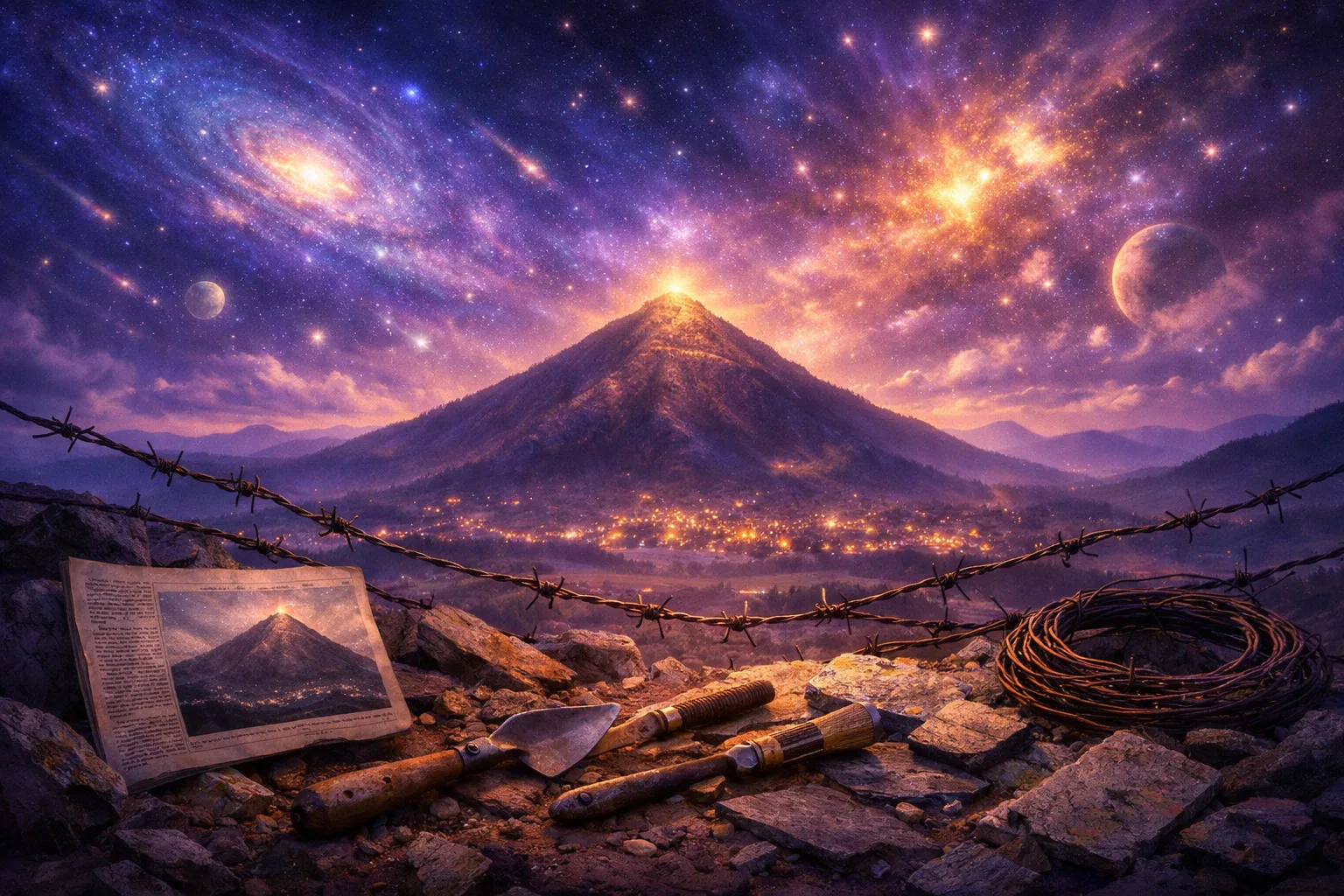
In 2005, Bosnian-American businessman and author Semir Osmanagić announced that Visočica, a steep, roughly triangular hill above the town of Visoko, concealed an immense human-made pyramid. He subsequently presented neighbouring hills as additional monuments and promoted nearby passages as parts of an ancient tunnel network. The complex was described not merely as old, but as one of the greatest archaeological discoveries in human history.
The basic visual argument was immediately persuasive: from certain angles, Visočica looks remarkably like a pyramid. Photographs showing its straight-looking slopes travelled well through television, newspapers and the internet. Excavated patches of layered rock could be presented as paving or masonry, while cracks in naturally occurring stone appeared in close-up photographs without the wider geological setting needed to interpret them.
The claim also arrived at an unusually receptive moment. Bosnia and Herzegovina was recovering from the destruction and dislocation of the 1992–95 war. A supposed civilisation older and more technically accomplished than ancient Egypt offered a dramatic reversal of the country’s recent image as a place defined by siege, ethnic violence and international supervision. The story promised prestige, visitors and employment, while allowing supporters to portray scepticism as condescension towards Bosnia rather than ordinary scientific criticism. Smithsonian’s account of the phenomenon found that national pride, the attraction of mystery and the hope of economic revival had become intertwined with the archaeological claim.[Smithsonian Magazine]smithsonianmag.comSmithsonian Magazine The Mystery of Bosnia's Ancient PyramidsSmithsonian MagazineThe Mystery of Bosnia's Ancient PyramidsDecember 1, 2009 — Sam Osmanagich claims that 12,000 years ago, early Europea…
What investigators actually found
The scientific objection was not simply that the idea sounded improbable. Geologists from the University of Tuzla examined the hill and concluded that it consisted of naturally deposited layers of conglomerate, sandstone and clay, shaped by geological and erosional processes. Similar angular landforms occur elsewhere in the Sarajevo–Zenica basin. Their pyramid-like profiles are examples of nature producing regular-looking forms from tilted layers of rock rather than evidence of monumental construction.[Wikipedia]WikipediaBosnian pyramid claimsBosnian pyramid claims
Archaeologists found a second problem: the dramatic claim threatened genuine heritage. The summit of Visočica contains the remains of the medieval royal town of Visoki, a protected site associated with the Bosnian kingdom. Specialists warned UNESCO that unsystematic excavations undertaken in pursuit of a nonexistent pyramid could damage medieval, Roman and prehistoric material that was actually present. Their 2006 letter described the supposed pyramid as a pseudoarchaeological myth and urged that any UNESCO interest not be misrepresented as endorsement.[Archaeology Magazine]archive.archaeology.orgArchaeology Magazine12 June 2006 'BOSNIAN PYRAMIDS' - Magazine Issue ArchiveJune 14, 2006 — 12 Jun 2006 — UNESCO is to send a team of arc…
The European archaeological response was unusually blunt, calling the project a “cruel hoax” on the public. Critics also challenged the authority with which the discovery was marketed. Osmanagić was frequently introduced as an archaeologist, although his academic background was not in archaeology or geology. Archaeology magazine noted that he was a businessman with degrees in economics and political science rather than a trained field archaeologist.[Archaeology Magazine]archive.archaeology.orgMagazine Pyramid SchemeArchaeology MagazinePyramid Scheme - Archaeology Magazine ArchiveBosnian "Pyramid of the Sun." Bosnian archaeologist who's spent 15 years…
Supporters have continued to cite geometric alignments, alleged concrete blocks, radiocarbon dates from organic material and unusual readings from instruments. Some recent publications sympathetic to the project still argue that human modification deserves consideration. These claims have not overturned the central geological finding: dating a leaf, piece of wood or sediment from a tunnel does not date the construction of a pyramid, while an apparently regular slab is not artificial masonry unless its manufacture and structural setting can be demonstrated. The existence of continuing pro-pyramid publications therefore shows that the controversy survives, not that scientific opinion has moved towards acceptance.[JBRES]jelsciences.comJBRESMultidisciplinary Evaluation of the Pyramid-ShapedMay 19, 2025 — This study presents a multidisciplinary investigation of the pyramid-shaped formation known as the Bosnian Pyramid of the…
Who benefited from the mystery
The story became durable partly because it produced real economic results even when its archaeological claims failed. Visitors arrived, souvenir businesses developed and the site evolved into a mixture of excavation attraction, landscaped park and New Age destination. Reporting from Visoko found local traders who regarded the scientific argument as less important than the steady arrival of tourists.[RadioFreeEurope/RadioLiberty]rferl.orgOpen source on rferl.org.
This creates an unusual feedback loop. Tourism is presented as proof that the discovery matters, while the attention generated by controversy brings more tourism. Excavation also changes the appearance of the hills: cleared surfaces, cut terraces and exposed layers can make natural geology look increasingly architectural in photographs. The result is not necessarily a single, secretive fraud in which every participant knows the truth. It is an ecosystem containing sincere believers, commercial opportunists, local boosters, volunteers, alternative-history enthusiasts and people who simply enjoy the spectacle.
The lesson is more interesting than “a funny pyramid fooled people”. Once a claim supplies identity, income and community, geological rebuttal alone may not dislodge it. The scientific question and the social value of believing can become almost separate matters.
When wartime propaganda borrowed an old painting
During the Bosnian War, misinformation carried consequences far beyond wasted money or damaged archaeology. Competing nationalist media systems used invented atrocities, distorted statistics and threatening stereotypes to create fear, justify territorial projects and portray entire civilian populations as dangerous.
One especially stark example involved an image presented by the Serbian newspaper Večernje novosti as a scene connected to a Serbian child whose family had supposedly been killed by Bosnian Muslims. The picture was not a news photograph at all. It came from an 1888 painting by the Serbian realist artist Uroš Predić. Detached from its original identity and supplied with a new caption, nineteenth-century art was transformed into apparently contemporary evidence.[Cymru Global]cymru.globalGlobal Propaganda and SrebrenicaGlobal Propaganda and Srebrenica
The mechanism was simple but powerful. Readers do not usually conduct art-historical research before reacting to a horrifying image. A picture appears to bypass argument: it seems to let the audience witness suffering directly. In wartime, when independent access to places and witnesses is restricted, a confident caption can determine what an image is understood to show.
Other false stories attributed secret extermination plans, forced sterilisation or religious conspiracies to opposing communities. Such propaganda was not merely an inaccurate description of an already existing conflict. International Criminal Tribunal for the former Yugoslavia judgments documented how media in places such as Prijedor helped identify non-Serbs as extremists and enemies while local political authorities prepared discriminatory and violent measures. The language of threat helped make persecution appear defensive or necessary.[Wikipedia]WikipediaForeign fighters in the Bosnian WarForeign fighters in the Bosnian War
This material must be handled with precision. Genuine atrocities were committed against civilians from all of Bosnia and Herzegovina’s principal communities, and acknowledging a fabricated story does not invalidate documented crimes against that community. Propaganda works precisely by exploiting real grief and fear, combining truth, omission and invention until challenging a false detail can be portrayed as hostility towards all victims.
The claim that authentic camp footage was staged
Bosnia’s deception history contains an important reversal: sometimes the hoax was the allegation that genuine evidence had been faked.
In August 1992, British television journalists filmed severely emaciated detainees at Trnopolje in northern Bosnia. The images, especially those of Fikret Alić behind strands of barbed wire, became defining visual evidence of the detention system established during the campaign against non-Serbs in the Prijedor area.
Five years later, the British magazine Living Marxism alleged that the journalists had manipulated the scene and deceived the world. Much of the argument concerned the precise position of the camera crew relative to a fenced enclosure. From that detail, the magazine advanced the much broader implication that the camp story itself had been manufactured.
ITN sued for libel and won in 2000. Later tribunal proceedings also exposed errors in the “fake pictures” argument. During the trial of former Bosnian Serb leader Radovan Karadžić, prosecution questioning established that a witness who believed the footage had been fabricated had confused or misunderstood key facts about the site.[Institute for War & Peace Reporting]iwpr.netfake camp claim demolishedfake camp claim demolished
Whether every viewer initially understood the exact layout of every fence is a narrower question than whether detainees were held, abused and killed within the Prijedor camp system. Court records, survivor testimony, local documentation and criminal convictions established the reality of that system independently of a single camera angle. The allegation of visual trickery endured because it offered a memorable technical puzzle that could distract from the much larger body of evidence.
This pattern has become common in denialist storytelling. Attention is fixed on an apparent anomaly in one photograph, translation or witness statement. The anomaly is then used to suggest that everything connected with the event is fraudulent. Minor uncertainty is converted into total disbelief, while corroborating evidence is omitted.

Srebrenica denial as organised historical falsification
The most consequential struggle over truth in post-war Bosnia and Herzegovina concerns Srebrenica. In July 1995, Bosnian Serb forces killed more than 8,000 Bosniak men and boys after taking the United Nations-declared safe area. International courts, including the International Criminal Tribunal for the former Yugoslavia and the International Court of Justice, determined that the killings constituted genocide.
Denial has nevertheless continued through claims that victim numbers were invented, that most of the dead were soldiers killed in ordinary combat, or that the genocide classification was merely a political label. These assertions persist despite multiple forms of mutually reinforcing evidence: intercepted communications, military records, eyewitness testimony, criminal judgments, execution locations, mass graves, personal possessions and DNA identifications.
Physical attempts to conceal the crime contributed to later confusion. Bodies were removed from primary burial sites with heavy machinery and transported to secondary graves, breaking remains apart and scattering some individuals across several locations. What denialists sometimes present as inconsistency was in part the result of an organised effort to hide evidence. Ongoing identification work and the reassembly of remains have made the crime more, not less, evidentially secure.[The Guardian]theguardian.comOpen source on theguardian.com.
Political institutions have also helped denial circulate. In April 2024, the National Assembly of Republika Srpska adopted a report disputing the genocide finding shortly before the United Nations considered an annual day of commemoration. That position contradicted judgments reached by international courts. The UN General Assembly subsequently established 11 July as the International Day of Reflection and Commemoration of the 1995 Genocide in Srebrenica and explicitly condemned genocide denial and the glorification of convicted war criminals.[Reuters]reuters.comBosnian Serb MPs adopt a report denying the Srebrenica genocideBosnian Serb MPs adopt a report denying the Srebrenica genocide
Genocide denial differs from an ordinary hoax because it is rarely built around one falsifiable prank. It is better understood as cumulative historical falsification: selective figures, mistranslated documents, attacks on witnesses, misleading comparisons and repeated assertions that legal or forensic findings are political inventions. Its beneficiaries are political actors whose legitimacy depends on preserving heroic national narratives and resisting responsibility.
How anonymous websites turned falsehood into a business
Bosnia and Herzegovina’s digital misinformation economy is generally less theatrical than the Visoko pyramids but more prolific. Research on the country’s online media found networks of websites whose principal purpose was to attract traffic through fabricated, distorted or recycled stories and convert that attention into advertising income.
The business model rewards emotional headlines rather than convincing long-term deceptions. A site can invent a quotation, announce a scandal, exaggerate a health warning or imply that a public figure has died. Social-media pages distribute the item, readers click, and automated advertisements generate small payments. Production costs are low because stories are copied, translated or lightly rewritten. A portal can disappear when exposed and return under another name.
A 2019 investigation divided Bosnia and Herzegovina’s misinformation outlets into several types, including purely commercial sites with little or no original journalism and politically connected portals that mixed genuine reporting with manipulation. Researchers found that profit was a major motivation and that murky ownership made responsibility difficult to establish. One examined publisher defended a fabricated email exchange by saying that it had been created with an online fake-mail tool and was intended as satire—an explanation that illustrates how “satire” can be invoked after readers have already been encouraged to treat a false document as real.[ceu.edu]cmds.ceu.eduBosnia: Business of MisinformationBosnia: Business of Misinformation
Anonymous portals have also served political interests. Instead of publishing propaganda under an accountable party or newspaper masthead, an operator can seed an accusation on an obscure site and allow larger outlets or political figures to repeat it. The original source may be almost invisible by the time the claim reaches a mass audience. Regional media researchers have identified the growth of such portals as a particularly important feature of Bosnia and Herzegovina’s disinformation environment.[OBCT]balcanicaucaso.orgOBCTDisinformation and anonymous portals in BosniaOBCTDisinformation and anonymous portals in Bosnia
Fact-checking organisations such as Raskrinkavanje emerged partly in response to this system. Their work does more than label individual stories false: it traces how claims migrate between websites and identifies outlets that repeatedly copy misinformation. That network approach is necessary because correcting the first publisher does little when dozens of replicas remain online.[Raskrinkavanje]raskrinkavanje.baOpen source on raskrinkavanje.ba.
The structural problem has not disappeared. A 2025 mapping project supported by UNESCO and Bosnia and Herzegovina’s Press and Online Media Council reported major transparency gaps among online news portals and called for a public registry and stronger disclosure of media ownership. When readers cannot determine who runs an outlet, who finances it or whether it has an editor, they have little basis for judging its incentives.[UNESCO]unesco.orgOpen source on unesco.org.

Why these stories survive exposure
Bosnia and Herzegovina’s famous deceptions differ sharply in purpose, but they share several survival mechanisms.
They offer emotional clarity. A mysterious pyramid turns a complicated past into a glorious ancient civilisation. Wartime propaganda divides the world into innocent victims and monstrous enemies. Denial protects a community from shame by presenting legal and forensic findings as hostile inventions.
They exploit the authority of images and documents. A painting becomes an atrocity photograph when supplied with a false caption. A naturally fractured rock becomes poured concrete in a tightly framed picture. A fabricated email gains credibility from the familiar appearance of an inbox.
They create beneficiaries. Tourist businesses profit from the pyramid narrative. Clickbait operators receive advertising income. Political movements gain cohesion by repeating stories that flatter supporters or delegitimise opponents.
They turn correction into evidence of persecution. Archaeologists become jealous gatekeepers, journalists become conspirators, courts become anti-national institutions and fact-checkers become political agents. Once criticism itself is incorporated into the theory, exposure can strengthen the loyalty of committed believers.
They blur different kinds of uncertainty. Honest debate about a fence line, the age of sediment or the interpretation of a wartime document is presented as proof that an entire event is unknown. Yet uncertainty about one detail does not erase the surrounding evidence.
The most useful question is therefore not simply, “Was this a hoax?” It is: what exactly was claimed, what evidence would demonstrate it, and does that evidence come from independent sources? In Visoko, the relevant tests concern geology, archaeology and secure dating rather than the hill’s appearance. For wartime claims, one photograph must be checked against witnesses, records, graves and judicial findings. For online stories, ownership, original sourcing and the path by which a quotation or document appeared are often more revealing than the confidence of the headline.
Bosnia and Herzegovina’s history of hoaxes is ultimately a history of contested authority. The strongest deceptions flourished where scientific institutions, journalism or courts competed with stories that supplied pride, profit or political protection. Their persistence shows that exposing a false claim is only the beginning. Understanding the need it serves explains why it may continue circulating long after the central evidence has been settled.
Amazon book picks
Further Reading
No matched book cards were available for When False Stories Became Bosnia's Public Reality, so this fallback keeps a direct Amazon reading path visible.
Topical books
Bosnia misinformation economy guide
Browse books, explainers and reference titles related to this topic.
Search AmazonRelated search
pseudoarchaeology Bosnia guide
Browse books, explainers and reference titles related to this topic.
Search AmazonRelated search
Bosnian War propaganda guide
Browse books, explainers and reference titles related to this topic.
Search AmazonEndnotes
1.
Source: Wikipedia
Title: Bosnian pyramid claims
Link:https://en.wikipedia.org/wiki/Bosnian_pyramid_claims
2.
Source: archive.archaeology.org
Link:https://archive.archaeology.org/online/features/osmanagic/UNESCO.pdf
Source snippet
Archaeology Magazine12 June 2006 '[BOSNIAN PYRAMIDS]({{ 'bosnian-pyramids/' | relative_url }})' - Magazine Issue ArchiveJune 14, 2006 — 12 Jun 2006 — UNESCO is to send a team of arc...
Published: June 14, 2006
3.
Source: archive.archaeology.org
Title: Magazine Bosnian “Pyramids” Update
Link:https://archive.archaeology.org/online/features/osmanagic/update.html
Source snippet
Osmanagic and the activities of his team pose a serious threat to the rich historical, cultural and archaeological heritage of the...Rea...
4.
Source: archive.archaeology.org
Title: Magazine Pyramid Scheme
Link:https://archive.archaeology.org/0607/abstracts/bosnia.html
Source snippet
Archaeology MagazinePyramid Scheme - Archaeology Magazine ArchiveBosnian "Pyramid of the Sun." Bosnian archaeologist who's spent 15 years...
5.
Source: jelsciences.com
Title: JBRESMultidisciplinary Evaluation of the Pyramid-Shaped
Link:https://www.jelsciences.com/articles/jbres2106.php
Source snippet
May 19, 2025 — This study presents a multidisciplinary investigation of the pyramid-shaped formation known as the Bosnian Pyramid of the...
Published: May 19, 2025
6.
Source: cymru.global
Title: Global Propaganda and Srebrenica
Link:https://cymru.global/blog/propaganda-and-srebrenica/
7.
Source: Wikipedia
Title: Foreign fighters in the Bosnian War
Link:https://en.wikipedia.org/wiki/Foreign_fighters_in_the_Bosnian_War
8.
Source: reuters.com
Title: Bosnian Serb MPs adopt a report denying the Srebrenica genocide
Link:https://www.reuters.com/world/europe/bosnian-serb-mps-adopt-report-denying-srebrenica-genocide-2024-04-18/
9.
Source: cmds.ceu.edu
Title: Bosnia: Business of Misinformation
Link:https://cmds.ceu.edu/sites/cmcs.ceu.hu/files/attachment/basicpage/1652/businessofmisinformationbosnia.pdf
10.
Source: balcanicaucaso.org
Title: OBCTDisinformation and anonymous portals in Bosnia
Link:https://www.balcanicaucaso.org/en/cp_article/disinformation-and-anonymous-portals-in-bosnia/
11.
Source: raskrinkavanje.ba
Link:https://raskrinkavanje.ba/en?page=16
12.
Source: unesco.org
Link:https://www.unesco.org/en/articles/new-report-exposes-major-transparency-gaps-bosnia-and-herzegovinas-online-news-sector
13.
Source: cmds.ceu.edu
Title: business misinformation bosnia lying profit
Link:https://cmds.ceu.edu/business-misinformation-bosnia-lying-profit
14.
Source: Wikipedia
Title: Propaganda during the Yugoslav Wars
Link:https://en.wikipedia.org/wiki/Propaganda_during_the_Yugoslav_Wars
15.
Source: Wikipedia
Title: Unusual articles
Link:https://en.wikipedia.org/wiki/Wikipedia%3AUnusual_articles
16.
Source: archive.archaeology.org
Link:https://archive.archaeology.org/news/page/512/?p%2F075289=
17.
Source: smithsonianmag.com
Title: Smithsonian Magazine The Mystery of Bosnia’s Ancient Pyramids
Link:https://www.smithsonianmag.com/history/the-mystery-of-bosnias-ancient-pyramids-148990462/
Source snippet
Smithsonian MagazineThe Mystery of Bosnia's Ancient PyramidsDecember 1, 2009 — Sam Osmanagich claims that 12,000 years ago, early Europea...
Published: December 1, 2009
18.
Source: rferl.org
Link:https://www.rferl.org/a/bosnia-visoko-pyramids-osmanagic-economy-hoax/28725843.html
19.
Source: iwpr.net
Title: fake camp claim demolished
Link:https://iwpr.net/global-voices/fake-camp-claim-demolished
20.
Source: theguardian.com
Link:https://www.theguardian.com/world/2025/jul/10/srebrenica-bosnia-genocide-remembered
21.
Source: journalismresearch.org
Link:https://journalismresearch.org/wp-content/uploads/2020/02/businessofmisinformationbosniafinal-1.pdf
22.
Source: theguardian.com
Title: radovan karadzic bosnia war crimes the hague
Link:https://www.theguardian.com/world/2010/mar/01/radovan-karadzic-bosnia-war-crimes-the-hague
23.
Source: theguardian.com
Link:https://www.theguardian.com/media/2000/mar/15/pressandpublishing.tvnews
24.
Source: theguardian.com
Link:https://www.theguardian.com/uk/2000/feb/29/juliahartleybrewer
25.
Source: pbs.org
Link:https://www.pbs.org/wgbh/pages/frontline/shows/karadzic/bosnia/media.html
26.
Source: reutersinstitute.politics.ox.ac.uk
Link:https://reutersinstitute.politics.ox.ac.uk/our-research/measuring-reach-fake-news-and-online-disinformation-europe
Additional References
27.
Source: youtube.com
Title: Why Europe Is Hiding The Largest Pyramid In The World
Link:https://www.youtube.com/watch?v=xoebZ2-KxIE
Source snippet
Bosnian Pyramids 2020 Update: Real or Hoax? | Ancient Architects...
28.
Source: youtube.com
Title: Bosnian ‘energy pyramids’ boosted by Djokovic visits | AFP
Link:https://www.youtube.com/watch?v=inyFah_hqK0
Source snippet
The BIGGEST Lie About Bosnia's Ancient Pyramids EXPOSED...
29.
Source: youtube.com
Title: Are There Ancient Pyramids in Visoko, Bosnia?
Link:https://www.youtube.com/watch?v=rR2o1CvEfRY
Source snippet
Bosnian 'energy pyramids' boosted by Djokovic visits | AFP...
30.
Source: researchgate.net
Link:https://www.researchgate.net/publication/339107429_Chapter_1_History_of_Fake_News
31.
Source: researchgate.net
Link:https://www.researchgate.net/publication/392679270_Politicized_Archaeology_and_Cultural_Gatekeeping_The_Case_of_the_Bosnian_Pyramids
32.
Source: imdb.com
Link:https://www.imdb.com/news/ni64972488/
33.
Source: facebook.com
Link:https://www.facebook.com/wimbledon/posts/all-the-emotions-on-day-12-ralph-lauren/1568551737974752/
34.
Source: mfrr.eu
Link:https://www.mfrr.eu/analysis-backsliding-in-bosnia-and-herzegovina-as-media-freedom-faces-myriad-challenges/
35.
Source: birn.eu.com
Link:https://birn.eu.com/
36.
Source: euwbmedia.com
Link:https://euwbmedia.com/tag/bosnia-and-herzegovina/
Amazon book picks
Further Reading
Books and field guides related to When False Stories Became Bosnia's Public Reality. Use these as the next step if you want deeper reading beyond the article.
Frauds, Myths, and Mysteries: Science and Pseudoscience in Ar...
Useful for evaluating pseudoarchaeological claims such as the Bosnian pyramids.
Black Lamb and Grey Falcon
Provides broad historical context for the region and competing narratives.
postcards from the grave
Addresses the realities behind wartime narratives and misinformation.
Topic Tree
Follow this branch
Related pages 192
- Albanian Hoaxes
- Algerian Hoaxes
- Antigua Deceptions
- Argentina Hoaxes
- Armenian Hoaxes
- +187 more in sidebar