Within Irish Hoaxes
Why Did Ireland's Statues Seem to Move?
The moving-statue reports reveal how sincere belief, visual effects and crowd expectation can create an experience without an organised hoax.
On this page
- What witnesses reported at Ballinspittle
- How staring, dim light and suggestion affect perception
- Why faith, uncertainty and crowds amplified the phenomenon
Page outline Jump by section
Introduction
In the summer of 1985, Ireland experienced one of the strangest episodes in its modern religious history. What began with reports that a statue of the Virgin Mary was moving at a roadside grotto near Ballinspittle, County Cork, rapidly spread across the country. Thousands of people claimed to see statues sway, breathe, nod, advance towards them or come alive. Crowds gathered nightly at grottos and churches, newspapers followed every development, and pilgrimage traffic surged. Yet the episode occupies an unusual place in the history of hoaxes and contested beliefs because there is little evidence of a single organiser, fraudster or deliberate deception behind it. Instead, Ballinspittle became a powerful example of how expectation, perception, faith and social influence can combine to create experiences that feel entirely real to witnesses.[Wikipedia]WikipediaMoving statuesMoving statues

The moving-statue phenomenon remains important not because investigators uncovered a hidden trick, but because it reveals how sincere people can reach extraordinary conclusions when visual ambiguity, emotional investment and collective belief reinforce one another.[wikipedia.org]WikipediaMoving statuesMoving statues
What Witnesses Reported at Ballinspittle
The events began in July 1985 at a grotto outside Ballinspittle. Witnesses reported that a statue of Our Lady appeared to move on its pedestal. Some described a gentle swaying motion. Others claimed the statue leaned forward, stepped towards observers, changed facial expression or seemed alive. As publicity grew, similar reports emerged from dozens of locations across Ireland. Not all involved the Virgin Mary; some centred on other religious images or alleged apparitions.[wikipedia.org]WikipediaMoving statuesMoving statues
The spread was remarkably rapid. Ballinspittle became a destination for pilgrims, curiosity-seekers and sceptics alike. Contemporary reports described thousands gathering at the grotto, while estimates suggested that tens of thousands, and perhaps more than 100,000 people, visited the site over the course of the phenomenon. Television crews and journalists documented crowds staring intently at the statue while waiting for movement to occur.[RTE.ie]rte.ieReport shows crowds praying at grotto.Read more…
What makes the case especially interesting is that many witnesses did not arrive expecting to invent a story. Numerous accounts came from ordinary observers who insisted they genuinely saw motion. Some viewers reported seeing nothing unusual, even while standing beside people who were convinced the statue had moved. This difference in experience became one of the central clues for later investigators.[Irish Examiner]irishexaminer.comarid 41546248Irish Examiner1985 revisited: Ballinspittle's moving statue — 'We weren't…4 Jan 2025 — A statue of the Virgin Mary that, in 1985, drew…
How Staring, Dim Light and Suggestion Affect Perception
One reason the Ballinspittle episode attracts attention from psychologists is that the conditions were almost ideal for creating visual misperceptions.
The statue stood above observers on a hillside. Many people viewed it at dusk or in fading evening light. Crowds often stared at it continuously for long periods while praying or waiting for a miracle. Under such conditions, the human visual system can behave in unexpected ways. Researchers from University College Cork who examined the phenomenon argued that prolonged staring at a fixed object in twilight conditions could produce convincing illusions of movement.[Wikipedia]WikipediaMoving statuesMoving statues
Several factors may have contributed:
- Autokinetic effects: When people stare at a stationary object against a dark or featureless background, the object can appear to drift or move.
- Eye fatigue and tiny eye movements: The eyes constantly make small involuntary motions. Under low-light conditions these can make fixed objects seem to sway.
- Changing light levels: As evening light fades, shadows shift and contrasts change, subtly altering the appearance of a statue.
- Expectation and attention: If observers are actively searching for movement, minor visual ambiguities can be interpreted as significant motion.[wikipedia.org]WikipediaMoving statuesMoving statues
Importantly, these explanations do not imply that witnesses were dishonest. Visual illusions occur because the brain actively constructs perception from incomplete information. People can sincerely report movement even when no physical movement occurred. This is why the phenomenon is often discussed as a case of collective interpretation rather than collective fraud.[Wikipedia]WikipediaMoving statuesMoving statues

Why Faith, Uncertainty and Crowds Amplified the Phenomenon
Visual conditions alone do not explain why moving-statue reports spread so widely in 1985. The broader social atmosphere mattered.
Ireland in the mid-1980s was experiencing economic hardship, emigration and uncertainty. Religious practice remained deeply woven into everyday life, and Marian devotion occupied a particularly important place within Irish Catholic culture. Apparition stories and pilgrimage traditions already had a long history, stretching back through events such as Knock in 1879. Against that background, reports of a moving statue resonated with existing expectations about divine signs and intervention.[MURAL]mural.maynoothuniversity.iePMMoving Statuesmoving statues and concrete thinkingby P Mulholland · Cited by 11 — In the early months of 1985 the Irish press reported a spate of…
Crowds also played a crucial role. When hundreds of people gather around a statue waiting for a miracle, reactions become socially contagious. A gasp, a shout or an excited claim that the statue has moved can direct everyone else’s attention towards the same interpretation. Once a few people announce that they have seen movement, others may begin scrutinising the statue in ways that make ambiguous visual impressions seem meaningful.[cora.ucc.ie]cora.ucc.ieby W Allen · 2014 · Cited by 2 —… Ireland's statues 'appeared' to move, speak and come alive in 1985. The devotional, on the other…
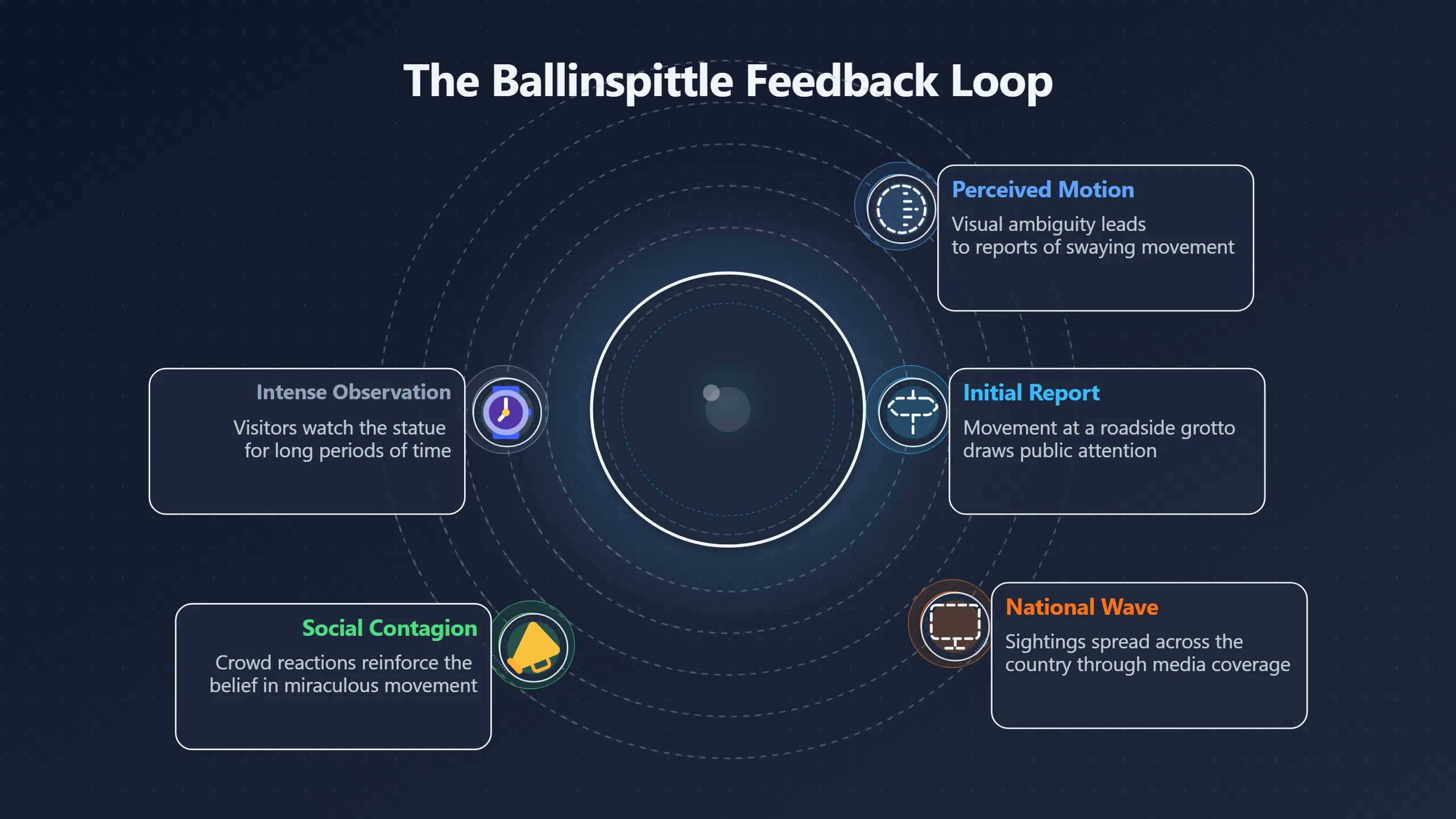
The phenomenon therefore fed on a feedback loop:
- A report of movement attracted visitors.
- Visitors watched intensely for signs.
- Some perceived movement.
- Their testimony attracted larger crowds.
- Larger crowds increased expectation and emotional intensity.
The result was a national wave of sightings that spread far beyond Ballinspittle itself.[wikipedia.org]WikipediaMoving statuesMoving statues
Did the Catholic Church Accept the Miracle?
One common misconception is that Church authorities endorsed the moving-statue claims. In reality, the institutional Catholic response was cautious and often sceptical.
While individual believers accepted the events as miraculous, Church leaders generally avoided declaring the sightings authentic. Contemporary reporting recorded senior clergy expressing reservations, and one bishop publicly described the phenomenon as an illusion. The Church did not formally recognise Ballinspittle as a verified miracle site.[wikipedia.org]WikipediaMoving statuesMoving statues
This cautious response is significant because it distinguishes Ballinspittle from a straightforward religious fraud. There was no official campaign promoting the phenomenon as proven supernatural fact. Instead, Church authorities largely observed the events while attempting to manage the enthusiasm they generated.[RTE.ie]rte.ieReport shows crowds praying at grotto.Read more…
A Case Between Miracle and Misperception
Ballinspittle occupies a distinctive place in Ireland’s history of disputed claims because it sits between categories. It was not exposed as a deliberate hoax in the way that forged artefacts or fabricated photographs have been. Nor was there convincing evidence that statues physically moved. The most persuasive explanations involve a combination of visual illusion, social reinforcement and sincere religious expectation.[wikipedia.org]WikipediaMoving statuesMoving statues
For historians of belief, that ambiguity is precisely what makes the episode valuable. It demonstrates how extraordinary experiences can emerge without a mastermind, a conspiracy or a conscious attempt to deceive. People were not necessarily fooled by a trick; many were responding to experiences that felt real within a powerful cultural and emotional setting.[MURAL]mural.maynoothuniversity.iePMMoving Statuesmoving statues and concrete thinkingby P Mulholland · Cited by 11 — In the early months of 1985 the Irish press reported a spate of…
The story continues to circulate because it touches on a recurring human question: when many people report witnessing the same remarkable event, how much of what they saw came from the world itself, and how much came from the way human beings perceive and interpret it? Ballinspittle remains one of Ireland’s most memorable examples of that boundary between miracle, illusion and collective expectation.[irishexaminer.com]irishexaminer.comarid 41546248Irish Examiner1985 revisited: Ballinspittle's moving statue — 'We weren't…4 Jan 2025 — A statue of the Virgin Mary that, in 1985, drew…
Amazon book picks
Further Reading
Books and field guides related to Why Did Ireland's Statues Seem to Move?. Use these as the next step if you want deeper reading beyond the article.
Why People Believe Weird Things
Directly explores belief, perception and extraordinary experiences.
The Believing Brain
Relevant to reports of moving statues and collective interpretation.
The Demon-Haunted World
Rating: 4.5/5 from 43 Google Books ratings
Provides a framework for assessing extraordinary claims.
eBay marketplace picks
Marketplace Samples
Live-tested eBay searches with available results related to this page.


Endnotes
1.
Source: Wikipedia
Title: Moving statues
Link:https://en.wikipedia.org/wiki/Moving_statues
2.
Source: rte.ie
Link:https://www.rte.ie/archives/collections/news/21203792-moving-statue-in-ballinspittle/
Source snippet
Report shows crowds praying at grotto.Read more...
3.
Source: cora.ucc.ie
Link:https://cora.ucc.ie/bitstream/10468/2105/4/William%20Allen%20PhD%20Thesis%202015.pdf
Source snippet
by W Allen · 2014 · Cited by 2 —... Ireland's statues 'appeared' to move, speak and come alive in 1985. The devotional, on the other...
4.
Source: rte.ie
Title: 716392 moving statues in ballinspittle
Link:https://www.rte.ie/archives/2015/0722/716392-moving-statues-in-ballinspittle/
Source snippet
RTÉ Archives | Religion | Moving Statues In BallinspittleJul 22, 2015 — Claim that a religious statue has moved in Ballinspittle, County...
5.
Source: books.openedition.org
Link:https://books.openedition.org/pur/81126?lang=en
Source snippet
OpenEdition BooksMoving Statues in Ireland: Theatre, Nation and Problems of...the statue's movements were the results of a simple optica...
6.
Source: irishtimes.com
Title: remembering ballinspittle and the moving statue
Link:https://www.irishtimes.com/opinion/an-irish-diary/2025/07/20/remembering-ballinspittle-and-the-moving-statue/
7.
Source: mural.maynoothuniversity.ie
Title: PMMoving Statues
Link:https://mural.maynoothuniversity.ie/1919/1/PMMoving_Statues.pdf
Source snippet
moving statues and concrete thinkingby P Mulholland · Cited by 11 — In the early months of 1985 the Irish press reported a spate of...
8.
Source: irishexaminer.com
Title: arid 41546248
Link:https://www.irishexaminer.com/news/spotlight/arid-41546248.html
Source snippet
Irish Examiner1985 revisited: Ballinspittle's moving statue — 'We weren't...4 Jan 2025 — A statue of the Virgin Mary that, in 1985, drew...
Additional References
9.
Source: reddit.com
Link:https://www.reddit.com/r/todayilearned/comments/1812r43/til_that_in_ireland_in_1985_people_across_the/
Source snippet
TIL that in Ireland in 1985, people across the country...In Ireland in 1985, people across the country claimed to have seen statue...
10.
Source: youtube.com
Link:https://www.youtube.com/watch?v=u-S9qGctuew
Source snippet
The Moving Statues Phenomenon, Ireland 1985...
11.
Source: youtube.com
Link:https://www.youtube.com/watch?v=0eP-pg8vOfM
Source snippet
The moving statue of Ballinspittle grotto (Ireland 1985)...
12.
Source: reddit.com
Link:https://www.reddit.com/r/ireland/comments/wkdn3b/80s_kids_do_ye_remember_stories_about_moving/
13.
Source: reddit.com
Link:https://www.reddit.com/r/ireland/comments/1m66rny/on_this_day_40_years_ago_ireland_was_gripped_by/
14.
Source: facebook.com
Link:https://www.facebook.com/groups/LimerickCityCitizens/posts/3633050636984417/
15.
Source: thesis.ncad.ie
Link:https://thesis.ncad.ie/T6426Want%20To%20Believe%20A%20Study%20On%20the%20Moving%20Statue%20Phenomenon%20of%201985%20and%20The%20Human%20Urge%20to%20Believe%20In%20the%20Miraculous%20-%20Focusing%20on%20Folklore%2C%20Superstition%20and%20The%20Supernatural_Wearen_Megan%20AD204-4ME%2022-23.pdf
16.
Source: irishimbasbooks.com
Link:https://irishimbasbooks.com/the-moving-statues-and-me/
17.
Source: youtube.com
Link:https://www.youtube.com/watch?v=q0K-m-3rZF8
Source snippet
Moving Statues of the Virgin Mary, Ireland 1985...
18.
Source: youtube.com
Link:https://www.youtube.com/watch?v=k9uNpszPV7s
Source snippet
Moving Statues in Asdee, Co. Kerry, Ireland 1985...
Topic Tree