Within Hungarian Hoaxes
Who Invented Hungary's Missing Medieval Past?
Hungary's forged relics reveal how patriotic demand, scarce evidence and weak authentication made convincing fakes possible.
On this page
- Sámuel Literáti Nemes and the antiquities market
- Why collectors and scholars accepted persuasive fakes
- The Rohonc Codex and the limits of certainty
Page outline Jump by section
Introduction
Hungary’s most famous mysteries of forgery are not necessarily the ones that have been conclusively solved. In the nineteenth century, collectors, aristocrats and scholars were eager to recover evidence of a medieval Hungarian past that seemed frustratingly incomplete. That demand created opportunities for skilled fabricators who could supply missing relics, manuscripts and antiquities. At the centre of this world stood Sámuel Literáti Nemes, an antiquarian whose genuine discoveries and fabricated artefacts became so entangled that later generations struggled to separate one from the other.[Academia]academia.eduAcademia(PDF) "Invented Middle Ages in 19th century Hungary…This article explores the dual role of Sámuel Literáti as both an antiquar…
The Rohonc Codex sits at the edge of this story. It is often described as Hungary’s equivalent of the Voynich Manuscript: an illustrated book written in an unknown script that nobody has convincingly deciphered. Some historians suspect it may be another nineteenth-century forgery. Others argue that the evidence is too weak to dismiss it so easily. The result is a rare case in which the mystery survives not because believers refuse to accept an answer, but because no answer has yet gained broad acceptance.[wikipedia.org]WikipediaRohonc CodexRohonc Codex
Who Invented Hungary’s Missing Medieval Past?
During the nineteenth century, Hungary experienced a surge of interest in national history, language and identity. Scholars searched for manuscripts, inscriptions and relics that could illuminate the country’s medieval origins. Yet many desired discoveries simply did not exist, or had not survived. This gap between historical ambition and available evidence created ideal conditions for forgery.[Academia]academia.eduAcademia(PDF) "Invented Middle Ages in 19th century Hungary…This article explores the dual role of Sámuel Literáti as both an antiquar…
Sámuel Literáti Nemes became one of the best-known figures in this environment. He was an energetic collector and dealer who acquired books, manuscripts, coins, artworks and antiquities for wealthy patrons. At the same time, evidence accumulated that he also manufactured or altered supposedly ancient objects. His forged materials were often sophisticated enough to deceive respected scholars and collectors.[Academia]academia.eduAcademia(PDF) "Invented Middle Ages in 19th century Hungary…This article explores the dual role of Sámuel Literáti as both an antiquar…
What made Nemes effective was not merely technical skill. He understood what his audience hoped to find. His creations frequently filled gaps in Hungarian history, supplying precisely the kinds of relics that patriotic collectors wanted to believe had survived. Rather than inventing wildly implausible objects, he produced artefacts that appeared to confirm existing expectations.[Academia]academia.eduAcademia(PDF) "Invented Middle Ages in 19th century Hungary…This article explores the dual role of Sámuel Literáti as both an antiquar…
This mechanism appears repeatedly in the history of historical forgery. Successful fakes rarely challenge prevailing assumptions. Instead, they reinforce them, offering evidence for stories people already wish were true.
Why Collectors and Scholars Accepted Persuasive Fakes
Modern readers may wonder how such fabrications fooled experts. The answer lies partly in the state of historical scholarship at the time.
Many of the methods now used to authenticate manuscripts and artefacts either did not exist or were still developing. Scientific dating techniques were unavailable. Large comparative databases of handwriting, paper, pigments and inscriptions had not yet been assembled. Provenance records—the documented chain of ownership for an object—were often incomplete or entirely absent.[Academia]academia.eduAcademia(PDF) "Invented Middle Ages in 19th century Hungary…This article explores the dual role of Sámuel Literáti as both an antiquar…
Several additional factors made forged antiquities attractive:
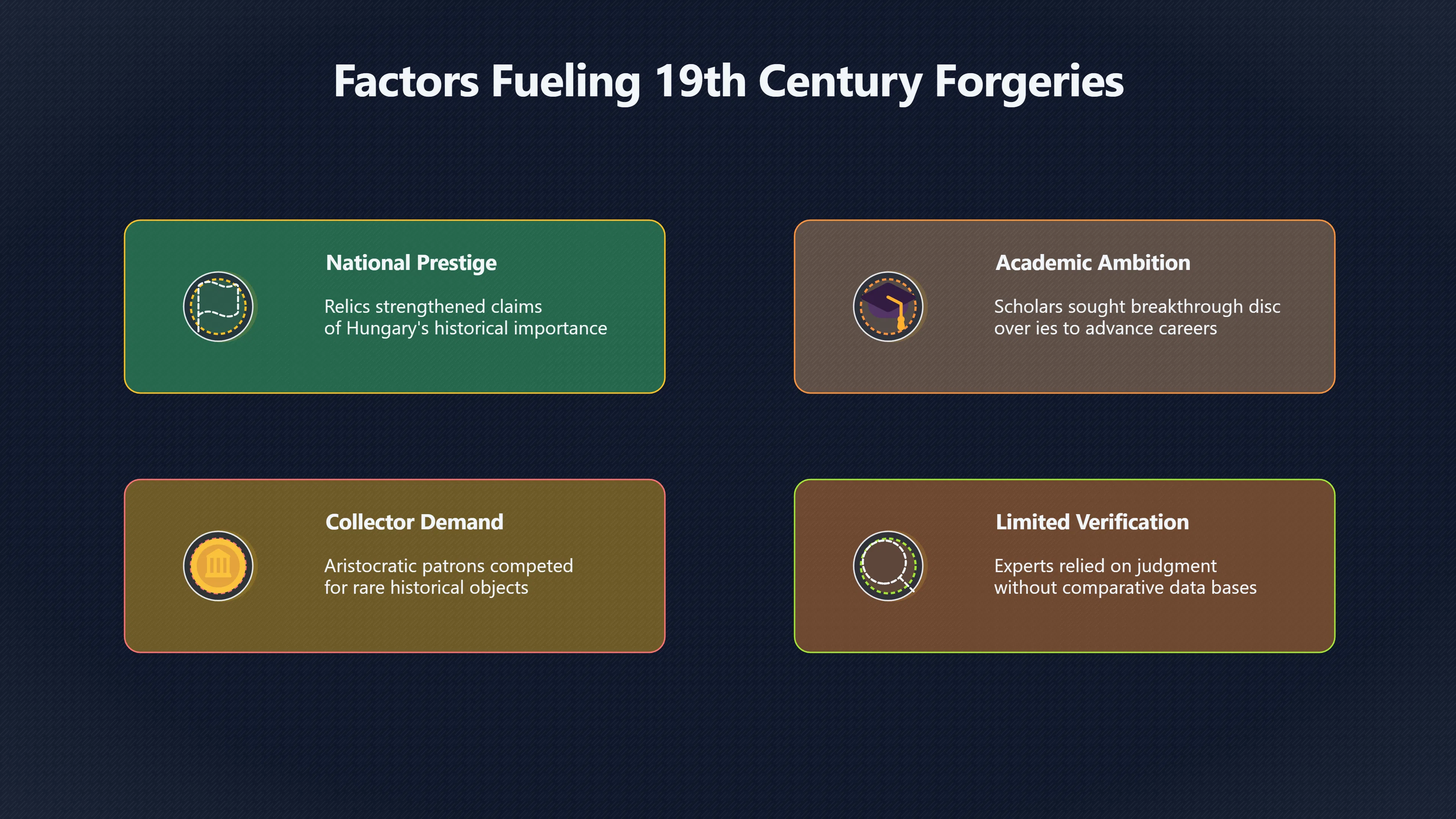
- National prestige: A newly discovered relic could strengthen claims about Hungary’s historical importance.
- Academic ambition: Scholars sought breakthrough discoveries that would advance careers and reputations.
- Collector demand: Aristocratic patrons competed to acquire rare historical objects.
- Limited verification: Experts often worked with restricted access to comparative material and relied heavily on judgement.[Academia]academia.eduAcademia(PDF) "Invented Middle Ages in 19th century Hungary…This article explores the dual role of Sámuel Literáti as both an antiquar…
The result was not widespread incompetence but a system that rewarded exciting discoveries more than cautious scepticism. In that environment, a convincing forgery could flourish for years before doubts emerged.
The Rohonc Codex and Its Strange Script
The Rohonc Codex entered public awareness in 1838 when Count Gusztáv Batthyány donated his library to the Hungarian Academy of Sciences. Among the books was a small manuscript of 448 pages filled with an unknown script and accompanied by dozens of illustrations depicting religious scenes, battles and everyday activities.[Wikipedia]WikipediaRohonc CodexRohonc Codex
The manuscript immediately attracted attention because nothing quite like it was known. Researchers found hundreds of distinct symbols—far more than would be expected in a conventional alphabet. The text appears to run from right to left, and the illustrations contain Christian, Muslim and other symbolic elements that make its cultural setting difficult to identify.[Wikipedia]WikipediaRohonc CodexRohonc Codex
For nearly two centuries, scholars, cryptographers and enthusiastic amateurs have proposed solutions. The codex has variously been claimed to contain:
- Ancient Hungarian writing.[books.google.com]books.google.comGoogle BooksRohonc CodexThe Rohonc Codex is a set of writings in an unknown writing system. it was donated to the Hungarian Academy of Sc…
- Early Romanian texts.
- Cuman material.
- Hindi or Brahmi-derived writing.
- Religious literature.
- Encoded historical narratives.
- Elaborate nonsense designed to imitate a manuscript.[Wikipedia]WikipediaRohonc CodexRohonc Codex
None of these interpretations has achieved scholarly consensus. Proposed decipherments typically explain only selected passages or rely on assumptions that other researchers find unconvincing.[Wikipedia]WikipediaRohonc CodexRohonc Codex
Is the Rohonc Codex a Forgery?
Suspicion fell on Sámuel Literáti Nemes surprisingly early. In 1866, the historian Károly Szabó suggested that the codex might be one of his creations. The theory seemed plausible because Nemes was active during the relevant period and was already associated with other historical fabrications.[Wikipedia]WikipediaRohonc CodexRohonc Codex
Yet the case against him remains largely circumstantial.
No document directly links Nemes to the manuscript’s creation. No draft, confession or contemporary witness has emerged. The suspicion rests primarily on opportunity, reputation and timing rather than direct evidence.[Wikipedia]WikipediaRohonc CodexRohonc Codex
Complicating matters further, studies of the paper indicate that it was probably produced in Venice during the sixteenth century. That finding does not prove the manuscript itself is sixteenth-century—unused old paper could have been written on much later—but it makes simple explanations less satisfactory.[Wikipedia]WikipediaRohonc CodexRohonc Codex
Modern researchers have also noted that the text displays patterns and internal structure. Whether those patterns represent language, a code, a shorthand system or an invented script remains uncertain, but they have persuaded some scholars that the manuscript may contain a genuine underlying system rather than random marks.[wikipedia.org]WikipediaRohonc CodexRohonc Codex
The current state of evidence therefore supports a more cautious conclusion: the codex may be a forgery, but it has not been decisively exposed as one.
Why the Mystery Has Survived
Most historical hoaxes eventually collapse because investigators uncover a technical mistake, a forged provenance or a confession. The Rohonc Codex has avoided all three outcomes.
Part of its resilience comes from the manuscript’s unusual nature. If it is a forgery, it is an exceptionally elaborate one. Producing hundreds of pages of structured text, accompanied by illustrations and written in a consistent script, would have required remarkable effort. If it is authentic, however, its language and writing system remain unidentified. Either explanation leaves major questions unanswered.[uni-hamburg.de]csmc.uni-hamburg.deNo 39: CSMC: University of HamburgThe Rohonc Codex is an intriguing historical document. Its 448 pages have all been penned in an u…
The codex has also accumulated a history of failed solutions. Each proposed decipherment tends to generate temporary excitement before specialists identify weaknesses in the method. Over time, this cycle has transformed the manuscript from a puzzle awaiting a solution into a case study in how easily people can convince themselves they have cracked an unsolved code.[Wikipedia]WikipediaRohonc CodexRohonc Codex
In that sense, the Rohonc Codex belongs naturally within Hungary’s history of forged antiquities. Even if it ultimately proves genuine, its story illustrates the same pressures that enabled nineteenth-century fabrications: national hopes, incomplete evidence, scholarly ambition and the desire to recover a lost past.
What These Cases Reveal About Historical Deception
The careers of Sámuel Literáti Nemes and the enduring mystery of the Rohonc Codex demonstrate that successful historical deception depends less on technical trickery than on cultural demand. Forgers prosper when audiences are eager for confirmation of something they already suspect or desire.
Nemes exploited a market hungry for medieval Hungarian relics. The Rohonc Codex, whether genuine or fabricated, continues to attract attention because it appears to promise access to a forgotten chapter of history. Both stories reveal how uncertainty can become valuable. When evidence is scarce and authentication tools are limited, the boundary between discovery and invention becomes surprisingly difficult to draw.[academia.edu]academia.eduAcademia(PDF) "Invented Middle Ages in 19th century Hungary…This article explores the dual role of Sámuel Literáti as both an antiquar…
For Hungary’s history of hoaxes and contested artefacts, that may be the most important lesson. The most influential fakes are rarely absurd inventions. They are persuasive because they fit neatly into the gaps that people most want filled.
Amazon book picks
Further Reading
Books and field guides related to Who Invented Hungary's Missing Medieval Past?. Use these as the next step if you want deeper reading beyond the article.
The Forger's Spell
Directly aligns with forged artifacts, authenticity and cultural prestige.
A History of Reading
Useful background for manuscript culture and textual interpretation.
eBay marketplace picks
Marketplace Samples
Live-tested eBay searches with available results related to this page.
Endnotes
1.
Source: academia.edu
Link:https://www.academia.edu/33548200/_Invented_Middle_Ages_in_19th_century_Hungary_The_forgeries_of_Samuel_Literati_Nemes_in_Patrick_Geary_and_Klaniczay_G%C3%A1bor_eds_Manufacturing_a_Past_for_the_Present_Forgery_and_Authenticity_in_Medievalist_Texts_and_Objects_in_Nineteenth_Century_Europe_Leiden_Brill
Source snippet
Academia(PDF) "Invented Middle Ages in 19th century Hungary...This article explores the dual role of Sámuel Literáti as both an antiquar...
2.
Source: Wikipedia
Title: Sámuel Literáti Nemes
Link:https://en.wikipedia.org/wiki/S%C3%A1muel_Liter%C3%A1ti_Nemes
3.
Source: Wikipedia
Title: Rohonc Codex
Link:https://en.wikipedia.org/wiki/Rohonc_Codex
4.
Source: csmc.uni-hamburg.de
Link:https://www.csmc.uni-hamburg.de/publications/aom/mom/39-en.html
Source snippet
No 39: CSMC: University of HamburgThe Rohonc Codex is an intriguing historical document. Its 448 pages have all been penned in an u...
5.
Source: academia.edu
Title: Figure 2
Link:https://www.academia.edu/figures/18236233/figure-2-ages-in-the-th-century-the-forgeries-of-samuel
6.
Source: albert.ias.edu
Title: Albert Einstein Institute Manufacturing a Past for the Present
Link:https://albert.ias.edu/bitstreams/1f8bb321-1e49-443c-8396-0e8bc6be0e94/download
Source snippet
The Forgeries of Sámuel Literáti Nemes 129... 16 See the Appendix to La Rocca's article, pp. 267–86...Read more...
7.
Source: books.google.com
Link:https://books.google.com/books/about/Rohonc_Codex.html?id=tPRQYgEACAAJ
Source snippet
Google BooksRohonc CodexThe Rohonc Codex is a set of writings in an unknown writing system. it was donated to the Hungarian Academy of Sc...
8.
Source: semanticscholar.org
Title: Semantic Scholar Cracking the code of the Rohonc Codex
Link:https://www.semanticscholar.org/paper/Cracking-the-code-of-the-Rohonc-Codex-Kir%C3%A1ly-Tokai/01435b976c65e1a704e8afee329b2dd1722c618b
Source snippet
Semantic ScholarCracking the code of the Rohonc CodexMay 28, 2018 — The Rohonc Codex is a small 448-page codex handwritten in a script th...
Published: May 28, 2018
9.
Source: passingstrangeness.wordpress.com
Title: the rohonc codex
Link:https://passingstrangeness.wordpress.com/2009/03/07/the-rohonc-codex/
10.
Source: voynich.fandom.com
Title: Rohonc Codex
Link:https://voynich.fandom.com/wiki/Rohonc_Codex
11.
Source: worldpolitics.substack.com
Title: rohonc codex
Link:https://worldpolitics.substack.com/p/rohonc-codex
Additional References
12.
Source: ciphermysteries.com
Title: benedek langs rohonc article in cryptologia
Link:https://ciphermysteries.com/2010/08/23/benedek-langs-rohonc-article-in-cryptologia
Source snippet
Cipher MysteriesBenedek Lang's Rohonc article in Cryptologia...23 Aug 2010 — unsubstantiated links to murky historical figures (forger Sá...
13.
Source: dokumen.pub
Link:https://dokumen.pub/the-rohonc-code-tracing-a-historical-riddle-9780271090269.html
Source snippet
after it was discovered, the mysterious manuscript garnered...
14.
Source: youtube.com
Title: The Rohonc Codex Hungary’s Impossible Book
Link:https://www.youtube.com/watch?v=K8UjuRVvTKc
Source snippet
Voynich Talk E2 (1/2) - The Rohonc Codex with Benedek Láng and Lev Király...
15.
Source: youtube.com
Title: The Rohonc Codex: Decoding the World’s Most Mysterious Manuscript!
Link:https://www.youtube.com/watch?v=WCzCx_gdHhU
Source snippet
Rohonc Codex: The Manuscript Nobody Can Read...
16.
Source: researchgate.net
Link:https://www.researchgate.net/publication/368279707_7_Invented_Middle_Ages_in_Nineteenth-century_Hungary_The_Forgeries_of_Samuel_Literati_Nemes
17.
Source: patrimonioediciones.com
Link:https://patrimonioediciones.com/portfolio-item/codex-rohonczi-%C2%B7-enchiridion-leonis-papae/?lang=en
18.
Source: medium.com
Link:https://medium.com/%40firalim/deciphering-the-rohonc-codex-through-old-slavic-mirrors-a-new-exploratory-approach-e570d724fbec
19.
Source: dokumen.pub
Link:https://dokumen.pub/manufacturing-a-past-for-the-present-forgery-and-authenticity-in-medievalist-texts-and-objects-in-nineteenth-century-europe-9004276807-9789004276802.html
20.
Source: reddit.com
Link:https://www.reddit.com/r/hungary/comments/109skng/s%C3%A1muel_liter%C3%A1ti_nemes_transylvanianhungarian/
21.
Source: reddit.com
Link:https://www.reddit.com/r/UnresolvedMysteries/comments/1iq0qkv/the_rohonc_codex_bargain_brand_voynich_manuscript/
Topic Tree