Within Tanzania Unmasked
The Laughter Epidemic Was Not a Joke
The outbreak was a real health crisis, but later retellings replaced distressing symptoms with a misleading story of endless laughter.
On this page
- What happened in the first school outbreak
- How the symptoms spread through communities
- Why popular retellings distort the medical record
Page outline Jump by section
Introduction
The so-called Tanganyika laughter epidemic is often presented as one of history’s strangest mysteries: schoolgirls heard a joke, could not stop laughing, and somehow infected hundreds of other people with laughter. That version is memorable, but it is misleading. The 1962 outbreak in what is now Tanzania was a genuine public health and social crisis, not a comic spectacle. Contemporary medical reports described episodes of laughter and crying alongside pain, fainting, breathing difficulties, restlessness and other distressing symptoms. Researchers later classified the event as a form of mass psychogenic illness, meaning a real outbreak of symptoms spreading through social and psychological processes rather than through a virus or poison.[wikipedia.org]WikipediaTanganyika laughter epidemicTanganyika laughter epidemic
The gap between the medical record and the popular legend makes the episode especially relevant to the history of contested truth in Tanzania. The outbreak itself was real. The misleading part is the simplified story that transformed a complex social and medical event into a tale of endless, contagious laughter.[ResearchGate]researchgate.net249929567 The laughter of the 1962 Tanganyika 'laughter epidemicThe laughter of the 1962 Tanganyika 'laughter epidemic'The present article discusses the role of laughter in the much cited '…
What happened in the first school outbreak
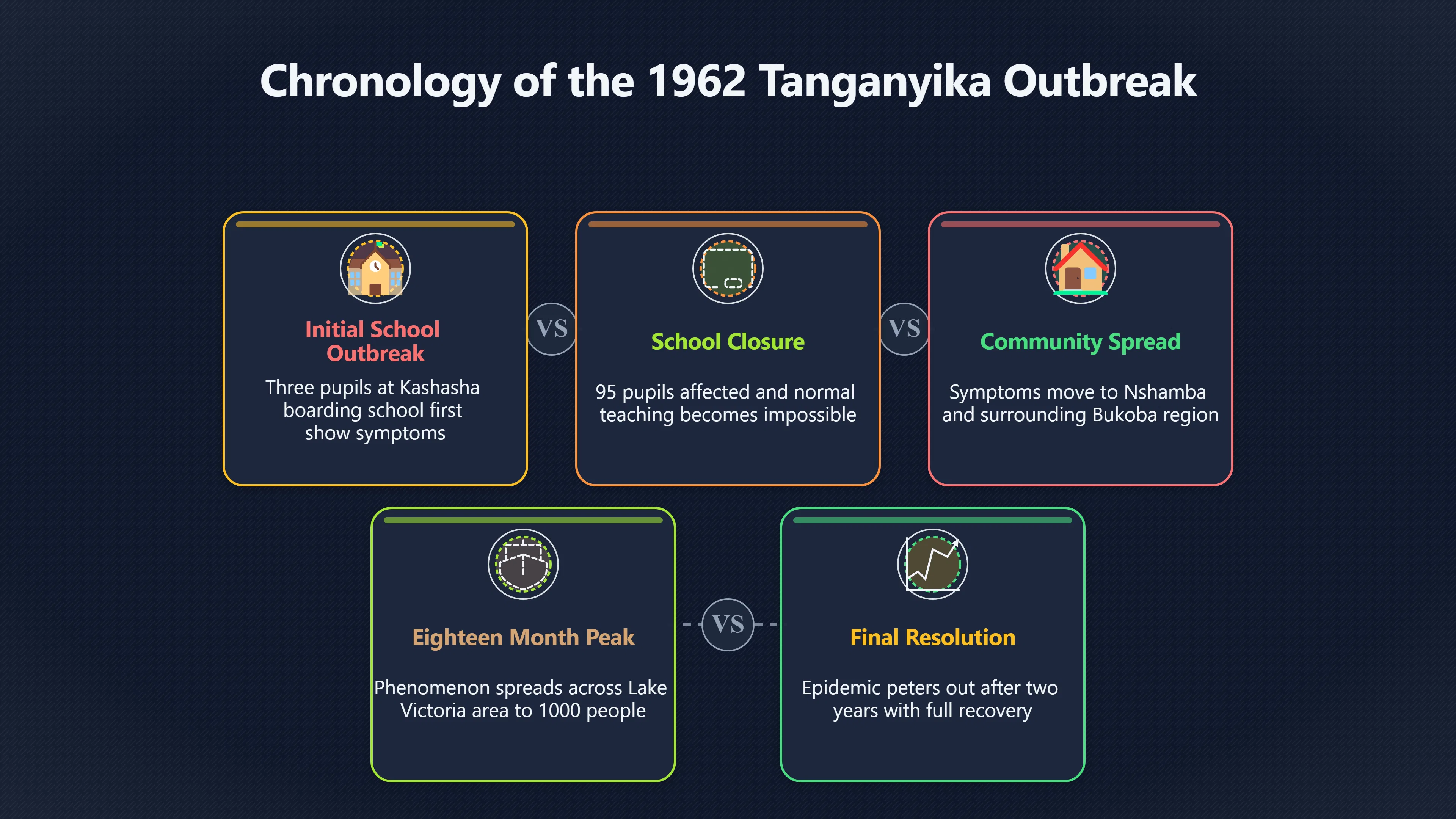
The epidemic began on 30 January 1962 at a mission-run girls’ boarding school in Kashasha, near Lake Victoria. Reports indicate that three pupils were initially affected before the condition spread through the student body. Eventually 95 of the school’s 159 pupils experienced symptoms severe enough to disrupt normal education. Teachers were not reported as suffering the attacks themselves, but they noted that many students could no longer concentrate on lessons. The school eventually closed because ordinary teaching had become impossible.[Wikipedia]WikipediaTanganyika laughter epidemicTanganyika laughter epidemic
The popular image is that pupils laughed continuously for months. The evidence shows something different. Individuals experienced attacks that varied in duration, from hours to days, rather than a single uninterrupted fit of laughter. Medical descriptions recorded emotional outbursts, crying, agitation and physical complaints as well as laughter. Symptoms could persist for extended periods in some cases, but the outbreak was not simply a school full of children laughing at a joke.[wikipedia.org]WikipediaTanganyika laughter epidemicTanganyika laughter epidemic
This distinction matters because the word “laughter” became the defining label, even though contemporary descriptions suggest that laughter was only one visible feature of a broader syndrome. Researchers revisiting the case have argued that later retellings exaggerated the centrality of laughter and obscured the wider pattern of distress.[ResearchGate]researchgate.net249929567 The laughter of the 1962 Tanganyika 'laughter epidemicThe laughter of the 1962 Tanganyika 'laughter epidemic'The present article discusses the role of laughter in the much cited '…
How the symptoms spread through communities
When the Kashasha school closed, affected pupils returned to their home communities. The symptoms then appeared in other locations connected through family and school networks. One of the most significant secondary outbreaks occurred in Nshamba, where hundreds of people, mostly young people and schoolchildren, experienced similar episodes. Other schools in the Bukoba region were also affected, leading to additional closures. Over roughly eighteen months, the phenomenon spread through a limited geographical area around Lake Victoria and affected around a thousand people.[Wikipedia]WikipediaTanganyika laughter epidemicTanganyika laughter epidemic
The pattern did not resemble an ordinary infectious disease. Teachers were often unaffected while pupils were heavily represented among those experiencing symptoms. Medical investigations failed to identify a toxin, pathogen or environmental contaminant that could explain the outbreak. Instead, the spread followed social connections and shared environments.[wikipedia.org]WikipediaTanganyika laughter epidemicTanganyika laughter epidemic
Researchers studying the event have therefore placed it within the category of mass psychogenic illness. In such outbreaks, symptoms are real and can be severe, but they spread through social influence, stress and shared expectations rather than through a biological infection. The affected individuals are not pretending, and the symptoms are not imagined. The illness is psychological in origin but physical in experience.[Wikipedia]WikipediaTanganyika laughter epidemicTanganyika laughter epidemic
Why popular retellings distort the medical record
The modern internet version of the story often contains three claims that are either exaggerated or unsupported.
First, that the epidemic was caused by something funny. No evidence suggests that a joke, comedy performance or amusing incident triggered the outbreak. The laughter itself was a symptom, not a response to humour. Researchers who revisited the case specifically criticised accounts that treated the event as “contagious laughter” in the ordinary sense.[ResearchGate]researchgate.net249929567 The laughter of the 1962 Tanganyika 'laughter epidemicThe laughter of the 1962 Tanganyika 'laughter epidemic'The present article discusses the role of laughter in the much cited '…
Second, that people simply laughed and nothing else happened. Contemporary reports recorded crying, pain, fainting, breathing problems, rashes and severe disruption of everyday life. Focusing only on laughter turns a complex health event into an entertaining curiosity.[wikipedia.org]WikipediaTanganyika laughter epidemicTanganyika laughter epidemic
Third, that the cause remains completely mysterious. While no single explanation commands universal agreement, the broad scholarly consensus points towards mass psychogenic illness linked to social stress. The outbreak occurred shortly after Tanganyika achieved independence in 1961, during a period of rapid social change and heightened expectations. Several researchers have argued that educational pressures, generational tensions and uncertainty created conditions in which psychological distress could spread through tightly connected communities.[wikipedia.org]WikipediaTanganyika laughter epidemicTanganyika laughter epidemic
The persistence of the simplified story reflects a familiar pattern in the history of strange events. A dramatic headline survives because it is easier to remember than the underlying evidence. “People laughed for months” is a stronger anecdote than “a stress-related outbreak produced a mixture of emotional and physical symptoms among schoolchildren.”
Why the outbreak became a legend
The laughter epidemic occupies an unusual place between medicine, folklore and popular history. Unlike many famous mysteries, there is little doubt that something significant happened. Contemporary observers documented the outbreaks, schools closed, and communities were disrupted. The dispute concerns interpretation rather than existence.[Wikipedia]WikipediaTanganyika laughter epidemicTanganyika laughter epidemic
That reality has often been overshadowed by sensational retellings. The event appears in lists of bizarre historical incidents, alongside tales of unexplained manias and strange epidemics. As the story travelled through newspapers, documentaries and internet summaries, the more dramatic image of unstoppable laughter gradually displaced the fuller medical record.[ResearchGate]researchgate.net249929567 The laughter of the 1962 Tanganyika 'laughter epidemicThe laughter of the 1962 Tanganyika 'laughter epidemic'The present article discusses the role of laughter in the much cited '…
For a project examining famous hoaxes, myths and contested stories in Tanzania, the laughter epidemic is an instructive case because it was not itself a hoax. The distortion came later. A real outbreak became wrapped in a misleading narrative that emphasised comedy over suffering and mystery over evidence. Understanding that difference reveals how easily a documented historical event can be transformed into a modern legend without anyone needing to invent it from scratch.[ResearchGate]researchgate.net249929567 The laughter of the 1962 Tanganyika 'laughter epidemicThe laughter of the 1962 Tanganyika 'laughter epidemic'The present article discusses the role of laughter in the much cited '…
Amazon book picks
Further Reading
Books and field guides related to The Laughter Epidemic Was Not a Joke. Use these as the next step if you want deeper reading beyond the article.
The Sleeping Beauties
Directly relevant to outbreaks like the Tanganyika laughter epidemic.
It's All in Your Head
Explores real symptoms arising through psychological and social processes.
The Invisible Gorilla
Helps explain how narratives about events become simplified and distorted.
The Psychopath Test
Investigates how institutions and experts interpret unusual behaviour.
eBay marketplace picks
Marketplace Samples
Live-tested eBay searches with available results related to this page.


Endnotes
1.
Source: Wikipedia
Title: Tanganyika laughter epidemic
Link:https://en.wikipedia.org/wiki/Tanganyika_laughter_epidemic
2.
Source: researchgate.net
Title: 249929567 The laughter of the 1962 Tanganyika ‘laughter epidemic’
Link:https://www.researchgate.net/publication/249929567The_laughter_of_the_1962_Tanganyika%27laughter_epidemic%27
Source snippet
The laughter of the 1962 Tanganyika 'laughter epidemic'The present article discusses the role of laughter in the much cited '...
3.
Source: dash.harvard.edu
Link:https://dash.harvard.edu/entities/publication/73120378-c9c1-6bd4-e053-0100007fdf3b
Source snippet
About two years after it began, the epidemic petered out. Nobody died. Everybody recovered.Read more...
4.
Source: Wikipedia
Title: List of mass panic cases
Link:https://en.wikipedia.org/wiki/List_of_mass_panic_cases
5.
Source: Wikipedia
Title: Epidemia de la risa de Tanganica
Link:https://es.wikipedia.org/wiki/Epidemia_de_la_risa_de_Tanganica
6.
Source: Wikipedia
Title: Mass psychogenic illness
Link:https://en.wikipedia.org/wiki/Mass_psychogenic_illness
7.
Source: health.howstuffworks.com
Link:https://health.howstuffworks.com/mental-health/human-nature/behavior/1962-tanganyika-laughter-epidemic.htm
Source snippet
The Mysterious 1962 Tanganyika Laughter Epidemic31 Mar 2023 — Some of the girls experienced other symptoms like physical pai...
8.
Source: Wikipedia
Title: Tanganyika Territory
Link:https://en.wikipedia.org/wiki/Tanganyika_Territory
9.
Source: Wikipedia
Link:https://en.wikipedia.org/wiki/1962
10.
Source: timesofindia.indiatimes.com
Link:https://timesofindia.indiatimes.com/world/rest-of-world/the-tanganyika-laughter-epidemic-of-1962-when-uncontrollable-laughing-became-a-public-health-crisis/articleshow/132113906.cms
Source snippet
This bizarre condition rapidly spread among students, later affecting neighboring villages and other schools across a 100-mile radius, ev...
Additional References
11.
Source: youtube.com
Link:https://www.youtube.com/watch?v=pGVvD7hlYzI
Source snippet
East African Laughing Epidemic – History Documentary... mass hysteria, also known as mass psychogenic illness - reflecting the ide...
12.
Source: youtube.com
Title: Can Laughter Kill You?
Link:https://www.youtube.com/watch?v=qpJKn8qdq4M
Source snippet
The Tanganyika Laughter Epidemic of 1962...
13.
Source: youtube.com
Title: Tanzanian Laughter Epidemic
Link:https://www.youtube.com/watch?v=ms7MpUNvAK0
Source snippet
Can Laughter Kill You? - The Mysterious Tanganyika Laughter Epidemic of 1962...
14.
Source: youtube.com
Link:https://www.youtube.com/watch?v=mB0HwyzHYRE
Source snippet
244 - The Tanganyika Laughter Epidemic: When Stress Went Viral in 1962...
15.
Source: historysnob.com
Link:https://www.historysnob.com/war-and-historical-events/laughter-isnt-the-best-medicine-how-hysteria-took-over-a-girls-school-in-1962
16.
Source: facebook.com
Link:https://www.facebook.com/IFLScience/posts/mass-hysteria-is-still-used-today-to-explain-collective-psychological-phenomena-/1552661649858280/
17.
Source: twpark.com
Link:https://twpark.com/
18.
Source: facebook.com
Title: the tanganyika laughter epidemic 1962in a girls boarding school in kashasha tang
Link:https://www.facebook.com/61557039268343/posts/the-tanganyika-laughter-epidemic-1962in-a-girls-boarding-school-in-kashasha-tang/122292581654234642/
19.
Source: facebook.com
Title: in 1962 an epidemic of laughter shut down an entire region for 18 months
Link:https://www.facebook.com/fbhistorypage/posts/in-1962-an-epidemic-of-laughter-shut-down-an-entire-region-for-18-months/122203846940330721/
20.
Source: youtube.com
Link:https://www.youtube.com/watch?v=AWprpDloucc
Source snippet
The Laughter Epidemic of 1962...
Topic Tree