Why Israel's Most Famous Hoaxes Endure
Israel’s best-known hoax stories are not a catalogue of national gullibility. They are episodes in which unusually powerful claims met unusually strong incentives: religious belief, archaeological prestige, television celebrity, political urgency and the commercial value of an object that appeared to confirm an ancient text.
Page outline Jump by section
Introduction
The most revealing cases range from disputed biblical manuscripts and inscribed relics to televised psychic feats and recycled war footage. Some were deliberate forgeries. Others were publicity-driven overclaims, careless mistakes or sincere interpretations that hardened into “facts” as they travelled. The common pattern is that the claim reached the public before its provenance, testing conditions or original context had been adequately checked. Exposure rarely ended the story. Court acquittals were mistaken for declarations of authenticity, failed demonstrations were reinterpreted as proof, and debunked images continued circulating because they satisfied an audience’s religious hopes or political suspicions.
Why forged antiquities became Israel’s defining hoax problem
Archaeological fraud has particular force in Israel because a small object can appear to settle a very large argument. An inscription mentioning a biblical ruler, temple or religious figure may command money, scholarly attention and international headlines. It may also be recruited into present-day disputes about sacred sites, historical continuity and national identity.
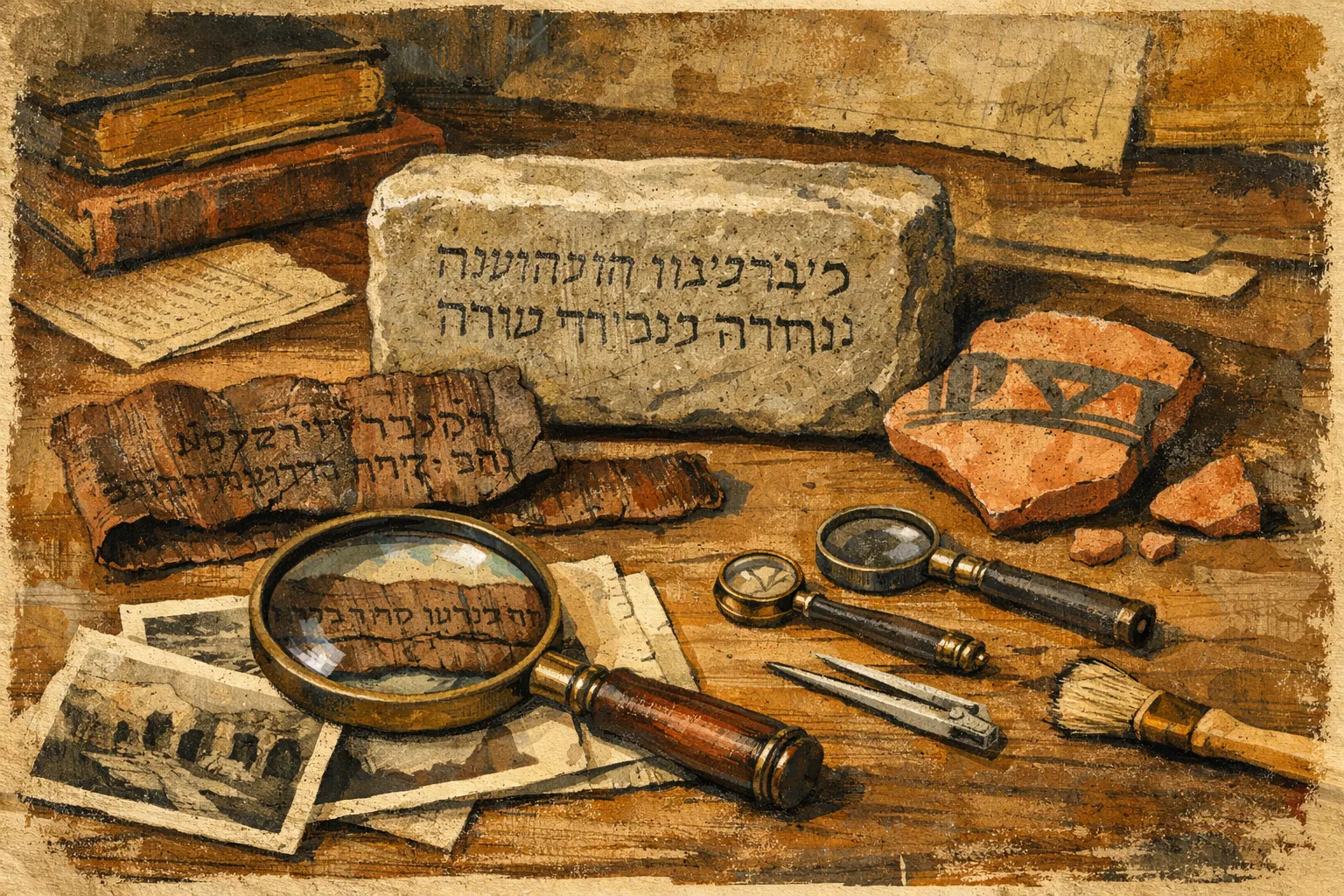
The central weakness is provenance: the documented place and circumstances in which an object was found. An inscription excavated by archaeologists within an undisturbed layer can be compared with surrounding pottery, architecture and organic material. An object bought from a dealer arrives without that protective web of evidence. Its stone or clay may be ancient while its writing is modern. Artificial “patina”, the surface layer associated with age, can be added to conceal fresh cutting. Even sophisticated laboratory tests can produce misleading reassurance when experts begin by assuming that the object is genuine.[The New Yorker]newyorker.comThe New Yorker Written in StoneGolan, who claims his innocence, gained fame for discovering the James ossuary, a stone burial box allegedly linked to Jesus Christ. The…
This helps explain why forged antiquities are often described as “too good to be true”. They are not merely old-looking. They tend to supply exactly the missing evidence that collectors, journalists or religious audiences most want to find.
The Shapira manuscripts: a forgery that will not stay settled
One of the earliest major scandals associated with Jerusalem’s antiquities trade involved Moses Wilhelm Shapira, a nineteenth-century bookseller and dealer. In 1883 he offered the British Museum 15 dark leather strips containing what he presented as an exceptionally ancient version of Deuteronomy. He reportedly sought £1 million, an extraordinary sum, while portions of the manuscript went on public display and attracted intense interest.[bl.iro.bl.uk]bl.iro.bl.ukD. GINSBURG AND THE SHAPIRA AFFAIR A…by FN REINER · Cited by 20 — IN July 1883, Moses Wilhelm Shapira, a well-known Jerusalem dealer i…
The claim was persuasive for several reasons. European museums were competing for biblical antiquities, the script looked archaic, and the supposed find location near the Dead Sea sounded plausible to readers familiar with biblical landscapes. Shapira also had access to genuine old manuscripts and antiquities, giving him the materials and specialist knowledge needed to make a fake more convincing.
But he carried damaging baggage. During the 1870s, his Jerusalem shop had sold large quantities of supposedly ancient “Moabite” pottery and figurines, many of which were exposed as modern fabrications after European museums had bought them. Recent research into his career emphasises that the disputed Deuteronomy strips did not appear in isolation: they emerged from a commercial world already crowded with invented inscriptions and manufactured relics.[ANCIENT JEW REVIEW]ancientjewreview.comthe myth of moses shapiraANCIENT JEW REVIEWThe Myth of Moses ShapiraSeptember 1, 2021 — 1 Sept 2021 — There, Shapira had offered literally thousands of fake antiq…
Scholars examining the strips in London concluded that they were forged. Critics identified problems in the text, writing and physical construction, and the British Museum rejected the purchase. The strips later disappeared, preventing modern scientific examination. That absence has allowed the case to revive repeatedly, especially after the genuine Dead Sea Scrolls demonstrated that ancient Hebrew manuscripts could indeed survive in the region’s dry caves.
A modern minority has argued that Shapira may have been judged too quickly. Other specialists remain convinced that the text contains signs of nineteenth-century composition and that its relationship to Shapira’s earlier trade in fakes is too close to dismiss. Because the originals are missing, the dispute now depends mainly on old transcriptions, drawings, correspondence and reports rather than direct testing. The safest conclusion is not that a modern reassessment has proved the strips genuine, but that the loss of the physical evidence has made absolute closure impossible.[biblicalarchaeology.org]library.biblicalarchaeology.orgThe BAS Library The Shapira Scrolls: The Case for ForgeryThe BAS LibraryThe Shapira Scrolls: The Case for Forgery - The BAS LibraryIn, antiquities dealer Moses Shapira presented to the watching…
The Shapira affair established a pattern that would recur in Israel’s later antiquities controversies: sensational provenance, biblical significance, commercial opportunity, conflicting experts and a final debate that outlived the object itself.
The James ossuary and the “forgery trial of the century”
The most famous modern Israeli antiquities dispute began publicly in 2002 with a limestone burial box, or ossuary, bearing an inscription translated as “James, son of Joseph, brother of Jesus”. The box itself was consistent with first-century burial practices. The explosive question was whether the final words connecting James to Jesus were ancient or had been added in modern times.
The object belonged to Israeli collector Oded Golan and lacked a documented excavation history. Nevertheless, it was unveiled through a press conference and magazine coverage, displayed at the Royal Ontario Museum and promoted as potentially the earliest archaeological reference to Jesus. The announcement succeeded because it combined a real ancient object, an apparently readable family relationship and names of immense religious importance.[The New Yorker]newyorker.comThe New Yorker Written in StoneGolan, who claims his innocence, gained fame for discovering the James ossuary, a stone burial box allegedly linked to Jesus Christ. The…
The Israel Antiquities Authority assembled committees that concluded the inscription was forged. Investigators also scrutinised other spectacular objects associated with the collector, including the Jehoash inscription, a stone text that appeared to describe repairs to the First Temple in Jerusalem. Specialists reported linguistic problems, suspicious surface deposits and evidence that ancient materials might have been altered to carry modern inscriptions.[theguardian.com]theguardian.comThe Guardian Faking it | IsraelThe Guardian Faking it | Israel
Golan and several others were prosecuted. After a long trial, he was acquitted in 2012 of the principal forgery charges, although he was convicted of lesser antiquities offences. This result is often misreported as proof that the James inscription and the Jehoash tablet are authentic. It was not. A criminal court decided that the prosecution had failed to prove beyond reasonable doubt that the defendants had committed the alleged forgeries. The judge did not possess a scientific test capable of converting an acquittal into a declaration that the objects were ancient.[The Times of Israel]timesofisrael.comOpen source on timesofisrael.com.
The distinction matters because legal and historical questions operate differently. A criminal conviction requires evidence linking a particular defendant to an act. An authenticity assessment asks whether an inscription fits the language, tool marks, surface chemistry and archaeological setting of its claimed period. A prosecutor can fail to identify who made a fake even when scholars retain strong reasons to doubt the object.
The case remains contested. Supporters of authenticity argue that the official investigation was overconfident, that some scientific findings were open to alternative interpretation and that the court exposed weaknesses in the prosecution’s expert evidence. Critics respond that the absence of secure provenance, the suspicious clustering of sensational objects and the linguistic and physical anomalies remain unresolved.[biblicalarchaeology.org]biblicalarchaeology.orgBiblical Archaeology Society James Ossuary Forgery Trial Resources GuideBiblical Archaeology Society James Ossuary Forgery Trial Resources Guide
Its lasting lesson is that a genuine ancient object can be used as the foundation for a modern deception. A forger does not need to manufacture two thousand years of stone; adding a few highly desirable words may be enough.
The Darius potsherd: how experts authenticated a modern inscription
In March 2023 the Israel Antiquities Authority announced what appeared to be the first inscription found in Israel bearing the name of the Persian king Darius I. The words had been scratched onto an ancient pottery fragment found at Tel Lachish. The authority dated the text to around 498 BCE and publicised it as a rare administrative record from the period of Persian rule.[The Times of Israel]timesofisrael.comOpen source on timesofisrael.com.
Two days later, the claim collapsed. A visiting specialist told the authority that she had inscribed the ancient fragment during a teaching demonstration the previous summer and had carelessly left it at the site. A later visitor found it without knowing its modern origin. Laboratory examination confirmed that the pottery itself was ancient, helping to give the modern writing an undeserved aura of authenticity. The authority accepted responsibility, described the incident as unintentional and announced a review of procedures.[AP News]apnews.comThe pottery fragment, discovered last December, was thought to be the first mention of the sixth-century B.C. empire builder in Israel. H…
This was not a commercial forgery in the usual sense. There was no reported attempt to sell the shard, invent a biblical discovery for profit or deceive the authority. It was a chain of mistakes: a modern demonstration placed on genuine ancient material, an object removed from its proper context, and investigators who interpreted the result within the exciting hypothesis already before them.
The episode is valuable precisely because it was resolved so quickly. It shows how expert knowledge can fail through confirmation bias without corruption or incompetence. Once the shard was believed to be an ancient inscription, its ancient clay, appropriate location and plausible wording seemed mutually reinforcing. The missing question was not “Could an ancient official have written this?” but “Can we prove that this writing was present when the shard entered the ground?”
The “Lost Tomb of Jesus”: when statistics became publicity
Not every questionable archaeological claim depends on a forged object. The burial cave discovered in East Talpiot, Jerusalem, in 1980 was a genuine archaeological site containing ten ossuaries, six of them inscribed. The controversy arose much later, when a 2007 television documentary and accompanying book argued that the tomb could have belonged to Jesus of Nazareth and his family.
The case relied on a cluster of names interpreted as corresponding to Jesus, Mary, Joseph and other New Testament figures. Publicity surrounding the programme cited striking probability figures suggesting that such a combination would be highly unlikely to occur by chance. The format gave an interpretive argument the feel of a scientific identification: viewers were offered a tomb, a family tree and a number that seemed to measure certainty.[arXiv]arxiv.orgarXiv Editorial: Statistics and "The lost tomb of JesusarXiv Editorial: Statistics and "The lost tomb of Jesus
The difficulty was that the calculation depended on decisions made before the arithmetic began. Researchers had to decide which inscriptions counted as matches, how rare each name was, which historical relationships to assume and how many comparable tombs should be considered. Critics argued that the selected identifications were uncertain and that the statistical model treated contested historical assumptions as established facts. One published critique estimated the probability that the tomb belonged to Jesus at less than two per cent under a different set of assumptions.[arXiv]arxiv.orgarXiv Discussion of: Statistical analysis of an archaeological findarXiv Discussion of: Statistical analysis of an archaeological find
Calling the programme a straightforward hoax would go too far. The tomb was real, its inscriptions were real, and the proponents publicly defended their reasoning. It is better understood as a case of sensational overinterpretation: an uncertain hypothesis packaged for television in a form more definite than the underlying evidence justified.
The episode also demonstrates how numerical precision can conceal interpretive fragility. “One in 600” sounds firmer than “these names seem suggestive”, yet the number is only as reliable as the historical choices fed into it.
Uri Geller and the television manufacture of psychic proof
Israel’s most internationally successful paranormal celebrity was Uri Geller, born in Tel Aviv and first known for public performances involving bent spoons, apparently transmitted drawings and watches that seemed to restart. Geller presented these effects not merely as conjuring but as evidence of telepathy or psychokinesis.
Television was the ideal medium. A bent spoon offered viewers an immediate visual event, while drawing-duplication demonstrations created the impression that private thoughts had crossed a physical barrier. Hosts and audiences were not usually equipped to identify misdirection, pre-bent metal, covert information or the handling conditions that professional magicians regard as crucial.
Geller’s reputation received scientific support in the 1970s when researchers at the Stanford Research Institute reported successful tests of apparent information transfer. Yet critics argued that the experimental controls were inadequate and left opportunities for sensory clues or ordinary trickery. Later assessments stressed that extraordinary claims require procedures designed with the methods of mentalists and conjurers in mind, not merely conventional laboratory observation.[Wikipedia]WikipediaUri GellerUri Geller
A celebrated counter-demonstration occurred on American television when Johnny Carson’s production team, after consulting magician James Randi, supplied its own props and prevented Geller’s party from handling them beforehand. Geller was unable to perform his usual effects. That did not conclusively prove how every earlier demonstration had worked, but it showed that changing the controls could make the claimed ability disappear.
Paradoxically, failure did not necessarily damage belief. Admirers could say that hostile conditions inhibited psychic power, while sceptics regarded the same failure as evidence that access to props and preparation had been essential. The event illustrates a recurring feature of paranormal claims: they can be protected by explanations that reinterpret unsuccessful tests rather than treating them as disconfirmation.
Geller’s career sits on the contested boundary between entertainment and deception. A stage magician openly presents impossible effects as theatrical illusion. A performer who attributes similar effects to supernatural powers asks the audience to accept a factual claim. The methods may overlap, but the implied contract with the public is different.
War imagery and the industrial scale of modern fakery
The information disorder surrounding Israel and Gaza since October 2023 differs from an old-fashioned hoax with a single author and reveal. It is a continuous mixture of deliberate propaganda, recycled footage, mistaken identification, manipulated audio, fabricated news branding, video-game imagery and genuine material given a false caption.
Within days of the Hamas-led attack on Israel and the beginning of Israel’s military campaign in Gaza, investigators documented footage from the video game Arma 3 being presented as helicopters shot down over Israel. Other posts used old material from Syria, Russia and unrelated military exercises. Fabricated videos imitated the visual style of the BBC, while genuine behind-the-scenes film footage was falsely described as proof that Israeli or Palestinian casualties were being staged.[reuters.com]reuters.comClip shows Arma 3 gameplay, not downed Israeli helicoptersClip shows Arma 3 gameplay, not downed Israeli helicopters
“Crisis actor” accusations became especially corrosive. In several cases, social-media users placed unrelated clips side by side and claimed that the same person had appeared alternately as a corpse, patient, rescuer or civilian. Fact-checkers found that the comparisons often involved different people, old films or videos taken from entirely different contexts. Such allegations do more than misdescribe an image: they encourage audiences to treat documented suffering as theatre.[AP News]apnews.comAP News Videos do not show a 'crisis actor' pretending to be a victimAP News Videos do not show a 'crisis actor' pretending to be a victim
The same ecosystem can also turn sincere error into propaganda. During chaotic events, eyewitnesses and volunteers may misinterpret scenes, while news organisations race to report incomplete information. The Associated Press found that two widely repeated accounts relating to sexual violence on 7 October were unsupported or mistaken, although other evidence indicated that sexual violence did occur. The correction therefore did not justify denying the broader crime; it showed how inaccurate details can undermine well-supported findings by giving opponents an excuse to dismiss everything together.[AP News]apnews.comOpen source on apnews.com.
Verification groups use several practical tests:
- locating the earliest known upload rather than trusting the latest caption;
- comparing landmarks, weather, shadows and road layouts;
- checking whether the clip comes from a game, film or previous conflict;
- examining whether a supposed news video appears on the broadcaster’s real channels;
- listening for replaced audio or mismatched speech;
- separating what an image shows from the claim being attached to it.
Bellingcat and Human Rights Watch have stressed that the purpose of verification is not to prove that every shocking image is false. It is to preserve the evidential value of genuine material by identifying where, when and by whom it was recorded.[bellingcat]bellingcat.comOpen source on bellingcat.com.
The speed of circulation makes corrections structurally weaker than the original falsehood. A dramatic clip can be shared in seconds; authenticating it may require finding earlier versions, contacting witnesses and comparing geographic details. Research on claims surrounding the 2023 war has consequently drawn on fact checks in numerous languages and across several platforms, reflecting the international rather than purely Israeli scale of the information battle.[arXiv]arxiv.orgOpen source on arxiv.org.

Why these stories remain believable
Israel’s recurring hoax and disputed-authenticity stories work through several different mechanisms, but they share a recognisable set of pressures.
They offer evidence people already want. A biblical inscription can appear to confirm scripture, a psychic performance can validate supernatural belief, and a wartime image can make an enemy look uniquely cruel or dishonest.
They borrow authority. Museums, laboratories, television studios and familiar news graphics make a claim feel checked even when the decisive test has not occurred.
They exploit genuine material. The James ossuary was an ancient burial box. The Darius fragment was ancient pottery. Recycled war clips may depict real violence, just not the event named in the caption. A deception is often strongest when most of its visible components are real.
They collapse important distinctions. A court acquittal becomes “proved authentic”; an unresolved interpretation becomes a discovery; a mistaken report becomes a deliberate lie; and a debunked example is used to deny a larger body of verified evidence.
They survive by changing form. Once a claim fails, it may return as a question: “Was the forgery accusation itself a cover-up?” The Shapira strips can no longer be tested, so their disappearance feeds continuing speculation. Paranormal failures become evidence of hostile psychic conditions. Corrected war images remain online after their original captions have been copied elsewhere.
What Israel’s hoax history actually reveals
The most important divide is not between believers and sceptics, or between experts and the public. Experts authenticated the modern Darius inscription; scientists produced disputed support for Geller; museums bought Shapira’s supposed antiquities; and journalists amplified archaeological claims before provenance questions were settled.
The more useful divide is between claims that can survive adversarial checking and claims protected from it. Reliable archaeology depends on excavation records, access to objects and independent testing. Reliable demonstrations require controls designed to exclude ordinary techniques. Reliable conflict reporting requires original files, identifiable locations, corroboration and willingness to revise early accounts.
Israel’s hoax history is therefore less a parade of bizarre curiosities than a study in the manufacture of authority. A relic, statistic, television performance or viral image becomes persuasive when it arrives in the right institutional frame and tells a story its audience is prepared to recognise. Exposure begins by breaking that frame: tracing the object’s ownership, changing the test conditions, finding the original footage or asking whether the evidence proves the headline rather than merely resembling it.
Amazon book picks
Further Reading
Books and field guides related to Why Israel's Most Famous Hoaxes Endure. Use these as the next step if you want deeper reading beyond the article.
Frauds, Myths, and Mysteries: Science and Pseudoscience in Ar...
Covers archaeological hoaxes, forgery claims and evidence evaluation.
The Bible Unearthed
Rating: 3.5/5 from 9 Google Books ratings
Provides context for debates where artifacts are used to support biblical claims.

The Sign and the Seal
Illustrates how dramatic historical claims capture public imagination.
eBay marketplace picks
Marketplace Samples
Live-tested eBay searches with available results related to this page.

Endnotes
1.
Source: bl.iro.bl.uk
Link:https://bl.iro.bl.uk/downloads/fc97b009-fb17-4884-baea-e97efeb89e39
Source snippet
D. GINSBURG AND THE SHAPIRA AFFAIR A...by FN REINER · Cited by 20 — IN July 1883, Moses Wilhelm Shapira, a well-known Jerusalem dealer i...
Published: July 1883
2.
Source: ancientjewreview.com
Title: the myth of moses shapira
Link:https://www.ancientjewreview.com/read/2021/8/31/the-myth-of-moses-shapira
Source snippet
ANCIENT JEW REVIEWThe Myth of Moses ShapiraSeptember 1, 2021 — 1 Sept 2021 — There, Shapira had offered literally thousands of fake antiq...
Published: September 1, 2021
3.
Source: jstor.org
Link:https://www.jstor.org/stable/27255723
4.
Source: academia.edu
Link:https://www.academia.edu/112996762/Authenticity_Examination_of_the_Jehoash_Inscription
5.
Source: arxiv.org
Title: arXiv Editorial: Statistics and “The lost tomb of Jesus”
Link:https://arxiv.org/abs/0803.3678
6.
Source: arxiv.org
Title: arXiv Discussion of: Statistical analysis of an archaeological find
Link:https://arxiv.org/abs/0804.0097
7.
Source: Wikipedia
Title: Uri Geller
Link:https://en.wikipedia.org/wiki/Uri_Geller
8.
Source: reuters.com
Title: Clip shows Arma 3 gameplay, not downed Israeli helicopters
Link:https://www.reuters.com/fact-check/clip-shows-arma-3-gameplay-not-downed-israeli-helicopters-2023-10-12/
9.
Source: reuters.com
Title: syria hospital attack footage falsely said be gaza 2023 2023 11 08
Link:https://www.reuters.com/fact-check/syria-hospital-attack-footage-falsely-said-be-gaza-2023-2023-11-08/
10.
Source: reuters.com
Link:https://www.reuters.com/fact-check/behind-the-scenes-footage-2022-short-film-falsely-linked-2024-gaza-war-2024-05-20/
11.
Source: bellingcat.com
Link:https://www.bellingcat.com/resources/how-tos/2023/10/26/separating-fact-from-fiction-on-social-media-in-times-of-conflict/
12.
Source: arxiv.org
Link:https://arxiv.org/abs/2401.16625
13.
Source: sobieski-thearteconomist-9642.medium.com
Title: i debunked uri geller 6fff34c4de17
Link:https://sobieski-thearteconomist-9642.medium.com/i-debunked-uri-geller-6fff34c4de17
14.
Source: Wikipedia
Title: List of scientific misconduct incidents
Link:https://en.wikipedia.org/wiki/List_of_scientific_misconduct_incidents
15.
Source: Wikipedia
Title: Fake news website
Link:https://en.wikipedia.org/wiki/Fake_news_website
16.
Source: Wikipedia
Title: Misinformation in the Gaza war
Link:https://en.wikipedia.org/wiki/Misinformation_in_the_Gaza_war
17.
Source: Wikipedia
Title: Shapira Scroll
Link:https://en.wikipedia.org/wiki/Shapira_Scroll
18.
Source: bellingcat.com
Title: hamas attacks israel bombs gaza and misinformation surges online
Link:https://www.bellingcat.com/news/2023/10/11/hamas-attacks-israel-bombs-gaza-and-misinformation-surges-online/
19.
Source: academia.edu
Title: The [Shapira Scrolls]({{ ‘shapira-scrolls-dd4ed9/’ | relative_url }}) The Case for Authenticity Dershowitz and Tabor
Link:https://www.academia.edu/81814044/The_Shapira_Scrolls_The_Case_for_Authenticity_Dershowitz_and_Tabor
20.
Source: academia.edu
Title: Sources for the Reinvestigation of the Shapira Strips
Link:https://www.academia.edu/144135552/Sources_for_the_Reinvestigation_of_the_Shapira_Strips
21.
Source: reuters.com
Title: clip shows arma 3 gameplay not israels laser weapon system 2023 10 18
Link:https://www.reuters.com/fact-check/clip-shows-arma-3-gameplay-not-israels-laser-weapon-system-2023-10-18/
22.
Source: reuters.com
Title: purported footage of israels defense system is from video game id USL2N2ND2D3
Link:https://www.reuters.com/article/fact-check/purported-footage-of-israels-defense-system-is-from-video-game-idUSL2N2ND2D3/
23.
Source: reuters.com
Title: fact checking online misinformation israel hamas conflict 2023 10 09
Link:https://www.reuters.com/world/middle-east/fact-checking-online-misinformation-israel-hamas-conflict-2023-10-09/
24.
Source: jstor.org
Link:https://www.jstor.org/stable/1453329
25.
Source: bl.iro.bl.uk
Link:https://bl.iro.bl.uk/concern/articles/562be574-53c8-4e9c-a366-e7a227df9ad0
26.
Source: blogs.bible.org
Title: new attempt to resurrect jesus tomb discussion sept 8
Link:https://blogs.bible.org/new-attempt-to-resurrect-jesus-tomb-discussion-sept-8/
27.
Source: newyorker.com
Title: The New Yorker Written in Stone
Link:https://www.newyorker.com/magazine/2004/04/12/written-in-stone
Source snippet
Golan, who claims his innocence, gained fame for discovering the James ossuary, a stone burial box allegedly linked to Jesus Christ. The...
28.
Source: apnews.com
Link:https://apnews.com/article/168cb72009a67859238e4e468108f5ab
Source snippet
The pottery fragment, discovered last December, was thought to be the first mention of the sixth-century B.C. empire builder in Israel. H...
29.
Source: site.tusculum.edu
Title: the shapira strips
Link:https://site.tusculum.edu/reference/the-shapira-strips/
Source snippet
TUSCULUM UNIVERSITYThe Shapira StripsIn 1883 Moses Wilhelm Shapira, an antiquities dealer in Jerusalem, presented 15 manuscript fragments...
30.
Source: library.biblicalarchaeology.org
Title: The BAS Library The Shapira Scrolls: The Case for Forgery
Link:https://library.biblicalarchaeology.org/article/the-shapira-scrolls-the-case-for-forgery/
Source snippet
The BAS LibraryThe Shapira Scrolls: The Case for Forgery - The BAS LibraryIn, antiquities dealer Moses Shapira presented to the watching...
31.
Source: theguardian.com
Title: The Guardian Faking it | Israel
Link:https://www.theguardian.com/artanddesign/2005/jan/20/heritage.museums
32.
Source: timesofisrael.com
Link:https://www.timesofisrael.com/8-years-after-trial-began-verdict-expected-in-biblical-antiquities-forgery-case/
33.
Source: timesofisrael.com
Link:https://www.timesofisrael.com/oded-golan-is-not-guilty-of-forgery-so-is-the-james-ossuary-for-real/
34.
Source: biblicalarchaeology.org
Title: Biblical Archaeology Society James Ossuary Forgery Trial Resources Guide
Link:https://www.biblicalarchaeology.org/daily/biblical-artifacts/artifacts-and-the-bible/why-did-the-james-ossuary-forgery-trial-verdict-find-oded-golan-and-robert-deutsch-not-guilty/
35.
Source: biblearchaeologyreport.com
Title: weighing the evidence is the james ossuary authentic
Link:https://biblearchaeologyreport.com/2023/04/20/weighing-the-evidence-is-the-james-ossuary-authentic/
36.
Source: biblearchaeology.org
Title: not so fast brother of jesus might be authentic but not james the son of joseph
Link:https://biblearchaeology.org/research-articles/not-so-fast-brother-of-jesus-might-be-authentic-but-not-james-the-son-of-joseph/
37.
Source: timesofisrael.com
Link:https://www.timesofisrael.com/too-good-to-be-true-darius-ostracon-mix-up-teaches-a-public-lesson-etched-in-pottery/
38.
Source: biblicalarchaeology.org
Title: the darius ostracon
Link:https://www.biblicalarchaeology.org/daily/archaeology-today/the-darius-ostracon/
39.
Source: apnews.com
Link:https://apnews.com/article/israel-hamas-gaza-misinformation-fact-check-e58f9ab8696309305c3ea2bfb269258e
40.
Source: firstamendment.mtsu.edu
Link:https://firstamendment.mtsu.edu/post/fact-focus-misinformation-about-the-israel-hamas-war-is-flooding-social-media-here-are-the-facts/
41.
Source: apnews.com
Title: AP News Videos do not show a ‘crisis actor’ pretending to be a victim
Link:https://apnews.com/article/fact-check-israel-hamas-gaza-false-crisis-actors-068772255064
42.
Source: apnews.com
Link:https://apnews.com/article/ca7905bf9520b1e646f86d72cdf03244
43.
Source: harryalbuspotter.fandom.com
Title: Uri Geller
Link:https://harryalbuspotter.fandom.com/wiki/Uri_Geller
44.
Source: biblicalarchaeology.org
Title: israeli court return the jehoash inscription
Link:https://www.biblicalarchaeology.org/daily/news/israeli-court-return-the-jehoash-inscription/
45.
Source: biblicalarchaeology.org
Title: the shapira scrolls authentic or forged
Link:https://www.biblicalarchaeology.org/daily/biblical-topics/hebrew-bible/the-shapira-scrolls-authentic-or-forged/
46.
Source: reutersinstitute.politics.ox.ac.uk
Title: trolling memes and deepfakes how ai thickening fog war
Link:https://reutersinstitute.politics.ox.ac.uk/news/trolling-memes-and-deepfakes-how-ai-thickening-fog-war
47.
Source: reutersinstitute.politics.ox.ac.uk
Link:https://reutersinstitute.politics.ox.ac.uk/news/bbc-expert-debunking-israel-hamas-war-visuals-volume-misinformation-twitter-was-beyond
48.
Source: theguardian.com
Title: how israel hamas war disinformation is being spread online
Link:https://www.theguardian.com/media/2023/oct/11/how-israel-hamas-war-disinformation-is-being-spread-online
49.
Source: biblearchaeology.org
Title: thinking clearly about the jesus family tomb
Link:https://biblearchaeology.org/research-articles/thinking-clearly-about-the-jesus-family-tomb/
50.
Source: english.wafa.ps
Link:https://english.wafa.ps/Pages/Details/133726
51.
Source: youtube.com
Link:https://www.youtube.com/watch?v=dqceUj3GTdI
Additional References
52.
Source: tandfonline.com
Link:https://www.tandfonline.com/doi/full/10.1080/00310328.2022.2050075
Source snippet
Taylor & Francis OnlineThe Career of Moses Shapira, Bookseller and Antiquarianby M Press · 2023 · Cited by 13 — This article takes a look...
53.
Source: youtube.com
Title: Science vs. Politics: The Story of the James Ossuary |Parable
Link:https://www.youtube.com/watch?v=aKIPFqIh3xc
Source snippet
The Lost Bible Scroll… Real or One of History's Biggest Fakes? | Dr. Joel Baden...
54.
Source: youtube.com
Title: The Lost Bible Scroll… Real or One of History’s Biggest Fakes? | Dr. Joel Baden
Link:https://www.youtube.com/watch?v=Iso7fS-dHrA
Source snippet
Jehoash Inscription: PROOF of David's Hidden Heir?...
55.
Source: youtube.com
Title: It’s a FAKE: The Unprovenanced “Darius Inscription” is Not Authentic
Link:https://www.youtube.com/watch?v=BnL23jzFUK0
Source snippet
Dead Sea scroll fragments are actually fake, researchers say...
56.
Source: youtube.com
Title: Dead Sea scroll fragments are actually fake, researchers say
Link:https://www.youtube.com/watch?v=zT_MU_pi-G8
Source snippet
Science vs. Politics: The Story of the James Ossuary |Parable...
57.
Source: researchgate.net
Link:https://www.researchgate.net/publication/300800906_The_Jehoash_Inscription_Tablet-After_the_verdict
58.
Source: i24news.tv
Link:https://www.i24news.tv/en/news/israel/archeology/1677852987-israel-ancient-shard-bearing-name-of-persian-king-darius-is-fake-antiquities-authority
59.
Source: researchgate.net
Link:https://www.researchgate.net/publication/300798551_Implications_of_the_Forgery_Trial_verdict_on_the_authenticity_of_the_James_Ossuary
60.
Source: facebook.com
Link:https://www.facebook.com/ynetglobal/posts/a-new-foa-report-cited-by-the-telegraph-says-thousands-of-coordinated-fake-accou/1510106484486033/
61.
Source: icfj.org
Link:https://www.icfj.org/sites/default/files/2018-07/A%20Short%20Guide%20to%20History%20of%20Fake%20News%20and%20Disinformation_ICFJ%20Final.pdf
Topic Tree
Follow this branch
Related pages 192
- Albanian Hoaxes
- Algerian Hoaxes
- Antigua Deceptions
- Argentina Hoaxes
- Armenian Hoaxes
- +187 more in sidebar