When Kazakhstan's Fictions Became Believable
Kazakhstan has no single hoax as internationally famous as the Piltdown Man or the Cottingley Fairies. Its most revealing stories instead sit along the borders between practical joke, paranormal folklore, political satire, propaganda and cultural impersonation.
Page outline Jump by section
Introduction
These episodes matter because they show that falsehood does not always begin as a calculated fraud. A joke may be copied without its warning label; an old photograph may acquire a new caption; folklore may be dressed in scientific language; and fiction may become a substitute for knowledge about a country unfamiliar to foreign audiences. Kazakhstan’s hoax history is therefore best understood not as a catalogue of gullibility, but as a study of how context disappears and authority is imitated.
The invented mysteries of Barsa-Kelmes
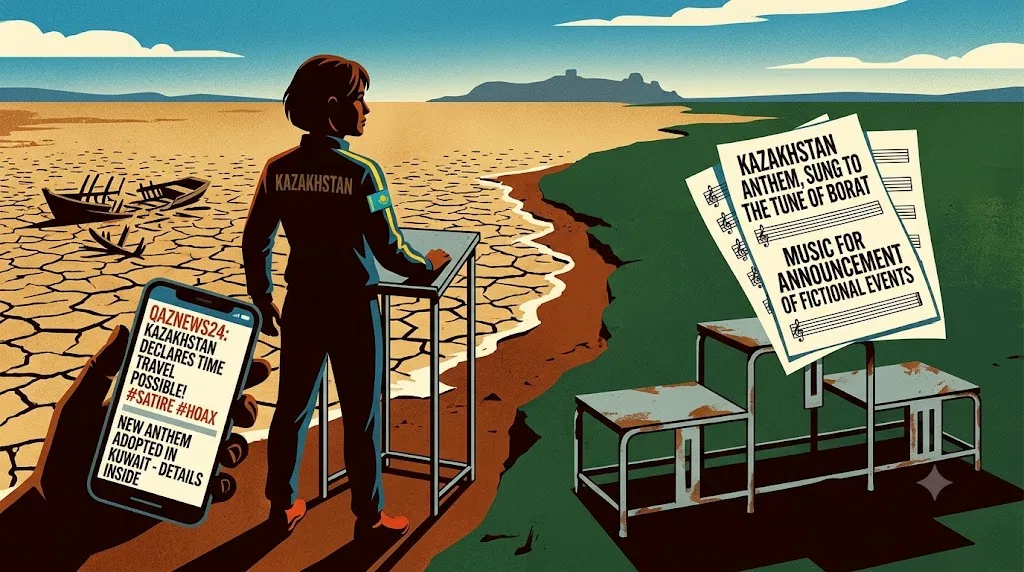
The most complete Kazakhstan-linked paranormal hoax concerns Barsa-Kelmes, a former island in the Aral Sea. Its name and isolation provided ideal material for mystery writers. Stories came to describe missing expeditions, unexplained lights, strange creatures, unidentified flying objects and zones in which time supposedly moved at a different speed.
The legends gained particular momentum during the late Soviet period, when magazines mixed popular science with speculative writing and readers were increasingly curious about subjects that official culture had previously discouraged. Accounts presented anecdotes from fishermen, purported local traditions and reports of anomalous events as though they formed a body of evidence.
Later reconstructions traced much of this material to a chain of jokes. Science-fiction enthusiasts, including the writer Sergei Lukyanenko, reportedly elaborated existing rumours for a prank played on fellow enthusiasts in Moscow. Fabricated letters and folklore-like material were added to make the story appear locally grounded. The recipients accepted the account and passed it to a wider publication. When the participants attempted to trace the original mystery, they discovered that an earlier newspaper story on which it rested had itself apparently been written as a joke.[Wikipedia]WikipediaOpen source on wikipedia.org.
The result was less a single deception than a hoax built from previous hoaxes. Each retelling supplied what the last version lacked: a witness, a historical source, an indigenous legend or the suggestion of scientific investigation. Material written for amusement acquired authority because later writers treated earlier publication as independent confirmation.
Barsa-Kelmes was especially persuasive because the real landscape already looked uncanny. The Aral Sea was shrinking dramatically, access to the island was difficult, and its name was commonly rendered in ways that suggested danger or non-return. Environmental devastation and geographical remoteness made improbable tales feel less implausible.
The exposure did not completely kill the story. Paranormal accounts still circulate because they are more memorable than the mundane history of their construction. They also survive through circular sourcing: one website repeats another, while both ultimately depend on Soviet-era magazine pieces or unattributed retellings. The case is a useful warning that numerous versions of a claim do not necessarily represent numerous witnesses.

When satire was treated as false news
A more recent dispute concerned Qaznews24, an Instagram account created by Temirlan Yensebek in 2021. It imitated the appearance and language of a news service while publishing deliberately absurd stories about poverty, corruption, discrimination and the political cult surrounding powerful leaders. The account identified its material as parody, attracted more than 5,000 followers within several weeks and reached a much larger audience through reposts.[Eurasianet]eurasianet.orgkazakhstan spoof news instagrammer investigated for spreading false informationKazakhstan: Spoof news Instagrammer investigated for…17 May 2021 — An Instagrammer in Kazakhstan who amused his followers wi…
The humour depended on recognisable reality. A fabricated report might describe an implausibly obedient official or an outrageous new rule, but the joke worked because readers recognised the behaviour being criticised. This is the central distinction between satire and fraudulent news: satire uses invention to expose or exaggerate something, whereas disinformation usually attempts to secure belief in the invention itself.
That distinction became blurred when posts were detached from the account. Screenshots travelled through messaging services and appeared on other pages without the original disclaimer. Police argued that people were circulating the stories as genuine news and opened an investigation into the knowing dissemination of false information. Human Rights Watch noted that Yensebek faced a potential prison sentence even though the account’s satirical character was apparent.[Eurasianet]eurasianet.orgkazakhstan spoof news instagrammer investigated for spreading false informationKazakhstan: Spoof news Instagrammer investigated for…17 May 2021 — An Instagrammer in Kazakhstan who amused his followers wi…
The investigation was eventually dropped in 2022. Authorities reportedly concluded that most visitors understood that Qaznews24 was not a genuine news organisation.[Eurasianet]eurasianet.orgkazakhstan police locate sense of humor drop case against satiristKazakhstan: Police locate sense of humor, drop case…15 Sept 2022 — Police in Kazakhstan have dropped their investigation int…
The episode reveals two separate mechanisms of deception:
- Imitated authority: the account borrowed the visual conventions of professional journalism.
- Context collapse: reposting removed the cues that marked an item as a joke.
Neither necessarily made the original author a hoaxer. The misleading version was often created by circulation itself. A satirical headline that was intelligible on a parody page could become plausible misinformation when reduced to a screenshot in a private chat.
The affair also raised a political question. Laws against knowingly false information can be used against deliberate fabrications that cause harm, but satire necessarily contains statements that are literally untrue. Treating falsity alone as proof of deception leaves officials considerable power to decide which jokes are permissible.
Yensebek later faced a separate prosecution connected with satirical online content, prompting renewed criticism from freedom-of-expression organisations. That later case should not be confused with the original Qaznews24 false-information investigation, but it demonstrates why the boundary between hoax and satire remains consequential in Kazakhstan.[ARTICLE 19]article19.orgkazakhstan release blogger and protect the right to satireARTICLE 19Kazakhstan: Release blogger and protect the right to satire10 Feb 2025 — Kazakhstan must drop all charges against Temirlan Yens…
The fake anthem that escaped from Borat
Perhaps the world’s best-known imitation of Kazakhstan is Borat Sagdiyev, Sacha Baron Cohen’s fictional television reporter. The character was never a plausible portrait of an actual Kazakh journalist. The invented customs, language and institutions in the film Borat were assembled as a comic device, largely to provoke revealing reactions from people elsewhere.
Yet many viewers possessed so little independent knowledge of Kazakhstan that the fiction became a reference point. The clearest demonstration came at the 2012 Arab Shooting Championships in Kuwait. After Kazakh athlete Maria Dmitrienko won a gold medal, organisers played the obscene mock anthem from Borat during the medal ceremony instead of Kazakhstan’s real national anthem. Kazakh officials demanded an investigation, and the ceremony was subsequently repeated correctly.[theguardian.com]theguardian.comThe Guardian Anger as spoof Kazakhstan anthem played at medalThe Guardian Anger as spoof Kazakhstan anthem played at medal
Reports indicated that the organisers had obtained the wrong recording from the internet. The incident was therefore an error rather than evidence of a planned anti-Kazakh hoax. Nevertheless, it showed how a fictional artefact could impersonate an official one once separated from its cinematic setting.
Several factors made the mistake possible. The recording sounded ceremonial, search engines returned widely circulated material, and the person selecting it apparently lacked the cultural knowledge needed to identify obvious warning signs. The film’s international reach also meant that its counterfeit anthem was more familiar to many people than the genuine composition.
This was not harmless from a Kazakh perspective. The lyrics traded in stereotypes about prostitution, backwardness and authoritarian nationalism. What foreign audiences treated as parody could appear to Kazakhs as one more instance in which their country was reduced to a joke written elsewhere.
At the same time, the anthem incident illustrates why Borat should not simply be classified as a hoax. The film openly presented a comic fictional character, not a secret documentary fraud. Deception arose when fragments of the fiction were relabelled, misunderstood or reused as factual representations. The Kuwait ceremony transformed a parody prop into a false official document.
The distinction is important:
- The fictional anthem was satire in the film.
- Selecting it as an authentic recording was misidentification.
- Sharing it later as Kazakhstan’s genuine anthem would be misinformation.
- Deliberately presenting it as genuine while knowing otherwise would constitute a hoax or malicious deception.
One piece of media can therefore move between categories without changing its content. Only its framing and the intentions of those distributing it change.

Real photographs, false events
Modern Kazakhstan-linked fabrications frequently use genuine images rather than elaborate forgeries. A photograph from one place or year is attached to a different crisis, making the post appear documented even though the caption is false.
Images from the Semipalatinsk nuclear testing area, for example, were circulated in 2025 as supposed evidence concerning Pakistan’s Kirana Hills. Fact-checkers traced the photographs back to the former Soviet nuclear test site in Kazakhstan. Nothing needed to be digitally altered; the deception depended entirely on replacing the location and context.[BOOM]boomlive.inBOOMOld Kazak Nuke Test Site Photos Falsely Shared AsBOOMOld Kazak Nuke Test Site Photos Falsely Shared As
This technique is effective because photographs are often treated as direct evidence. In reality, an image can establish only what it visibly contains. It cannot by itself prove when or where it was taken, why an event occurred or whether the accompanying description is accurate.
Periods of unrest create particularly favourable conditions for such mislabelling. During Kazakhstan’s January 2022 protests, verified reporting was impeded by disrupted communications, rapidly changing events and competing political narratives. The demonstrations began over fuel prices and broadened into a major political crisis, followed by violence, mass arrests and the arrival of a Russian-led military force.[Reuters]reuters.comKazakh president fails to quell protests, ex-Soviet statesKazakh president fails to quell protests, ex-Soviet states
In that environment, dramatic clips and unsupported explanations travelled faster than investigators could check them. Kazakhstan’s government characterised the violence as an attack involving foreign-trained terrorists, but subsequent reporting noted that convincing public evidence for this central claim had not been produced. Independent observers also challenged official accounts of deaths, detentions and alleged torture.[AP News]apnews.comAP News A year after Kazakhstan's deadly riots, questions persistAP News A year after Kazakhstan's deadly riots, questions persist
It would be premature to label every disputed statement from the crisis a deliberate hoax. Some information remained unavailable; some witnesses sincerely interpreted confused events differently; and parts of the violence are still poorly explained. The episode belongs in a history of contested truth because it shows how propaganda, rumour, incomplete evidence and genuine uncertainty become entangled.
A useful credibility test is to separate four questions that viral posts often collapse into one:
- Is the image authentic?
- Was it taken in Kazakhstan?
- Was it recorded during the event claimed?
- Does it prove the political explanation attached to it?
A post may pass the first test and fail all the others.
Why Kazakhstan attracts invented histories
Kazakhstan is unusually vulnerable to certain forms of international fakery because it is geographically vast but poorly understood by many outside Central Asia. Familiarity gaps allow recognisable stereotypes to replace specific knowledge. A claim may feel “Kazakh” to a foreign reader merely because it involves empty steppe, nomads, Soviet ruins, secret laboratories or an authoritarian official.
The country’s genuine history also supplies excellent raw material for exaggerated stories. Kazakhstan contains major archaeological sites, burial mounds, ancient metalwork and the remains of Soviet nuclear and space programmes. Authentic discoveries can easily be paired with fake illustrations, unsupported claims of giants or aliens, and invented accounts of suppressed technology.
Here the most common problem is not necessarily a forged object placed in a museum. It is the digital counterfeit of context. A real excavation is illustrated with an artificial image. A reconstruction is presented as a photograph of an intact discovery. A scientific hypothesis becomes a statement of certainty. A sensational page then cites another page that copied the same unsupported claim.
The “Golden Man” discovered near Issyk demonstrates why care is needed. The burial and its surviving artefacts are genuine and archaeologically important, but the complete golden warrior seen in exhibitions is a scholarly reconstruction assembled from objects found in a disturbed grave. Treating every detail of that modern display as an untouched ancient figure would confuse reconstruction with discovery. Kazakhstan’s heritage sources themselves describe the specialised restoration and interpretive work required to prepare archaeological finds for museums.[«Қазақстан тарихы» порталы]e-history.kzOpen source on e-history.kz.
That does not make the Golden Man a fake. Reconstructions are legitimate tools when clearly labelled. The misleading step occurs when uncertainty, replacement parts or modern arrangement are concealed so that viewers believe they are seeing an object exactly as it emerged from the ground.
What the cases reveal
Kazakhstan’s best-documented deception stories share a recurring pattern: the original context is lost before the false version becomes famous.
The Barsa-Kelmes legends acquired credibility when jokes were treated as sources. Qaznews24 stories became misleading when screenshots escaped a clearly satirical account. The Borat anthem became an imposture when someone mistook a film prop for an official recording. Nuclear-test photographs became false evidence when their captions moved them to another country.
These are different from classic frauds in which a single perpetrator manufactures an object and collects money from a victim. They are distributed deceptions. Responsibility is spread among creators, careless republishers, algorithms, officials, audiences and institutions that fail to verify material.
They also show why “fake” is often too blunt a label. Kazakhstan’s contested stories include:
- deliberate practical jokes;
- commercial or political misinformation;
- satire mistaken for journalism;
- folklore expanded into pseudoscience;
- genuine photographs supplied with false captions;
- official allegations not supported by publicly available evidence;
- and sincere mistakes caused by unfamiliarity.
Understanding which category applies is not a technical nicety. It determines who intended to deceive, who benefited, what kind of evidence can settle the matter and whether punishment, correction or simply better labelling is the appropriate response.
The enduring lesson is that exposure rarely erases a memorable invention. The paranormal Barsa-Kelmes remains more entertaining than the history of its fabrication, and the mock Borat anthem remains instantly recognisable to audiences who have never heard Kazakhstan’s real one. A successful hoax does not merely make people believe a false statement. It creates an image vivid enough to survive after the statement has been corrected.
Amazon book picks
Further Reading
Books and field guides related to When Kazakhstan's Fictions Became Believable. Use these as the next step if you want deeper reading beyond the article.
Mistakes Were Made (but Not by Me)
Explains why people accept and defend dubious stories.
eBay marketplace picks
Marketplace Samples
Live-tested eBay searches with available results related to this page.

Endnotes
1.
Source: Wikipedia
Link:https://en.wikipedia.org/wiki/Barsa-Kelmes
2.
Source: eurasianet.org
Title: kazakhstan spoof news instagrammer investigated for spreading false information
Link:https://eurasianet.org/kazakhstan-spoof-news-instagrammer-investigated-for-spreading-false-information
Source snippet
Kazakhstan: Spoof news Instagrammer investigated for...17 May 2021 — An Instagrammer in Kazakhstan who amused his followers wi...
Published: May 2021
3.
Source: eurasianet.org
Title: kazakhstan police locate sense of humor drop case against satirist
Link:https://eurasianet.org/kazakhstan-police-locate-sense-of-humor-drop-case-against-satirist
Source snippet
Kazakhstan: Police locate sense of humor, drop case...15 Sept 2022 — Police in Kazakhstan have dropped their investigation int...
4.
Source: article19.org
Title: kazakhstan release blogger and protect the right to satire
Link:https://www.article19.org/resources/kazakhstan-release-blogger-and-protect-the-right-to-satire/
Source snippet
ARTICLE 19Kazakhstan: Release blogger and protect the right to satire10 Feb 2025 — Kazakhstan must drop all charges against Temirlan Yens...
5.
Source: boomlive.in
Title: BOOMOld Kazak Nuke Test Site Photos Falsely Shared As
Link:https://www.boomlive.in/fact-check/fake-news-viral-photos-us-department-of-energy-pakistan-kirana-hills-fact-check-28577
6.
Source: reuters.com
Title: Kazakh president fails to quell protests, ex-Soviet states
Link:https://www.reuters.com/markets/commodities/kazakhstan-government-resigns-after-violent-protests-over-fuel-price-2022-01-05/
7.
Source: reuters.com
Title: protests erupt kazakhstan after fuel price rise 2022 01 04
Link:https://www.reuters.com/markets/commodities/protests-erupt-kazakhstan-after-fuel-price-rise-2022-01-04/
8.
Source: reuters.com
Title: troops protesters clash almaty main square kazakhstan shots heard 2022 01 06
Link:https://www.reuters.com/world/asia-pacific/troops-protesters-clash-almaty-main-square-kazakhstan-shots-heard-2022-01-06/
9.
Source: reuters.com
Link:https://www.reuters.com/fact-check/
10.
Source: reuters.com
Title: some kazakh protesters feel they were tricked into fuelling clan feud 2022 01 28
Link:https://www.reuters.com/world/asia-pacific/some-kazakh-protesters-feel-they-were-tricked-into-fuelling-clan-feud-2022-01-28/
11.
Source: reuters.com
Title: kazakh president says constitutional order has mostly been restored 2022 01 07
Link:https://www.reuters.com/world/asia-pacific/kazakh-president-says-constitutional-order-has-mostly-been-restored-2022-01-07/
12.
Source: instagram.com
Title: DVp 03Fk Wh G
Link:https://www.instagram.com/p/DVp_03FkWhG/
13.
Source: instagram.com
Link:https://www.instagram.com/reel/DVrAkAskpxU/
14.
Source: instagram.com
Link:https://www.instagram.com/pibfactcheck/p/Dafs9bADuYQ/
15.
Source: instagram.com
Link:https://www.instagram.com/reel/DTojhizAIO0/?hl=en
16.
Source: Wikipedia
Title: Fake news
Link:https://en.wikipedia.org/wiki/Fake_news
17.
Source: eurasianet.org
Title: kazakhstan astana not amused at borat blunder in kuwait
Link:https://eurasianet.org/kazakhstan-astana-not-amused-at-borat-blunder-in-kuwait
18.
Source: theguardian.com
Title: The Guardian Anger as spoof Kazakhstan anthem played at medal
Link:https://www.theguardian.com/sport/2012/mar/24/spoof-anthem-kazakhstan-borat
19.
Source: timesofisrael.com
Link:https://www.timesofisrael.com/kazakhstan-slams-scandalous-playing-of-spoof-anthem/
20.
Source: apnews.com
Title: AP News A year after Kazakhstan’s deadly riots, questions persist
Link:https://apnews.com/article/27777324a342490b737866449ca00f93
21.
Source: e-history.kz
Link:https://e-history.kz/en/news/show/7275
Additional References
22.
Source: hrw.org
Title: authorities kazakhstan cant take joke
Link:https://www.hrw.org/news/2021/05/20/authorities-kazakhstan-cant-take-joke
Source snippet
Human Rights WatchAuthorities in Kazakhstan Can't Take a Joke20 May 2021 — Ensebek, a 25-year-old from Almaty, Kazakhstan, is under crimi...
Published: May 2021
23.
Source: amnesty.org
Link:https://www.amnesty.org/en/wp-content/uploads/2022/04/EUR5747872021ENGLISH.pdf
Source snippet
Amnesty InternationalPERSECUTED FOR SATIRE ON SOCIAL MEDIAIn the beginning of April 2021 Temirlan created a satirical Instagram blog Qazn...
Published: April 2021
24.
Source: amnestyusa.org
Title: UA 21.25 Kazakhstan
Link:https://www.amnestyusa.org/wp-content/uploads/2025/03/UA-21.25-Kazakhstan.pdf
Source snippet
Amnesty International USAURGENT ACTION10 Mar 2025 — Temirlan Ensebek is a blogger, author, and creator of the satirical Instagram account...
25.
Source: youtube.com
Title: Kazakhstan national anthem in Kuwait international games Borat AC360
Link:https://www.youtube.com/watch?v=TUNxdG_4DqI
Source snippet
Kuwait Plays BORAT Theme AS Kazahkstan National Anthem...
26.
Source: youtube.com
Title: The Most Dangerous Place in the World: There Is No Way Back
Link:https://www.youtube.com/watch?v=pNhjf5PihnY
Source snippet
Kazakhstan national anthem in Kuwait international games Borat AC360...
27.
Source: factcheck.kz
Link:https://factcheck.kz/en
28.
Source: reddit.com
Link:https://www.reddit.com/r/Archaeology/comments/1tmkchl/debunkung_trtaria_the_deepest_rabbit_hole_in_fake/
29.
Source: hangar1publishing.com
Link:https://hangar1publishing.com/blogs/cryptids/momo-creature?srsltid=AfmBOor0ZQjFM5BwUHKeRv4kjb04w1FsInD_j_UhZJHDKUjPEJDu5Cp3
30.
Source: reddit.com
Link:https://www.reddit.com/r/Archaeology/comments/1h080r5/forged_discoveries_scandal_in_german_archaeology/
31.
Source: donsmaps.com
Link:https://www.donsmaps.com/hoax.html
Topic Tree
Follow this branch
Related pages 192
- Albanian Hoaxes
- Algerian Hoaxes
- Antigua Deceptions
- Argentina Hoaxes
- Armenian Hoaxes
- +187 more in sidebar