How India's Most Famous Hoaxes Took Hold
India’s best-known hoax stories range from forged Buddhist relics and transplanted fossils to miracle-drinking statues, imaginary monsters and political disinformation. They did not succeed because Indians were unusually credulous.
Page outline Jump by section
Introduction
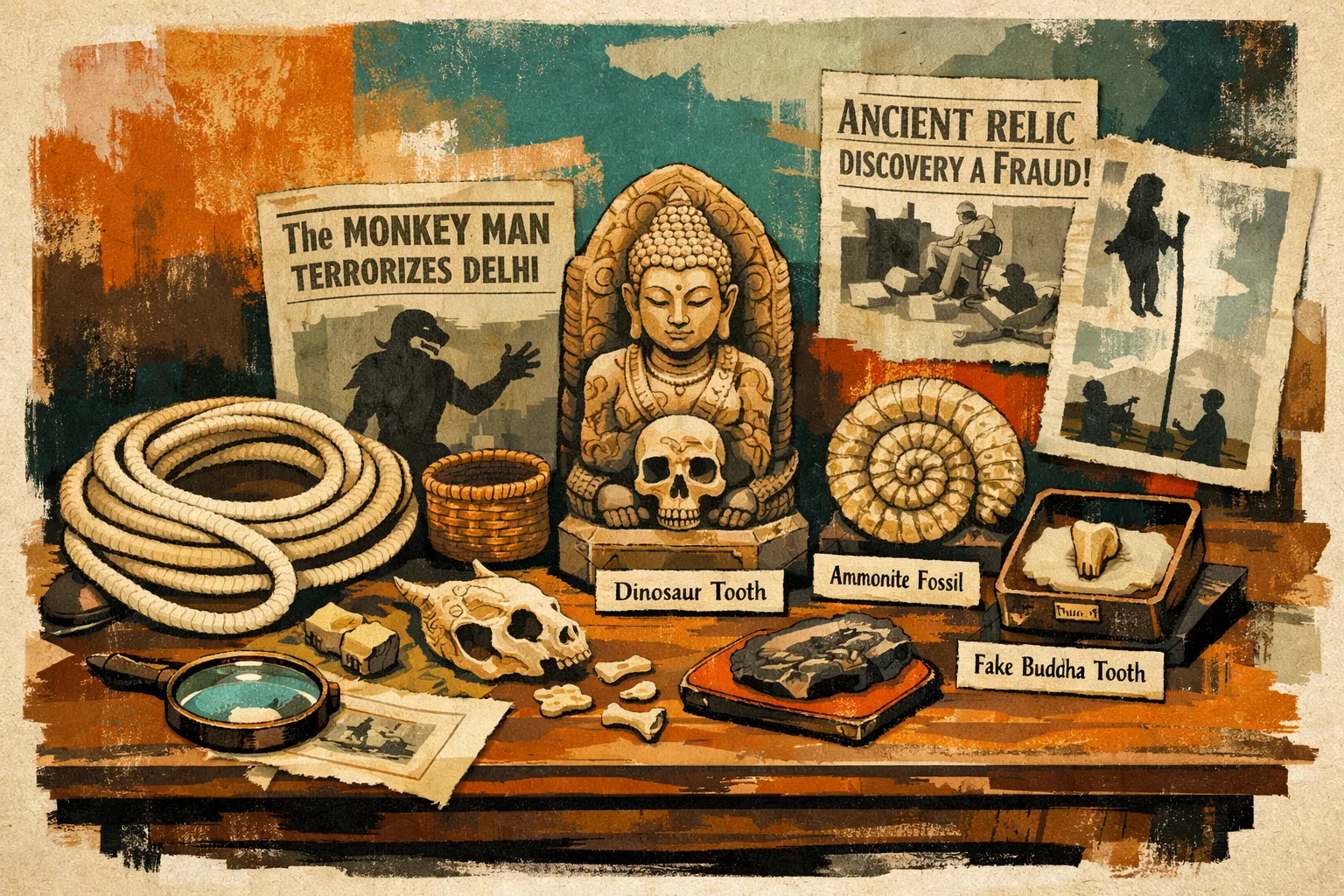
Some cases were deliberate frauds. Others were rumours, sincere religious interpretations, moral panics or legends enlarged by repetition. That distinction matters. The Himalayan fossil scandal involved systematic scientific deception; the Delhi “Monkey Man” appears to have emerged from fear, suggestion and sensational reporting rather than a single mastermind. The famous Indian rope trick, meanwhile, became attached to India largely through a foreign newspaper stunt. Together, these episodes show how falsehood acquires credibility—and why exposure rarely makes a memorable story disappear.
The rope trick that newspapers made real
The classic Indian rope trick supposedly began when a magician threw a rope into the air, where it remained mysteriously rigid. A boy climbed it and vanished. In the most lurid version, the magician followed, severed limbs fell from the sky, and the child later emerged alive from a basket.
There is no convincing evidence that this complete outdoor spectacle was ever performed. Historian of magic Peter Lamont traced its modern fame to an 1890 article in the Chicago Tribune, written under the conspicuously playful pseudonym “Fred S. Ellmore”—“Fred sell more”. The newspaper later admitted that the account was invented, but the retraction attracted far less notice than the original marvel.[Hertfordshire Research Archive]uhra.herts.ac.ukHertfordshire Research Archivethe rise and fall of the indian rope trick1April 24, 2007 — by P Lamont · 2001 · Cited by 17 — The paper de…
Older Asian writings do describe rope, chain or suspension illusions, but they do not clearly document the full dismemberment-and-restoration performance popularised in Western newspapers. That difference is important: genuine traditions of Indian conjuring became raw material for a much more extravagant colonial fantasy.
The story then began manufacturing its own evidence. Travellers recalled performances that they had supposedly witnessed years before. Stage magicians advertised recreations. Photographs were published as proof, although some showed rigid poles or staged scenes rather than a free-hanging rope. Magicians and investigators repeatedly offered rewards for a convincing outdoor demonstration, without receiving one.[Wikipedia]WikipediaIndian rope trickIndian rope trick
The trick persisted because it fitted several expectations at once. Editors gained a sensational story; Western readers received confirmation of an imagined “mystical East”; performers acquired an irresistible publicity device; and later witnesses could reshape ordinary memories around a legend they already knew. The episode is therefore both an Indian-themed hoax and a warning about attribution: the deception was chiefly created and amplified outside India, even though India supplied its setting and exotic appeal.
When archaeology manufactured sacred evidence
In the late nineteenth century, archaeology in British India carried exceptional authority. Inscriptions and relics could identify ancient cities, settle religious geography and establish scholarly reputations. That made archaeological evidence valuable—and forgery tempting.
Alois Anton Führer, a German archaeologist employed by the Archaeological Survey of India, became involved in important work connected with Buddhist sites in northern India and the Nepalese borderlands. His career collapsed in 1898 after evidence emerged that he had falsified inscriptions, invented discoveries and supplied sham Buddhist relics. Contemporary investigators described inscriptions associated with some of his excavations as “impudent forgeries”. He was also accused of selling supposedly authentic relics to a Burmese monk; one alleged tooth of the Buddha was carved ivory, while another was reportedly an animal tooth.[wikipedia.org]WikipediaAlois Anton FührerAlois Anton Führer
The scandal requires a careful qualification. Führer’s fraud does not mean that every discovery associated with him was fake. In particular, specialists have defended the authenticity of the Ashokan inscription at Lumbini, which identifies the area as the Buddha’s birthplace. Evidence indicates that the pillar was known locally and that Führer may not have been present when its inscription was first uncovered. Scholars have also argued that its language and script contain features beyond Führer’s ability to reproduce convincingly.[Wikipedia]WikipediaLumbini pillar inscriptionLumbini pillar inscription
That mixture of real and false material made the case unusually damaging. A wholly fabricated collection can simply be rejected; a compromised excavation leaves later researchers asking which records remain usable. Führer’s recognised forgeries also cast suspicion over objects and sites that may be genuine.
The episode reveals how institutional prestige can become part of a deception. Führer was not a street seller offering an obvious curiosity. He had an official position, scholarly publications and access to sites that few outsiders could inspect. His claims therefore entered circulation with authority already attached. Exposure depended not on a single spectacular test but on inconsistencies, surprise inspections, correspondence and comparison with earlier archaeological descriptions.
Modern antiquities trafficking often uses a related method: not necessarily forging the object, but forging its history. Stolen temple sculptures have been sold with false ownership records or fabricated provenance, allowing genuine artefacts to enter reputable collections under deceptive paperwork. Investigations into dealer Subhash Kapoor’s network showed how museums could acquire authentic Indian antiquities whose legal histories had been falsified.[chasingaphrodite.com]chasingaphrodite.comCHASING APHRODITEBall State's Kapoor Return Reveals New False ProvenanceNovember 17, 2015 — 17 Nov 2015 — “Homeland Security Investigations has presented convincing evidence that the work was stolen and its do…

The fossils that travelled farther than their discoverer
The Himalayan fossil affair was one of the most serious scientific frauds associated with modern India. For decades, Panjab University palaeontologist Vishwa Jit Gupta published research describing fossils supposedly collected from Himalayan rock formations. His work influenced attempts to date geological layers and reconstruct the region’s distant past.
The problem was that many specimens did not belong where Gupta said they had been found. Australian geologist John Talent became suspicious after field experience failed to match the published record. Some of Gupta’s supposedly Himalayan fossils closely resembled specimens from established sites elsewhere in the world. At a scientific meeting in Calgary in 1987, Talent demonstrated striking similarities between one of Gupta’s fossils and material from Morocco.[Wikipedia]WikipediaHimalayan fossil hoaxHimalayan fossil hoax
Further investigation found a disturbing pattern. Fossils appeared to have been obtained from foreign collections, commercial sources or other researchers and then relabelled as Himalayan discoveries. Published sites were vague, inaccessible or apparently imaginary. Field checks failed to locate the rock formations and fossil beds described in the papers. Gupta was also accused of recycling specimens, plagiarising material and misleading co-authors who had trusted his claimed field data.[Wikipedia]WikipediaHimalayan fossil hoaxHimalayan fossil hoax
The fraud was especially effective because palaeontology depends heavily on provenance. A fossil’s appearance is only part of its scientific value. Researchers must know exactly where it was found, in which layer and beside what other material. Move an authentic fossil to a false geological setting and it becomes false evidence, even though the object itself is real.
Gupta’s output also created a protective barrier. Hundreds of publications, numerous collaborators and years of citation made the claims seem established. Challenging them meant questioning not one paper but a substantial section of Himalayan palaeontology. When the Geological Society of India reviewed the work, it advised researchers to disregard doubtful records unless independent evidence could establish that the fossils really occurred at the stated sites. An official university inquiry later found Gupta responsible for data recycling, plagiarism, invented locations and deception of fellow scientists.[Wikipedia]WikipediaHimalayan fossil hoaxHimalayan fossil hoax
The aftermath demonstrated a recurring weakness in scientific self-correction. Publication and peer review can assess whether an argument appears plausible, but they cannot always detect fabricated field origins. The fraud became visible only when researchers compared specimens internationally, revisited locations and demanded notebooks, registration details and original collections. Gupta’s reinstatement after an initial suspension also drew criticism, showing that institutional responses to misconduct may be slower and less decisive than the production of the false research itself.[Wikipedia]WikipediaHimalayan fossil hoaxHimalayan fossil hoax
A miracle explained without calling worshippers frauds
On 21 September 1995, reports spread across India that statues of the deity Ganesha were drinking spoonfuls of milk. Worshippers queued at temples, household statues were tested, milk sales rose sharply, and the story reached communities in several other countries within hours.
To many participants, the disappearing liquid was direct physical evidence of a miracle. Yet demonstrations by scientists and sceptics showed that milk placed against the surface of a statue could be drawn away from a spoon, spread across the material and run down its front. Surface tension, capillary movement, the porosity of some statues and the thin film formed where the spoon touched the figure could make the milk appear to vanish into the mouth or trunk. Coloured-liquid tests showed that much of it was coating the statue or collecting below rather than being consumed.[imsc.res.in]imsc.res.inOpen source on res.in.
Calling the entire event a hoax would be misleading. There is no need to suppose that millions of participants were pretending or that a central organiser engineered every observation. Most people saw a real physical effect and interpreted it through a religious framework. Some promoters may have exaggerated what happened, and political accusations circulated at the time, but the main mechanism was a combination of ordinary fluid behaviour, expectation and rapid social transmission.
The speed of the story was itself part of the phenomenon. Telephone calls, television reports, temple networks and word of mouth allowed similar demonstrations to be repeated almost immediately. Once viewers expected the milk to disappear, a small fall in the spoon’s level could seem decisive. Spillage beneath crowded statues was less memorable than the apparent movement at the mouth.
The episode illustrates the difference between fraud and a mistaken inference. The observation—milk leaving the spoon—was often genuine. The contested part was its cause. A laboratory explanation did not necessarily erase the event’s spiritual meaning for believers, but it removed the need for a supernatural account of the physical process.
How Delhi created a monster from fear
In May 2001, residents of Delhi began reporting attacks by a strange nocturnal creature. Descriptions varied radically. It was said to resemble a monkey, a masked man, a mechanical figure or a hairy animal with metal claws, glowing eyes and extraordinary jumping ability. Hundreds of sightings were reported, and police produced sketches and deployed officers across affected neighbourhoods.[Wikipedia]WikipediaMonkey-man of DelhiMonkey-man of Delhi
No consistent creature was found. Investigators and psychiatrists concluded that the panic was being driven by rumour, anxiety, misidentification and sensational coverage. Some reported wounds may have had ordinary causes; other injuries occurred when frightened people fled imagined attacks. Several deaths were linked to falls from rooftops or stairways during the panic.[WIRED]wired.comOpen source on wired.com.
The “Monkey Man” was not a straightforward invented prank like the newspaper rope trick. It behaved more like a self-generating urban legend. Each new report supplied a template for the next. In dark streets and during power cuts, an animal, shadow, intruder or sudden noise could be interpreted as the creature already dominating conversation.
Contradictory descriptions did not immediately weaken the story. They made it adaptable. A fixed suspect might have been disproved, but a monster that could be part animal, part machine and part masked attacker could absorb almost any encounter. Police attention and newspaper sketches, although intended to reassure or investigate, also confirmed that authorities regarded the threat as worth pursuing.
The panic was concentrated in neighbourhoods where people often slept outdoors or on roofs during hot weather and where poor lighting could magnify uncertainty. Rumour therefore interacted with material conditions. The practical danger was not a supernatural assailant but a frightened population primed to run, jump or attack a suspected stranger.
Similar panics have appeared elsewhere in India, including reports of mysterious scratchers, supernatural attackers and child abductors. The useful lesson is not that witnesses simply invent experiences. Fear changes how ambiguous sensations are noticed, remembered and described. Once a community has a shared explanation, separate incidents can be pulled into a single imaginary pattern.

When an Indian newspaper became a propaganda launchpad
In July 1983, the Indian newspaper Patriot published an anonymous letter claiming that AIDS might have been created through American biological-weapons research at Fort Detrick. The writer was presented as a reputable American scientist, but the allegation became part of a Soviet-bloc disinformation operation later documented through intelligence records and archival research.
The placement in India was strategically useful. Soviet outlets could repeat the allegation while presenting it as a report that had originated independently abroad. In 1985, the Soviet newspaper Literaturnaya Gazeta expanded the story, claiming that American researchers had collected viruses in Africa and combined them for military purposes. The narrative was then reproduced through newspapers, radio and state-linked media in numerous countries.[state.gov]history.state.govOffice of the Historian Historical DocumentsOffice of the Historian Historical Documents
The operation is often called “INFEKTION”, although archival historians have found that the relevant East German campaign was codenamed Operation Denver. Whatever label is used, its mechanism is clear: seed a claim in a seemingly independent foreign publication, cite that publication as evidence, elaborate the story through aligned outlets, and allow repetition across borders to imitate corroboration.[JSTOR]jstor.orgOpen source on jstor.org.
The allegation exploited real fears. Governments had conducted unethical medical experiments; military biological programmes had existed; AIDS was new, lethal and poorly understood; and affected communities had reasons to distrust official institutions. Disinformation did not have to invent distrust from nothing. It attached a fabricated explanation to genuine historical grievances.
Scientific evidence did not support the Fort Detrick story. HIV’s evolutionary history and epidemiology point to zoonotic transmission and circulation in central Africa decades before the alleged American laboratory creation. Yet the bioweapon claim survived because it offered intention, villainy and a simple origin story for a frightening epidemic.
India’s role in this episode should not be confused with authorship by Indian society as a whole. An Indian outlet was used as an intermediary in an international influence campaign. The case nevertheless belongs in India’s media history because it demonstrates how local publication can lend foreign propaganda credibility—and how a small article can become globally consequential when powerful institutions decide to amplify it.
The false histories that refuse to retire
A different kind of contested truth surrounds claims that the Taj Mahal was originally a Hindu temple called “Tejo Mahalaya”. The theory was popularised by writer P. N. Oak, who argued that numerous Islamic monuments had earlier Hindu identities. Mainstream historians and the Archaeological Survey of India have rejected the Taj Mahal claim, pointing to documentary, architectural and epigraphic evidence that the mausoleum was commissioned by the Mughal emperor Shah Jahan in the seventeenth century.[The Guardian]theguardian.comThe Guardian Taj Mahal is Muslim tomb not Hindu temple, Indian court toldThe Guardian Taj Mahal is Muslim tomb not Hindu temple, Indian court told
This is better described as pseudohistory than as an isolated practical joke. Its persuasiveness does not rest on one forged object. It depends on selective resemblance, speculative wordplay, distrust of academic institutions and the political appeal of recovering a supposedly suppressed past. Features ordinary in Mughal or broader South Asian architecture are reinterpreted as clues to an earlier temple, while contemporary records and the monument’s documented construction history are discounted.
Court rejection and expert rebuttal have not ended the story. In July 2026, the Allahabad High Court sought responses from the central government and the Archaeological Survey of India in a renewed petition requesting an inspection and advancing the temple claim. Seeking a response is not a judicial endorsement of the theory, but legal proceedings can return a rejected historical claim to the news cycle and make an old controversy appear newly unresolved.[The Times of India]timesofindia.indiatimes.comOpen source on indiatimes.com.
Such legends endure because they concern ownership and identity rather than architecture alone. For supporters, the claim can function as a story of historical dispossession; for opponents, it exemplifies the political rewriting of evidence. Merely listing factual corrections may therefore have limited effect. The dispute persists not because historians have uncovered equally strong rival explanations, but because the monument has become a symbolic prize in a modern argument.
From whispered rumours to forwarded images
Digital communication did not invent India’s rumour culture, but it altered its speed, scale and visibility. During 2018, false warnings about child kidnappers circulated widely through WhatsApp. Videos and messages detached from their original settings were presented as evidence that gangs were entering particular districts. In several places, strangers were attacked by crowds; some victims were killed. Reuters documented cases in which forwarded rumours helped trigger mob violence against innocent people.[Reuters]reuters.comWhen a text can trigger a lynching: Whats App strugglesWhen a text can trigger a lynching: Whats App struggles
These messages were rarely sophisticated forgeries. Their power came from apparent intimacy. A warning forwarded by a relative, neighbour or local group administrator felt less like anonymous mass media and more like personal advice. End-to-end encryption also made the overall movement of a rumour difficult for researchers, authorities and the platform itself to observe.
Images have proved particularly effective. Research on political WhatsApp groups around India’s 2019 election found that a notable share of widely shared images contained known misinformation. False material frequently continued circulating even after fact-checking organisations had debunked it. Altered captions, recycled photographs and screenshots disguised as news reports allowed old content to be assigned to a new person, place or crisis.[arXiv]arxiv.orgOpen source on arxiv.org.
Artificial intelligence has added convincing synthetic speech and video to this older repertoire. During the 2024 general election, viral deepfakes appeared to show Bollywood actors making political appeals they had not recorded. Election officials established monitoring teams, but the enormous volume of content and uneven local resources made rapid verification difficult.[Reuters]reuters.comOpen source on reuters.com.
Commercial fraud uses similar methods. Fake endorsements place the faces or voices of business leaders, cricketers and financial commentators in advertisements for fraudulent investment platforms. In 2025, Meta said it had removed more than 23,000 accounts and pages associated with scams aimed primarily at users in India and Brazil, including schemes using deepfake celebrity endorsements and counterfeit app-store pages.[The Indian Express]indianexpress.comThe Indian Express Meta blocks 23K Facebook accounts targeting Indian usersThe Indian Express Meta blocks 23K Facebook accounts targeting Indian users
The technology changes, but the basic structure resembles older hoaxes:
- Borrow authority. Use a scientist, deity, newspaper, museum, celebrity or familiar contact.
- Create apparent witnesses. Repetition makes independent confirmation seem more extensive than it is.
- Exploit urgency. A miracle must be seen today; a child kidnapper is nearby; an investment opportunity is closing.
- Make correction slower than transmission. Retractions, laboratory tests and provenance checks require more effort than forwarding the original claim.
- Detach the story from its first failure. Once copied into new formats, a disproved claim returns without the correction attached.
What India’s hoaxes reveal
The most revealing Indian hoax stories are not all deliberate fabrications. They form a spectrum.
At one end are calculated frauds: Führer’s fake relics, Gupta’s false fossil locations and the planted AIDS-bioweapon allegation. Their promoters controlled evidence or concealed its origin. In the middle are pseudohistorical and commercial claims assembled from selective facts, misleading documents or borrowed authority. At the other end are collective errors such as the milk miracle and the Monkey Man panic, where ordinary physical events or ambiguous experiences acquired extraordinary explanations through expectation and repetition.
Several recurring conditions allowed these stories to thrive.
Authority often replaced verification. An official archaeologist, university professor or respected newspaper could make a weak claim appear settled. People downstream usually had no access to the excavation trench, fossil site or anonymous source.
Objects seemed more trustworthy than narratives. A tooth, inscription, fossil, photograph or video looked like direct evidence. Yet physical objects can be mislabelled, images recaptioned and genuine antiquities supplied with false ownership histories.
Corrections lacked the appeal of the original claim. A rope trick involving levitation and resurrection was more memorable than a newspaper retraction. A monster with metal claws travelled better than a psychiatric explanation involving suggestion and panic.
True background facts supported false conclusions. Indian conjurors really performed remarkable illusions. Milk really did leave the spoon. Western governments really had histories of secret military research. The strongest deception often begins with something that can be verified, then adds an unsupported causal story.
Exposure depended on comparison. Fraud became visible when a Moroccan fossil was placed beside its supposed Himalayan twin, when coloured milk was traced down a statue, when field teams revisited claimed sites, or when intelligence archives revealed how a newspaper allegation had been planted and recycled.
That is why famous hoaxes remain valuable after they have been debunked. They show that scepticism is not a reflexive refusal to believe unusual things. It is the slower work of establishing origin, custody, mechanism and independent confirmation. In India’s most memorable cases, the decisive question was rarely whether a story sounded strange. It was whether the evidence had travelled by a more suspicious route than the story admitted.
Amazon book picks
Further Reading
Books and field guides related to How India's Most Famous Hoaxes Took Hold. Use these as the next step if you want deeper reading beyond the article.
Extraordinary Popular Delusions and the Madness of Crowds
Rating: 4.0/5 from 5 Google Books ratings
Matches the page's broad theme of famous hoaxes and credulity.
The Demon-Haunted World
Rating: 4.5/5 from 43 Google Books ratings
Explains why extraordinary claims gain traction.
The Rise of the Indian Rope Trick
Covers the creation and spread of a celebrated false story.
eBay marketplace picks
Marketplace Samples
Live-tested eBay searches with available results related to this page.


Endnotes
1.
Source: Wikipedia
Title: Indian rope trick
Link:https://en.wikipedia.org/wiki/Indian_rope_trick
2.
Source: Wikipedia
Title: Alois Anton Führer
Link:https://en.wikipedia.org/wiki/Alois_Anton_F%C3%BChrer
3.
Source: jstor.org
Link:https://www.jstor.org/stable/40926240
Source snippet
Dr Führer's Wanderjahreby A HUXLEY · 2010 · Cited by 14 — 1892-93 season saw a break in his career of forgery: for 1892-93 the watch...
4.
Source: Wikipedia
Title: Lumbini pillar inscription
Link:https://en.wikipedia.org/wiki/Lumbini_pillar_inscription
5.
Source: chasingaphrodite.com
Title: CHASING APHRODITEBall State’s Kapoor Return Reveals New False Provenance
Link:https://chasingaphrodite.com/2015/11/17/ball-states-kapoor-return-reveals-new-false-provenance/
Source snippet
November 17, 2015 — 17 Nov 2015 — “Homeland Security Investigations has presented convincing evidence that the work was stolen and its do...
Published: November 17, 2015
6.
Source: chasingaphrodite.com
Title: at looted temple in india locals unwittingly worship a fake
Link:https://chasingaphrodite.com/2013/07/24/at-looted-temple-in-india-locals-unwittingly-worship-a-fake/
7.
Source: Wikipedia
Title: Himalayan fossil hoax
Link:https://en.wikipedia.org/wiki/Himalayan_fossil_hoax
8.
Source: imsc.res.in
Link:https://www.imsc.res.in/~jayaram/Articles/milkb.html
9.
Source: Wikipedia
Title: Ganesha drinking milk miracle
Link:https://en.wikipedia.org/wiki/Ganesha_drinking_milk_miracle
10.
Source: Wikipedia
Title: Monkey-man of Delhi
Link:https://en.wikipedia.org/wiki/Monkey-man_of_Delhi
11.
Source: wired.com
Link:https://www.wired.com/2001/06/monkey-business-2
12.
Source: history.state.gov
Title: Office of the Historian Historical Documents
Link:https://history.state.gov/historicaldocuments/frus1981-88v41/d9
13.
Source: Wikipedia
Title: Operation Denver
Link:https://en.wikipedia.org/wiki/Operation_Denver
14.
Source: jstor.org
Link:https://www.jstor.org/stable/26924704
15.
Source: reuters.com
Title: When a text can trigger a lynching: Whats App struggles
Link:https://www.reuters.com/article/technology/when-a-text-can-trigger-a-lynching-whatsapp-struggles-with-incendiary-messages-idUSKBN1JL0OS/
16.
Source: reuters.com
Title: india asks whatsapp to curb spread of false messages id USKBN1JT20P
Link:https://www.reuters.com/article/world/india-asks-whatsapp-to-curb-spread-of-false-messages-idUSKBN1JT20P/
17.
Source: reuters.com
Link:https://www.reuters.com/article/world/police-arrest-25-in-latest-whatsapp-rumour-led-lynching-in-karnataka-idUSKBN1K50VC/
18.
Source: arxiv.org
Link:https://arxiv.org/abs/2005.09784
19.
Source: arxiv.org
Link:https://arxiv.org/abs/2006.02471
20.
Source: arxiv.org
Link:https://arxiv.org/abs/2005.02443
21.
Source: reuters.com
Link:https://www.reuters.com/world/india/india-sieves-online-deluge-stamp-out-disinformation-worlds-biggest-election-2024-04-25/
22.
Source: Wikipedia
Title: Subhash Kapoor (art dealer)
Link:https://en.wikipedia.org/wiki/Subhash_Kapoor_%28art_dealer%29
23.
Source: Wikipedia
Title: Indian Whats App lynchings
Link:https://en.wikipedia.org/wiki/Indian_WhatsApp_lynchings
24.
Source: jp.reuters.com
Link:https://jp.reuters.com/article/world/whatsapp-launches-fact-check-service-to-fight-fake-news-during-india-polls-idUSKCN1RE0H9/
25.
Source: history.state.gov
Link:https://history.state.gov/historicaldocuments/frus1981-88v41/d30
26.
Source: theory.tifr.res.in
Title: ganapati milk
Link:https://theory.tifr.res.in/bombay/leisure/trivia/ganapati-milk.html
27.
Source: uhra.herts.ac.uk
Link:https://uhra.herts.ac.uk/id/eprint/2333/1/902376.pdf
Source snippet
Hertfordshire Research Archivethe rise and fall of the indian rope trick1April 24, 2007 — by P Lamont · 2001 · Cited by 17 — The paper de...
Published: April 24, 2007
28.
Source: theguardian.com
Link:https://www.theguardian.com/books/2003/dec/28/historybooks.features
Source snippet
The GuardianGive 'em enough rope | History books27 Dec 2003 — Peter Lamont has conjured up a magical read in his history of an unstoppabl...
29.
Source: ignca.gov.in
Link:https://ignca.gov.in/Asi_data/21606.pdf
Source snippet
archeological survey of indiaOther forgeries of Dr. Führer. found in the small stupas at Sagarwå are impudent forgeries, and when Dr. Füh...
30.
Source: itsartlaw.org
Title: subhash kapoor a decade in review
Link:https://itsartlaw.org/case-review/subhash-kapoor-a-decade-in-review/
31.
Source: theguardian.com
Title: The Guardian Taj Mahal is Muslim tomb not Hindu temple, Indian court told
Link:https://www.theguardian.com/world/2017/aug/30/taj-mahal-muslim-tomb-not-hindu-temple-indian-court-told
32.
Source: timesofindia.indiatimes.com
Link:https://timesofindia.indiatimes.com/india/taj-mahal-or-rauza-i-munavvara-why-some-people-are-reading-history-wrong/articleshow/80430965.cms
33.
Source: timesofindia.indiatimes.com
Link:https://timesofindia.indiatimes.com/city/allahabad/109-historical-features-cited-in-allahabad-high-court-plea-claiming-taj-mahal-as-hindu-temple/articleshow/132235362.cms
34.
Source: timesofindia.indiatimes.com
Link:https://timesofindia.indiatimes.com/city/allahabad/alld-hc-seeks-centre-asi-reply-on-plea-for-taj-mahal-survey/articleshow/132223203.cms
35.
Source: indianexpress.com
Title: The Indian Express Meta blocks 23K Facebook accounts targeting Indian users
Link:https://indianexpress.com/article/technology/tech-news-technology/meta-blocks-23k-facebook-accounts-investment-scam-crackdown-9988929/
36.
Source: chasingaphrodite.com
Link:https://chasingaphrodite.com/tag/looted-antiquities/
37.
Source: chasingaphrodite.com
Link:https://chasingaphrodite.com/2012/08/03/kapoors-footprints-230-objects-from-alleged-antiquities-trafficker-traced-to-museums-around-the-globe/
38.
Source: facebook.com
Link:https://www.facebook.com/shayariee/posts/senior-advocate-hari-shankar-jain-has-repeated-a-controversial-claim-that-the-ta/1420800026759587/
39.
Source: facebook.com
Link:https://www.facebook.com/groups/149844915349213/posts/2305886566411693/
40.
Source: facebook.com
Title: as the us grapples with the issue of russian disinformation historians look back
Link:https://www.facebook.com/woodrowwilsoncenter/posts/as-the-us-grapples-with-the-issue-of-russian-disinformation-historians-look-back/2297606576954056/
41.
Source: facebook.com
Title: History Seekers.Thailand
Link:https://www.facebook.com/groups/HistorySeekers.Thailand/posts/2392817810980430/
42.
Source: timesofindia.indiatimes.com
Link:https://timesofindia.indiatimes.com/science/this-indian-scientist-behind-the-himalayan-fossil-hoax-has-fooled-the-world-for-30-years-know-how/articleshow/119292435.cms
43.
Source: timesofindia.indiatimes.com
Link:https://timesofindia.indiatimes.com/city/mumbai/art-experts-struggle-to-distinguish-real-from-a-very-good-fake/articleshow/31695554.cms
44.
Source: madrasmusings.com
Title: indian rope trick
Link:https://madrasmusings.com/vol-34-no-21/indian-rope-trick/
45.
Source: thetimes.com
Title: money for old rope 967xhllrw6z
Link:https://www.thetimes.com/travel/destinations/uk-travel/scotland-travel/money-for-old-rope-967xhllrw6z
46.
Source: nga.gov.au
Title: the right of return
Link:https://nga.gov.au/stories-ideas/the-right-of-return/
Additional References
47.
Source: youtube.com
Title: The Monkey Man of Delhi | India’s Most Mysterious Urban Legend
Link:https://www.youtube.com/watch?v=abfsr4qlqis
Source snippet
Real Story of 'Monkey Man' Horror in Delhi | 3000 Cops, 367 Attacks? | Explained | Varun Jauhari...
48.
Source: nature.com
Link:https://www.nature.com/articles/343396a0.pdf
49.
Source: youtube.com
Title: Fake News Causing Mass Hysteria: Case Study of Monkey Man
Link:https://www.youtube.com/watch?v=ukAt2KnAPJg
Source snippet
The Monkey Man of Delhi | India's Most Mysterious Urban Legend...
50.
Source: academia.edu
Link:https://www.academia.edu/83952744/Examination_of_the_Authenticity_of_Rummindei_Pillar_Inscription_in_the_Light_of_an_Alternate_Interpretation_of_the_Inscription
51.
Source: hamletram.blogspot.com
Link:https://hamletram.blogspot.com/search/label/Alois%20Anton%20F%C3%BChrer
52.
Source: medium.com
Link:https://medium.com/%40abaebad/ganesha-drinking-milk-miracle-78530abb68c4
53.
Source: palaeontologicalsociety.in
Link:https://palaeontologicalsociety.in/ress.pdf
54.
Source: socialscienceresearch.org
Link:https://socialscienceresearch.org/index.php/GJHSS/article/view/3085/1-Indian-Idols-Drinking-Milk_html
55.
Source: x.com
Link:https://x.com/LawChakra/status/2074135905615667402
56.
Source: instagram.com
Link:https://www.instagram.com/p/DX1M_uWDOza/
Topic Tree
Follow this branch
Related pages 192
- Albanian Hoaxes
- Algerian Hoaxes
- Antigua Deceptions
- Argentina Hoaxes
- Armenian Hoaxes
- +187 more in sidebar