How Cambodia's Most Famous Deceptions Took Hold
Cambodia’s best-documented hoax history is not a simple collection of practical jokes.
Page outline Jump by section
Introduction
What connects these cases is the manufacture of authority around something real. An ancient statue acquires a respectable paper trail; genuine hardship becomes a misleading fundraising story; an authentic carving receives a pseudoscientific caption. Understanding Cambodia’s famous frauds and legends therefore requires more than asking whether an object or photograph is genuine. The crucial questions are who supplied its story, what evidence should exist, who benefited from belief and why institutions failed to check.
How looted art acquired a respectable past
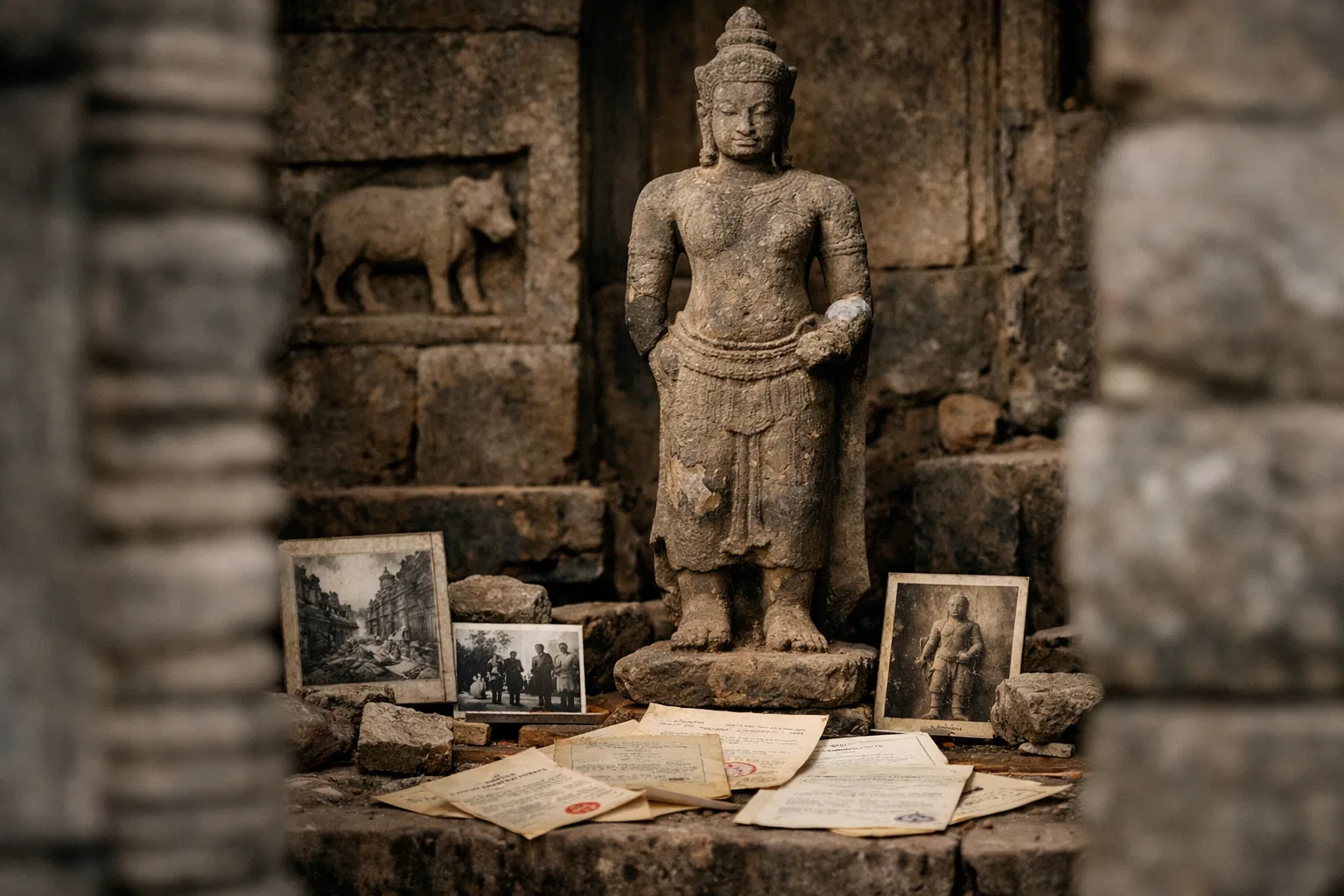
The most important Cambodian art deceptions have often involved authentic antiquities rather than newly manufactured fakes. The sculpture itself may be centuries old, but the account of how it reached a dealer, collector or museum is invented. This false ownership history, known as fabricated provenance, can transform a visibly looted temple object into something apparently fit for legal sale.
The late British dealer Douglas Latchford became the central figure in the exposure of this system. For decades he was treated as an authority on Khmer art, supplying museums and private collectors while publishing lavish books on Cambodian sculpture. In 2019, United States prosecutors charged him with trafficking looted antiquities and falsifying provenance, invoices and customs records. He denied involvement in smuggling and died in 2020 before the charges could be tried, so the allegations did not result in a criminal verdict against him.[Department of Justice]justice.govantiquities dealer charged trafficking looted cambodian artifactsDepartment of JusticeAntiquities Dealer Charged With Trafficking In Looted…27 Nov 2019 — At all times relevant to this Indictment, DOU…
According to prosecutors, the deceptions included false statements that objects had belonged to established collections for many years. Such claims were especially valuable if they placed an antiquity outside Cambodia before the modern international restrictions on illicit cultural-property trafficking. A convincing collector’s name, an early acquisition date and official-looking paperwork could hide a much more recent removal from a temple or archaeological site. In a 2022 forfeiture action concerning 35 antiquities, the US Department of Justice alleged that Latchford used false statements, fake provenance documents and misleading customs papers to conceal looting.[Department of Justice]justice.govDepartment of Justice Southern District of New YorkDepartment of JusticeSouthern District of New York - Department of Justice…
Publication provided another layer of respectability. Investigators examining Latchford’s books found that objects linked to him had been photographed, classified and presented as important works of Khmer art. Prosecutors argued that inclusion in such volumes could give trafficked pieces an academic appearance and make them easier to sell. A catalogue entry did not merely describe the object; it could become part of the evidence later used to reassure a buyer.[ICIJ]icij.orgHow we tracked Cambodian antiquities to leadingHow we tracked Cambodian antiquities to leading…October 5, 2021 — 5 Oct 2021 — Prosecutors say Latchford used the books to give st…
The sculptures whose story unravelled
Three ninth-century bronze sculptures acquired by the National Gallery of Australia show how an invented history can collapse. The gallery bought the group from Latchford in 2011 for US$1.5 million. Its stated provenance traced the bronzes to an English businessman who had supposedly acquired them in Vietnam in the late 1960s. Researchers could not confirm that account through the man’s friends, archives or known collecting interests.[National Gallery of Australia]nga.gov.aureturning the godsNational Gallery of AustraliaReturning the Gods13 Feb 2024 — ANNE DAVIES reports on why three 1000-year-old Cham bronze sculptures are be…
The investigation changed direction when evidence emerged that the sculptures had been excavated in Cambodia during the 1990s and moved through Thailand. Cambodian researchers, international specialists, former looters and material supplied by Latchford’s family helped reconstruct their likely route. The gallery concluded that the works had probably been removed illegally and agreed to return them to Cambodia.[National Gallery of Australia]nga.gov.auright of return cambodiaNational Gallery of AustraliaRight of return: Cambodia3 Aug 2023 — The National Gallery celebrates the repatriation of three bronze sculp…
An even more physically compelling case involved a monumental warrior sculpture from Koh Ker. Archaeologists found feet still attached to a pedestal at the Cambodian site and compared them with a footless statue offered for sale in New York. Digital and archaeological comparison helped establish that the separated pieces belonged together. The statue was eventually returned in 2014 after investigators traced its passage through the international market.[Le Monde.fr]lemonde.frLe Monde.fr Cambodia celebrates the return of its Khmer deitiesThese returns are part of a broader wave in the 2020s, made possible by a multinational effort involving Cambodian authorities, internati…
These investigations reveal how false provenance is exposed. Researchers compare old photographs, excavation records, shipping documents, correspondence and sales catalogues. They interview former owners and people involved in looting. They also return to the original monuments, where abandoned feet, broken pedestals and matching fragments can contradict a dealer’s immaculate paperwork.
The consequences have reached major institutions. In 2023, the Metropolitan Museum of Art announced that it would return 14 sculptures to Cambodia and two to Thailand, including all Angkorian works then known by the museum to be associated with Latchford. In February 2026, Cambodia received another 74 objects from Britain under an agreement with his family.[The Metropolitan Museum of Art]metmuseum.orgOpen source on metmuseum.org.

Looted original or modern forgery?
Cambodia’s antiquities problem also includes modern objects passed off as ancient, although individual claims of forgery are often harder to establish publicly. Genuine looting and forgery can thrive together: the appearance of undocumented originals on the market gives newly made imitations a plausible environment in which to circulate.
Cambodian museum specialists have warned that high-quality copies can deceive buyers and sometimes reach institutional collections. Authentication may involve stone composition, tool marks, weathering, iconography and comparison with excavated works, but connoisseurship is not infallible. Some replicas are also made openly for conservation or display, particularly where vulnerable originals have been removed from temple sites. A legitimate replacement becomes deceptive only when someone later represents it as an ancient original.[The Cambodia Daily]english.cambodiadaily.comThe Cambodia Daily In Pursuit of ProvenanceThe Cambodia Daily In Pursuit of Provenance
The distinction matters. A forged statue falsely claims ancient manufacture. A looted statue is genuinely ancient but carries a false legal and personal history. The second form of deception has proved particularly dangerous because scientific testing may confirm the object’s age while saying nothing about when it was removed, who owned it or whether its paperwork was fabricated.
Did Angkor’s artists carve a dinosaur?
At Ta Prohm, the late twelfth-century temple near Angkor, a small relief shows a rounded animal surrounded by a row of leaf-like shapes. When these shapes are interpreted as plates along its back, the creature resembles a squat stegosaurus. Photographs of the carving have consequently circulated as supposed evidence that people once saw living dinosaurs.
The claim is most strongly associated with young-Earth creationist arguments. In that interpretation, the artist could only have depicted a stegosaur from direct human knowledge, contradicting the scientific conclusion that non-avian dinosaurs disappeared tens of millions of years before humans emerged. Supporters point to the arched back and apparent plates as identifying features.[Answers Research Journal]assets.answersresearchjournal.orgAnswers Research Journal The Stegosaur Engravings at Ta ProhmAnswers Research Journal The Stegosaur Engravings at Ta Prohm
The carving does not provide reliable evidence for that conclusion. The supposed plates resemble the decorative foliage surrounding other animal images at Ta Prohm. The creature also lacks key stegosaur features: its head is disproportionately large, its forelegs and hind legs are similar in length, and it has no recognisable spiked tail. Critical examinations have suggested that it could be a rhinoceros, boar, buffalo, lizard or imaginary animal, although no identification has gained universal acceptance.[Eckerd Research Portal]ecscholar.eckerd.eduResearch Portal A Stegosaur Carving on the Ruins of Ta Prohm? Think AgainResearch Portal A Stegosaur Carving on the Ruins of Ta Prohm? Think Again
There have also been suggestions that the relief might be a modern alteration, partly because it appears lighter or cleaner than nearby stone. That possibility has not been demonstrated. Cleaning, handling and the taking of moulds may explain differences in appearance, and the carving’s exact subject remains uncertain. The absence of a firm alternative identification does not strengthen the dinosaur case; it simply means that an ambiguous medieval image is difficult to read.
This episode is better classified as pseudoscientific interpretation than as an original Cambodian hoax. There is no good evidence that the temple sculptor intended a deception. The misleading effect arose much later, when tightly framed photographs and confident captions separated the animal from the decorative conventions visible elsewhere on the monument.
Who really “discovered” Angkor?
Henri Mouhot is still frequently described as the French explorer who discovered Angkor in 1860. The claim is false in its ordinary meaning. Cambodian communities knew the monuments, lived and worshipped around them, and maintained relationships with the landscape long before Mouhot arrived. European visitors had also recorded Angkor centuries earlier.[Wonders of Cambodia]wondersofcambodia.comWonders of Cambodia Henri Mouhot and the “Rediscovery” of Angkor: Explorer,Wonders of Cambodia Henri Mouhot and the “Rediscovery” of Angkor: Explorer,
Mouhot did not present himself as the first person to find the complex. His journals acknowledged earlier visitors, including the missionary Charles-Émile Bouillevaux, whose account appeared before Mouhot’s journey. Portuguese and Spanish travellers had described Angkor from the sixteenth century, while a thirteenth-century Chinese account of the city had been translated into French decades before Mouhot travelled in Cambodia.[Alison in Cambodia]alisonincambodia.wordpress.comAlison in Cambodia Stop saying the French discovered Angkor | Alison in CambodiaAlison in Cambodia Stop saying the French discovered Angkor | Alison in Cambodia
What Mouhot did achieve was Western popularisation. His descriptions and drawings, published after his death, reached an audience fascinated by exploration and ruined civilisations. Retelling gradually converted “made Angkor famous in Europe” into “discovered a lost city”. That change supplied a simple heroic narrative with a recognisable European protagonist.
The story also reflected colonial assumptions about who could count as a discoverer. A place known to local people could still be described as lost until a European traveller reported it to European institutions. Mouhot himself badly underestimated the age and Khmer origins of the monuments, finding it difficult to reconcile the architecture with his prejudiced view of contemporary Cambodian society. Later archaeological, inscriptional and historical work established the monuments firmly within Khmer civilisation.[Wikipedia]WikipediaHenri MouhotHenri Mouhot
It would be misleading to call the discovery myth a single, planned fraud. It is closer to an invented tradition produced by repetition, imperial storytelling and tourism. Its endurance shows that misinformation does not always need a mastermind. A memorable phrase, copied through guidebooks and popular histories, can gradually displace a more accurate but less dramatic account.
When an orphanage was not what visitors imagined
Cambodia’s orphanage-tourism boom offered foreign visitors an emotionally powerful story. Travellers could tour residential institutions, watch children perform, volunteer briefly and make donations to young people presented as abandoned or parentless. Yet research repeatedly found that large numbers of children living in these facilities had one or both parents alive.
In 2011, UNICEF reported that most of roughly 12,000 children then living in Cambodian orphanages were not orphans in the strict sense, and that nearly three-quarters had a living parent. The number of institutions had risen sharply alongside tourism and foreign donations. A later national survey identified hundreds of residential facilities, while research published through Columbia University estimated that nearly 80 per cent of adolescents in institutional care had at least one living parent.[voanews.com]voanews.comOpen source on voanews.com.
The misleading story did not always depend upon an explicit claim that every child’s parents were dead. The label “orphanage”, the visible poverty of residents, organised performances and tourists’ assumptions did much of the persuasive work. Visitors generally could not check family records, institutional licences, recruitment practices or how donations were spent.
Some children entered residential care because their families faced genuine poverty, lacked access to education or were persuaded that an institution would provide better opportunities. Critics found that the presence of international donors could create a financial incentive to recruit and retain children. In the worst cases, deprivation itself became part of the fundraising display: poorly supported children generated sympathy, and sympathy generated income.[asc.fisipol.ugm.ac.id]asc.fisipol.ugm.ac.idOrphanages and their volunteers: A look at Cambodia'sOrphanages and their volunteers: A look at Cambodia's
Campaigners also warned that rapid cycles of foreign volunteers could harm children through repeated attachment and separation, weak safeguarding and loss of privacy. Friends-International and UNICEF responded with the “Children Are Not Tourist Attractions” campaign, urging travellers to support families and properly regulated services rather than institutions offering casual access to children.[friends-international.org]friends-international.orgTHIN KTHIN K
This was not one centrally organised Cambodian scam, nor does the evidence show that every residential home was fraudulent. Some children cannot safely remain with their birth families, and the quality of institutional care varies. The deception lay in fundraising models that blurred orphanhood, poverty and temporary family separation while encouraging visitors to treat emotional access as proof of charitable legitimacy.
The case is especially instructive because the donors were not usually motivated by greed. They wanted to help. Their good intentions made the story more persuasive, demonstrating how a deceptive market can be sustained by sincere participants who mistake an intense personal experience for reliable evidence.

Scam compounds and manufactured relationships
Cambodia’s largest modern fraud operations work on an industrial rather than theatrical scale. From guarded compounds, converted casinos and office developments, organised criminal groups have run false romances, bogus cryptocurrency investments and other online schemes aimed at victims around the world.
A typical investment fraud begins with an apparently accidental message, a social-media introduction or contact through a dating service. The operator gradually develops trust and introduces a trading platform that appears professional. The victim’s account displays fictional gains, and a small early withdrawal may be allowed to prove that the system works. Larger deposits follow. Eventually withdrawals are blocked, additional fees are demanded or the platform disappears.
The most disturbing feature is that the person sending the fraudulent messages may also be a victim. Workers have been recruited with advertisements promising legitimate jobs, then transported to Cambodia or across regional borders. Survivors have reported confiscated passports, confinement, debt, beatings and threats intended to force them to meet scamming targets. Fake employment offers therefore supply labour for the same organisations that use fake emotional relationships to steal from distant victims.[Reuters]reuters.comAmnesty says Cambodia is enabling brutal scam industryAmnesty says Cambodia is enabling brutal scam industry
Amnesty International reported in 2025 that it had identified 53 Cambodian scam compounds and numerous suspected sites associated with trafficking, forced labour and severe abuse. The Cambodian government rejected claims that it had ignored the industry, pointing to raids, a national task force and its own status as a victim of transnational crime. Amnesty nevertheless concluded that many sites had not been effectively investigated or had continued operating after police interventions.[Reuters]reuters.comAmnesty says Cambodia is enabling brutal scam industryAmnesty says Cambodia is enabling brutal scam industry
A further Amnesty assessment published in June 2026 argued that a prominent crackdown had failed to dismantle most of the compounds it examined or to protect many trafficking victims. Because the report is an advocacy organisation’s assessment rather than a judicial ruling, its allegations should be distinguished from proven criminal convictions. Even so, evidence from survivors, international agencies, sanctions authorities and law-enforcement investigations supports the broader conclusion that Cambodia has become a significant centre of organised online fraud.[Amnesty International]amnesty.orgInternational Cambodia: Evidence suggests scamming compoundsInternational Cambodia: Evidence suggests scamming compounds
These schemes differ from traditional mass-media hoaxes. They do not ask millions of people to accept one public story. They create thousands of personalised realities: a lover, recruiter, investment adviser or successful trading account designed for a particular target. Stolen photographs, scripted conversations, artificial intelligence and fabricated interfaces allow personal trust to be produced at industrial scale.
Why the stories worked
Cambodia’s hoaxes, contested legends and frauds vary widely, but the strongest cases share several mechanisms.
A real object supported a false account. Looted statues were genuinely ancient, while the ownership records around them were fabricated. The Ta Prohm relief is authentic, although the claim that it records a living dinosaur is not supported.
Authority moved faster than verification. Dealers published scholarly-looking books, museums displayed objects, charities offered direct access to children, and guidebooks repeated the discovery of Angkor. Once an institution accepted a claim, later audiences often treated that acceptance as independent proof.
Conflict destroyed records and weakened oversight. Cambodia’s civil war, Khmer Rouge period and subsequent instability created opportunities for antiquities to be removed and their histories obscured. Missing evidence could be blamed on upheaval even when the gap was convenient for a seller.
Emotion rewarded belief. Collectors imagined themselves rescuing endangered art. Tourists believed they were helping abandoned children. Online fraud victims thought they had found affection, friendship or financial security. The emotional value of the claim discouraged awkward questions.
Cross-border systems divided responsibility. Cambodian antiquities passed through neighbouring countries, international dealers and Western museums. Scam operations recruit workers, target victims and move money across many jurisdictions. Each intermediary can claim to know only one part of the story.
The central lesson is that authenticity is rarely a single yes-or-no judgement. An artefact can be ancient but illegally removed. A charitable institution can house genuinely disadvantaged children while marketing a false picture of orphanhood. A historical explorer can write a real and influential account while later generations give him an achievement he never claimed. A person sending fraudulent messages may be using an invented identity under coercion.
Cambodia’s history of contested truth is therefore not evidence of national gullibility. It is a history of incentives: prestige in the art market, authority in colonial storytelling, income in tourism and enormous profits from digital crime. Exposure came when researchers stopped accepting the visible object or emotional encounter as the whole story and began reconstructing the missing chain of ownership, authorship, family connection or financial control.

Amazon book picks
Further Reading
Books and field guides related to How Cambodia's Most Famous Deceptions Took Hold. Use these as the next step if you want deeper reading beyond the article.
Ancient Angkor
Provides background on Angkor and Khmer history referenced throughout the page.
The Art of Deception
Explains the mechanics of trust, authority and fraud central to the article.
Cambodia's Curse
Provides wider Cambodian context for understanding major deception stories.
eBay marketplace picks
Marketplace Samples
Live-tested eBay searches with available results related to this page.


Endnotes
1.
Source: justice.gov
Title: antiquities dealer charged trafficking looted cambodian artifacts
Link:https://www.justice.gov/usao-sdny/pr/antiquities-dealer-charged-trafficking-looted-cambodian-artifacts
Source snippet
Department of JusticeAntiquities Dealer Charged With Trafficking In Looted...27 Nov 2019 — At all times relevant to this Indictment, DOU...
2.
Source: justice.gov
Title: Department of Justice Southern District of New York
Link:https://www.justice.gov/usao-sdny/pr/major-collection-cambodian-and-southeast-asian-antiquities-subject-forfeiture-action
Source snippet
Department of JusticeSouthern District of New York - Department of Justice...
3.
Source: icij.org
Title: How we tracked Cambodian antiquities to leading
Link:https://www.icij.org/investigations/pandora-papers/how-we-tracked-ancient-cambodian-antiquities-leading-museums/
Source snippet
How we tracked Cambodian antiquities to leading...October 5, 2021 — 5 Oct 2021 — Prosecutors say Latchford used the books to give st...
Published: October 5, 2021
4.
Source: ecscholar.eckerd.edu
Title: Research Portal A Stegosaur Carving on the Ruins of Ta Prohm? Think Again
Link:https://ecscholar.eckerd.edu/view/pdfCoverPage?download=true&filePid=13136495030006111&instCode=01ECKERD_INST
5.
Source: Wikipedia
Title: Henri Mouhot
Link:https://en.wikipedia.org/wiki/Henri_Mouhot
6.
Source: unicef.org
Link:https://www.unicef.org/cambodia/media/1331/file/Residential%20care%20facilities%20in%20Cambodia%20Report%20English.pdf
7.
Source: publichealth.columbia.edu
Title: one percent cambodian children live orphanages yet have living parent
Link:https://www.publichealth.columbia.edu/news/one-percent-cambodian-children-live-orphanages-yet-have-living-parent
8.
Source: asc.fisipol.ugm.ac.id
Title: Orphanages and their volunteers: A look at Cambodia’s
Link:https://asc.fisipol.ugm.ac.id/2019/12/18/orphanages-and-their-volunteers-a-look-at-cambodias-orphanage-voluntourism-industry/
9.
Source: friends-international.org
Title: THIN K
Link:https://friends-international.org/blog/index.php/think-support-families-orphanages/
10.
Source: reuters.com
Title: Amnesty says Cambodia is enabling brutal scam industry
Link:https://www.reuters.com/sustainability/society-equity/amnesty-says-cambodia-is-enabling-brutal-scam-industry-2025-06-26/
11.
Source: amnesty.org
Title: International Cambodia: Evidence suggests scamming compounds
Link:https://www.amnesty.org/en/latest/news/2026/06/cambodia-evidence-suggests-scamming-compounds-bypassed-despite-high-profile-crackdown/
12.
Source: amnesty.org
Link:https://www.amnesty.org/en/documents/asa23/1093/2026/en/
13.
Source: Wikipedia
Title: Douglas Latchford
Link:https://en.wikipedia.org/wiki/Douglas_Latchford
14.
Source: Wikipedia
Title: Unusual articles
Link:https://en.wikipedia.org/wiki/Wikipedia%3AUnusual_articles
15.
Source: unicef.org
Title: EN Final Report UNICEF Cambodia.pdf
Link:https://www.unicef.org/cambodia/media/10506/file/EN_Final%20Report%20-%20UNICEF%20Cambodia.pdf.pdf
16.
Source: nga.gov.au
Title: returning the gods
Link:https://nga.gov.au/stories-ideas/returning-the-gods/
Source snippet
National Gallery of AustraliaReturning the Gods13 Feb 2024 — ANNE DAVIES reports on why three 1000-year-old Cham bronze sculptures are be...
17.
Source: nga.gov.au
Title: right of return cambodia
Link:https://nga.gov.au/stories-ideas/right-of-return-cambodia/
Source snippet
National Gallery of AustraliaRight of return: Cambodia3 Aug 2023 — The National Gallery celebrates the repatriation of three bronze sculp...
18.
Source: lemonde.fr
Title: Le Monde.fr Cambodia celebrates the return of its Khmer deities
Link:https://www.lemonde.fr/en/international/article/2025/04/02/cambodia-celebrates-the-return-of-its-khmer-deities_6739755_4.html
Source snippet
These returns are part of a broader wave in the 2020s, made possible by a multinational effort involving Cambodian authorities, internati...
19.
Source: metmuseum.org
Link:https://www.metmuseum.org/press-releases/return-of-khmer-works-2023-news
20.
Source: english.cambodiadaily.com
Title: The Cambodia Daily In Pursuit of Provenance
Link:https://english.cambodiadaily.com/2004/05/29/in-pursuit-of-provenance/
21.
Source: assets.answersresearchjournal.org
Title: Answers Research Journal The Stegosaur Engravings at Ta Prohm
Link:https://assets.answersresearchjournal.org/doc/v10/stegosaur_engravings_ta_prohm.pdf
22.
Source: alisonincambodia.wordpress.com
Title: Alison in Cambodia That is not a stegosaurus | Alison in Cambodia
Link:https://alisonincambodia.wordpress.com/2014/10/14/that-is-not-a-stegosaurus/
23.
Source: wondersofcambodia.com
Title: Wonders of Cambodia Henri Mouhot and the “Rediscovery” of Angkor: Explorer,
Link:https://wondersofcambodia.com/henri-mouhot-and-the-rediscovery-of-angkor-explorer-myth-and-legacy/
24.
Source: alisonincambodia.wordpress.com
Title: Alison in Cambodia Stop saying the French discovered Angkor | Alison in Cambodia
Link:https://alisonincambodia.wordpress.com/2014/10/05/stop-saying-the-french-discovered-angkor/
25.
Source: voanews.com
Link:https://www.voanews.com/a/unicef-concern-prompts-cambodian-investigation-of-orphanages-118493469/136916.html
26.
Source: metmuseum.org
Title: The Met Appoints Head of Provenance Research
Link:https://www.metmuseum.org/press-releases/head-of-provenance-research-2024-news
27.
Source: metmuseum.org
Title: Recent Repatriations to Cambodia and Thailand
Link:https://www.metmuseum.org/perspectives/recent-repatriations-to-cambodia-and-thailand
28.
Source: nga.gov.au
Title: NGA Annual Report 23 24
Link:https://nga.gov.au/media/dd/documents/NGA_Annual_Report_23_24.pdf
29.
Source: amnesty.org.au
Title: Amnesty International Report Falling Through the Cracks
Link:https://www.amnesty.org.au/wp-content/uploads/2026/06/Amnesty-International-Report-Falling-Through-the-Cracks.pdf
30.
Source: mola.omeka.net
Link:https://mola.omeka.net/items/show/2132
31.
Source: answersresearchjournal.org
Title: cambodian stegosaur carving argument
Link:https://answersresearchjournal.org/cambodian-stegosaur-carving-argument/
32.
Source: ice.gov
Title: 30 looted antiquities returned kingdom cambodia
Link:https://www.ice.gov/news/releases/30-looted-antiquities-returned-kingdom-cambodia
33.
Source: so04.tci-thaijo.org
Link:https://so04.tci-thaijo.org/index.php/jssnu/article/view/266882
Additional References
34.
Source: theguardian.com
Link:https://www.theguardian.com/culture/2023/aug/03/national-gallery-of-australia-hands-back-ninth-century-cambodian-sculptures-it-believes-were-stolen
Source snippet
The sculptures, acquired in 2011 for $US1.5m, were determined to be looted by notorious antiquities dealer Douglas Latchford. The sculptu...
35.
Source: apnews.com
Link:https://apnews.com/article/64e8bc00afd7e14340c566980190ba4f
Source snippet
Latchford, who was indicted in the U.S. in 2019 for trafficking in stolen antiquities, allegedly orchestrated the smuggling of these item...
36.
Source: theartnewspaper.com
Title: douglas latchford death of an adventurer explorer
Link:https://www.theartnewspaper.com/news/douglas-latchford-death-of-an-adventurer-explorer
Source snippet
12 August 2020. Douglas Latchford's death reignites unresolved controversy over alleged smuggling of Cambodian antiquities.Read more...
Published: August 2020
37.
Source: youtube.com
Title: Stolen Art, Artifacts and Diamonds | 60 Minutes Full Episodes
Link:https://www.youtube.com/watch?v=kgAag5g9Ig8
Source snippet
Abandoned compounds and stranded victims: Cambodia's crackdown on scam syndicates...
38.
Source: youtube.com
Title: How a Looted Khmer Treasure Exposed the Art World’s Dark Secret
Link:https://www.youtube.com/watch?v=MrrEtGy_NHg
Source snippet
Stolen Art, Artifacts and Diamonds | 60 Minutes Full Episodes...
39.
Source: youtube.com
Title: Cambodia to Museums: We Want Our Statues Back
Link:https://www.youtube.com/watch?v=L1ofad6bfwo
Source snippet
How a Looted Khmer Treasure Exposed the Art World's Dark Secret...
40.
Source: facebook.com
Link:https://www.facebook.com/groups/archeologyandcivilizations/posts/9088881037872006/
41.
Source: asianitinerary.com
Link:https://asianitinerary.com/angkor-wat-henri-mouhot/
42.
Source: facebook.com
Link:https://www.facebook.com/aljazeera/posts/are-lost-civilisation-theories-rooted-in-racismdohadebates/1405429131631437/
43.
Source: facebook.com
Link:https://www.facebook.com/PhnomPenhPost/posts/cambodia-has-secured-the-return-of-74-khmer-cultural-objects-formerly-held-by-th/1432203465616156/
Topic Tree
Follow this branch
Related pages 192
- Albanian Hoaxes
- Algerian Hoaxes
- Antigua Deceptions
- Argentina Hoaxes
- Armenian Hoaxes
- +187 more in sidebar