Within Togo Hoaxes
How Did Sarakawa Become a National Legend?
A real air crash became a state-backed story of sabotage, destiny and presidential invulnerability.
On this page
- What happened in the 1974 crash
- How the sabotage story served the regime
- Monuments, ceremonies and the survival myth
Page outline Jump by section
Introduction
The Sarakawa crash of 24 January 1974 was a real aviation disaster, but the legend that grew around it became one of the most powerful examples of political myth-making in modern Togo. President Gnassingbé Eyadéma survived when a military aircraft crashed near the northern village of Sarakawa. Several others on board were killed. What transformed the event into a national legend was not the crash itself but the official story that followed: Eyadéma claimed the aircraft had been sabotaged by foreign interests angered by his plans to take greater control of Togo’s phosphate industry, and the regime gradually presented his survival as evidence of a special destiny and almost supernatural resilience.[Wikipedia]Wikipedia1974 Togolese Air Force C 47 crash1974 Togolese Air Force C 47 crash
For decades, state ceremonies, monuments and official media repeated this narrative. The result was not a conventional hoax in which an entirely invented event was later exposed, but a political myth built around a genuine incident. The crash became a foundational story in the personality cult that surrounded Eyadéma throughout much of his 38-year rule.[wikipedia.org]Wikipedia1974 Togolese Air Force C 47 crash1974 Togolese Air Force C 47 crash
What Happened in the 1974 Crash?
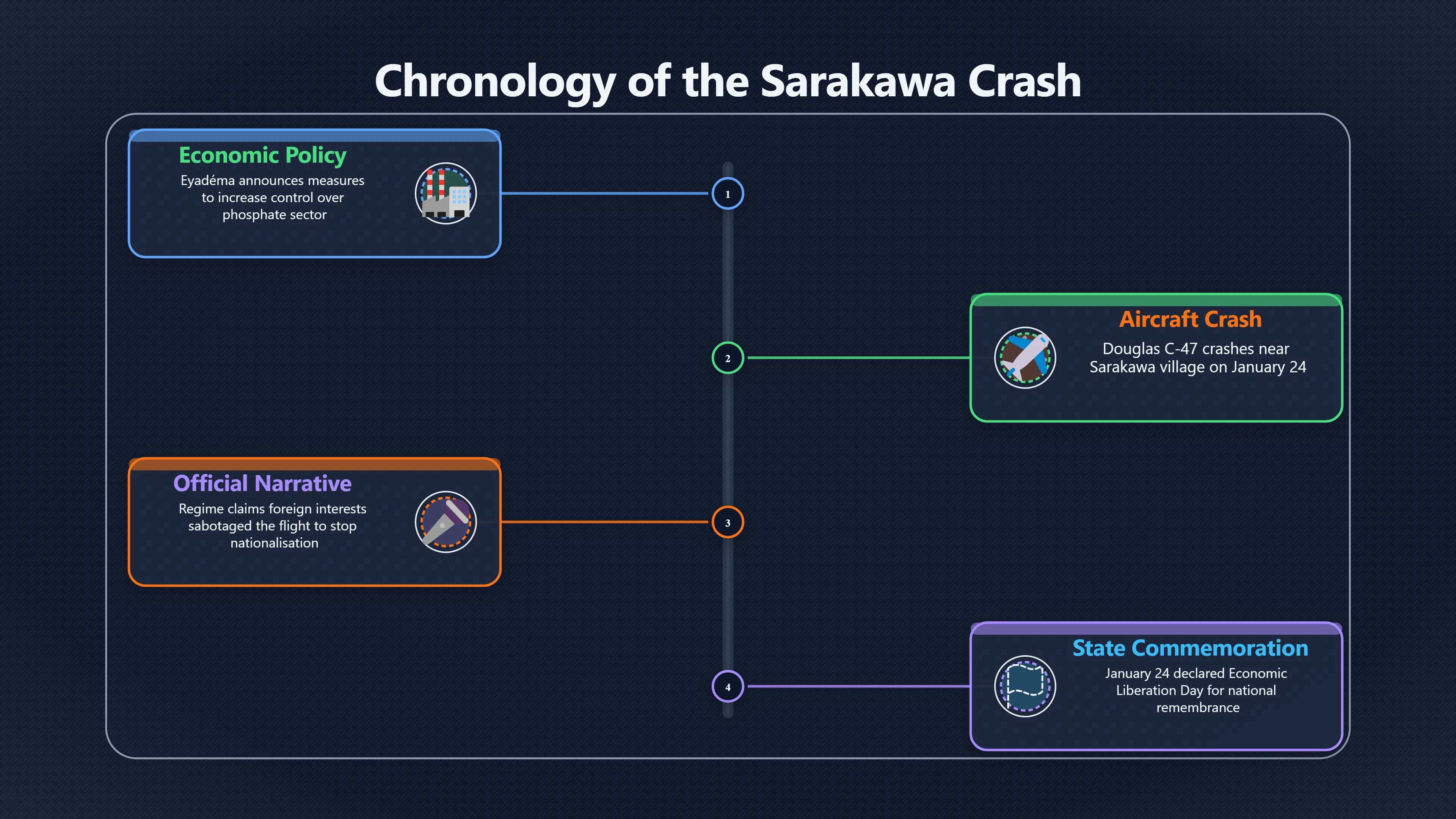
On 24 January 1974, a Togolese Air Force Douglas C-47 carrying President Eyadéma crashed near Sarakawa in northern Togo while approaching its destination. Eyadéma survived. The pilot and several passengers did not. Contemporary and later accounts differ on the exact number of people aboard and the number of survivors, a discrepancy that would later become important because the official narrative increasingly centred on Eyadéma as the unique survivor of the disaster.[Wikipedia]Wikipedia1974 Togolese Air Force C 47 crash1974 Togolese Air Force C 47 crash
The basic facts of the accident are not seriously disputed. The aircraft crashed, lives were lost, and the president emerged alive. What remains disputed is why the aircraft crashed and how the event was subsequently represented. Aviation records generally classify the cause as undetermined rather than proven sabotage. Some later accounts have suggested ordinary accident explanations, including operational factors, while no publicly demonstrated investigation conclusively established a foreign assassination plot.[wikipedia.org]Wikipedia1974 Togolese Air Force C 47 crash1974 Togolese Air Force C 47 crash
Yet almost immediately the disaster was framed politically. Only two weeks earlier, Eyadéma had announced measures increasing Togolese control over the country’s phosphate sector, one of the most important sources of national revenue. The timing allowed the government to connect the crash to a broader story of economic sovereignty and conflict with powerful foreign interests.[republicoftogo.com]republicoftogo.comRépublique Togolaise Sarakawa, 36 ans aprèsRépublique TogolaiseSarakawa, 36 ans aprèsJanuary 22, 2010 — 22 Jan 2010 — Le 24 janvier 1974, l'avion du président Eyadema s'écrase à Sa…
How the Sabotage Story Served the Regime
The official version held that financial or foreign interests opposed to phosphate nationalisation had arranged the destruction of the aircraft. In this telling, the crash was not an accident but an attempted assassination aimed at preventing Togo from exercising greater control over its natural resources.[wikipedia.org]Wikipedia1974 Togolese Air Force C 47 crash1974 Togolese Air Force C 47 crash
Whether true or not, the claim offered several political advantages.
First, it transformed a potentially embarrassing aviation disaster into a patriotic drama. Rather than appearing vulnerable, the president became the heroic target of powerful enemies. The story linked Eyadéma personally to national independence and economic self-determination. If foreign interests wanted him dead, supporters could conclude that he must be defending the nation successfully.[Wikipedia]Wikipedia1974 Togolese Air Force C 47 crash1974 Togolese Air Force C 47 crash
Second, the narrative strengthened a broader legitimacy strategy already visible in the regime. Eyadéma’s government repeatedly portrayed him as the man who had saved Togo from instability and external threats. The Sarakawa story fit perfectly into that framework because it depicted him surviving a supposedly international conspiracy.[D-NB]d-nb.infopersonalized, sacrificed,Power and influence across two Gnassingbé presidencies…August 12, 2019 — by A Osei · Cited by 35 — Eyadema claimed to have “saved”…
Third, the story provided a memorable symbol that could be repeated endlessly. Political myths are often more effective when attached to a dramatic image. A president emerging alive from a wrecked aircraft offered exactly that kind of image, making the event easy to commemorate and retell.[Cambridge University Press & Assessment]cambridge.orgCambridge University Press & AssessmentThe Togolese Regime and its Exiled Opposition in Ghanaby N Raunet · 2023 — The personality cult, t…
From Survivor to Chosen Leader
The most striking feature of the Sarakawa legend was how it evolved from a survival story into a narrative of exceptional destiny.
Eyadéma publicly linked his survival to personal strength and special protection. According to numerous accounts, he encouraged the belief that the crash demonstrated extraordinary qualities that separated him from ordinary politicians. The regime increasingly promoted an image of a leader who repeatedly escaped death, assassination attempts and other dangers.[Wikipedia]Wikipedia1974 Togolese Air Force C 47 crash1974 Togolese Air Force C 47 crash
Over time, accounts of the crash often became more dramatic than the underlying evidence justified. Critics argued that the official version exaggerated or distorted aspects of the event, particularly by presenting Eyadéma as the sole survivor when other accounts reported additional survivors. The factual disputes mattered because they supported a larger claim: that the president had miraculously emerged alone from catastrophe through exceptional courage or supernatural favour.[wikipedia.org]Wikipedia1974 Togolese Air Force C 47 crash1974 Togolese Air Force C 47 crash
The Sarakawa narrative became part of a much wider personality cult. State-controlled media, public ceremonies and official symbolism presented Eyadéma as a uniquely gifted national protector. Scholars examining Togolese politics have described this system as one in which official communication and public ritual worked together to reinforce the leader’s legitimacy and popularity.[Cambridge University Press & Assessment]cambridge.orgCambridge University Press & AssessmentThe Togolese Regime and its Exiled Opposition in Ghanaby N Raunet · 2023 — The personality cult, t…
Monuments, Ceremonies and the Survival Myth
The physical landscape of Togo helped preserve the Sarakawa story.
A monument was erected near the crash site, featuring a prominent representation of Eyadéma and memorial elements associated with those who died. The site became a place of official remembrance and political symbolism rather than merely an aviation accident memorial.[wikipedia.org]Wikipedia1974 Togolese Air Force C 47 crash1974 Togolese Air Force C 47 crash
The anniversary of the crash was also woven into state ceremonies. The government commemorated the event repeatedly, presenting it as a defining moment in national history. Eyadéma declared 24 January “Economic Liberation Day”, directly connecting his survival to the phosphate nationalisation programme and to a narrative of resistance against external control.[Wikipedia]Wikipedia1974 Togolese Air Force C 47 crash1974 Togolese Air Force C 47 crash
These commemorations did more than remember the dead. They reinforced a political lesson: Togo had faced hostile forces, its leader had survived, and the nation had emerged stronger. Through repetition, the crash ceased to be merely a historical event and became a foundational national myth.[Wikipedia]Wikipedia1974 Togolese Air Force C 47 crash1974 Togolese Air Force C 47 crash
Why the Legend Still Matters
The Sarakawa story remains significant because it illustrates how political myths can emerge from real events. Unlike an invented conspiracy or fabricated document, the crash genuinely happened. The contested element is the meaning attached to it.[Wikipedia]Wikipedia1974 Togolese Air Force C 47 crash1974 Togolese Air Force C 47 crash
For supporters of Eyadéma during his rule, Sarakawa symbolised courage, survival and national independence. For critics, it demonstrated how governments can use tragedy to construct a personality cult and elevate political leaders above ordinary scrutiny. The continuing disagreement over survivor counts, sabotage claims and official interpretations reflects that broader struggle over memory and legitimacy.[Wikipedia]Wikipedia1974 Togolese Air Force C 47 crash1974 Togolese Air Force C 47 crash
Within the history of contested truth in Togo, Sarakawa stands out because the myth never depended on inventing the disaster. Instead, it depended on controlling the story told about it. A real plane crash became a national tale of conspiracy, destiny and presidential invulnerability, making it one of the clearest examples of state-sponsored legend-building in the country’s modern history.[wikipedia.org]Wikipedia1974 Togolese Air Force C 47 crash1974 Togolese Air Force C 47 crash
eBay marketplace picks
Marketplace Samples
Live-tested eBay searches with available results related to this page.

Endnotes
1.
Source: Wikipedia
Title: 1974 Togolese Air Force C 47 crash
Link:https://en.wikipedia.org/wiki/1974_Togolese_Air_Force_C-47_crash
2.
Source: catalogue.bnf.fr
Link:https://catalogue.bnf.fr/ark%3A/12148/cb12699358n
Source snippet
BnF CatalogueNotice RAMEAU "Crash de Sarakawa (1974)"24 janvier 1974: crash du DC-3 des Forces armées togolaises transportant le préside...
3.
Source: cambridge.org
Link:https://www.cambridge.org/core/journals/african-studies-review/article/transnational-strategies-of-legitimation-in-the-1990s-the-togolese-regime-and-its-exiled-opposition-in-ghana/38A594E2D41E2FD53B04A5AF77B588C1
Source snippet
Cambridge University Press & AssessmentThe Togolese Regime and its Exiled Opposition in Ghanaby N Raunet · 2023 — The personality cult, t...
4.
Source: Wikipedia
Title: Gnassingbé Eyadéma
Link:https://en.wikipedia.org/wiki/Gnassingb%C3%A9_Eyad%C3%A9ma
5.
Source: d-nb.info
Title: personalized, sacrificed,
Link:https://d-nb.info/1213247284/34
Source snippet
Power and influence across two Gnassingbé presidencies...August 12, 2019 — by A Osei · Cited by 35 — Eyadema claimed to have “saved”...
Published: August 12, 2019
6.
Source: aviation-safety.net
Link:https://aviation-safety.net/wikibase/329968
7.
Source: youtube.com
Link:https://www.youtube.com/watch?v=gO5Ixk8N7yA
Source snippet
TOGO - Trapped In A Political Dynasty...
8.
Source: youtube.com
Link:https://www.youtube.com/watch?v=YZ59dwOfYu8
9.
Source: baaa-acro.com
Link:https://www.baaa-acro.com/crash/crash-douglas-c-47a-35-dl-sara-kawa-6-killed
Source snippet
Bureau of Aircraft Accidents ArchivesCrash of a Douglas C-47A-35-DL in Sara Kawa: 6 killedBoth pilots and four passengers were killed whi...
10.
Source: republicoftogo.com
Title: République Togolaise Sarakawa, 36 ans après
Link:https://www.republicoftogo.com/toutes-les-rubriques/politique/sarakawa-36-ans-apres
Source snippet
République TogolaiseSarakawa, 36 ans aprèsJanuary 22, 2010 — 22 Jan 2010 — Le 24 janvier 1974, l'avion du président Eyadema s'écrase à Sa...
Published: January 22, 2010
11.
Source: military-history.fandom.com
Title: Military Wiki Gnassingbé Eyadéma
Link:https://military-history.fandom.com/wiki/Gnassingb%C3%A9_Eyad%C3%A9ma
12.
Source: kids.kiddle.co
Title: Gnassingbé Eyadéma
Link:https://kids.kiddle.co/Gnassingb%C3%A9_Eyad%C3%A9ma
Additional References
13.
Source: democracyinafrica.org
Title: Democracy in Africa Togo at the crossroads?
Link:https://democracyinafrica.org/togo-crossroads-personal-power-term-limits-elite-continuity/
Source snippet
Personal power, term limits, and...31 Oct 2018 — Gnassingbé Eyadema came to power in a military coup in 1967. One of the narratives he r...
14.
Source: africa.sis.gov.eg
Title: Un sabotage imputé aux milieux
Link:https://africa.sis.gov.eg/fran%C3%A7ais/actualit%C3%A9s/articles-et-rapports/1974-le-togo-annonce-la-nationalisation-des-mines-de-phosphates/
Source snippet
Egyptian Government Portal1974: Le Togo annonce la nationalisation des mines de...25 Jan 2020 — Le 24 janvier 1974, le DC3 dans lequel...
15.
Source: youtube.com
Title: Gnassingbé Eyadéma: The Brutal Dictator from Togo | African Dictators
Link:https://www.youtube.com/watch?v=TAR83Q3ubj4
Source snippet
38 Years as President: How Gnassingbe Eyadema of Togo Rose to Power Through a Bloody Military Coup...
16.
Source: facebook.com
Link:https://www.facebook.com/US.ADST/posts/onthisday-president-eyadema-of-togo-passed-away-in-a-plane-crash-in-2005-ambassa/3741617819247394/
17.
Source: youtube.com
Title: The Sarakawa Crash // HISTORY ep1
Link:https://www.youtube.com/watch?v=c4CtjfaTvNs
Source snippet
Gnassingbé Eyadéma: The Brutal Dictator from Togo | African Dictators...
18.
Source: africasacountry.com
Title: the end of the eyadema dynasty in togo
Link:https://africasacountry.com/2017/09/the-end-of-the-eyadema-dynasty-in-togo
19.
Source: tripadvisor.com
Title: Picture of Le monument Sarakawa, Kara
Link:https://www.tripadvisor.com/LocationPhotoDirectLink-g480247-d19500816-i464769042-Le_monument_Sarakawa-Kara_Kara_Region.html
20.
Source: youtube.com
Link:https://www.youtube.com/watch?v=cCyoWrp5J8s
Source snippet
The Sarakawa Crash // HISTORY ep1...
21.
Source: theguardian.com
Link:https://www.theguardian.com/news/2005/feb/07/guardianobituaries
22.
Source: facebook.com
Link:https://www.facebook.com/groups/133559973907173/posts/1734886247107863/
Topic Tree