Within Georgia Hoaxes
How Zana Became Georgia's Supposed Ape Woman
Folklore and pseudoscience turned an enslaved African woman in Abkhazia into a supposed relic human until genetics corrected the story.
On this page
- What later stories claimed about Zana
- How folklore became pseudoscientific evidence
- What genetic research revealed about her ancestry
Page outline Jump by section
Introduction
The story of Zana is one of the most striking examples in Georgia’s hoax and pseudoscience history, not because it began as a deliberate fraud, but because folklore, racial prejudice and speculative science gradually transformed a real woman into a supposed non-human creature. By the late twentieth century, Zana was widely presented in cryptozoological literature as evidence that a surviving “ape-man”, Neanderthal or other relic human species still existed in the Caucasus. Modern genetic research eventually demonstrated that these claims were wrong. Zana was a human woman of African ancestry who lived in nineteenth-century Abkhazia, then part of the Russian Empire. The transformation of her story from enslaved woman to “ape-woman” reveals how myths can become accepted as scientific evidence when investigators begin with a sensational conclusion and work backwards.[nih.gov]pmc.ncbi.nlm.nih.govPMCThe genomic origin of Zana of Abkhaziaby A Margaryan · 2021 — Even though the results confirm Zana's largely eastern (~66%) African origin, she also displayed significant l…

What Later Stories Claimed About Zana
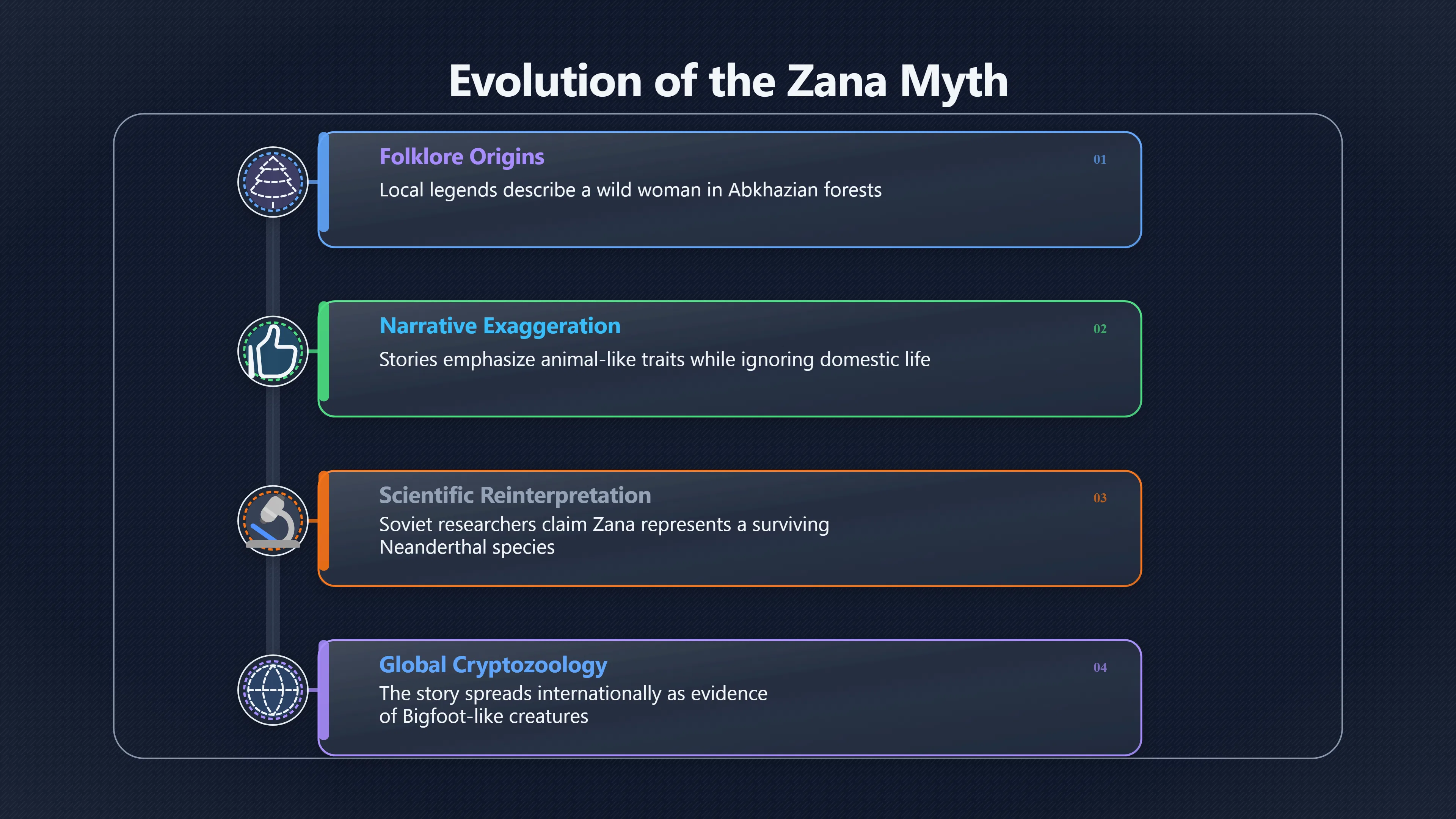
Accounts collected decades after Zana’s death described her as a wild woman captured in the forests of Abkhazia and brought to a local estate. According to these stories, she was unusually strong, dark-skinned, heavily hairy, unable to speak and difficult to control. Local folklore associated her with the Abkhaz wild-man tradition, a legendary creature often compared to the almas or yeti traditions found elsewhere across Eurasia.[Wikipedia]WikipediaZana of TkhinaZana of Tkhina
In its original setting, this identification belonged to folklore rather than science. Rural communities often interpreted unfamiliar people through existing legends, and stories about wild forest beings were already established in the region. Over time, however, later retellings exaggerated the tale. Descriptions of Zana became increasingly dramatic, emphasising supposed animal-like features while downplaying the fact that she lived among humans, performed domestic work and had children.[Wikipedia]WikipediaZana of TkhinaZana of Tkhina
By the 1960s and 1970s, some Soviet researchers and cryptozoologists began treating the story not as folklore but as possible proof that an unknown hominid population had survived into modern times. Writers such as Boris Porshnev argued that Zana might represent a surviving Neanderthal or another relic human species. These claims spread internationally through books, documentaries and popular articles about Bigfoot-like creatures.[Wikipedia]WikipediaZana of TkhinaZana of Tkhina
The result was a remarkable inversion of reality. A woman who had likely experienced enslavement and exploitation became famous primarily as a supposed biological curiosity.
How Folklore Became Pseudoscientific Evidence
The appeal of the Zana story rested on several factors that made it persuasive to believers.
First, there was little direct evidence. Most accounts were collected long after Zana’s death and relied on oral testimony passed through several generations. Memories, local legends and repeated retellings became mixed together, making it difficult to separate observation from embellishment.[Wikipedia]WikipediaZana of TkhinaZana of Tkhina
Second, Soviet-era interest in relic hominids created a ready-made framework into which Zana could be fitted. Researchers searching for evidence of surviving primitive humans interpreted ambiguous details as confirmation of their theories. Physical descriptions that might have reflected unusual appearance, disability, trauma or medical conditions were instead treated as signs of non-human ancestry.[Wikipedia]WikipediaZana of TkhinaZana of Tkhina
Third, racial assumptions played an important role. Zana’s African ancestry was not understood by many investigators, and her dark skin and reported physical appearance were often presented as evidence of primitiveness rather than human diversity. Modern historians and genetic researchers have noted that the story cannot be separated from nineteenth- and twentieth-century stereotypes that portrayed Africans as closer to animals than Europeans. The sensational “ape-woman” narrative gained attention partly because it echoed those prejudices.[PMC]pmc.ncbi.nlm.nih.govPMCThe genomic origin of Zana of Abkhaziaby A Margaryan · 2021 — Even though the results confirm Zana's largely eastern (~66%) African origin, she also displayed significant l…
Even after early DNA work suggested that Zana’s descendants had sub-Saharan African ancestry, some writers continued searching for ways to preserve the relic-hominid theory. Alternative explanations proposing extremely ancient migrations or hidden non-human populations persisted despite weak supporting evidence.[Channel 4]channel4.comwas russian bigfoot actually african slaveChannel 4Was Russian 'Bigfoot' actually an African slave?1 Nov 2013 — Zana's ancestry was 100% Sub-Saharan African and that she was most…

What Genetic Research Revealed About Her Ancestry
The turning point came through modern genetic analysis.
Researchers first examined the remains of Khwit, widely believed to be one of Zana’s sons. Later work identified and analysed a female skeleton thought to be Zana herself. Genome sequencing established a direct maternal relationship between the two, confirming the identification.[wiley.com]advanced.onlinelibrary.wiley.comThe genomic origin of Zana of Abkhaziamore…
The results were decisive. Zana was fully human and genetically closest to populations from eastern Africa, with additional western African ancestry. Researchers found no evidence that she belonged to a separate human species, a surviving Neanderthal population or any unknown primate lineage. Her son showed ordinary mixed African and Caucasian ancestry consistent with a human family history.[nih.gov]pmc.ncbi.nlm.nih.govPMCThe genomic origin of Zana of Abkhaziaby A Margaryan · 2021 — Even though the results confirm Zana's largely eastern (~66%) African origin, she also displayed significant l…
The genetic findings also strengthened historical explanations linking Zana to African communities that existed around the Black Sea region. Historians have long documented the presence of people of African descent in Abkhazia, often associated with the Ottoman slave trade and related movements of enslaved people into the Caucasus. Zana’s ancestry fits comfortably within that human history and requires no extraordinary biological explanation.[Wikipedia]WikipediaOpen source on wikipedia.org.
Researchers further suggested that medical conditions such as congenital generalized hypertrichosis, which can produce unusually extensive hair growth and distinctive facial features, might help explain some of the descriptions that later fuelled the myth. While such explanations remain partly speculative, they are far more consistent with the evidence than claims of a surviving ape-man.[Wikipedia]WikipediaZana of TkhinaZana of Tkhina
Why the Legend Still Circulates
The Zana story survives because it sits at the intersection of folklore, mystery and cryptozoology. Tales of hidden wild people are inherently memorable, and for decades the absence of conclusive evidence allowed speculation to flourish.
Yet the modern evidence changes the meaning of the story. Rather than demonstrating the existence of a relic human species, Zana’s case illustrates how folklore can be mistaken for scientific data and how social prejudice can distort perceptions of real people. The most important discovery was not that an ape-woman had been found, but that a woman who had been transformed into a legend was finally recognised as what she always was: a human being.[nih.gov]pmc.ncbi.nlm.nih.govPMCThe genomic origin of Zana of Abkhaziaby A Margaryan · 2021 — Even though the results confirm Zana's largely eastern (~66%) African origin, she also displayed significant l…
Within Georgia’s wider history of contested truths and extraordinary claims, Zana’s transformation from enslaved woman to supposed ape-woman remains a powerful example of how myths can gain authority when repeated through scientific-sounding language, and how careful investigation can eventually restore a more accurate account of the past.[nih.gov]pmc.ncbi.nlm.nih.govPMCThe genomic origin of Zana of Abkhaziaby A Margaryan · 2021 — Even though the results confirm Zana's largely eastern (~66%) African origin, she also displayed significant l…
Amazon book picks
Further Reading
Books and field guides related to How Zana Became Georgia's Supposed Ape-Woman. Use these as the next step if you want deeper reading beyond the article.
Why People Believe Weird Things
Explains acceptance of pseudoscientific and extraordinary claims.
The Demon-Haunted World
Rating: 4.5/5 from 43 Google Books ratings
Promotes scientific reasoning against folklore-based misconceptions.
Sasquatch: Legend Meets Science
Illustrates how alleged relic-human narratives are constructed and debated.
eBay marketplace picks
Marketplace Samples
Live-tested eBay searches with available results related to this page.



Endnotes
1.
Source: pmc.ncbi.nlm.nih.gov
Title: PMCThe genomic origin of Zana of Abkhazia
Link:https://pmc.ncbi.nlm.nih.gov/articles/PMC9744565/
Source snippet
by A Margaryan · 2021 — Even though the results confirm Zana's largely eastern (~66%) African origin, she also displayed significant l...
2.
Source: advanced.onlinelibrary.wiley.com
Title: The genomic origin of Zana of Abkhazia
Link:https://advanced.onlinelibrary.wiley.com/doi/abs/10.1002/ggn2.10051
Source snippet
more...
3.
Source: Wikipedia
Title: Zana of Tkhina
Link:https://en.wikipedia.org/wiki/Zana_of_Tkhina
4.
Source: Wikipedia
Title: Almas (folklore)
Link:https://en.wikipedia.org/wiki/Almas_%28folklore%29
5.
Source: channel4.com
Title: was russian bigfoot actually african slave
Link:https://www.channel4.com/press/news/was-russian-bigfoot-actually-african-slave
Source snippet
Channel 4Was Russian 'Bigfoot' actually an African slave?1 Nov 2013 — Zana's ancestry was 100% Sub-Saharan African and that she was most...
6.
Source: Wikipedia
Link:https://en.wikipedia.org/wiki/Afro-Abkhazians
7.
Source: Wikipedia
Title: Zana (film)
Link:https://en.wikipedia.org/wiki/Zana_%28film%29
8.
Source: pubmed.ncbi.nlm.nih.gov
Link:https://pubmed.ncbi.nlm.nih.gov/36618122/
Source snippet
The genomic origin of Zana of Abkhaziaby A Margaryan · 2021 — Population genomic analyses demonstrated that Zana's immediate geneti...
9.
Source: researchprofiles.ku.dk
Link:https://researchprofiles.ku.dk/en/publications/the-genomic-origin-of-zana-of-abkhazia/
Source snippet
We speculate that...Read more...
Additional References
10.
Source: youtube.com
Link:https://www.youtube.com/watch?v=-kbuf6S-Kew
Source snippet
Zana of Tkhina wild woman Abkhazia Bryan Sykes Russian Villagers Capture Female Sasquatch | MBM 259 MountainBeastMysteries...
11.
Source: abkhazdna.substack.com
Title: Zana from Abkhazia
Link:https://abkhazdna.substack.com/p/zanadna-en
Source snippet
by Kalaero - Abkhaz DNA ProjectZana was a wild girl captured by Prince Achba of Chloy in the forest of Zaadan (hence her name). On closer...
12.
Source: youtube.com
Title: BEYOND BIGFOOT: DNA, Biomechanics & the Dehumanization of Zana
Link:https://www.youtube.com/watch?v=FLrl_8C84QY
Source snippet
The Story of Zana! The Mysterious Russian NEANDERTHAL Found in 1850! She had Children...
13.
Source: reddit.com
Link:https://www.reddit.com/r/skeptic/comments/symw0c/zana_the_apewoman_dna_case_was_fake/
Source snippet
r/skeptic - Zana the apewoman DNA case was fakeZana the apewoman DNA case was fake. Pseudoscience. r/skeptic - Zana the apewoman DN...
14.
Source: youtube.com
Title: Was This WOMAN Really BIGFOOT? The ZANA Mystery
Link:https://www.youtube.com/watch?v=VUfC7n0lqa0
Source snippet
BEYOND BIGFOOT: DNA, Biomechanics & the Dehumanization of Zana...
15.
Source: researchgate.net
Link:https://www.researchgate.net/publication/355261335_FrAnTK_A_Frequency-based_Analysis_ToolKit_for_efficient_exploration_of_allele_sharing_patterns_in_present-day_and_ancient_genomic_datasets
16.
Source: medium.com
Link:https://medium.com/the-mystery-box/zanas-story-78541727cd93
17.
Source: scribd.com
Link:https://www.scribd.com/document/958954893/Zana-the-Yeti-Woman
18.
Source: youtube.com
Title: Zana New DNA “The Origin of Bigfoot”
Link:https://www.youtube.com/watch?v=aXibs5gi7f8
Source snippet
Was This WOMAN Really BIGFOOT? The ZANA Mystery...
19.
Source: youtube.com
Link:https://www.youtube.com/watch?v=NTer-0Ix7Lo
Topic Tree