When Cuba's Most Powerful Stories Outran the Evidence
Cuba’s best-known history of hoaxes is not a parade of harmless practical jokes. Its most consequential falsehoods grew around invasion, revolution, exile and international rivalry.
Page outline Jump by section
Introduction
These episodes are not all the same. Some were deliberate fabrications, some were publicity stunts, some were unexecuted plans for deception, and others were sincere but premature explanations amplified by fear. The distinction matters. Cuba’s hoax history shows how easily a claim can become politically useful before it becomes evidentially secure—and how later corrections rarely travel as far as the original story.
When Cuba became a laboratory for sensational news
During Cuba’s revolt against Spanish colonial rule in the 1890s, American newspapers faced ideal conditions for unreliable reporting. The conflict was distant enough that verification was difficult, emotionally powerful enough to attract readers, and politically charged enough that every story could be presented as evidence for or against intervention.
Spanish forces did carry out severe repression. General Valeriano Weyler’s policy of moving rural civilians into controlled settlements caused hunger, disease and substantial loss of life. Yet genuine suffering was accompanied by exaggerated, recycled or weakly sourced reports. Correspondents competed for dramatic accounts, Cuban insurgents and their supporters had an interest in attracting American sympathy, Spanish officials minimised abuses, and newspaper editors rewarded certainty and spectacle rather than caution. The result was not one grand invented story but an information market in which fact, advocacy, rumour and fabrication were difficult to separate. The US State Department’s historical account notes that sensational reporting helped build public support for intervention, although it cautions against the simplistic claim that newspapers alone caused the Spanish-American War.[Office of the Historian]state.govOffice of the Historian U.SDiplomacy and Yellow Journalism, 1895–1898The peak of yellow journalism, in terms of both intensity and influence, came in early 1898, wh…
The period also produced a durable myth about the press itself. William Randolph Hearst is repeatedly said to have answered an illustrator who found no sign of imminent conflict in Cuba: “You furnish the pictures, and I’ll furnish the war.” The line perfectly captures the popular image of Hearst as a publisher willing to manufacture a war for circulation. Its evidential history, however, is disputed. It first appeared in a correspondent’s memoir several years later, and no original telegram has been found. Media historian W. Joseph Campbell has argued that the exchange is probably apocryphal, while other researchers maintain that the surviving testimony should not be dismissed outright. The safest conclusion is that the quotation is not established fact, even though Hearst’s newspapers undeniably campaigned aggressively for Cuban independence and American intervention.[ucpress.edu]content.ucpress.eduUniversity of California Press“I'll Furnish the War”The Making of a Media Myth. You furnish the pictures, and I'll furnish the war. —Attributed to William Randolph Hearst in James…
That distinction is revealing. A dubious anecdote about fabricated journalism survived because it expressed a broader truth about the era’s press culture. Like many successful legends, it offered a neat villain, a memorable sentence and a simple explanation for a complicated political event.
The rescue that doubled as a publicity spectacle
One of the era’s most theatrical episodes centred on Evangelina Cisneros, a young Cuban woman imprisoned by Spanish authorities. Hearst’s New York Journal portrayed her as an innocent beauty persecuted by a brutal colonial regime. The paper organised petitions, enlisted prominent supporters and made her captivity a recurring emotional story. In October 1897, Journal reporter Karl Decker helped Cisneros escape from confinement in Havana and reach the United States.
The escape itself was real. The deception lay in its presentation and surrounding publicity. The Journal described the operation as an extraordinary newspaper triumph, carefully shaping Cisneros into an ideal heroine and minimising uncertainties about her political involvement and the assistance she received. Rival newspapers challenged aspects of the account and accused Hearst’s organisation of manufacturing drama. Contemporary press material preserved by the Library of Congress shows that even at the time some newspapers called the rescue story false or heavily contrived.[Research Guides]guides.loc.govchronicling america yellow journalismResearch GuidesYellow Journalism: Topics in Chronicling America5 Feb 2026 — The Baton Rouge Advocate claims that the rescue of Evangelina…
Cisneros’s case sits between rescue, propaganda and media stunt rather than fitting neatly into the category of hoax. A real prisoner was freed, but the operation was also designed as a circulation-building performance. Hearst’s newspaper did not merely report an event; it created, branded and repeatedly advertised one.
The story worked because it compressed the Cuban conflict into a form familiar to mass audiences: a vulnerable young woman, a cruel foreign jailer and a daring American rescuer. Complicated questions about colonial rule, insurgent tactics and US strategic interests disappeared behind a personal melodrama. That technique—turning politics into an emotionally irresistible human story—remains central to modern misinformation even when the core event is genuine.
“Remember the Maine” before the cause was known
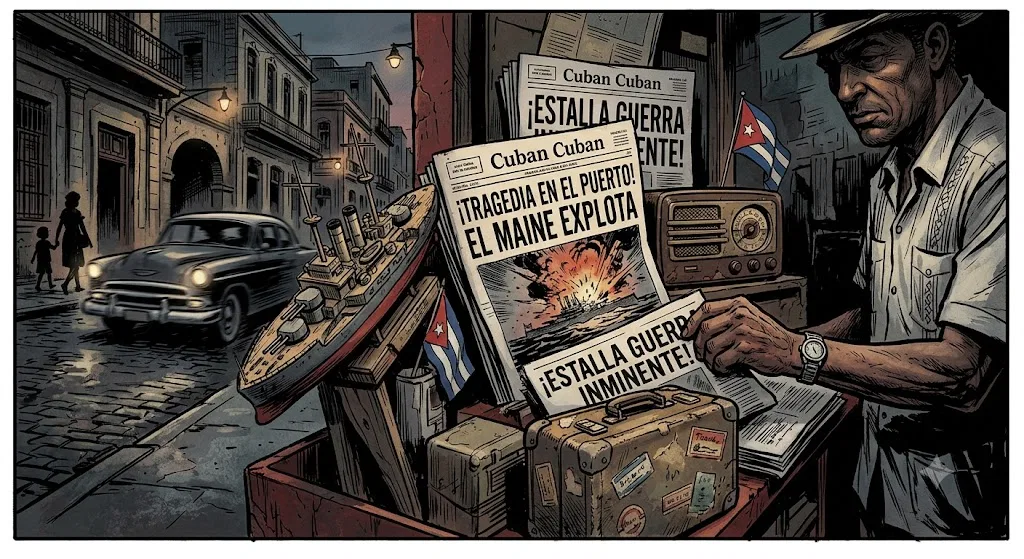
On 15 February 1898, the American battleship USS Maine exploded in Havana harbour, killing 266 men. The cause was not immediately known. Nevertheless, sensational newspapers rapidly promoted the possibility that a Spanish mine or hostile action had destroyed the ship. Headlines, illustrations and commentary converted suspicion into something close to certainty, helping make “Remember the Maine” a rallying cry for war.
An American naval inquiry concluded in 1898 that an external mine had triggered the ship’s magazines. A second inquiry in 1911 also supported an external explosion, although it placed it differently. These official findings gave later readers good reason to believe that the accusation against Spain had been proved. Yet neither inquiry established who might have planted a mine, and Spain denied responsibility. The US Navy’s own documentary history now notes that the cause remains debated and that the most respected modern technical reassessment favoured an internal explosion.[Naval History and Heritage Command]history.navy.milOpen source on navy.mil.
In 1976, Admiral Hyman Rickover commissioned specialists to reconsider the surviving evidence. Their analysis found no convincing technical sign that an external mine had initiated the disaster. They argued that heat from a coal-bunker fire probably ignited a neighbouring ammunition magazine. Later computer-based reconstructions have challenged parts of that conclusion and revived the possibility of an external blast, so the precise mechanism is not finally settled. What is settled is that newspaper claims assigning blame appeared long before the evidence could support them.[U.S. Naval Institute]usni.orgU.S. Naval Institute A Special Report: What Really Sank the Maine?U.S. Naval Institute A Special Report: What Really Sank the Maine?
The Maine therefore should not be described simply as a proved hoax or a confirmed false-flag attack. There is no good evidence that the United States deliberately destroyed its own ship. The clearer deception was rhetorical: uncertainty was stripped away, the most politically useful explanation was treated as fact, and an unresolved disaster became a moral demand for intervention.
The episode also demonstrates why corrections struggle. “The cause remains uncertain” is historically responsible but emotionally weak. “Spain attacked an American ship” supplies an enemy, a motive and a course of action. By the time technical re-examinations appeared decades later, the slogan had already become part of national memory.
A fake law that separated real families
One of the most consequential Cuban Cold War fabrications concerned parental authority. In the early 1960s, rumours spread that Fidel Castro’s government intended to abolish parents’ legal rights, take control of Cuban children and send them to state institutions or the Soviet Union. A bogus legal text circulated as apparent proof that such a measure was imminent.
The rumour did not emerge in a vacuum. The revolutionary government had closed or nationalised private schools, expanded political education and sharply restricted independent religious institutions. Many parents therefore had genuine reasons to fear increasing state control over their children’s upbringing. The fabricated law transformed that general anxiety into an immediate and specific threat. Historian Deborah Shnookal’s study describes how the false document was circulated by anti-Castro networks and reinforced by sensational broadcasts, including material from the CIA-supported Radio Swan.[universitypressscholarship.com]universitypressscholarship.comOpen source on universitypressscholarship.com.
The claim contributed to the atmosphere surrounding Operation Pedro Pan, through which more than 14,000 unaccompanied Cuban minors travelled to the United States between 1960 and 1962. The migration itself was real, as were the fears of parents and the political changes that prompted them. What was false was the supposed law proving that the government was about to abolish parental authority and seize children wholesale.
Responsibility remains politically contested. Operation Pedro Pan involved the Catholic Welfare Bureau, Cuban families, exile organisers and US authorities; it cannot be reduced to a single intelligence operation. A US federal court reviewing records in a lawsuit brought by scholar María de los Angeles Torres did not find that the children’s evacuation programme itself was a CIA operation. That finding does not erase the documented propaganda environment or the circulation of the false parental-rights measure. It means that the fabricated law, the wider migration programme and allegations of central CIA control must be assessed separately rather than collapsed into one conspiracy narrative.[Wikipedia]WikipediaOperation Peter PanOperation Peter Pan
The human consequences made this far more than a media curiosity. Parents acted under severe uncertainty, often believing that separation was the only way to protect their children. Some families reunited quickly; others remained divided for years. The case shows how an effective political hoax often attaches itself to real danger. The revolutionary state was transforming education and family life, but the fake law converted plausible concern into apparent documentary certainty.
Operation Northwoods: a hoax plan that was never carried out
Operation Northwoods occupies an unusual place in Cuba’s history of deception because the proposed fabrications are documented, but there is no evidence that the plan was implemented. In March 1962, the US Joint Chiefs of Staff submitted proposals for creating or simulating incidents that could be blamed on Castro’s government and used to justify American military intervention.
The declassified memorandum suggested a range of possible “pretexts”. These included staging attacks around the US naval base at Guantánamo Bay, manufacturing evidence of Cuban terrorism, simulating the loss of an aircraft and presenting a refugee-boat tragedy in a way that implicated Cuba. The document explicitly treated public opinion and international credibility as operational problems: the incidents had to appear convincing enough to create support for war.[National Security Archive]nsarchive2.gwu.eduOpen source on gwu.edu.
The proposals were approved by the Joint Chiefs but were not adopted as US policy, and President John F. Kennedy did not authorise their execution. This boundary is essential. Northwoods is evidence that senior military planners seriously contemplated organised deception; it is not evidence that every subsequent attack, accident or confrontation involving Cuba was secretly staged.
Its later discovery nevertheless changed how historians and the public evaluate official denials. The documents were released through the work of the Assassination Records Review Board and publicised by the National Security Archive. Before declassification, claims that American officials had considered fabricating Cuban aggression might easily have sounded like unsupported conspiracy theory. After declassification, at least this specific proposal could be read in the planners’ own words.[National Security Archive]nsarchive2.gwu.eduOpen source on gwu.edu.
Northwoods is therefore a useful warning in both directions. Governments sometimes do devise deception plans, so scepticism towards official narratives can be justified. But the existence of one documented proposal does not validate unrelated accusations. Good sceptical history depends on records, chronology and proof of implementation—not merely on the fact that officials once considered something similar.
Havana syndrome and the danger of naming an explanation too early
Beginning in late 2016, American and Canadian personnel in Havana reported disturbing symptoms including dizziness, headaches, balance problems, pressure sensations and cognitive difficulties. Some also described hearing a strange, apparently directional sound. The cluster became known as “Havana syndrome”, later termed anomalous health incidents by the US government.
The illnesses and distress reported by affected people should not be dismissed as imaginary. The contested question is what caused them. Early public discussion frequently implied that personnel had been attacked with an unknown acoustic or microwave weapon, perhaps by a hostile state. That explanation became attached to the incidents before investigators had identified a device, an attacker or a consistent biological mechanism.
A 2020 National Academies committee judged directed, pulsed radio-frequency energy to be a plausible explanation for a subset of cases, while stressing major gaps in available information. Other researchers proposed environmental sounds, ordinary medical conditions, stress responses or the social spread of symptoms and expectations. Analysis of one widely publicised recording found similarities to the call of an Indies short-tailed cricket, although identifying a sound does not by itself explain every reported illness.[National Academies]nationalacademies.orgOpen source on nationalacademies.org.
Medical investigations have also produced mixed interpretations. National Institutes of Health studies reported in 2024 found no consistent evidence of brain injury or other measurable biological differences between studied personnel and comparison groups, but the authors did not conclude that participants’ symptoms were unreal. Critics argued that varied cases, delays in examination and study design made definitive conclusions difficult.[The Guardian]theguardian.comOpen source on theguardian.com.
Official assessments have continued to change. Earlier US intelligence judgements found it very unlikely that a foreign adversary was responsible for most incidents, while allowing that a small number remained unexplained. In 2026, those assessments were withdrawn for further review amid claims that contrary intelligence and alternative technical interpretations had not been handled properly. New reporting has also described experiments suggesting that pulsed-energy exposure may be biologically capable of producing some relevant symptoms, though this does not establish that such a weapon was used in Havana or identify a perpetrator.[The Wall Street Journal]wsj.comThe Havana Syndrome, first reported by U.S. diplomats in Cuba a decade ago, involves symptoms such as dizziness, fatigue, and cognitive i…
“Havana syndrome” is therefore not a safely closed hoax. It is better understood as a contested episode in which illness, national security secrecy, uncertain science and media framing became entangled. The mistake would be to jump from “some early claims were weakly supported” to “all sufferers were deceivers”, or from “a mechanism may be technically possible” to “a foreign attack has been proved”.
Its place in a history of contested truth lies in the speed with which a place name became an implied explanation. Calling the cluster “Havana syndrome” tied it to Cuba even after similar reports appeared elsewhere. A provisional label hardened into a public narrative of covert attack, making later nuance difficult.

Why Cuban hoax stories remain persuasive
The strongest Cuban cases share several mechanisms even though their politics and periods differ.
They used genuine fear as their foundation. Spanish repression was real, revolutionary changes to education were real, Cold War hostility was real, and diplomats genuinely became unwell. Fabrications and premature conclusions succeeded because they attached themselves to circumstances people already found threatening.
They supplied documentary or visual authority. A supposedly authentic law, an official naval finding, a dramatic newspaper illustration or a classified planning memorandum carries more weight than ordinary rumour. Yet documents can be forged, official inquiries can be mistaken, and genuine records can describe plans that were never executed.
They rewarded powerful intermediaries. Newspapers gained circulation, political movements gained sympathy, governments gained support for policy, and broadcasters gained attention. This does not prove that every promoter knew a claim was false. It does explain why correction could be less attractive than repetition.
They simplified responsibility. Spain sank the ship; the revolution would seize every child; Cuba or another hostile government deployed a secret weapon. Each formula replaced uncertainty with an identifiable culprit. Such stories are easier to mobilise around than explanations involving institutional failures, overlapping causes or incomplete evidence.
They survived exposure by changing form. Once the parental-rights document was shown to be false, the wider memory of revolutionary pressure on families could sustain the story. Even as the cause of the Maine remained disputed, the sinking continued to symbolise Spanish aggression. A debunked detail often survives inside a larger narrative that audiences still consider morally true.
How to read claims about Cuban deception
Cuba’s political history attracts both real documentary revelations and elaborate speculation. Separating them requires more than deciding whether a story feels pro-Cuban or anti-Cuban.
A useful first question is what kind of claim is being made. The Northwoods papers prove that proposals were written and submitted; they do not prove execution. The fake parental-rights law proves a propaganda fabrication circulated; it does not show that every parent who feared state intervention was irrational. The uncertain cause of the Maine undermines early confident accusations; it does not prove deliberate American sabotage.
The second question is when certainty appeared. Claims published before investigators had access to wreckage, medical records or original documents deserve particular caution. In several Cuban cases, the most memorable interpretation was also the earliest and least tested.
The third is whether independent evidence converges. A story becomes stronger when archives, technical analysis, contemporary records and testimony point in the same direction. It becomes weaker when it depends on a late memoir, an unattributed quotation, a copy of unknown origin or an inference repeated across sources without new proof.
Finally, it is worth asking who is erased by the argument over truth. The sailors killed aboard the Maine, the children separated from their parents and the officials reporting debilitating symptoms were real people, whatever explanation ultimately proves correct. Scepticism is most useful when it tests claims without turning uncertainty into contempt for those affected.
What Cuba’s hoax history reveals
The central lesson is not that Cuban history is unusually full of deception. It is that the island repeatedly occupied a point where empires, revolutionaries, exiles, intelligence services and mass media competed to define reality. Under those conditions, information itself became an instrument of policy.
The most famous stories also challenge the idea that exposure cleanly defeats a hoax. Technical studies did not erase “Remember the Maine”. Demonstrating that a law was fabricated could not undo family separations. Declassifying Northwoods clarified one historical episode while also feeding broader theories unsupported by the document. Scientific uncertainty over anomalous health incidents continues to permit mutually incompatible narratives.
Cuba’s history of contested truth is therefore best read as a series of boundary cases: between reporting and campaigning, rescue and spectacle, fear and manipulation, planning and action, illness and explanation. The durable falsehood is often not a completely invented event. It is a real event forced too quickly into a story that serves someone’s political, commercial or emotional needs.
Amazon book picks
Further Reading
Books and field guides related to When Cuba's Most Powerful Stories Outran the Evidence. Use these as the next step if you want deeper reading beyond the article.
CUBA: AN AMERICAN HISTORY
Provides context for Cuba, U.S. intervention, propaganda and political narratives.
Manufacturing Consent
Helps explain how narratives and information campaigns gain influence.
The War of 1898
Examines myths, memory and interpretations surrounding Cuba and the Spanish-American War.
The True Believer
Useful for understanding why dramatic political stories spread despite weak evidence.
eBay marketplace picks
Marketplace Samples
Live-tested eBay searches with available results related to this page.

Endnotes
1.
Source: history.state.gov
Title: Office of the Historian U.S
Link:https://history.state.gov/milestones/1866-1898/[yellow-journalism
Source snippet
Diplomacy and Yellow Journalism, 1895–1898The peak of yellow journalism, in terms of both intensity and influence, came in early 1898, wh...
2.
Source: history.state.gov
Title: spanish american war
Link:https://history.state.gov/milestones/1866-1898/spanish-american-war
Source snippet
Office of the HistorianThe Spanish-American War, 1898After the U.S. battleship Maine exploded and sank in Havana harbor under mysterious...
3.
Source: history.navy.mil
Link:https://www.history.navy.mil/research/publications/documentary-histories/united-states-navy-s/destruction-of-the-m/report-of-the-naval-0.html
4.
Source: universitypressscholarship.com
Link:https://www.universitypressscholarship.com/view/10.5744/florida/9781683401551.001.0001/upso-9781683401551-chapter-004
5.
Source: Wikipedia
Title: Operation Peter Pan
Link:https://en.wikipedia.org/wiki/Operation_Peter_Pan
6.
Source: Wikipedia
Title: Operation Northwoods
Link:https://en.wikipedia.org/wiki/Operation_Northwoods
7.
Source: archives.gov
Link:https://www.archives.gov/files/research/jfk/releases/2018/202-10002-10104.pdf
8.
Source: Wikipedia
Title: Unusual articles
Link:https://en.wikipedia.org/wiki/Wikipedia%3AUnusual_articles
9.
Source: Wikipedia
Title: How the Battleship Maine Was Destroyed
Link:https://en.wikipedia.org/wiki/How_the_Battleship_Maine_Was_Destroyed
10.
Source: Wikipedia
Title: Havana syndrome
Link:https://en.wikipedia.org/wiki/Havana_syndrome
11.
Source: history.state.gov
Link:https://history.state.gov/historicaldocuments/frus1961-63v10/d35
12.
Source: content.time.com
Link:https://content.time.com/time/subscriber/article/0%2C33009%2C854840%2C00.html
13.
Source: content.ucpress.edu
Title: University of California Press“I’ll Furnish the War”
Link:https://content.ucpress.edu/chapters/11067001.ch01.pdf
Source snippet
The Making of a Media Myth. You furnish the pictures, and I'll furnish the war. —Attributed to William Randolph Hearst in James...
14.
Source: rfrajola.com
Link:https://www.rfrajola.com/2k19/Hearst_telegram_2019.pdf
Source snippet
W. R. HEARST... That last quotation is from an unpublished memorandum that Hearst's son had provided...
15.
Source: guides.loc.gov
Title: chronicling america yellow journalism
Link:https://guides.loc.gov/chronicling-america-yellow-journalism
Source snippet
Research GuidesYellow Journalism: Topics in Chronicling America5 Feb 2026 — The Baton Rouge Advocate claims that the rescue of Evangelina...
16.
Source: guides.loc.gov
Link:https://guides.loc.gov/chronicling-america-yellow-journalism/selected-articles
Source snippet
Research GuidesSearch Strategies & Selected Articles - Yellow Journalism5 Feb 2026 — Spanish-American War: Topics in Chronicling America...
17.
Source: usni.org
Title: U.S. Naval Institute A Special Report: What Really Sank the Maine?
Link:https://www.usni.org/magazines/naval-history-magazine/1998/april/special-report-what-really-sank-maine
18.
Source: nsarchive2.gwu.edu
Link:https://nsarchive2.gwu.edu/news/20010430/northwoods.pdf
19.
Source: nationalacademies.org
Link:https://www.nationalacademies.org/units/HMD-BGH-18-07/publication/25889
20.
Source: theguardian.com
Link:https://www.theguardian.com/us-news/2024/mar/18/havana-syndrome-study-government-officials
21.
Source: wsj.com
Link:https://www.wsj.com/politics/national-security/gabbard-rescinds-finding-that-doubted-foreign-involvement-in-havana-syndrome-8fc34be9
Source snippet
The Havana Syndrome, first reported by U.S. diplomats in Cuba a decade ago, involves symptoms such as dizziness, fatigue, and cognitive i...
22.
Source: tile.loc.gov
Link:https://tile.loc.gov/storage-services/service/sgp/sgpbatches/batch_dlc_bleecker_ver02/data/sn83030180/print2449/1897101301/0288.pdf
23.
Source: guides.loc.gov
Link:https://guides.loc.gov/world-of-1898/chronology
24.
Source: tile.loc.gov
Link:https://tile.loc.gov/storage-services/master/gdc/gdcebookspublic/20/20/71/88/41/2020718841/2020718841.pdf
25.
Source: intechopen.com
Link:https://www.intechopen.com/chapters/73698
26.
Source: nsarchive2.gwu.edu
Link:https://nsarchive2.gwu.edu/news/20010430/
27.
Source: nsarchive.gwu.edu
Title: cuba and caribbean
Link:https://nsarchive.gwu.edu/regions/cuba-and-caribbean?page=8
28.
Source: library.ecu.edu
Title: the maine
Link:https://library.ecu.edu/specialcollections/2009/04/03/the-maine/
29.
Source: nationalacademies.org
Link:https://www.nationalacademies.org/read/25889
Additional References
30.
Source: historynewsnetwork.org
Title: you furnish the pictures and ill furnish the war
Link:https://www.historynewsnetwork.org/article/you-furnish-the-pictures-and-ill-furnish-the-war
Source snippet
HNN“You furnish the pictures and I'll furnish the war” —...24 Nov 2019 — For the past two decades, journalism professor W. Joseph Campbe...
31.
Source: washingtonpost.com
Title: havana syndrome cia norway experiment
Link:https://www.washingtonpost.com/national-security/2026/02/14/havana-syndrome-cia-norway-experiment/
Source snippet
This revelation, alongside the U.S. government's covert acquisition of a foreign-made pulsed radio-wave device with suspected ties to sim...
32.
Source: youtube.com
Title: Yellow Journalism | Citizen Hearst | American Experience | PBS
Link:https://www.youtube.com/watch?v=oU2BjNTcToU
Source snippet
Yellow Journalism: The Architecture of Modern Manipulation...
33.
Source: youtube.com
Title: Yellow Journalism: The Architecture of Modern Manipulation
Link:https://www.youtube.com/watch?v=dlj6heQn9Oc
Source snippet
How the Media Started the Spanish-American War | Citizen Hearst...
34.
Source: youtube.com
Title: How the Media Started the Spanish-American War | Citizen Hearst
Link:https://www.youtube.com/watch?v=5oZ104tr8gM
Source snippet
'Operation Mongoose': Washington's Secret War on Cuba...
35.
Source: youtube.com
Title: ‘Operation Mongoose’: Washington’s Secret War on Cuba
Link:https://www.youtube.com/watch?v=OauVknmjTTw
Source snippet
US False Flag Operation Against Americans - Operation Northwoods...
36.
Source: facebook.com
Link:https://www.facebook.com/jeremy.slate/videos/you-furnish-the-pictures-and-ill-furnish-the-warwilliam-randolph-hearst-may-or-m/1297256592533929/
37.
Source: academia.edu
Link:https://www.academia.edu/124445911/Operation_Northwoods_The_Pentagons_Scripts_for_Overthrowing_Castro
38.
Source: researchgate.net
Link:https://www.researchgate.net/publication/386329984_Disinformation_and_fake_news_against_Cuba_proposal_for_historical_periodization
39.
Source: researchgate.net
Link:https://www.researchgate.net/publication/393354961_Fakes_Copies_and_Replicas_in_Cuban_Archeology
Topic Tree
Follow this branch
Related pages 192
- Albanian Hoaxes
- Algerian Hoaxes
- Antigua Deceptions
- Argentina Hoaxes
- Armenian Hoaxes
- +187 more in sidebar