How Norway's Most Famous Hoaxes Fooled the Public
Norway’s best-known deceptions do not form one neat tradition of national gullibility. They range from forged runes and invented medieval art to staged wildlife footage, fraudulent séances, publicity campaigns and enduring monster stories. What links them is not simply that people were fooled.
Page outline Jump by section
Introduction
Some episodes were deliberate frauds. Others were publicity stunts, practical jokes or folklore promoted far beyond the available evidence. The most revealing cases are those in which the correction arrived slowly. A convincing image or prestigious setting could keep a false claim alive even after specialists raised doubts. Norway’s history of hoaxes therefore shows how authority is manufactured—and why an exposure rarely travels as widely as the original tale.
Ancient-looking objects and invented medieval art
The runestone that spoke the wrong language
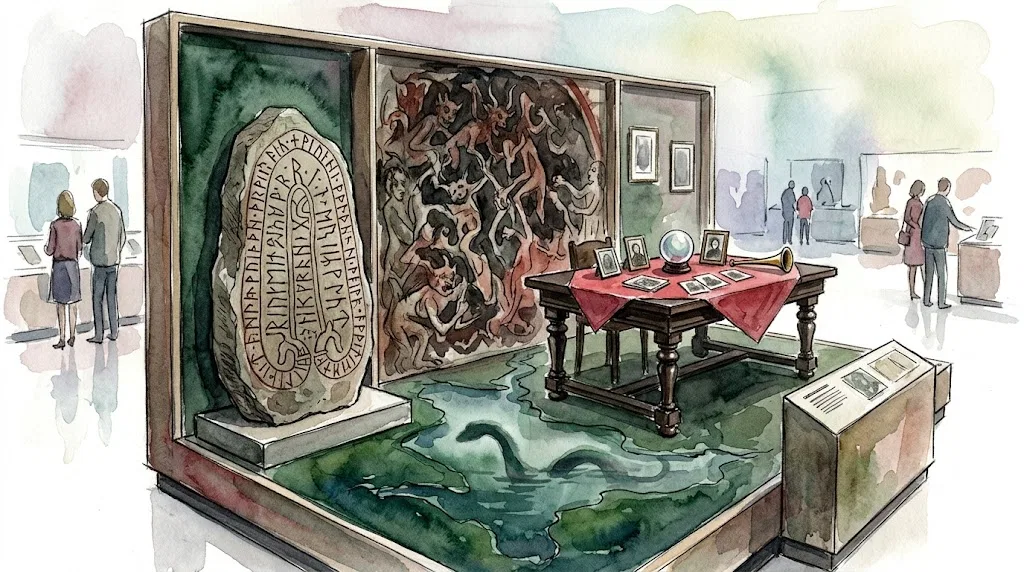
In 1990, a stone bearing runes was found at Ringåsen in Ringerike. Its appearance invited an exciting interpretation: perhaps it was a genuine survival from Norway’s early runic past. The inscription used characters associated with the older runic alphabet, which made the object look especially ancient.
Linguistic examination told a different story. According to the University of Oslo’s Historical Museum, the runes had been cut recently. The inscription also contained incorrect linguistic forms, including a grammatical ending that did not belong in the supposed period. In other words, the maker had copied the outward signs of antiquity without mastering the language behind them.[historiskmuseum.no]historiskmuseum.noA fake runestoneThis runestone was found in 1990 on Ringåsen – 'Ring Ridge' – in Ringerike. The inscription is written in older runes and the…Read more…
This is a common weakness in forged antiquities. A modern creator may imitate letter shapes, weathering or heroic subject matter while introducing combinations that would have been unnatural to an actual historical writer. Runologists therefore examine more than the look of individual symbols. They consider vocabulary, grammar, spelling conventions, carving sequence, archaeological setting and whether the claimed object fits established patterns.
The Ringåsen stone matters because runes carry unusual cultural weight in Norway. They are associated with Viking history, identity and the possibility of direct contact with otherwise distant lives. A questionable inscription can therefore attract attention before its details are tested. The forgery succeeded visually, but failed linguistically.
The medieval “demon wall” painted in the twentieth century
A stranger case emerged at Sauherad Church in Telemark. During restoration work beginning in 1941, conservator Gerhard Gotaas revealed what appeared to be a dense medieval wall painting filled with human and demonic figures. Its unusual imagery generated fascination, partly because it seemed to offer a rare and disturbing glimpse into medieval religious imagination.
The difficulty was that the composition did not resemble securely dated Norwegian church art from any recognised period. Its style, structure and imagery appeared anomalous. Later investigation concluded that the supposed medieval work was largely a modern creation associated with the restoration itself. Researchers found that Gotaas had painted or substantially invented the imagery rather than simply uncovering a forgotten medieval mural.[ScienceNorway]sciencenorway.noScience Norway This demon wall was supposed to be from the Middle AgesThis demon wall was supposed to be from the Middle Ages…December 13, 2021 — 13 Dec 2021 — The demon wall in Sauherad chur…
The deception was especially effective because it occurred in an authentic old church and was presented through the authority of conservation. Viewers were not looking at an isolated object of unknown origin; they were seeing an image apparently recovered from beneath centuries of paint. The location supplied a ready-made provenance.
The wall also demonstrates why restoration can blur the boundary between preservation and invention. Older conservation practice sometimes tolerated extensive repainting where modern standards would demand clear documentation and minimal intervention. Yet the Sauherad case went beyond interpretative restoration. A modern work was allowed to acquire the status and mystery of a medieval discovery.
Its eventual exposure depended not on one dramatic confession but on cumulative art-historical analysis: the absence of convincing parallels, technical study of the painted surface and scrutiny of the restorer’s actions. What had first looked uniquely mysterious became suspicious precisely because it was too unlike genuine medieval art.
When spirits appeared under controlled conditions
Spiritualism gained followers in Norway from the late nineteenth century, as it did across Europe and North America. Séances promised evidence that personality survived death. Mediums produced voices, moving objects, ghostly photographs and “materialisations”—supposed physical manifestations of spirits. These claims attracted bereaved families, curious members of the public and investigators who hoped psychic phenomena might be studied scientifically.[Teknisk Museum]tekniskmuseum.noTeknisk Museum Spirit photography and spiritualismTeknisk MuseumSpirit photography and spiritualism - OsloOctober 23, 2024 — Despite the exposure of the medium Einer Nielsen as a fraud, s…
One of the most important Norwegian exposures concerned the Danish medium Einer Nielsen. Nielsen was known for producing “ectoplasm”, a pale substance said to emerge from a medium’s body and form spirit figures. He had already received support from some psychical researchers, making him a valuable test case rather than an obscure stage performer.
In 1922, a committee connected with the university in Kristiania, the city now called Oslo, subjected Nielsen to controlled examination. The investigators concluded that his supposed ectoplasm was fraudulent. The negative Norwegian report damaged the favourable assessment previously issued in Denmark and contributed to resignations and embarrassment within Danish psychical research circles.[Wikipedia]WikipediaEiner NielsenEiner Nielsen
The case shows why séance fraud could survive repeated suspicions. Demonstrations usually took place in darkness or weak red light, while sitters were encouraged to remain still and avoid touching the medium. Cloth, paper, photographs and other materials could be concealed, released and retrieved under conditions that made ordinary inspection difficult. The theatrical rules of the séance were presented as necessary for fragile spirit phenomena, but they also protected the performer’s methods.
Norway’s Technical Museum places Nielsen’s exposure within a larger history of spirit photography and spiritualism. Fraud did not destroy the movement. Believers could argue that one dishonest medium proved nothing about other mediums, while emotionally powerful experiences outweighed formal tests for many participants.[Teknisk Museum]tekniskmuseum.noTeknisk Museum Spirit photography and spiritualismTeknisk MuseumSpirit photography and spiritualism - OsloOctober 23, 2024 — Despite the exposure of the medium Einer Nielsen as a fraud, s…
That pattern recurs throughout hoax history: exposure may discredit a performer without removing the desire that made the performance persuasive. Nielsen’s audience was not merely buying a trick. It was being offered apparent proof that death was not final.
The lake monster that became useful without being proved
Lake Seljord in Telemark is said to contain a long, serpent-like creature often nicknamed Selma. Reports are traced back to the eighteenth century, and the creature has become one of Norway’s most durable monster traditions. Yet no conclusive biological evidence has established the existence of an unknown large animal in the lake.[Visit Norway]visitnorway.comVisit NorwayNorwegian road signsSeljordsormen! (The Seljord sea serpent.) "Selma" is a legendary lake monster said to lurk in Lake Seljor…
This is not best described as a single proven hoax. There is no identified mastermind who invented every sighting. The story belongs in the more ambiguous territory between folklore, misidentification, sincere testimony, publicity and cryptozoology—the search for animals not recognised by science.
Monster-hunting expeditions in the late 1990s and 2000 used aircraft, sonar, underwater equipment and even a specially designed trap. Reports of unusual readings were treated as reasons for further searching, but the expeditions did not produce a specimen, reliable DNA or sufficiently clear imagery to establish what witnesses had seen.[The Guardian]theguardian.comThe GuardianSecret life of the Norwegian Nessie | World news31 Aug 1999 — Lake monster Selma has eluded scientific proof for 250 years Fl…
Several ordinary explanations remain possible for individual reports: waves seen under unusual light, swimming animals, floating timber, groups of fish, wake patterns or mistakes in judging distance and scale. None can explain every story with certainty, but that uncertainty is not positive evidence for a monster. An unexplained observation means that the information is insufficient, not that the most spectacular interpretation has been confirmed.
Selma has nevertheless produced clear cultural and commercial benefits. The creature appears in tourism promotion, inspired a lookout tower and became part of Seljord’s visual identity. Visit Norway openly describes the monster as legendary, notes the lack of proof and presents it as both mascot and tourist attraction.[Visit Norway]visitnorway.comVisit Norway Copy of 'BikepackerVisit Norway Copy of 'Bikepacker
This makes Selma a useful example of a legend that no longer needs literal belief to survive. Visitors may enjoy looking for the monster while doubting it exists. Local promotion can preserve the mystery without formally claiming scientific confirmation. The story’s economic value lies in remaining unresolved.
The staged lemming deaths that became “natural history”
Few wildlife myths are as persistent as the claim that lemmings deliberately commit mass suicide by rushing over cliffs. The belief became closely associated with the Norwegian lemming, whose dramatic population cycles and occasional migrations seemed to offer a natural basis for the tale. In reality, lemmings do not organise suicidal marches.
The myth existed before cinema, but it received enormously influential visual support from Disney’s 1958 nature film White Wilderness. The film presented lemmings moving across the landscape and plunging from a cliff into water. The sequence looked like documentary proof of behaviour that audiences had previously encountered mainly as hearsay.
It was staged. The scenes were filmed in Alberta, Canada, not in the Norwegian Arctic. Lemmings were brought to the location, and the impression of a vast migration was created using restricted camera angles, editing and a rotating, snow-covered platform. Investigations later established that animals were forced over the cliff for the sequence.[alaska.gov]adfg.alaska.govOpen source on alaska.gov.
The deception was unusually powerful because moving images appeared to settle the question. Viewers did not think they were watching an illustration or dramatic reconstruction. The film belonged to a documentary series and won major awards, reinforcing its authority. The staged behaviour was therefore absorbed into popular knowledge as a fact about nature.
Real lemming behaviour supplied just enough plausibility. Their numbers can rise sharply, and animals may disperse when populations are dense. They can enter water while moving through the landscape and may drown during difficult crossings. None of this amounts to intentional collective suicide.[PMC]pmc.ncbi.nlm.nih.govOpen source on nih.gov.
The lasting damage is visible in language. Calling people “lemmings” still suggests mindless obedience leading to destruction. A manufactured wildlife scene became both a false biological belief and a metaphor for human behaviour. Even after the footage was exposed, the image remained more memorable than the correction.
The island that supposedly abolished time
In June 2019, international news outlets reported that Sommarøy, an island community west of Tromsø, wanted to become the world’s first “time-free zone”. Residents living under the midnight sun were said to be rejecting conventional schedules, abandoning opening hours and hanging watches on a bridge as symbols of freedom from the clock.
The idea was perfectly designed for global travel coverage. It combined an authentic Arctic phenomenon with an uplifting anti-stress message and picturesque images. Residents really do experience continuous summer daylight, and informal activity at unusual hours is plausible in such conditions. Those truths made the larger claim easier to accept.
The campaign was subsequently revealed as a publicity stunt linked to Innovation Norway and the promotion of Norwegian tourism. The publicised petition and political presentation had been staged for the campaign, while journalists were not initially given a clear account of the tourism agency’s role.[theguardian.com]theguardian.comThe Guardian The Norwegian island that abolished time: 'You can cutThe Guardian The Norwegian island that abolished time: 'You can cut
This was not merely a harmless slogan printed in an advertisement. It was packaged to resemble an organic civic movement and distributed in a form likely to be reported as news. The campaign benefited from a familiar weakness in international lifestyle journalism: an appealing story about a remote place can be republished quickly when it contains vivid photographs, local characters and a simple claim.
The exposure prompted criticism in Norway because a publicly owned tourism body had used methods associated with fabricated news. Innovation Norway acknowledged that it should have been clearer about its involvement. Defenders could still point to a genuine underlying sentiment: summer life on Sommarøy may feel less governed by darkness, conventional bedtime and the usual daily rhythm. But that did not make the reported campaign spontaneous or the island legally free from time.
The case demonstrates the thin line between creative promotion and deception. Advertising normally signals that it is advertising. Native publicity works differently: it seeks credibility by looking like independent reporting. Sommarøy’s story travelled because the commercial mechanism was initially hidden behind the image of a charming local rebellion.

April Fools and the social licence to deceive
Not every Norwegian hoax sought lasting belief. Some of the country’s most fondly remembered deceptions were explicitly tied to 1 April, when newspapers and broadcasters could rely on a temporary social licence to publish falsehoods for amusement.
A frequently cited example occurred in 1950, when Aftenposten reported that Norway’s state alcohol retailer had too much wine and too few bottles. Readers were encouraged to bring their own containers to obtain cheap supplies. People reportedly arrived carrying buckets and other vessels, only to discover that the offer was an April Fools’ joke.[hoaxes.org]hoaxes.orgOpen source on hoaxes.org.
The prank worked because it combined two recognisable institutions: a trusted newspaper and the state-controlled wine system. Its details were absurd enough to be funny afterwards but plausible enough to motivate action beforehand. Readers could imagine a bureaucratic storage problem producing an unusual public offer.
April Fools’ stories also reveal how attitudes towards media deception have changed. In an era of widespread online misinformation, several Nordic news organisations reconsidered or abandoned fabricated 1 April reports, fearing that deliberate falsehoods could further weaken confidence in journalism or continue circulating after the joke had been disclosed.[The Straits Times]straitstimes.comThe Straits Times Rattled by 'fake news', Nordic press dumps April Fools' DayThe Straits Times Rattled by 'fake news', Nordic press dumps April Fools' Day
The distinction between a prank and harmful misinformation depends partly on containment. A traditional April Fools’ item is expected to be exposed quickly and understood within a shared custom. Online, however, the original claim may be copied without its date, correction or humorous context. A joke designed to last a morning can become a durable false fact.
Why Norwegian hoaxes endure
Norway’s famous deceptions survived for different reasons, but several recurring mechanisms stand out.
Authentic surroundings supplied borrowed credibility. A modern painting in a medieval church looked old because the building was old. A dubious runestone gained power from Norway’s genuine runic heritage.
Institutions reduced scepticism. University investigators could expose a medium, but earlier endorsements had helped him attract believers. Newspapers, museums, documentary studios and tourism bodies all carried authority that individual claimants lacked.
The claims fitted existing expectations. People already associated medieval churches with demons, northern lakes with monsters, Arctic rodents with strange migrations and remote islands with unconventional ways of life. The false element rarely appeared from nowhere.
Images outran corrections. The lemming sequence supplied an unforgettable visual narrative. The later explanation—camera angles, imported animals and staging—was more complicated and less emotionally immediate.
Some stories remained profitable after exposure. Selma still attracts visitors without scientific proof. Sommarøy continues to be described through the language of freedom from clocks. A debunked tale can become folklore, branding or metaphor rather than disappearing.
The central lesson is not that Norwegians were unusually easy to deceive. These episodes arose where belief, authority and incentive met. Forgers wanted antiquity, mediums offered consolation, filmmakers wanted drama, journalists wanted a memorable story and tourism promoters wanted global attention. Exposure changed the factual record, but it did not always erase the story’s emotional or commercial usefulness.
Amazon book picks
Further Reading
Books and field guides related to How Norway's Most Famous Hoaxes Fooled the Public. Use these as the next step if you want deeper reading beyond the article.
Extraordinary Popular Delusions and the Madness of Crowds
Rating: 4.0/5 from 5 Google Books ratings
Directly relevant to understanding why hoaxes gain traction.
Why People Believe Weird Things
Examines belief in hoaxes, myths and extraordinary claims.
eBay marketplace picks
Marketplace Samples
Live-tested eBay searches with available results related to this page.


Endnotes
1.
Source: historiskmuseum.no
Title: A fake runestone
Link:https://www.historiskmuseum.no/english/exhibitions/exhibitions-archive/kiss-me-the-world-of-runes/a-fake-runestone/
Source snippet
This runestone was found in 1990 on Ringåsen – 'Ring Ridge' – in Ringerike. The inscription is written in older runes and the...Read more...
2.
Source: sciencenorway.no
Title: Science Norway This demon wall was supposed to be from the Middle Ages
Link:https://www.sciencenorway.no/art-historie-humanities/this-demon-wall-was-supposed-to-be-from-the-middle-ages-but-its-only-80-years-old-and-a-fake/1942260
Source snippet
This demon wall was supposed to be from the Middle Ages...December 13, 2021 — 13 Dec 2021 — The demon wall in Sauherad chur...
Published: December 13, 2021
3.
Source: Wikipedia
Title: Einer Nielsen
Link:https://en.wikipedia.org/wiki/Einer_Nielsen
4.
Source: Wikipedia
Link:https://en.wikipedia.org/wiki/Mediumship
5.
Source: adfg.alaska.gov
Link:https://www.adfg.alaska.gov/index.cfm?adfg=wildlifenews.view_article&articles_id=56
6.
Source: pmc.ncbi.nlm.nih.gov
Link:https://pmc.ncbi.nlm.nih.gov/articles/PMC5958362/
7.
Source: forbes.com
Title: norway tourism bosses slammed for fake news pr stunt
Link:https://www.forbes.com/sites/davidnikel/2019/06/26/norway-tourism-bosses-slammed-for-fake-news-pr-stunt/
8.
Source: hoaxes.org
Link:https://hoaxes.org/af_database/display/category/norway
9.
Source: Wikipedia
Title: List of hoaxes
Link:https://en.wikipedia.org/wiki/List_of_hoaxes
10.
Source: Wikipedia
Title: Kensington Runestone
Link:https://en.wikipedia.org/wiki/Kensington_Runestone
11.
Source: Wikipedia
Title: Han van Meegeren
Link:https://en.wikipedia.org/wiki/Han_van_Meegeren
12.
Source: Wikipedia
Title: Selma (lake monster)
Link:https://en.wikipedia.org/wiki/Selma_%28lake_monster%29
13.
Source: Wikipedia
Title: Princess Märtha Louise of Norway
Link:https://en.wikipedia.org/wiki/Princess_M%C3%A4rtha_Louise_of_Norway
14.
Source: Wikipedia
Title: April Fools’ Day
Link:https://en.wikipedia.org/wiki/April_Fools%27_Day
15.
Source: historiskmuseum.no
Title: runic bunglers
Link:https://www.historiskmuseum.no/english/exhibitions/exhibitions-archive/kiss-me-the-world-of-runes/runic-bunglers/
16.
Source: historiskmuseum.no
Title: the first runestones
Link:https://www.historiskmuseum.no/english/exhibitions/exhibitions-archive/kiss-me-the-world-of-runes/the-first-runestones/
17.
Source: historiskmuseum.no
Title: Belief and superstition
Link:https://www.historiskmuseum.no/english/exhibitions/exhibitions-archive/kiss-me-the-world-of-runes/belief-and-superstition/
18.
Source: historiskmuseum.no
Title: Personal names
Link:https://www.historiskmuseum.no/english/exhibitions/exhibitions-archive/kiss-me-the-world-of-runes/personal-names/
19.
Source: historiskmuseum.no
Title: Runes in medieval towns
Link:https://www.historiskmuseum.no/english/exhibitions/exhibitions-archive/kiss-me-the-world-of-runes/runes-in-medieval-towns/
20.
Source: historiskmuseum.no
Title: Recumbent gravestones
Link:https://www.historiskmuseum.no/english/exhibitions/exhibitions-archive/kiss-me-the-world-of-runes/recumbent-gravestones/
21.
Source: historiskmuseum.no
Title: Runic inscriptions after the Reformation
Link:https://www.historiskmuseum.no/english/exhibitions/exhibitions-archive/kiss-me-the-world-of-runes/runic-inscriptions-after-the-reformation/
22.
Source: historiskmuseum.no
Title: viking runes
Link:https://www.historiskmuseum.no/english/exhibitions/exhibitions-archive/kiss-me-the-world-of-runes/viking-runes/
23.
Source: historiskmuseum.no
Title: Runic letters and class exercises
Link:https://www.historiskmuseum.no/english/exhibitions/exhibitions-archive/kiss-me-the-world-of-runes/runic-letters-and-class-exercises/
24.
Source: sciencenorway.no
Link:https://www.sciencenorway.no/tag/humanities
25.
Source: sciencenorway.no
Title: a mystery lies hidden behind the cladding of this stave church
Link:https://www.sciencenorway.no/art-history-religion/a-mystery-lies-hidden-behind-the-cladding-of-this-stave-church/2526788
26.
Source: sciencenorway.no
Title: how norwegians made sure criminals went to hell
Link:https://www.sciencenorway.no/forskningno-history-norway/how-norwegians-made-sure-criminals-went-to-hell/1444369
27.
Source: sciencenorway.no
Title: where did the angels go
Link:https://www.sciencenorway.no/religion/where-did-the-angels-go/2407074
28.
Source: sciencenorway.no
Title: medieval scribes wrote about religion medicine and magic in the margins
Link:https://www.sciencenorway.no/history-horisont-religion/medieval-scribes-wrote-about-religion-medicine-and-magic-in-the-margins/1935456
29.
Source: sciencenorway.no
Link:https://www.sciencenorway.no/tag/history
30.
Source: sciencenorway.no
Title: pastor i believe it was an angel that called
Link:https://www.sciencenorway.no/history-religion-superstition/pastor-i-believe-it-was-an-angel-that-called/2406022
31.
Source: sciencenorway.no
Link:https://www.sciencenorway.no/christmas-culture-history/people-once-believed-lussi-wreaked-havoc-on-the-night-of-13-december-we-children-were-afraid/2590644
32.
Source: sciencenorway.no
Link:https://www.sciencenorway.no/archaeology-christianity-history/what-is-the-rose-from-the-famous-norwegian-selbu-mitten-doing-in-the-remains-of-a-medieval-cathedral-in-sudan/1964555
33.
Source: history.com
Title: 7 historical hoaxes
Link:https://www.history.com/articles/7-historical-hoaxes
34.
Source: tekniskmuseum.no
Title: Teknisk Museum Spirit photography and spiritualism
Link:https://www.tekniskmuseum.no/en/stories/spirit-photography-and-spiritualism
Source snippet
Teknisk MuseumSpirit photography and spiritualism - OsloOctober 23, 2024 — Despite the exposure of the medium Einer Nielsen as a fraud, s...
Published: October 23, 2024
35.
Source: visitnorway.com
Link:https://www.visitnorway.com/typically-norwegian/norwegian-road-signs/
Source snippet
Visit NorwayNorwegian road signsSeljordsormen! (The Seljord sea serpent.) "Selma" is a legendary lake monster said to lurk in Lake Seljor...
36.
Source: theguardian.com
Link:https://www.theguardian.com/world/1999/sep/01/4
Source snippet
The GuardianSecret life of the Norwegian Nessie | World news31 Aug 1999 — Lake monster Selma has eluded scientific proof for 250 years Fl...
37.
Source: visitnorway.com
Title: Visit Norway Copy of ‘Bikepacker
Link:https://www.visitnorway.com/listings/copy-of-bikepacker-seljord-hjartdal/280818/
38.
Source: abc.net.au
Link:https://www.abc.net.au/science/articles/2004/04/27/1081903.htm
39.
Source: theguardian.com
Title: The Guardian The Norwegian island that abolished time: ‘You can cut
Link:https://www.theguardian.com/world/2019/jun/20/sommaroy-island-norway-attempt-create-first-time-free-zone
40.
Source: straitstimes.com
Title: The Straits Times Rattled by ‘fake news’, Nordic press dumps April Fools’ Day
Link:https://www.straitstimes.com/world/europe/rattled-by-fake-news-nordic-press-dumps-april-fools-day-jokes
41.
Source: visitnorway.com
Link:https://www.visitnorway.com/listings/hanakamjuvet-seljord/7913/
42.
Source: visitnorway.com
Link:https://www.visitnorway.com/places-to-go/eastern-norway/telemark/plan-your-trip/
43.
Source: theguardian.com
Link:https://www.theguardian.com/world/2004/aug/24/arts.artsnews1
44.
Source: theguardian.com
Title: m lamar keene fake psychic florida
Link:https://www.theguardian.com/tv-and-radio/2022/feb/01/m-lamar-keene-fake-psychic-florida
45.
Source: theguardian.com
Title: looking back 1 april pranks from the archive
Link:https://www.theguardian.com/news/2014/apr/01/looking-back-1-april-pranks-from-the-archive
46.
Source: instagram.com
Link:https://www.instagram.com/reel/CG-N2yqi59S/?hl=en
Additional References
47.
Source: brill.com
Link:https://brill.com/display/book/9789004325968/B9789004325968_066.pdf?srsltid=AfmBOorDj2q5nWgKlzAnAzPoB6hHRnTXHrlIPEclnThz28LS0OxPA0eY
Source snippet
Spiritualism in NorwaySpiritualism had its breakthrough in Norway in the mid-1880s, thanks to one man, the lawyer Bernt Christian Sv...
48.
Source: youtube.com
Link:https://www.youtube.com/watch?v=mLu0ze5L-6E
Source snippet
Election info changes quickly. Verify responses with official sources...
49.
Source: youtube.com
Title: Heather Hughes: the Fake News industry in North Macedonia
Link:https://www.youtube.com/watch?v=wDM2RFtGQyw
Source snippet
65 - Jonas Bendiksen - THE BOOK OF VELES...
50.
Source: freemanart.ca
Link:https://www.freemanart.ca/greatest_art_forgers_fakers.htm
51.
Source: reddit.com
Link:https://www.reddit.com/r/Cryptozoology/comments/1nm3wcq/had_this_pic_in_my_library_about_a_decade_ago/
52.
Source: facebook.com
Link:https://www.facebook.com/smithsonianmagazine/posts/in-the-last-years-of-his-life-houdini-whod-once-displayed-open-curiosity-about-s/1310554620936725/
53.
Source: facebook.com
Link:https://www.facebook.com/groups/625436697499583/posts/7968392789870567/
54.
Source: reddit.com
Link:https://www.reddit.com/r/Cryptozoology/comments/1lou52s/more_strange_photos_from_my_cryptozoology/
55.
Source: wired.com
Link:https://www.wired.com/2000/08/nessies-cousin
56.
Source: linkedin.com
Link:https://www.linkedin.com/posts/dr-chris-arnold_sommar%C3%B8y-visitnorway-norway-activity-7362875116952666113-xeXU
Topic Tree
Follow this branch
Related pages 192
- Albanian Hoaxes
- Algerian Hoaxes
- Antigua Deceptions
- Argentina Hoaxes
- Armenian Hoaxes
- +187 more in sidebar