Within Grenada
Was Grenada Really a Rescue Mission?
The case for invasion turned uncertain risks to American students and a dual-use airport into a compelling rescue narrative.
On this page
- What was claimed about the medical students
- Why Point Salines airport looked threatening
- How capability became proof of intention
Page outline Jump by section
Introduction
The 1983 invasion of Grenada is often remembered through a simple story: American troops landed to rescue endangered medical students and to prevent a Soviet-Cuban military outpost from taking shape in the Caribbean. Those claims were not invented from nothing. Grenada had just experienced a violent political crisis, Prime Minister Maurice Bishop had been killed, martial law had been declared, and hundreds of American students were on the island. At the same time, a large new airport was being built with Cuban assistance. Yet the debate that followed centred on a crucial question: did these facts prove the dangers that were claimed, or were uncertain risks presented as established threats? The controversy remains one of the clearest examples in Grenada’s history of how political leaders can transform possibility into apparent certainty through persuasive public narratives.[Wikipedia]WikipediaPeople's Revolutionary Army (GrenadaPeople's Revolutionary Army (Grenada

What Was Claimed About the Medical Students?
The most emotionally powerful justification for the invasion was the claim that American medical students in Grenada needed urgent rescue. President Ronald Reagan repeatedly linked the situation to memories of the 1979–81 Iranian hostage crisis, suggesting that Americans on the island could face a similar fate if action was delayed. The image of vulnerable students trapped by a revolutionary regime gave the operation a moral clarity that a broader geopolitical argument lacked.[Wikipedia]WikipediaUnited States invasion of GrenadaUnited States invasion of Grenada
The difficulty is that evidence of an actual hostage situation was far weaker than the public rhetoric implied. Students reported mixed experiences. Some described growing instability, armed patrols and concern about what might happen next. Others contacted relatives and journalists before or during the invasion and stated that they had felt safe and had not believed they were being held captive. Contemporary reporting recorded students telling family members that they had not been threatened before the American landing began.[The Washington Post]washingtonpost.comThe Washington PostAmericans in Grenada, Calling Home, Say They Were Safe…October 26, 1983 — 25 Oct 1983 — Americans in Grenada, Calli…
This does not mean there was no danger. Grenada was under a harsh curfew, political killings had occurred, and the future was highly uncertain. The key issue is that uncertainty became public certainty. A plausible fear that students might eventually be endangered was often presented as evidence that they already required military rescue. Critics later argued that the distinction mattered because the operation was justified not merely as a precaution but as an urgent humanitarian necessity.[wikipedia.org]WikipediaPeople's Revolutionary Army (GrenadaPeople's Revolutionary Army (Grenada
Even within later American discussions, disagreement persisted. Some officials maintained that intelligence suggested a real risk of hostage-taking, while other participants and critics argued that the danger had been overstated. The dispute was therefore less about whether Grenada was unstable and more about whether instability itself justified the certainty of the rescue narrative.[Los Angeles Times]latimes.comLos Angeles Times Book Questions Rationale for Grenada InvasionLos Angeles TimesBook Questions Rationale for Grenada InvasionDecember 3, 1989 — 3 Dec 1989 — A former Reagan Administration official, La…
Why Point Salines Airport Looked Threatening
Alongside the student-rescue argument stood a second claim: that Grenada’s new Point Salines airport was evidence of a growing Soviet-Cuban military presence.
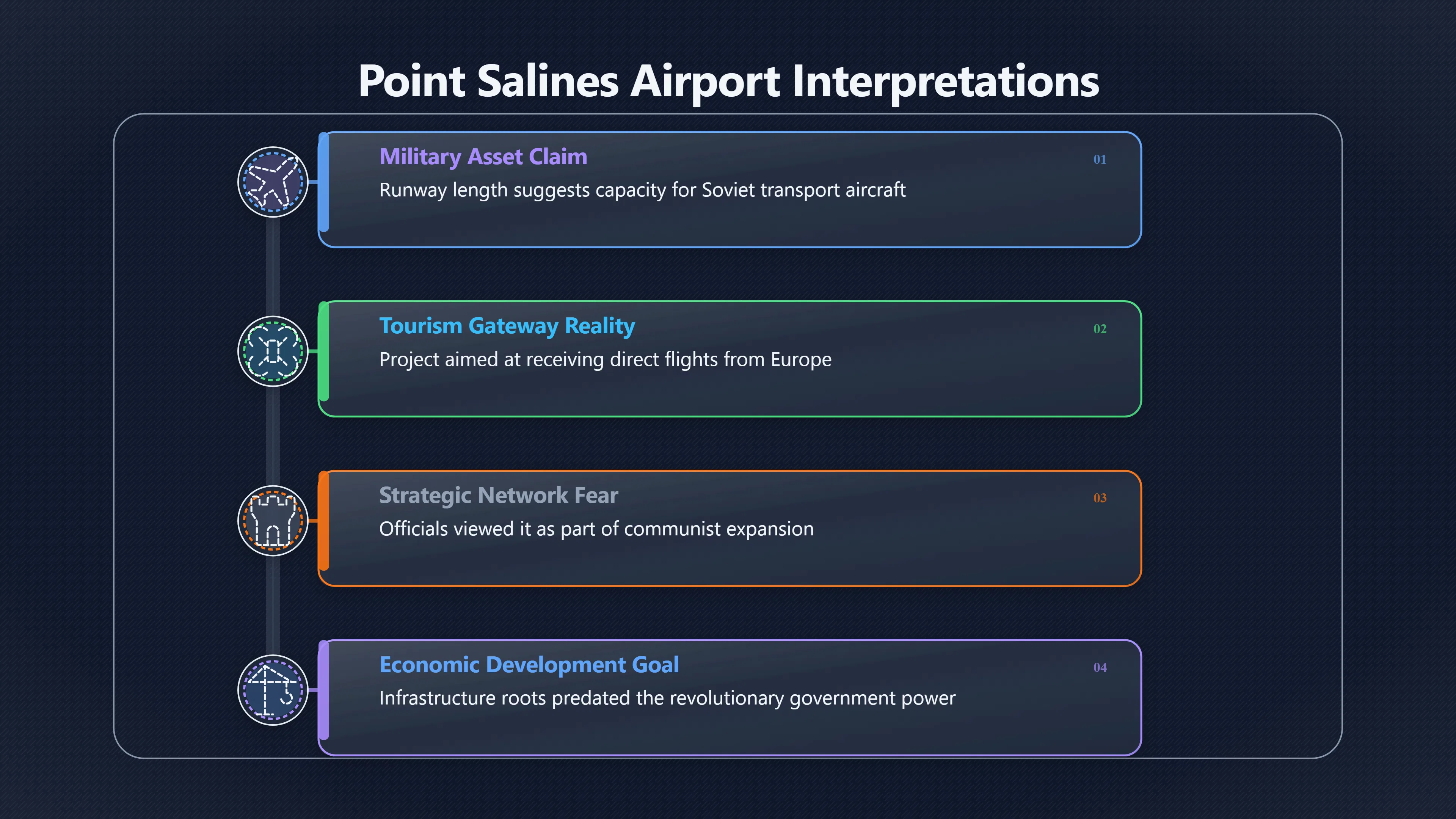
To many observers in 1983, the project looked suspicious. The runway was far longer than the one at Grenada’s existing Pearls Airport. Cuban workers were helping to construct it. The island’s revolutionary government maintained close relations with Cuba and other communist states. Reagan administration officials argued that the runway and associated facilities could accommodate large Soviet military transport aircraft and therefore support regional military operations.[Wikipedia]WikipediaUnited States invasion of GrenadaUnited States invasion of Grenada
Viewed through the tense atmosphere of the Cold War, those facts appeared alarming. American officials warned that the airport was not simply a civilian development project but part of a wider strategic network stretching through Cuba and beyond. The airport became a visual symbol of perceived communist expansion in the Caribbean.[Wikipedia]WikipediaUnited States invasion of GrenadaUnited States invasion of Grenada
Yet there was an alternative explanation that was often overlooked in popular discussion. Grenada’s existing airport had serious limitations. It could not easily handle large long-range passenger aircraft, and its geography made major expansion difficult. Supporters of the Point Salines project argued that Grenada depended heavily on tourism and needed an airport capable of receiving direct flights from Europe and North America. They pointed out that the project had international backing extending beyond Cuba and had roots reaching back before the revolutionary government came to power.[Wikipedia]WikipediaMaurice Bishop International AirportMaurice Bishop International Airport
The airport therefore became a classic Cold War dispute in which the same physical object supported two radically different stories: a tourism gateway or a strategic military asset.
How Capability Became Proof of Intention
The most revealing aspect of the airport controversy was the way capability was often treated as proof of intention.
It was true that the runway could accommodate large military aircraft. However, the ability to support military operations is not the same thing as evidence that military operations are planned. Many civilian international airports possess runways capable of handling military transports. The central question was whether there was convincing evidence that Grenada intended to use Point Salines as a Soviet-Cuban military base.[Wikipedia]WikipediaUnited States invasion of GrenadaUnited States invasion of Grenada
Critics of the administration argued that the leap from capability to intention occurred without sufficient proof. One of the most cited examples came from Congressman Ron Dellums, who visited Grenada before the invasion and concluded that the airport was fundamentally an economic-development project rather than a military facility. He argued that the military interpretation relied more on assumption than demonstrated evidence.[Wikipedia]WikipediaUnited States invasion of GrenadaUnited States invasion of Grenada
This does not mean the administration’s concerns were entirely imaginary. During the Cold War, governments routinely analysed infrastructure in terms of its potential military value. A runway that could receive large transport aircraft naturally attracted strategic attention. The controversy arose because potential use was frequently presented to the public as though it demonstrated intended use.[Wikipedia]WikipediaUnited States invasion of GrenadaUnited States invasion of Grenada
The distinction mattered politically. A runway that might one day support military logistics creates a debate about future risk. A runway described as evidence of an active military threat creates a much stronger case for immediate action.
Why the Claims Were So Persuasive
The rescue and airport narratives reinforced each other.
The student story supplied a clear moral argument centred on innocent civilians. The airport story supplied a geopolitical argument centred on Soviet and Cuban influence. Together they transformed a complicated intervention into a familiar Cold War drama: Americans in danger, hostile revolutionaries, and a strategic threat growing close to home.[JSTOR]jstor.orghostage crisis. By renaming the Grenada crisis a "rescue mission," Reagan allowed Americans the chance to relive a hostage situation and…
The timing also mattered. The memory of the Iranian hostage crisis remained fresh in the United States. Images of armed revolutionaries and American citizens potentially trapped abroad carried enormous emotional force. In that environment, warnings about what might happen could easily be received as evidence of what was already happening.[JSTOR]jstor.orghostage crisis. By renaming the Grenada crisis a "rescue mission," Reagan allowed Americans the chance to relive a hostage situation and…
The airport claim benefited from similar psychological dynamics. Long runways, Cuban construction crews and Cold War rivalries were highly visible facts. The more difficult question—whether those facts demonstrated a military mission—received far less public attention than dramatic images of a supposedly strategic airfield.[Wikipedia]WikipediaUnited States invasion of GrenadaUnited States invasion of Grenada
What Later Debates Revealed
The invasion rapidly succeeded militarily, but arguments about its justification never disappeared. Subsequent historians, journalists and political analysts have generally agreed on several points: Grenada was experiencing a genuine crisis; American students faced uncertainty; and the airport could theoretically support military aircraft. The enduring dispute concerns how far those realities justified the conclusions presented to the public.[U.S. Naval Institute]usni.orgsecret mission urgent furyNaval InstituteSecret Mission of Urgent Fury | Naval History MagazineSeptember 1, 2021 — The island teetered on the brink of civil war. F…
For students of propaganda, political communication and contested truth, the episode is significant because the most influential claims were not obvious fabrications. They were stronger than simple rumours yet weaker than proven facts. The rescue narrative converted potential danger into immediate peril, while the airport narrative converted military capability into presumed intention. Those rhetorical shifts helped build public support for an operation that might otherwise have appeared far more controversial.[jstor.org]jstor.orghostage crisis. By renaming the Grenada crisis a "rescue mission," Reagan allowed Americans the chance to relive a hostage situation and…
Within Grenada’s broader history of disputed stories, the 1983 invasion stands as a reminder that the most persuasive narratives often emerge not from outright invention but from selective interpretation. Facts were real, but their meaning remained contested. The debate continues because the central questions were never simply what existed on the island, but what those facts were believed to prove.[wikipedia.org]WikipediaUnited States invasion of GrenadaUnited States invasion of Grenada
eBay marketplace picks
Marketplace Samples
Live-tested eBay searches with available results related to this page.

Endnotes
1.
Source: Wikipedia
Title: People’s Revolutionary Army (Grenada)
Link:https://en.wikipedia.org/wiki/People%27s_Revolutionary_Army_%28Grenada%29
2.
Source: Wikipedia
Title: United States invasion of Grenada
Link:https://en.wikipedia.org/wiki/United_States_invasion_of_Grenada
3.
Source: jstor.org
Link:https://www.jstor.org/stable/27550810
Source snippet
hostage crisis. By renaming the Grenada crisis a "rescue mission," Reagan allowed Americans the chance to relive a hostage situation and...
4.
Source: Wikipedia
Title: Maurice Bishop International Airport
Link:https://en.wikipedia.org/wiki/Maurice_Bishop_International_Airport
5.
Source: usni.org
Title: secret mission urgent fury
Link:https://www.usni.org/magazines/naval-history-magazine/2021/october/secret-mission-urgent-fury
Source snippet
Naval InstituteSecret Mission of Urgent Fury | Naval History MagazineSeptember 1, 2021 — The island teetered on the brink of civil war. F...
Published: September 1, 2021
6.
Source: emerald.com
Link:https://www.emerald.com/fs/article/10/3/27/85213/The-American-invasion-of-Grenada-a-note-on-false
7.
Source: jstor.org
Link:https://www.jstor.org/stable/40395465
8.
Source: washingtonpost.com
Link:https://www.washingtonpost.com/archive/politics/1983/10/26/americans-in-grenada-calling-home-say-they-were-safe-before-invasion/7cf1186e-a7de-43f2-94bb-3c19c83da565/
Source snippet
The Washington PostAmericans in Grenada, Calling Home, Say They Were Safe...October 26, 1983 — 25 Oct 1983 — Americans in Grenada, Calli...
Published: October 26, 1983
9.
Source: theoxfordculturereview.com
Title: this was no invasion presidential rhetoric and american interventionism
Link:https://theoxfordculturereview.com/2017/08/13/this-was-no-invasion-presidential-rhetoric-and-american-interventionism/
Source snippet
The Oxford Culture Review“This was no invasion”: Presidential rhetoric and American...13 Aug 2017 — Presenting Grenada as a 'rescue miss...
10.
Source: latimes.com
Title: Los Angeles Times Book Questions Rationale for Grenada Invasion
Link:https://www.latimes.com/archives/la-xpm-1989-12-03-mn-323-story.html
Source snippet
Los Angeles TimesBook Questions Rationale for Grenada InvasionDecember 3, 1989 — 3 Dec 1989 — A former Reagan Administration official, La...
Published: December 3, 1989
Additional References
11.
Source: ebsco.com
Link:https://www.ebsco.com/research-starters/history/grenada-occupation
Source snippet
The alleged military application of the new Grenadian airport was used from 1981...Read more...
12.
Source: youtube.com
Title: US Invasion of Grenada
Link:https://www.youtube.com/watch?v=Jl9nTxdJUY0
Source snippet
3 Minute History...
13.
Source: youtube.com
Title: U.S. Invasion of Grenada Was Insane
Link:https://www.youtube.com/watch?v=tGE_mvRLAdU
Source snippet
US Invasion of Grenada - Operation Urgent Fury | Rare Cold War News Footage (1983)...
14.
Source: youtube.com
Title: Grenada Invasion | U.S. Army Forces in Action | Cold War History Documentary
Link:https://www.youtube.com/watch?v=RnC70mM5DYc
Source snippet
U.S. Invasion of Grenada Was Insane...
15.
Source: facebook.com
Title: one of the campaigns in which our all american paratroopers served that is often
Link:https://www.facebook.com/82ndAirborneDivision/posts/one-of-the-campaigns-in-which-our-all-american-paratroopers-served-that-is-often/10159659718000387/
16.
Source: asomf.org
Link:https://www.asomf.org/airborne-invasion-of-grenada/
17.
Source: researchgate.net
Title: 233581239 The American invasion of Grenada A note on false prophecy
Link:https://www.researchgate.net/publication/233581239_The_American_invasion_of_Grenada_A_note_on_false_prophecy
18.
Source: reaganlibrary.gov
Link:https://www.reaganlibrary.gov/public/2021-06/40-322-209378400-R04-061-2021.pdf
19.
Source: blogs.dickinson.edu
Title: the scrutiny and importance of the invasion of grenada
Link:https://blogs.dickinson.edu/hist-118pinsker/2017/12/09/the-scrutiny-and-importance-of-the-invasion-of-grenada/
20.
Source: youtube.com
Link:https://www.youtube.com/watch?v=upU-RNPEJmY
Source snippet
Grenada Invasion | U.S. Army Forces in Action | Cold War History Documentary...
Topic Tree