Within Madagascar Hoaxes
How Newspapers Made the Man Eating Tree Seem Real
A fabricated explorer, invented community and imaginary plant became believable through repetition, scientific language and colonial prejudice.
On this page
- The original 1874 story and its invented witnesses
- Why repeated reprints looked like independent confirmation
- How investigators traced the legend back to fiction
Page outline Jump by section
Introduction
The “man-eating tree of Madagascar” is one of the most successful newspaper hoaxes of the nineteenth century. It claimed that a giant carnivorous plant on Madagascar could seize, crush and consume a human being during a ritual sacrifice. The story was vivid, scientific-sounding and seemingly supported by eyewitness testimony. Yet the explorer who reported it never existed, the community involved appears to have been invented, and no specimen, photograph or credible observation was ever produced. What made the tale remarkable was not the claim itself, but the way repeated newspaper reprints transformed a single fabrication into something that looked like established fact. For decades, readers encountered the story in newspapers, books and popular collections of wonders, often without realising that all versions traced back to the same invented source.[rbg.ca]rbg.caRoyal Botanical GardensBotanicult Fiction: The Man-eating Tree of MadagascarJune 23, 2020 — 23 Jun 2020 — There Leche had encountered the…
The Original 1874 Story and Its Invented Witnesses
The legend entered public circulation in April 1874 through an article published in the New York World. Journalist Edmund Spencer presented what appeared to be a report from a German explorer named Karl Leche (sometimes later rendered as Carl Liche). According to the article, Leche had travelled through Madagascar and encountered a group called the Mkodo. He supposedly witnessed the sacrifice of a woman to a gigantic tree whose tentacle-like leaves wrapped around her body, crushed her and absorbed her remains.[rbg.ca]rbg.caRoyal Botanical GardensBotanicult Fiction: The Man-eating Tree of MadagascarJune 23, 2020 — 23 Jun 2020 — There Leche had encountered the…
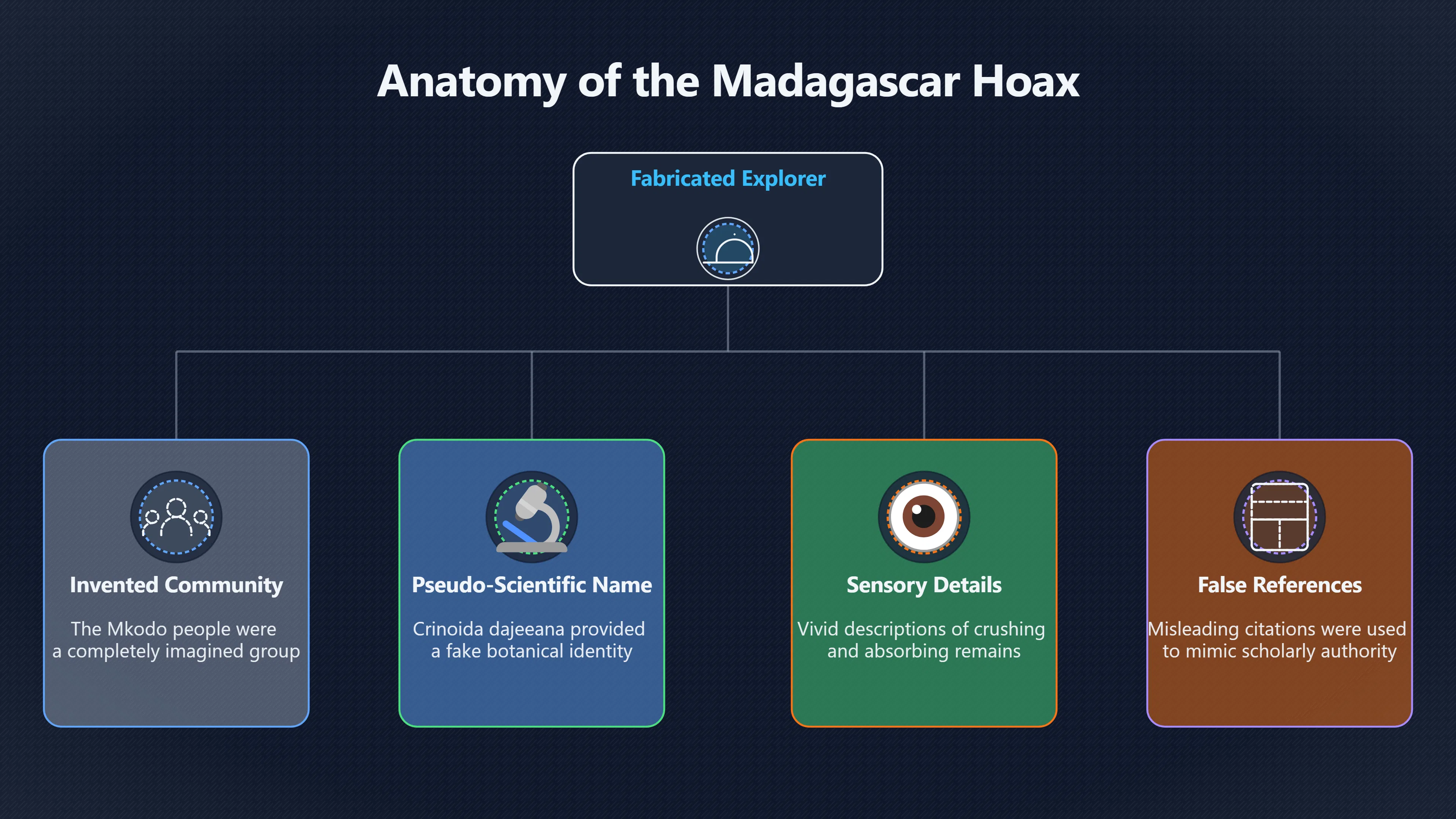
The account was carefully constructed to appear trustworthy. It included:
- A named European explorer acting as eyewitness.
- A supposedly remote Malagasy community unfamiliar to readers.
- Detailed botanical descriptions that mimicked scientific observation.
- References to other publications and authorities.
- Dramatic sensory details that made the scene memorable.[rbg.ca]rbg.caRoyal Botanical GardensBotanicult Fiction: The Man-eating Tree of MadagascarJune 23, 2020 — 23 Jun 2020 — There Leche had encountered the…
The story even gave the plant a scientific-sounding identity, sometimes referred to as Crinoida dajeeana. To nineteenth-century readers, this combination of exploration, science and exotic geography created an impression of authenticity.[encyclopedia.pub]encyclopedia.pubMan-Eating Plant | Encyclopedia MDPI17 Nov 2022 — The earliest known report of a man-eating plant originated as a literary fabrication wr…
Later investigation found that the central elements collapsed under scrutiny. Researchers could find no evidence that Karl Leche existed, no evidence of a Mkodo people matching the description, and no trace of the extraordinary plant itself. Even some of the supposed scholarly references proved misleading or impossible.[The Garden History Blog]thegardenhistory.blogdarwin and the man eating tree of madagascarKarl Leche, Dr. Omelius Friedlowski, the Mkodi…Read more…
Why Repeated Reprints Looked Like Independent Confirmation
The most important reason the hoax survived was repetition.
Nineteenth-century newspapers frequently copied material from one another. A dramatic story published in New York could appear weeks or months later in Australia, Britain or elsewhere, often with only minor editing. Readers encountering the tale in different publications naturally assumed multiple reporters had confirmed it. In reality, many versions descended from the same original article.[encyclopedia.pub]encyclopedia.pubMan-Eating Plant | Encyclopedia MDPI17 Nov 2022 — The earliest known report of a man-eating plant originated as a literary fabrication wr…
As the story travelled, small variations accumulated. The explorer’s name changed spelling. Details were expanded or altered. Additional commentary was attached. These modifications created the illusion of multiple sources rather than repeated recycling. What looked like a growing body of evidence was actually a growing chain of copies.[Wikipedia]WikipediaMan-eating plantMan-eating plant
The process resembles a modern internet rumour. A claim repeated across many websites can appear independently verified even when every version ultimately originates from a single unverified source. The man-eating tree became an early example of this information cascade.[Gale]go.gale.comMan-eating plantsNewspapers planted a forest of tree-monster stories in the years that followed.Read more…
Why Readers Were Ready to Believe It
The hoax succeeded because it mixed invention with ideas that already seemed plausible.
Madagascar genuinely contains unusual plants and animals found nowhere else on Earth. For many nineteenth-century readers, the island occupied a place in the imagination similar to a biological frontier. Reports of strange discoveries from distant regions were common, and many were genuine. Against that backdrop, a bizarre new species did not seem impossible.[Royal Botanical Gardens]rbg.caRoyal Botanical GardensBotanicult Fiction: The Man-eating Tree of MadagascarJune 23, 2020 — 23 Jun 2020 — There Leche had encountered the…
The story also borrowed credibility from real carnivorous plants. Species such as Venus flytraps and pitcher plants had fascinated scientists and the public. Discoveries about plant movement and insect-eating plants challenged older assumptions about what vegetation could do. The man-eating tree simply exaggerated those real phenomena to absurd proportions.[Wikipedia]WikipediaMan-eating plantMan-eating plant
Colonial attitudes played a role as well. The article portrayed the supposed Mkodo as primitive worshippers participating in gruesome rituals. Such depictions aligned with stereotypes that many Western readers already accepted about distant peoples. The sensational description of an unnamed African or Malagasy community therefore faced less scepticism than a similar claim located closer to home.[sites.smith.edu]sites.smith.eduman eating trees are a myth update trees dont eat women eitherman eating trees are a myth update trees dont eat women either
In this sense, the hoax relied not only on fabricated science but also on cultural assumptions that made extraordinary claims easier to accept.

How the Story Escaped the Newspaper Page
The legend might have faded quickly if it had remained a single newspaper curiosity. Instead, later writers revived and amplified it.
One of the most influential was former Michigan governor Chase S. Osborn, whose 1924 book Madagascar: Land of the Man-Eating Tree repeated the story and helped introduce it to a new generation. Osborn acknowledged uncertainty about the tree’s existence, yet the very act of retelling the tale in a travel book gave it renewed legitimacy. Readers could easily interpret the story as a genuine mystery rather than an old newspaper fabrication.[wikipedia.org]WikipediaMan-eating plantMan-eating plant
The legend also spread into collections of wonders, cryptid literature and popular discussions of unexplained phenomena. Each retelling detached the story further from its journalistic origins. Over time many readers encountered the tree without knowing where the claim had started.[Gale]go.gale.comMan-eating plantsNewspapers planted a forest of tree-monster stories in the years that followed.Read more…
How Investigators Traced the Legend Back to Fiction
The decisive debunking came through historical investigation rather than botanical discovery.
Science writer Willy Ley examined the story in the mid-twentieth century and traced it back through its publication history. Instead of finding independent witnesses, he found a chain leading to the original newspaper account. The supposed explorer, tribe and plant all lacked credible evidence outside the story itself. Ley concluded that the man-eating tree, Karl Leche and the Mkodo were fabrications.[wikipedia.org]WikipediaMan-eating plantMan-eating plant
Subsequent researchers strengthened that conclusion. No verified scientific expedition ever documented such a plant. No herbarium specimen exists. No trustworthy observer reported seeing it. The alleged supporting references failed to provide genuine confirmation. The story survived because it was repeated, not because new evidence appeared.[The Garden History Blog]thegardenhistory.blogdarwin and the man eating tree of madagascarKarl Leche, Dr. Omelius Friedlowski, the Mkodi…Read more…
The investigation revealed a useful lesson in historical fact-checking: when supposedly independent reports all trace back to one source, quantity of repetition should not be mistaken for quality of evidence.
Why the Man-Eating Tree Still Circulates
Despite more than a century of debunking, the man-eating tree remains one of Madagascar’s most famous invented wonders.
Part of its endurance comes from the story’s perfect ingredients. It combines exploration, mystery, dangerous nature, lost tribes and scientific curiosity. It also survives because it occupies an ambiguous space between folklore, horror fiction and supposed eyewitness testimony. Many people encounter it through books, websites or documentaries that present it as an unresolved mystery rather than a solved hoax.[Gale]go.gale.comMan-eating plantsNewspapers planted a forest of tree-monster stories in the years that followed.Read more…
The legend also illustrates a broader pattern in the history of misinformation. A dramatic claim, repeated often enough and detached from its source, can acquire an appearance of truth that outlives the original publication by generations. The man-eating tree never existed, but the story about it proved remarkably resilient.[rbg.ca]rbg.caRoyal Botanical GardensBotanicult Fiction: The Man-eating Tree of MadagascarJune 23, 2020 — 23 Jun 2020 — There Leche had encountered the…
What the Hoax Reveals
The man-eating tree story is less revealing about Madagascar than about the media culture that produced it. Its success depended on newspaper syndication, fascination with scientific discovery, appetite for sensational travel stories and assumptions about distant societies. The fabricated explorer and imaginary tree became believable because they arrived wrapped in the language of observation and expertise.[rbg.ca]rbg.caRoyal Botanical GardensBotanicult Fiction: The Man-eating Tree of MadagascarJune 23, 2020 — 23 Jun 2020 — There Leche had encountered the…
For historians of hoaxes, the case remains a classic example of how a single invented report can become accepted folklore through repetition alone. Long before social media, the man-eating tree demonstrated that a compelling narrative can spread faster than verification and survive long after the evidence has disappeared.[gale.com]go.gale.comMan-eating plantsNewspapers planted a forest of tree-monster stories in the years that followed.Read more…
Amazon book picks
Further Reading
Books and field guides related to How Newspapers Made the Man-Eating Tree Seem Real. Use these as the next step if you want deeper reading beyond the article.
Why People Believe Weird Things
Directly addresses belief in sensational stories and hoaxes.
Extraordinary Popular Delusions and the Madness of Crowds
Rating: 4.0/5 from 5 Google Books ratings
Examines how implausible claims become widely accepted.
The Demon-Haunted World
Rating: 4.5/5 from 43 Google Books ratings
Strong fit for investigating legendary claims lacking evidence.
eBay marketplace picks
Marketplace Samples
Live-tested eBay searches with available results related to this page.




Endnotes
1.
Source: encyclopedia.pub
Link:https://encyclopedia.pub/entry/35098
Source snippet
Man-Eating Plant | Encyclopedia MDPI17 Nov 2022 — The earliest known report of a man-eating plant originated as a literary fabrication wr...
2.
Source: hoaxes.org
Title: man eating tree of madagascar
Link:https://hoaxes.org/archive/permalink/man_eating_tree_of_madagascar
Source snippet
Then ensued "a grotesque and indescribably hideous orgie." Leche concluded his letter...Read more...
3.
Source: Wikipedia
Title: Man-eating plant
Link:https://en.wikipedia.org/wiki/Man-eating_plant
4.
Source: go.gale.com
Title: Man-eating plants
Link:https://go.gale.com/ps/i.do?id=GALE%7CA456275906&issn=10639330&it=r&linkaccess=abs&p=AONE&sid=googleScholar&sw=w&v=2.1
Source snippet
Newspapers planted a forest of tree-monster stories in the years that followed.Read more...
5.
Source: sites.smith.edu
Title: man eating trees are a myth update trees dont eat women either
Link:https://sites.smith.edu/fys169-f19/2019/11/27/man-eating-trees-are-a-myth-update-trees-dont-eat-women-either/
6.
Source: sfgate.com
Title: The Dirt: Myths about man-eating plants
Link:https://www.sfgate.com/homeandgarden/article/The-Dirt-Myths-about-man-eating-plants-3236037.php
7.
Source: rbg.ca
Link:https://www.rbg.ca/the-man-eating-tree-of-madagascar/
Source snippet
Royal Botanical GardensBotanicult Fiction: The Man-eating Tree of MadagascarJune 23, 2020 — 23 Jun 2020 — There Leche had encountered the...
Published: June 23, 2020
8.
Source: thegardenhistory.blog
Title: darwin and the man eating tree of madagascar
Link:https://thegardenhistory.blog/2024/01/06/darwin-and-the-man-eating-tree-of-madagascar/
Source snippet
Karl Leche, Dr. Omelius Friedlowski, the Mkodi...Read more...
Additional References
9.
Source: reddit.com
Link:https://www.reddit.com/r/botany/comments/1pthfth/the_crazy_true_story_of_the_madagascar_maneating/
Source snippet
The Crazy True Story of The Madagascar Man-Eating TreeAccording to that report, a German botanist named Karl Leche encountered the...
10.
Source: weirdhistorian.com
Link:https://www.weirdhistorian.com/the-myth-and-mayhem-of-the-man-eating-tree-of-madagascar/
Source snippet
It all started with a New York World article published on April 28, 1874...
Published: April 28, 1874
11.
Source: youtube.com
Title: The Cannibal Tree
Link:https://www.youtube.com/watch?v=IG30h1SvzWU
Source snippet
"Man eating tree" hoax The Cannibal Tree - Carniverous Tree hoax in 1897 Where's My Yowie...
12.
Source: archive.org
Link:https://archive.org/stream/B-001-014-617/B-001-014-617_djvu.txt
13.
Source: youtube.com
Title: Is the Man-Eating Tree of Madagascar Real?
Link:https://www.youtube.com/watch?v=RF8Rt7t4ACU
Source snippet
The Cannibal Tree - Carniverous Tree hoax in 1897...
14.
Source: youtube.com
Title: The Legend Of Man Eating Plants
Link:https://www.youtube.com/watch?v=G4-qBnDeybo
Source snippet
Is the Man-Eating Tree of Madagascar Real?...
15.
Source: facebook.com
Title: Are there lost photos of the Madagascar man-eating tree?
Link:https://www.facebook.com/groups/thecfz/posts/10161835502382013/
16.
Source: youtube.com
Title: The Man-Eating Tree of Madagascar: Real or Hoax?
Link:https://www.youtube.com/watch?v=MM7GPEVLWUE
Source snippet
The Man-Eating Tree of Madagascar...
17.
Source: fatehbaz.tumblr.com
Link:https://fatehbaz.tumblr.com/post/182100690519/man-eating-plants-in-early-horror-fiction-and
18.
Source: youtube.com
Title: The Man-Eating Tree of Madagascar
Link:https://www.youtube.com/watch?v=WxBOO-KU9C8
Source snippet
The Legend Of Man Eating Plants...
Topic Tree