Within Canada's Famous Hoaxes
Did Vikings Really Reach Northern Ontario?
Genuine Norse weapons appeared to rewrite Ontario's past because their false discovery story survived longer than the evidence deserved.
On this page
- The discovery claim and museum endorsement
- Why authentic artefacts made the story persuasive
- The testimony and provenance trail that exposed the hoax
Page outline Jump by section
Introduction
Did Vikings really reach northern Ontario? The Beardmore relics were once presented as dramatic proof that they had. In the 1930s, a broken Viking sword, an axe head and other iron objects were said to have been unearthed near Beardmore, Ontario. Because experts agreed that the artefacts themselves were genuinely Norse and dated to the Viking Age, the discovery seemed capable of rewriting part of Canada’s early history. For roughly two decades the objects were displayed by the Royal Ontario Museum as evidence of a Viking presence deep in the Canadian interior.[Wikipedia]WikipediaBeardmore RelicsBeardmore Relics

The problem was not the age of the artefacts. It was the story attached to them. Over time, contradictions in witness accounts, questions about where the objects had really come from, and sworn testimony from the discoverer’s own son undermined the claim that they had ever been excavated near Beardmore at all. The case became one of Canada’s most famous examples of a forged archaeological discovery: authentic objects paired with a false provenance.[Wikipedia]WikipediaBeardmore RelicsBeardmore Relics
The Discovery Claim and Museum Endorsement
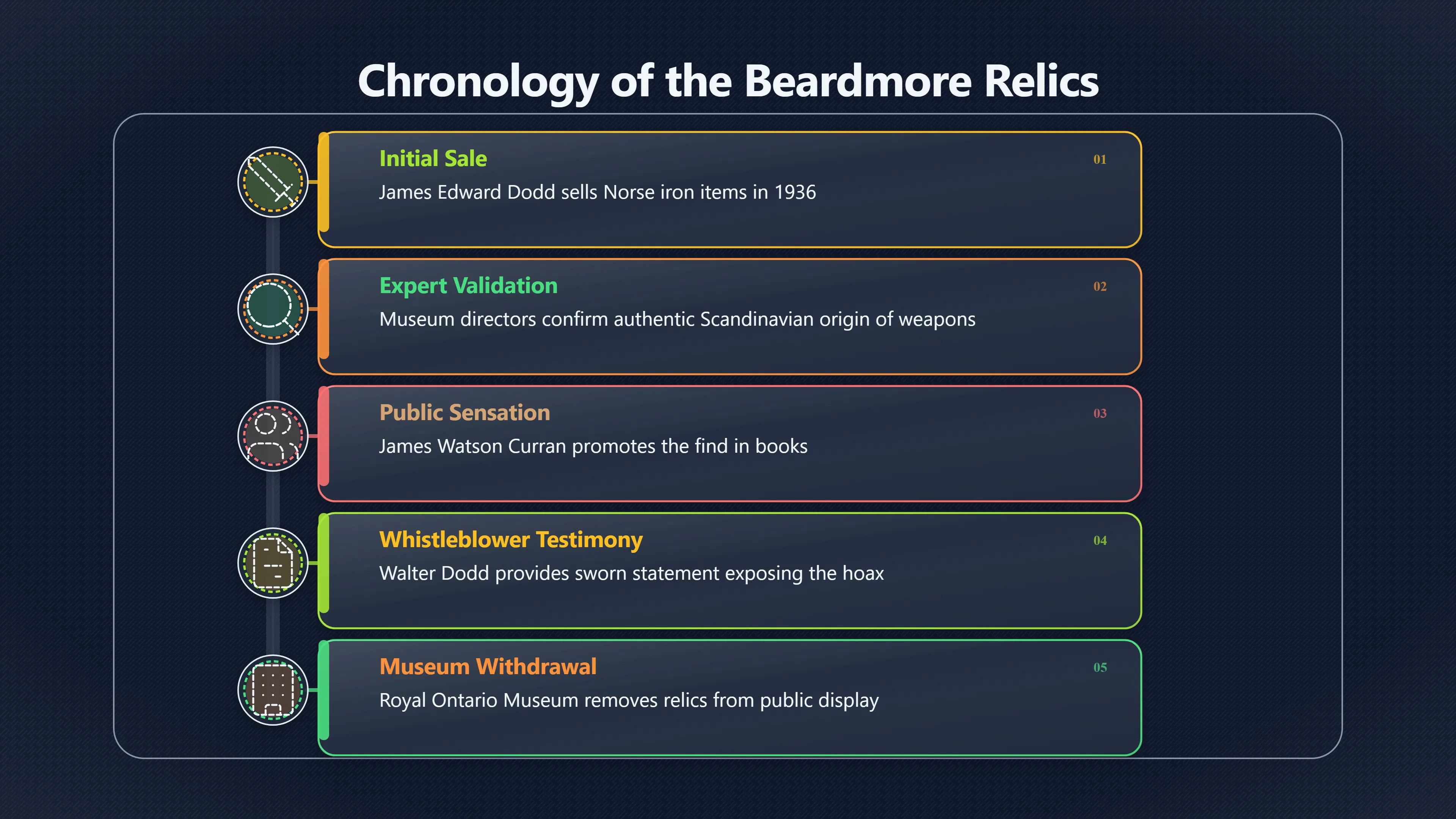
The story began with James Edward “Eddy” Dodd, a railway worker and prospector from Port Arthur, now part of Thunder Bay. In 1936 he sold a cache of iron artefacts to the Royal Ontario Museum, claiming he had uncovered them while prospecting near Beardmore several years earlier. The collection included a Viking sword, an axe head and additional iron fragments.[Wikipedia]WikipediaBeardmore RelicsBeardmore Relics
Charles Trick Currelly, the museum’s influential founding director, examined the objects and sought opinions from European specialists. Their verdict was striking: the artefacts appeared to be authentic Norse weapons. Once experts confirmed their Scandinavian origin, the museum accepted Dodd’s account of where they had supposedly been found and placed the relics on display.[Wikipedia]WikipediaBeardmore RelicsBeardmore Relics
The claim quickly attracted publicity. Newspaper editor James Watson Curran became one of its strongest advocates, arguing that the find demonstrated a Norse presence in the Great Lakes region centuries before later European exploration. Through articles, lectures and his book Here Was Vinland, he helped turn a local discovery into a national historical sensation.[Wikipedia]WikipediaBeardmore RelicsBeardmore Relics
For many Canadians, the combination of a respected museum, expert authentication and an exciting historical possibility made the story highly convincing.
Why Authentic Artefacts Made the Story Persuasive
The Beardmore affair is unusual because it was not based on forged objects. Most researchers agree that the sword and axe were genuine Viking-period artefacts. The deception centred on their alleged discovery site.[Wikipedia]WikipediaBeardmore RelicsBeardmore Relics
This distinction explains why the story survived so long.
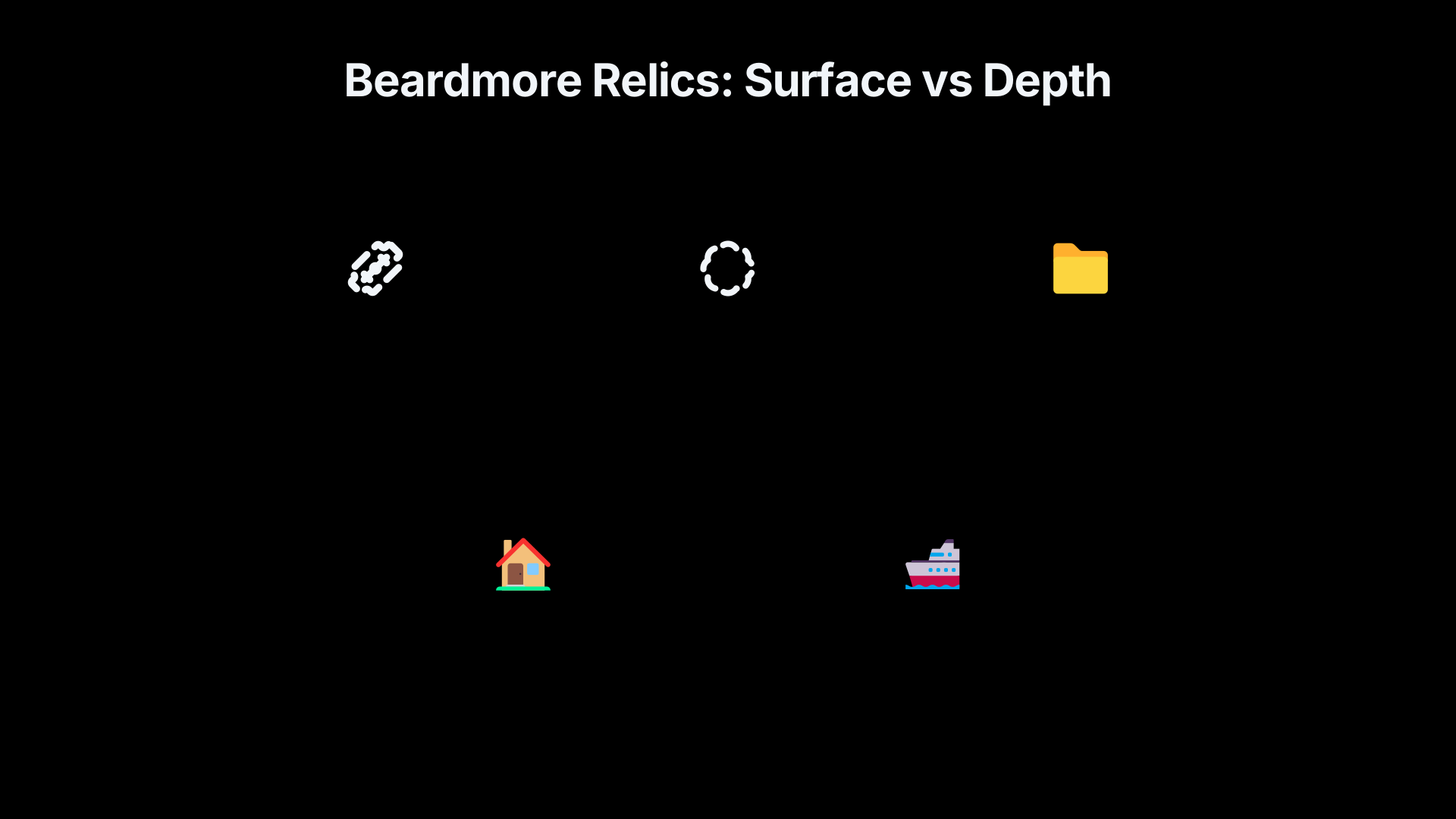
Archaeologists can often determine the age, style and cultural origin of an artefact through physical examination. What they cannot determine from the object alone is exactly where it was found. That requires reliable documentation, excavation records and a secure chain of custody known as provenance. The Beardmore relics possessed strong evidence of authenticity but weak evidence of provenance.[Wikipedia]WikipediaBeardmore RelicsBeardmore Relics
Several factors reinforced belief in the discovery:
- The artefacts looked genuine because they were genuine. Experts could identify them as Norse weapons rather than modern replicas.[Wikipedia]WikipediaBeardmore RelicsBeardmore Relics
- The claim fit an existing historical question. Scholars already knew Vikings had reached North America, even if the extent of their travels remained uncertain.[Wikipedia]WikipediaBeardmore RelicsBeardmore Relics
- Institutional authority mattered. The endorsement of the Royal Ontario Museum transformed a prospector’s story into accepted history for many members of the public.[JSTOR]jstor.orgBeardmore: The Viking Hoax That Rewrote HistoryIn 1956 the discovery was exposed as an unquestionable hoax, tarnishing the reputatio…
- The discovery was exciting without seeming impossible. Unlike a fantastical monster or miracle, Viking exploration was historically plausible, making the claim easier to accept.[Wikipedia]WikipediaBeardmore RelicsBeardmore Relics
The result was a powerful lesson in how authentic evidence can be used to support a false conclusion when critical contextual information is missing.
The Doubts That Never Went Away
Scepticism appeared almost immediately. Archaeologists questioned inconsistencies in Dodd’s account and noted that his descriptions of the discovery changed over time. Critics also pointed out the absence of supporting archaeological evidence. No Norse settlement, burial site or associated artefacts were found near the alleged discovery location.[Wikipedia]WikipediaBeardmore RelicsBeardmore Relics
Some researchers suspected that the objects had been obtained from Scandinavian immigrants living in the Port Arthur area and then deliberately planted to create a sensational find. Such accusations remained difficult to prove, however, because the artefacts themselves were undeniably old.[Wikipedia]WikipediaBeardmore RelicsBeardmore Relics
The controversy increasingly became a dispute about testimony rather than archaeology. Supporters defended Dodd’s account. Critics focused on contradictions and missing documentation. For years neither side could produce conclusive evidence strong enough to settle the matter.[Wikipedia]WikipediaBeardmore RelicsBeardmore Relics
The Testimony and Provenance Trail That Exposed the Hoax
The decisive blow came in the mid-1950s.
Walter Dodd, the discoverer’s son, submitted a sworn statement declaring that his father had not unearthed the relics near Beardmore. According to Walter, the artefacts had been found in the basement or foundations of a house in Port Arthur and were later planted at the alleged discovery site. He stated that he had personally witnessed the planting and that earlier statements supporting the official story had been made under pressure from his father.[Wikipedia]WikipediaBeardmore RelicsBeardmore Relics
The testimony transformed the debate. What had been a dispute over probabilities became a direct allegation of fraud from someone close to the central figure. A public inquiry followed, and the Royal Ontario Museum eventually withdrew the relics from display as evidence of a Viking discovery in Ontario.[Wikipedia]WikipediaBeardmore RelicsBeardmore Relics
Subsequent historical research strengthened the alternative explanation. Investigators traced likely pathways by which authentic Norse artefacts could have reached north-western Ontario through Norwegian immigrants and private collections during the early twentieth century. Historian Douglas Hunter’s research has linked the relics to Scandinavian immigrant networks in the Port Arthur area, providing a plausible route for the weapons long before Dodd claimed to have discovered them.[Douglas Hunter]dwhauthor.wordpress.combeardmore revisited jens blochs dark norwegian pastDouglas Hunter“Beardmore” revisited: Jens Bloch's dark Norwegian past28 Apr 2020 — In my 2018 book Beardmore, which investigates the Viki…
Other testimony also pointed toward fabrication. Accounts collected during the controversy included statements suggesting that the supposed discovery had been staged rather than excavated from an ancient site.[JSTOR]jstor.orgFurther Evidence on the Beardmore RelicsFurther Evidence on the Beardmore RelicsOctober 12, 1957 — by E Carpenter · 1957 · Cited by 5 — named Eli Ragotte told a Winnipeg Fr…
What the Beardmore Case Reveals About Archaeological Hoaxes
The Beardmore relics remain important because they expose a weakness that affects archaeology, museums and historical research more broadly: an artefact can be genuine while the story attached to it is false.
In many famous forgery cases, scientific testing eventually reveals that an object is modern. Beardmore was more complicated. The sword and axe passed authenticity tests because they were authentic. The vulnerable point was provenance. Once confidence in the discovery story collapsed, the historical significance of the artefacts changed completely.[Wikipedia]WikipediaBeardmore RelicsBeardmore Relics
The case also illustrates the influence of institutional prestige. Currelly’s reputation and the museum’s authority helped establish the claim, while critics struggled for years to overturn it. Later commentators have argued that the controversy demonstrates how organisations can become invested in dramatic conclusions and therefore reluctant to abandon them when contrary evidence appears.[Wikipedia]WikipediaBeardmore RelicsBeardmore Relics
Today the Beardmore relics are generally treated as genuine Norse artefacts with a false Canadian discovery story. They no longer serve as evidence that Vikings reached northern Ontario. Instead, they stand as a cautionary example of how historical narratives can be built on weak provenance, even when the physical evidence itself is real.[wikipedia.org]WikipediaBeardmore RelicsBeardmore Relics
Amazon book picks
Further Reading
Books and field guides related to Did Vikings Really Reach Northern Ontario?. Use these as the next step if you want deeper reading beyond the article.
Frauds, Myths, and Mysteries: Science and Pseudoscience in Ar...
Examines forged discoveries and disputed evidence.
The Vikings and America
Provides context for claims of Norse exploration in North America.
The Vinland Map and the tartar relation
Offers a parallel case of disputed historical evidence.
Archaeological Frauds, Hoaxes and Fakes
Covers false provenance and deceptive archaeological claims.
eBay marketplace picks
Marketplace Samples
Example marketplace items related to this page. Use the search link to explore similar finds on eBay.


Endnotes
1.
Source: Wikipedia
Title: Beardmore Relics
Link:https://en.wikipedia.org/wiki/Beardmore_Relics
2.
Source: quillandquire.com
Title: beardmore the viking hoax that rewrote history
Link:https://quillandquire.com/review/beardmore-the-viking-hoax-that-rewrote-history/
Source snippet
Beardmore: The Viking Hoax That Rewrote HistoryIn 1936, the Royal Ontario Museum purchased 10th-century Norse relics from a prospector wh...
3.
Source: jstor.org
Link:https://www.jstor.org/stable/j.ctv4t7z9h
Source snippet
Beardmore: The Viking Hoax That Rewrote HistoryIn 1956 the discovery was exposed as an unquestionable hoax, tarnishing the reputatio...
4.
Source: Wikipedia
Title: James Watson Curran
Link:https://en.wikipedia.org/wiki/James_Watson_Curran
5.
Source: jstor.org
Title: Further Evidence on the Beardmore Relics
Link:https://www.jstor.org/stable/665853
Source snippet
Further Evidence on the Beardmore RelicsOctober 12, 1957 — by E Carpenter · 1957 · Cited by 5 — named Eli Ragotte told a Winnipeg Fr...
Published: October 12, 1957
6.
Source: Wikipedia
Title: Reperti di Beardmore
Link:https://it.wikipedia.org/wiki/Reperti_di_Beardmore
7.
Source: youtube.com
Title: Beardmore’s Viking Discovery
Link:https://www.youtube.com/watch?v=46P3wNKmBaM
Source snippet
VIKINGS - Art at the ROM...
8.
Source: youtube.com
Link:https://www.youtube.com/watch?v=4JFRhTgwojg
Source snippet
in America? Evidence in the Mississippi Basin | Hoax or History...
9.
Source: dwhauthor.wordpress.com
Title: beardmore revisited jens blochs dark norwegian past
Link:https://dwhauthor.wordpress.com/2020/04/28/beardmore-revisited-jens-blochs-dark-norwegian-past/
Source snippet
Douglas Hunter“Beardmore” revisited: Jens Bloch's dark Norwegian past28 Apr 2020 — In my 2018 book Beardmore, which investigates the Viki...
10.
Source: passingstrangeness.wordpress.com
Title: Passing Strangeness The Beardmore Relics
Link:https://passingstrangeness.wordpress.com/2025/12/03/the-beardmore-relics/
Source snippet
Those interested...Read more...
11.
Source: canadacommons.ca
Link:https://canadacommons.ca/artifacts/1878713/beardmore/2627796/
Additional References
12.
Source: nqonline.ca
Link:https://nqonline.ca/article/beardmore-the-viking-hoax-that-rewrote-history-by-douglas-hunter/
Source snippet
The Newfoundland QuarterlyBeardmore: The Viking Hoax that Rewrote History by...The Hoax arose from an attempt by an obscure gold prospec...
13.
Source: youtube.com
Title: Vikings in America? Evidence in the Mississippi Basin | Hoax or History
Link:https://www.youtube.com/watch?v=By8D9_73RKI
Source snippet
Archaeological Frauds: The Kensington Runestone...
14.
Source: arxiv.org
Title: arXiv Scroll Times: Tracing the Provenance of Paintings as a Window into History
Link:https://arxiv.org/abs/2306.08834
15.
Source: youtube.com
Title: Archaeological Frauds: The Kensington Runestone
Link:https://www.youtube.com/watch?v=jzgfU99abao
Source snippet
The Rock that Makes People Argue A Lot | Kensington Runestone...
16.
Source: dokumen.pub
Link:https://dokumen.pub/beardmore-the-viking-hoax-that-rewrote-history-9780773555341.html
17.
Source: ontarioarchaeology.org
Link:https://ontarioarchaeology.org/wp-content/uploads/OA_web_100.pdf
18.
Source: archive.org
Link:https://archive.org/download/picturegalleryof01jeff/picturegalleryof01jeff.pdf
19.
Source: facebook.com
Link:https://www.facebook.com/groups/1519076065078299/posts/4101177293534817/
20.
Source: youtube.com
Title: The Rock that Makes People Argue A Lot | Kensington Runestone
Link:https://www.youtube.com/watch?v=EcPLwMai5_E
21.
Source: nipigonmuseumtheblog.blogspot.com
Title: beardmore relics hoax or history who
Link:https://nipigonmuseumtheblog.blogspot.com/2011/09/beardmore-relics-hoax-or-history-who.html
Topic Tree