Within Cuba Hoaxes
Who Sank the Maine and What Was Proved?
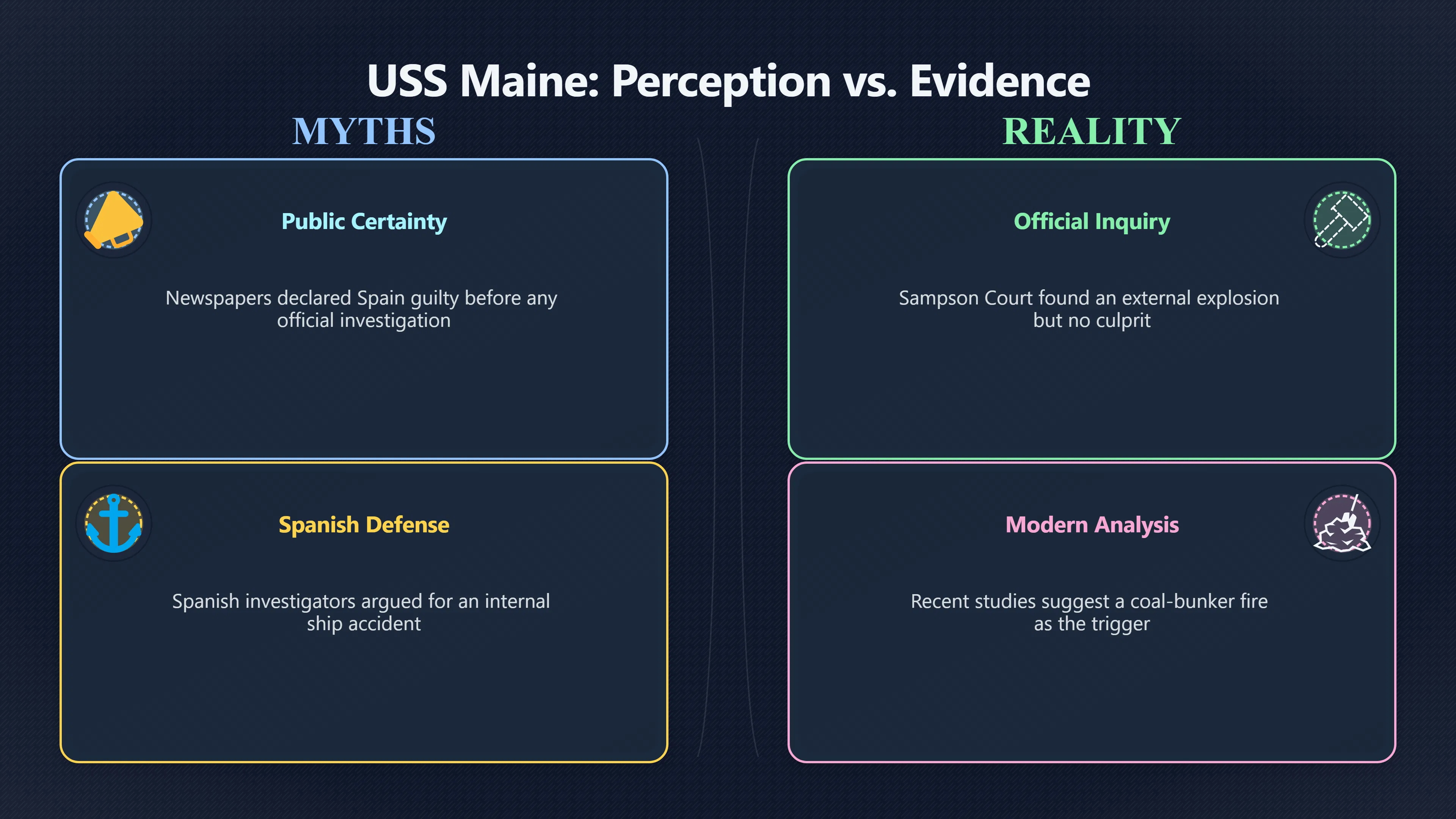
The Maine disaster became a case study in how uncertainty can be converted into blame before investigators know what happened.
On this page
- What newspapers claimed after the explosion
- How official inquiries changed the accepted story
- Why the cause remains disputed
Page outline Jump by section
Introduction
The explosion of the USS Maine in Havana harbour on 15 February 1898 is often remembered as the spark that helped ignite the Spanish–American War. Less often remembered is that the most famous accusation came before the evidence. Within days of the disaster, many American newspapers and politicians treated Spanish guilt as an established fact even though investigators had not yet determined what had caused the explosion. More than a century later, the precise cause remains disputed, but one conclusion is widely accepted: the rush to assign blame outran the available proof.[loc.gov]blogs.loc.govthe spanish american war and the yellow pressThe Library of CongressThe Spanish American War and the Yellow Press6 Feb 2024 — When the USS Maine mysteriously exploded, the American “…
For a history of deception, propaganda and contested truth connected to Cuba, the Maine is significant not because historians have uncovered a simple hoax. Rather, it became a classic example of how uncertainty can be transformed into certainty by newspapers, political pressure and public emotion. The story shows how a claim can become influential long before it becomes demonstrably true.
Who Sank the Maine and What Was Proved?
At about 9:40 p.m. on 15 February 1898, a massive explosion tore through the American battleship while it was anchored in Havana harbour. More than 250 sailors were killed. The ship had been sent to Cuba during a period of tension between the United States and Spain over the Cuban war of independence.[Smithsonian Magazine]smithsonianmag.comSmithsonian MagazineRemember The MaineOn February 15, 1898, a mysterious explosion destroyed the American battleship Maine in Havana Harb…
The immediate problem was simple: nobody knew what had happened.
There were several possibilities. A mine might have exploded beneath the vessel. An accident inside the ship could have ignited its ammunition magazines. Other explanations were suggested as well. In the first hours after the disaster, certainty was impossible because the wreck had not yet been thoroughly examined.[U.S. Naval Institute]usni.orgspecial report what really sank maineNaval InstituteA Special Report: What Really Sank the Maine?The available evidence is consistent with an internal explosion alone. We the…
Yet public discussion quickly moved from the question “What caused the explosion?” to the much stronger claim “Who did it?” That shift occurred before investigators had gathered enough evidence to answer either question.[1898exhibition.si.edu]1898exhibition.si.eduSpain Guilty!1898: U.S. Imperial Visions and RevisionsSoon after the explosion of the USS Maine, newspapers in the United States crafted bold headline…
What Newspapers Claimed After the Explosion
The most famous example of premature blame came from the sensational newspapers later associated with “yellow journalism”. Publishers such as William Randolph Hearst and Joseph Pulitzer were locked in fierce circulation battles, and the Maine disaster offered a dramatic story with enormous emotional impact.[loc.gov]blogs.loc.govthe spanish american war and the yellow pressThe Library of CongressThe Spanish American War and the Yellow Press6 Feb 2024 — When the USS Maine mysteriously exploded, the American “…
Many headlines strongly implied or openly asserted that Spain was responsible. Some newspapers spoke of mines, sabotage and treachery before official investigators had reached any conclusion. Hearst’s New York Journal offered rewards for identifying the supposed perpetrators and ran coverage that treated Spanish involvement as highly probable. The result was not merely reporting on public anger; it actively reinforced and amplified it.[si.edu]1898exhibition.si.eduSpain Guilty!1898: U.S. Imperial Visions and RevisionsSoon after the explosion of the USS Maine, newspapers in the United States crafted bold headline…
This does not mean newspapers invented the explosion itself. The ship really did explode and many Americans sincerely suspected Spanish involvement. The problem was evidential. Claims of Spanish guilt were often presented with a confidence that exceeded what investigators actually knew.[The Library of Congress]blogs.loc.govthe spanish american war and the yellow pressThe Library of CongressThe Spanish American War and the Yellow Press6 Feb 2024 — When the USS Maine mysteriously exploded, the American “…
Even some contemporary officials urged caution. Captain Charles Sigsbee, commander of the Maine, initially warned against speculation while facts were still being gathered. His restraint was soon overwhelmed by louder demands for answers and retaliation.[U.S. Naval Institute]usni.orgremember maine one more timeU.S. Naval InstituteRemember the Maine, One More TimeHavana, Cuba, in 1898, “Remember the Maine and to Hell with Spain” soon became a ral…
Why the accusation spread so easily
Several conditions made the blame narrative persuasive:
- The explosion occurred amid an already heated dispute over Cuba’s future.
- Many Americans had been reading reports of Spanish repression in Cuba for months.
- The loss of hundreds of sailors created a powerful emotional response.
- A hostile act seemed easier to understand than a complicated technical accident.
- Newspapers benefited commercially from dramatic and morally clear stories.[loc.gov]blogs.loc.govthe spanish american war and the yellow pressThe Library of CongressThe Spanish American War and the Yellow Press6 Feb 2024 — When the USS Maine mysteriously exploded, the American “…
The slogan “Remember the Maine! To Hell with Spain!” captured this mood. It transformed an unresolved investigation into a political rallying cry.[Wikipedia]WikipediaUSS Maine (1890USS Maine (1890

How Official Inquiries Changed the Accepted Story
The first major American investigation was the Sampson Court of Inquiry in 1898. After examining the wreckage, it concluded that the ship had been destroyed by an external explosion, probably a mine. However, the inquiry did not directly identify Spain as the culprit. That distinction was often lost in public discussion. A finding that a mine exploded beneath the ship was frequently interpreted as proof of Spanish guilt even though the board had not established who, if anyone, had planted such a device.[History]history.comThe USS Maine explodes in Cuba's Havana HarborAn official U.S. Naval Court of Inquiry ruled in March that the ship was blown up by…
Spain conducted its own inquiry and reached a different conclusion. Spanish investigators argued that the evidence pointed toward an internal accident rather than an external mine. Their findings received far less attention in the United States, where public opinion had already hardened.[Wikipedia]WikipediaUSS Maine (1890USS Maine (1890
A second American inquiry, the Vreeland Board in 1911, broadly supported the earlier conclusion that an external explosion had occurred. Yet questions remained because the physical evidence was incomplete and interpretations of the wreck differed.[Wikipedia]WikipediaUSS Maine (1890USS Maine (1890
The most influential challenge to the mine theory came much later. In the 1970s Admiral Hyman Rickover sponsored a detailed re-examination of the evidence. His team concluded that there was no convincing technical proof of an external mine and argued that an internal coal-bunker fire was the most likely trigger.[U.S. Naval Institute]usni.orgspecial report what really sank maineNaval InstituteA Special Report: What Really Sank the Maine?The available evidence is consistent with an internal explosion alone. We the…
Further studies, including computer modelling conducted around the centenary of the disaster, did not produce a universally accepted answer. Some analyses found aspects of the damage compatible with a mine; others found an internal explosion more convincing. Instead of settling the debate, modern investigations narrowed it to competing technical interpretations.[usni.org]usni.orgspecial report what really sank maineNaval InstituteA Special Report: What Really Sank the Maine?The available evidence is consistent with an internal explosion alone. We the…
Why the Cause Remains Disputed
The central difficulty is that investigators have never possessed perfect evidence.
The explosion destroyed the very area that might have revealed its origin. The wreck was altered by salvage operations, later examinations and the passage of time. Experts studying the same physical traces have often disagreed about what those traces imply.[U.S. Naval Institute]usni.orgspecial report what really sank maineNaval InstituteA Special Report: What Really Sank the Maine?The available evidence is consistent with an internal explosion alone. We the…
Today, several points are widely accepted:
- The ship’s magazines exploded and caused catastrophic destruction.
- No conclusive evidence has ever proved that Spain deliberately attacked the vessel.
- No investigation has produced a definitive explanation accepted by all specialists.
- Internal-accident theories gained substantial support during the twentieth century.
- The political blame placed on Spain in 1898 was stronger than the evidence available at the time.[usni.org]usni.orgspecial report what really sank maineNaval InstituteA Special Report: What Really Sank the Maine?The available evidence is consistent with an internal explosion alone. We the…
This distinction is crucial. The historical question “What caused the explosion?” is not identical to “Who was responsible?” Public debate in 1898 often merged the two questions into one.
A Case Study in Blame Before Proof
The Maine disaster sits at the boundary between tragedy, propaganda and historical uncertainty. Unlike a straightforward hoax, there was no universally accepted fabricated event to expose. The explosion was real. The deception lay more in the confidence with which uncertain claims were presented and repeated.
Newspapers, politicians and activists transformed a mystery into a narrative of guilt before investigators had finished their work. Once that narrative took hold, later doubts struggled to compete with the emotional power of the original accusation. Historians still debate the mechanics of the explosion, but they are far less divided on a broader lesson: public certainty arrived long before the evidence did.[loc.gov]blogs.loc.govthe spanish american war and the yellow pressThe Library of CongressThe Spanish American War and the Yellow Press6 Feb 2024 — When the USS Maine mysteriously exploded, the American “…
Amazon book picks
Further Reading
Books and field guides related to Who Sank the Maine and What Was Proved?. Use these as the next step if you want deeper reading beyond the article.
The War of 1898
Directly engages with the Maine, war origins and competing interpretations.
All the News That's Fit to Sell
Provides context on press behavior and news commercialization.
eBay marketplace picks
Marketplace Samples
Live-tested eBay searches with available results related to this page.
Endnotes
1.
Source: history.com
Link:https://www.history.com/this-day-in-history/february-15/the-maine-explodes
Source snippet
The USS Maine explodes in Cuba's Havana HarborAn official U.S. Naval Court of Inquiry ruled in March that the ship was blown up by...
2.
Source: usni.org
Title: special report what really sank maine
Link:https://www.usni.org/magazines/naval-history-magazine/1998/april/special-report-what-really-sank-maine
Source snippet
Naval InstituteA Special Report: What Really Sank the Maine?The available evidence is consistent with an internal explosion alone. We the...
3.
Source: Wikipedia
Title: USS Maine (1890)
Link:https://en.wikipedia.org/wiki/USS_Maine_%281890%29
4.
Source: 1898exhibition.si.edu
Title: Spain Guilty!
Link:https://1898exhibition.si.edu/node/82
Source snippet
1898: U.S. Imperial Visions and RevisionsSoon after the explosion of the USS Maine, newspapers in the United States crafted bold headline...
5.
Source: blog.newspapers.com
Title: the sinking of the uss maine february 15 1898
Link:https://blog.newspapers.com/the-sinking-of-the-uss-maine-february-15-1898/
6.
Source: youtube.com
Title: Yellow Journalism | Citizen Hearst
Link:https://www.youtube.com/watch?v=oU2BjNTcToU
Source snippet
Yellow Journalism: The Architecture of Modern Manipulation...
7.
Source: blogs.loc.gov
Title: the spanish american war and the yellow press
Link:https://blogs.loc.gov/headlinesandheroes/2024/02/the-spanish-american-war-and-the-yellow-press/
Source snippet
The Library of CongressThe Spanish American War and the Yellow Press6 Feb 2024 — When the USS Maine mysteriously exploded, the American “...
8.
Source: smithsonianmag.com
Link:https://www.smithsonianmag.com/history/remember-the-maine-56071873/
Source snippet
Smithsonian MagazineRemember The MaineOn February 15, 1898, a mysterious explosion destroyed the American battleship Maine in Havana Harb...
Published: February 15, 1898
9.
Source: cfr.org
Title: remember the maine
Link:https://www.cfr.org/articles/remember-the-maine
Source snippet
Council on Foreign RelationsRemember the Maine!15 Feb 2026 — The explosion and sinking of a U.S. battleship in Havana harbor in 1898 prop...
10.
Source: usni.org
Title: remember maine one more time
Link:https://www.usni.org/magazines/naval-history-magazine/1990/april/remember-maine-one-more-time
Source snippet
U.S. Naval InstituteRemember the Maine, One More TimeHavana, Cuba, in 1898, “Remember the Maine and to Hell with Spain” soon became a ral...
11.
Source: sites.smith.edu
Link:https://sites.smith.edu/fys169-f19/2019/12/06/the-u-s-s-maine-disaster-yellow-journalism-at-its-finest/
Source snippet
Smith College SitesThe U.S.S Maine Disaster: Yellow Journalism At Its Finest6 Dec 2019 — Newspapers, including William Randolph Hearst's...
12.
Source: historymatters.gmu.edu
Link:https://historymatters.gmu.edu/d/5470/
13.
Source: history.navy.mil
Link:https://www.history.navy.mil/content/history/nhhc/about-us/leadership/director/directors-corner/h-grams/h-gram-015/h-015-3.html
Additional References
14.
Source: youtube.com
Title: Yellow Journalism: The Architecture of Modern Manipulation
Link:https://www.youtube.com/watch?v=dlj6heQn9Oc
Source snippet
Yellow Journalism & The Spanish-American War...
15.
Source: youtube.com
Title: “Remember the Maine”: 125th Anniversary Discussion
Link:https://www.youtube.com/watch?v=xRV8t1oAFvU
Source snippet
This Mysterious Event Led to the Spanish-American War...
16.
Source: reddit.com
Link:https://www.reddit.com/r/AskHistorians/comments/1o6a6lf/is_it_possible_the_spanish_actually_caused_the/
17.
Source: facebook.com
Link:https://www.facebook.com/groups/407393904507233/posts/1337456264834321/
18.
Source: reddit.com
Link:https://www.reddit.com/r/AskHistorians/comments/2kma0f/in_my_high_school_history_classes_the_fate_of_the/
19.
Source: youtube.com
Title: Yellow Journalism & The Spanish-American War
Link:https://www.youtube.com/watch?v=vhQl21zVnJs
Source snippet
“Remember the Maine”: 125th Anniversary Discussion...
20.
Source: facebook.com
Title: on this day in history february 15 1898 the uss maine exploded in havana harbor
Link:https://www.facebook.com/TRPresidentialLibrary/posts/-on-this-day-in-history-february-15-1898-the-uss-maine-exploded-in-havana-harbor/677547857932061/
21.
Source: tnmuseum.org
Title: remember the maine and the spanish american war
Link:https://tnmuseum.org/junior-curators/posts/remember-the-maine-and-the-spanish-american-war
22.
Source: counterpunch.org
Title: the spanish american war was based on a lie
Link:https://www.counterpunch.org/2024/02/16/the-spanish-american-war-was-based-on-a-lie/
23.
Source: medium.com
Title: remember the maine 1898 bd88936e1b69
Link:https://medium.com/lessons-from-history/remember-the-maine-1898-bd88936e1b69
Topic Tree