Within El Salvador Hoaxes
What Really Killed El Salvador's Livestock?
Salvadoran Chupacabra reports show how real animal deaths became evidence for a monster that was never biologically verified.
On this page
- How the Chupacabra legend reached El Salvador
- What the Sonsonate attacks actually established
- Why unexplained carcasses keep reviving the story
Page outline Jump by section
Introduction
Stories about the Chupacabra in El Salvador usually begin with a real problem: dead livestock, injured animals and frightened farmers searching for an explanation. The evidence for those losses is genuine. The evidence for a previously unknown blood-drinking monster is not. Since the 1990s, reports of unexplained animal deaths across Latin America have repeatedly been linked to the Chupacabra legend, and El Salvador became part of that wider wave of claims. Yet investigations of similar incidents elsewhere have consistently pointed towards known predators, disease, scavenging and misinterpretation rather than a new species.[Wikipedia]WikipediaOpen source on wikipedia.org.
The Salvadoran case is therefore less a story about discovering a monster than about how an alarming explanation can spread when a disturbing event lacks an immediate answer. Livestock attacks, especially those that occur at night and leave unusual wounds, provide exactly the kind of mystery in which folklore and news reporting can reinforce one another.
How the Chupacabra Legend Reached El Salvador
The Chupacabra emerged as a modern legend in Puerto Rico during the mid-1990s after reports that farm animals had been found dead with puncture wounds and had supposedly been drained of blood. The story spread rapidly through newspapers, television reports and word of mouth across Latin America, including El Salvador.[Wikipedia]WikipediaOpen source on wikipedia.org.
Unlike older rural legends that were passed down through generations, the Chupacabra was a media-age creature. Reports in one country encouraged people elsewhere to interpret local livestock deaths through the same narrative. Once the term became familiar, almost any unexplained farm attack could be discussed as possible evidence of the creature.
This distinction matters. Many Salvadorans who reported suspicious incidents were not necessarily inventing stories. They were often trying to make sense of events that had already occurred. A dead goat or sheep was real; the leap from that observation to a supernatural predator was the uncertain part.
What the Sonsonate Attacks Actually Established
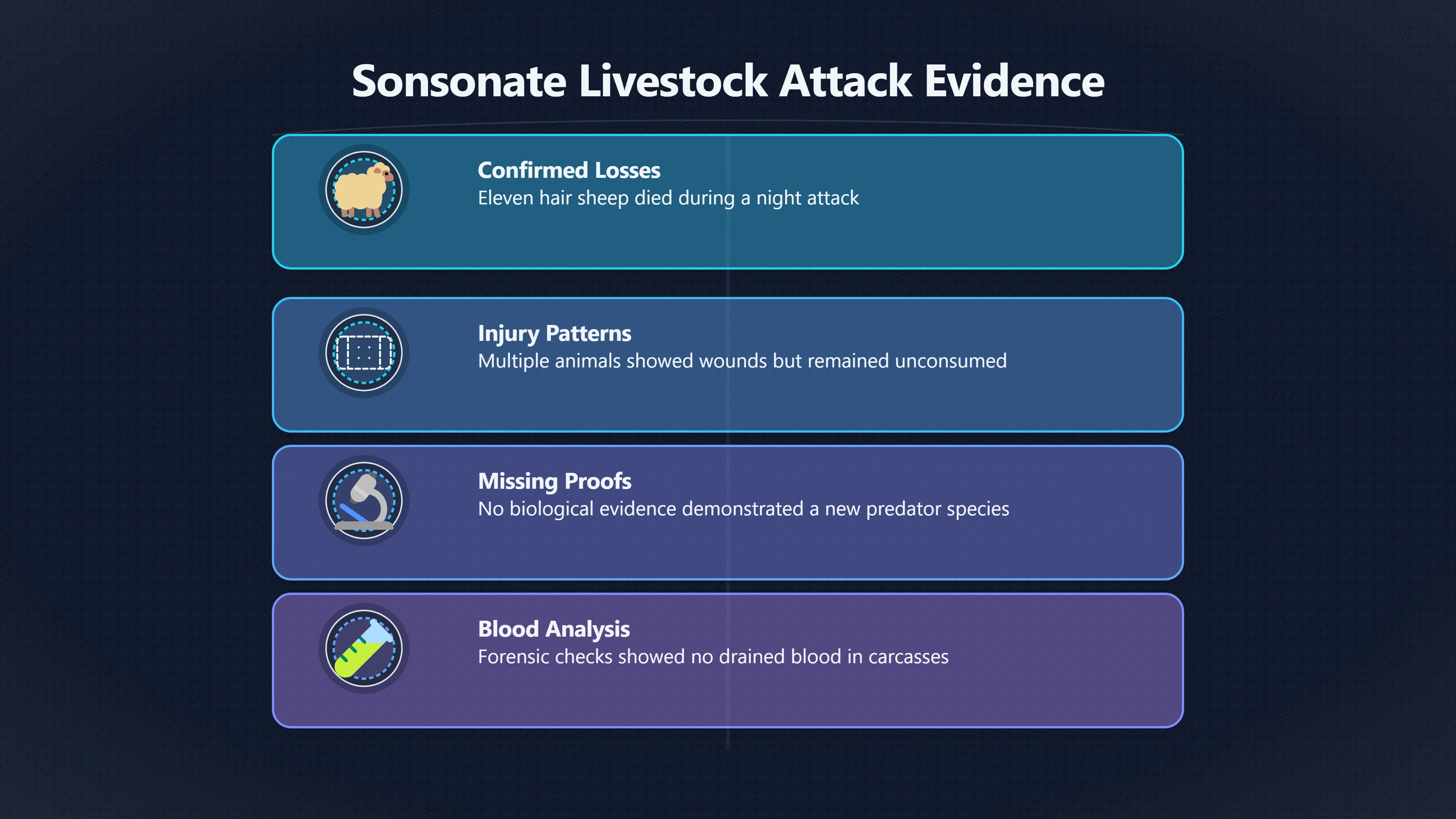
One of the most widely reported Salvadoran incidents occurred in Sonsonate in February 2014. Farmers reported that eleven hair sheep had been killed and many others injured during a night-time attack. Local residents speculated that the Chupacabra might be responsible because the animals appeared wounded but not fully consumed.[Wikipedia]WikipediaOpen source on wikipedia.org.
What the incident established is straightforward:
- Livestock were attacked.
- Multiple animals died.
- The responsible animal was not immediately identified.
- Residents proposed the Chupacabra as an explanation.
What it did not establish was equally important:
- No unknown species was captured.
- No biological evidence demonstrated a new predator.
- No forensic investigation showed that animals had been drained of blood.
- No repeatable evidence linked the deaths to a monster rather than a known animal.
This gap between observation and interpretation is central to understanding the legend. A predator attack is evidence of a predator attack. It is not automatically evidence of an extraordinary predator.
Why the Wounds Seemed Mysterious
Many Chupacabra stories rely on details that sound unusual to non-specialists but are not necessarily unusual to wildlife investigators.
Reports frequently mention:
- Neck wounds.
- Limited feeding on the carcass.
- Multiple animals killed in a single night.
- Apparent absence of large amounts of blood.
Each of these observations can occur during attacks by known predators. Coyotes, dogs and other canids sometimes kill more animals than they consume, especially when livestock are confined and panic spreads through a pen. Predators may abandon carcasses after the attack or return later. Puncture wounds around the neck are also common because predators often target the throat.[Wikipedia]WikipediaOpen source on wikipedia.org.
Claims that animals were completely drained of blood have repeatedly failed under closer examination. Veterinary investigations connected with the wider Chupacabra phenomenon found that carcasses generally contained blood and showed injuries consistent with conventional predation.[Wikipedia]WikipediaOpen source on wikipedia.org.
The result is a recurring pattern: a genuinely shocking livestock death acquires dramatic details as it is retold, making the event seem more mysterious than the physical evidence supports.

The Scientific Explanations Behind Chupacabra Reports
Researchers examining the broader Chupacabra phenomenon have identified several mechanisms that help explain sightings and livestock attacks.
Misidentified Predators
One of the strongest explanations involves coyotes, dogs and other canids suffering from severe mange, a skin disease caused by parasitic mites. Mange can cause dramatic hair loss, thickened skin and an unusual appearance that makes familiar animals seem unrecognisable.[mongabay.com]news.mongabay.comMongabay NewsMystery of the chupacabra monster likely solvedBiologist Barry OConnor says that most chupacabra sightings are probably link…
Biologists studying alleged Chupacabra specimens in North America repeatedly found that carcasses presented as monsters were actually known animals, most commonly coyotes affected by mange. DNA testing consistently pointed towards ordinary species rather than undiscovered creatures.[Wikipedia]WikipediaOpen source on wikipedia.org.
Predator Behaviour Misunderstood
Another factor is the way predators behave during livestock attacks. People often expect a predator to consume most of a carcass immediately. In reality, attacks do not always follow that pattern. Injured, inexperienced or stressed predators may leave prey behind, and multiple animals can be killed during a single event.[Wikipedia]WikipediaOpen source on wikipedia.org.
Media Amplification
Once a community becomes familiar with the Chupacabra story, later incidents are interpreted through that framework. Instead of asking, “Which predator caused this?”, people may begin by asking, “Could this be the Chupacabra again?”
That shift changes how evidence is perceived. Ambiguous details become supporting clues rather than reasons for caution.
Why Unexplained Carcasses Keep Reviving the Story
The Chupacabra survives because it occupies a space between folklore and apparent eyewitness evidence.
Unlike legends that exist entirely in stories, Chupacabra reports usually begin with something tangible: a dead animal, damaged livestock or a strange-looking creature seen at night. These real events give the legend credibility and allow it to reappear whenever a new incident occurs.
Several features help keep the story alive:
- Rural attacks often happen in darkness and are poorly witnessed.
- Carcasses can be altered by scavengers before examination.
- Witnesses may see only a brief glimpse of an animal.
- News coverage often highlights mystery before explanations emerge.
- Ordinary explanations can feel less satisfying than a monster narrative.
The legend is also flexible. Different reports describe entirely different creatures: reptilian, canine, alien-like, winged or hairless. Rather than weakening belief, these contradictions often allow the story to adapt to whatever evidence happens to appear.[Wikipedia]WikipediaOpen source on wikipedia.org.

What the Salvadoran Cases Reveal
The Salvadoran Chupacabra episodes are best understood as a combination of real livestock losses and uncertain interpretation. Farmers experienced genuine economic damage and genuine fear. What never emerged was convincing biological evidence that an unknown predator existed.
That makes the Chupacabra an instructive example within El Salvador’s wider history of contested claims and modern legends. It shows how an unexplained event can become attached to a powerful narrative, especially when the explanation is memorable, dramatic and already familiar from regional media coverage.
The enduring mystery is therefore not the existence of a monster. It is the social process by which ordinary livestock attacks can be transformed into evidence for one. In El Salvador, as elsewhere in Latin America, the Chupacabra became famous not because it was proven, but because it provided a compelling answer before the facts were fully known.[wikipedia.org]WikipediaOpen source on wikipedia.org.
Amazon book picks
Further Reading
Books and field guides related to What Really Killed El Salvador's Livestock?. Use these as the next step if you want deeper reading beyond the article.
The Skeptic's Guide to the Paranormal
Explains how extraordinary animal-attack claims are investigated.
eBay marketplace picks
Marketplace Samples
Live-tested eBay searches with available results related to this page.

Endnotes
1.
Source: Wikipedia
Link:https://en.wikipedia.org/wiki/Chupacabra
2.
Source: news.mongabay.com
Link:https://news.mongabay.com/2010/10/mystery-of-the-chupacabra-monster-likely-solved/
Source snippet
Mongabay NewsMystery of the chupacabra monster likely solvedBiologist Barry OConnor says that most chupacabra sightings are probably link...
3.
Source: Wikipedia
Link:https://es.wikipedia.org/wiki/Chupacabras
4.
Source: nationalgeographic.com
Title: 101028 chupacabra evolution halloween science monsters chupacabras picture
Link:https://www.nationalgeographic.com/culture/article/101028-chupacabra-evolution-halloween-science-monsters-chupacabras-picture
Source snippet
Since chupacabras are likely mangy coyotes, this explains why they're are often called “goat suckers,” attacking...Read more...
Additional References
5.
Source: youtube.com
Link:https://www.youtube.com/watch?v=Hh-G14e4GGo
Source snippet
Chupacabra–Coyote Connection? The Mystery of the Blue DogsWe look at photos of a strange canine many people call a 'Blue Dog.' Could this...
6.
Source: youtube.com
Link:https://www.youtube.com/watch?v=k9-u5z46ka4
Source snippet
The Horrifying Killings of El Chupacabra • Mystery FilesSensitive topics: deceased animals/animal mutilation Have you ever found yourself...
7.
Source: downtoearth.org.in
Title: Down To Earth Is the Chupacabra a Mangy Coyote or Raccoon?
Link:https://www.downtoearth.org.in/wildlife-biodiversity/is-the-cryptid-chupacabra-of-the-americas-actually-a-coyote-or-raccoon-with-mange
Source snippet
Texas...17 Oct 2024 — All characteristics of a chupacabra as described by eye witnesses match those of cainids with mange says John Tome...
8.
Source: ckwri.tamuk.edu
Title: CK Wildlife Research Institute CKWRI’s Dr
Link:https://www.ckwri.tamuk.edu/news-events/ckwris-dr-scott-henke-gives-his-interpretation-chupacabra
Source snippet
Scott Henke gives his interpretation of the...In less than 30 years, the Chupacabra has become a true horrific phenomenon. This resolute...
9.
Source: princeton.edu
Link:https://www.princeton.edu/~accion/chupa21.html
10.
Source: shutterstock.com
Link:https://www.shutterstock.com/es/search/chupacabras
11.
Source: desmos.com
Link:https://www.desmos.com/scientific
12.
Source: sbcm.co.uk
Link:https://sbcm.co.uk/wp-content/uploads/2025/11/The-deadly-Chupacabra.pdf
13.
Source: facebook.com
Link:https://www.facebook.com/PBSDigitalStudios/videos/el-chupacabras-a-modern-mystery-monstrum/1508873919292615/
14.
Source: facebook.com
Link:https://www.facebook.com/groups/231061140337469/posts/4379524388824436/
Topic Tree