Within Guatemala Deceptions
How a Fake Army Won Through Radio
A clandestine station invented rebel victories to make a tiny invasion force seem unstoppable during Guatemala's 1954 coup.
On this page
- Why the rebel force needed an illusion
- How the Voice of Liberation fabricated victory
- What the deception changed and what it did not
Page outline Jump by section
Introduction
In June 1954, a small US-backed force crossed into Guatemala with little chance of winning a conventional war. Yet within days President Jacobo Árbenz’s government was collapsing. One of the most important reasons was not military strength but a carefully constructed illusion: a clandestine radio station that convinced many listeners that a powerful rebel army was sweeping across the country. The station, known as the Voice of Liberation (La Voz de la Liberación), was a CIA psychological warfare project created as part of Operation PBSUCCESS. It broadcast invented victories, exaggerated defections and fabricated reports of rebel advances, helping turn a minor invasion into what seemed like an unstoppable national uprising.[wikipedia.org]Wikipedia1954 Guatemalan coup d'étatApril 8, 2026 — The most wide-reaching psychological weapon was the radio station Voice of Liberation, La Voz de la Liberación. E. Howard…

The episode is one of Guatemala’s most significant examples of political deception. Unlike a forged document or a fake photograph, the trick depended on controlling perceptions in real time. The goal was not simply to spread false information but to make soldiers, officials and civilians believe that resistance had already become futile.[wikipedia.org]Wikipedia1954 Guatemalan coup d'étatApril 8, 2026 — The most wide-reaching psychological weapon was the radio station Voice of Liberation, La Voz de la Liberación. E. Howard…
Why the Rebel Force Needed an Illusion
The military reality facing the anti-Árbenz rebels was stark. Carlos Castillo Armas entered Guatemala with only a few hundred fighters. The Guatemalan army was much larger and, on paper, capable of defeating the invasion. CIA planners understood that battlefield victories alone were unlikely to bring down the government. Instead, they aimed to undermine confidence within the army and among political elites.[wikipedia.org]WikipediaGuatemalan RevolutionGuatemalan Revolution
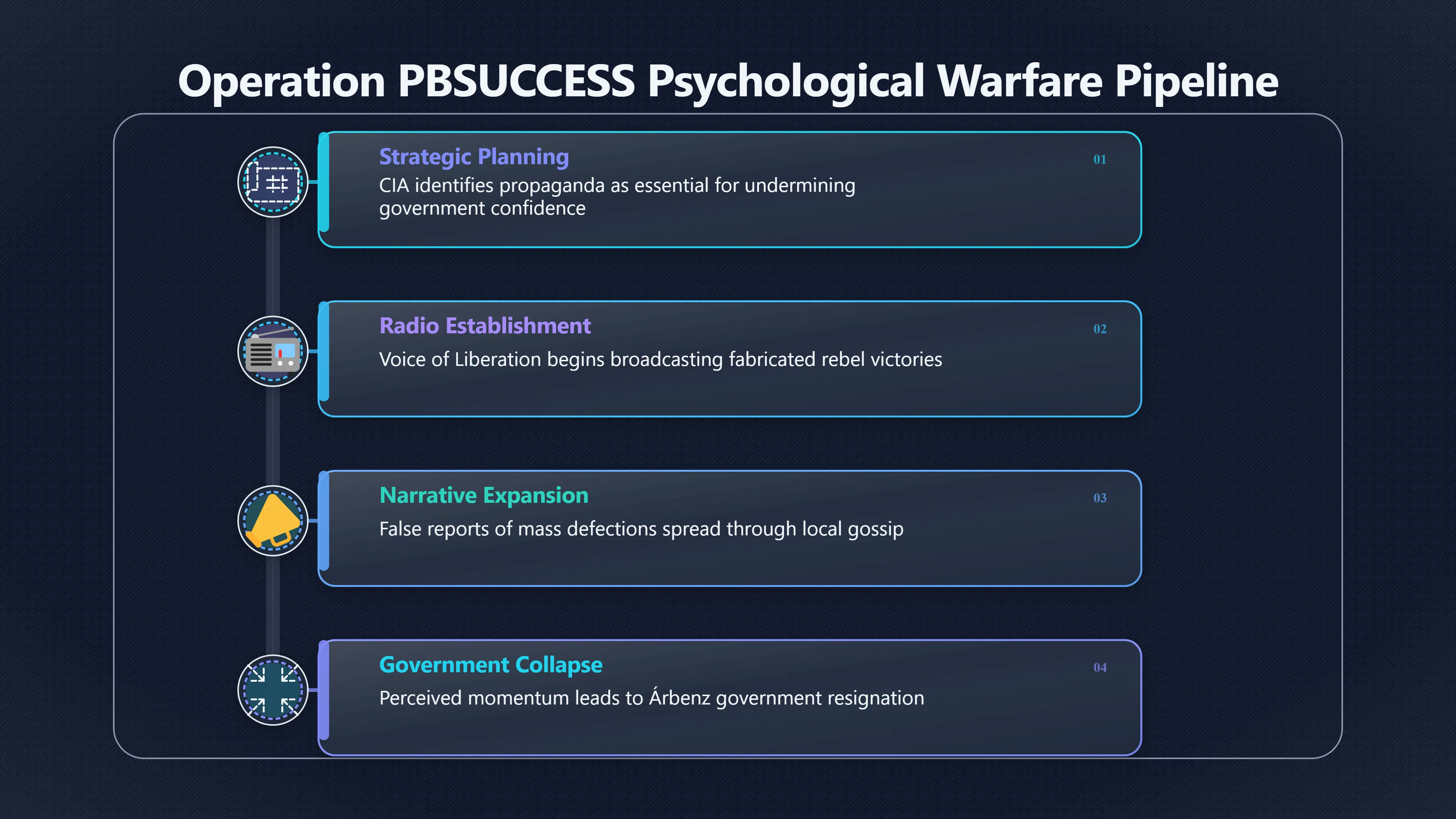
Psychological warfare had been built into the operation from the beginning. Declassified planning documents show that propaganda and political action were considered essential components of the campaign rather than secondary support activities. CIA officials believed that if key officers concluded that Árbenz was doomed, they might refuse to defend him even if the rebels remained militarily weak.[Office of the Historian]history.state.govOffice of the HistorianForeign Relations of the United States, 1952–1954, GuatemalaAs a result of this, existing CIA assets personnelwise…
The radio station became the centrepiece of that strategy because radio was one of the fastest ways to reach large audiences in 1950s Guatemala. News often travelled through broadcasts, rumours and word of mouth. If listeners could be persuaded that rebel columns were appearing everywhere at once, the perception of momentum could become more important than the actual balance of forces.[gwu.edu]nsarchive2.gwu.eduNational Security ArchiveE55-56The Voice of Liberation. As Guatemalans turned on their short-wave radios on the morning of 1 May 1954, th…
How the Voice of Liberation Fabricated Victory
The Voice of Liberation began broadcasting on 1 May 1954. It claimed to be operating from inside Guatemala, supposedly from territory controlled by anti-government forces deep in the countryside. In reality, the operation was organised by the CIA and its collaborators. David Atlee Phillips, who later became a well-known CIA officer, played a central role in directing the broadcasts.[wikipedia.org]Wikipedia1954 Guatemalan coup d'étatApril 8, 2026 — The most wide-reaching psychological weapon was the radio station Voice of Liberation, La Voz de la Liberación. E. Howard…
The station’s power came from its presentation. Rather than sounding like a foreign propaganda outlet, it imitated the style of a local revolutionary broadcaster. Announcers delivered urgent bulletins, battlefield updates and reports from supposed rebel commanders. The broadcasts created the impression that listeners were hearing information from a growing resistance movement already active across the country.[gwu.edu]nsarchive2.gwu.eduNational Security ArchiveE55-56The Voice of Liberation. As Guatemalans turned on their short-wave radios on the morning of 1 May 1954, th…
Many of the station’s most dramatic reports were exaggerated or entirely fabricated. It announced victories that had not occurred, described rebel units that did not exist and suggested that government forces were defecting in large numbers. The station repeatedly portrayed Castillo Armas’s forces as far larger and more successful than they really were.[gwu.edu]nsarchive2.gwu.eduNational Security ArchiveE55-56The Voice of Liberation. As Guatemalans turned on their short-wave radios on the morning of 1 May 1954, th…
Several techniques made the deception persuasive:
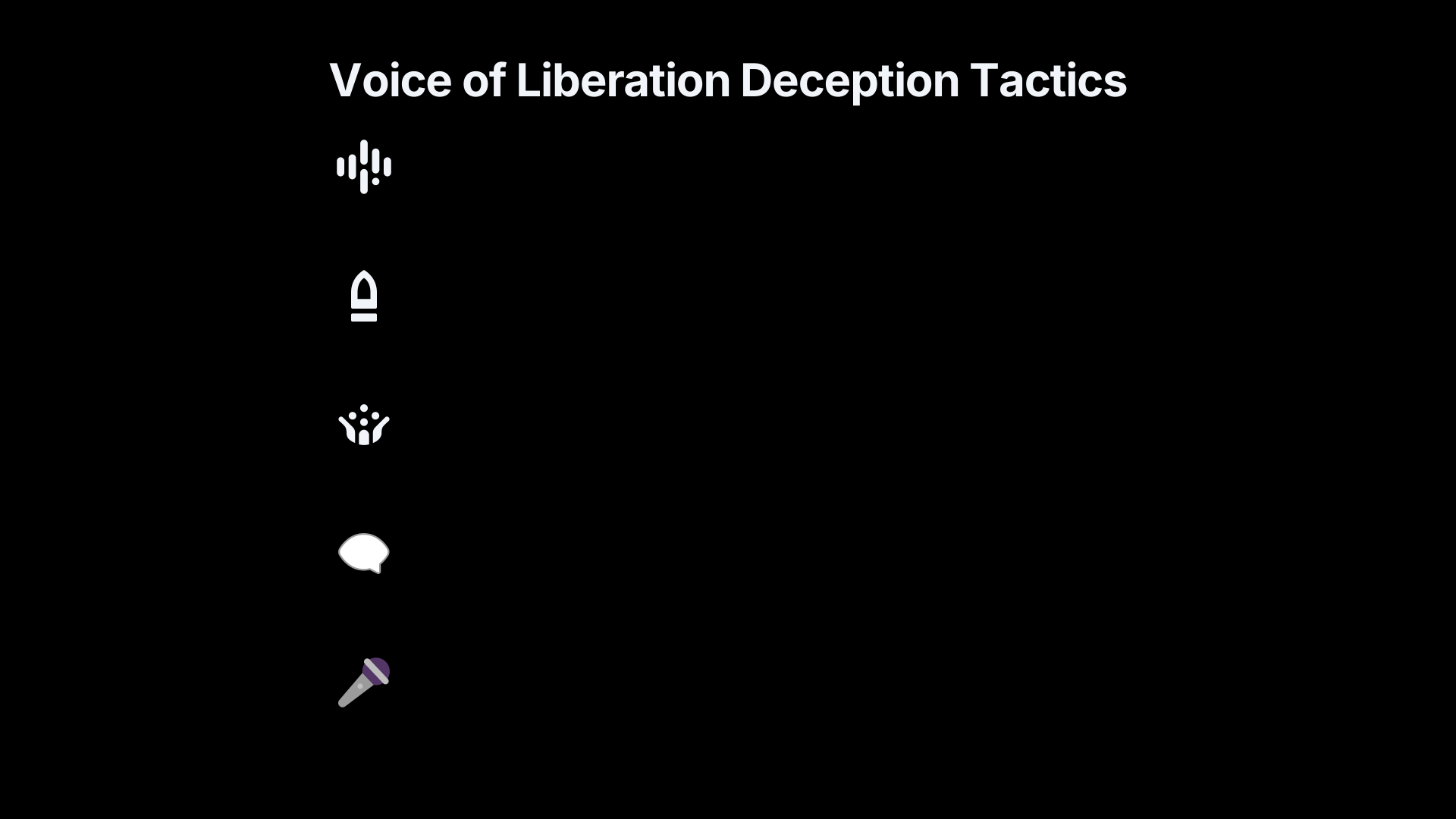
- False location claims: The station insisted it was broadcasting from within Guatemala, giving the impression of an established insurgent network.[wikipedia.org]Wikipedia1954 Guatemalan coup d'étatApril 8, 2026 — The most wide-reaching psychological weapon was the radio station Voice of Liberation, La Voz de la Liberación. E. Howard…
- Invented battlefield reports: Announcers described rebel advances and victories regardless of the actual military situation.[National Security Archive]nsarchive2.gwu.eduNational Security ArchiveE55-56The Voice of Liberation. As Guatemalans turned on their short-wave radios on the morning of 1 May 1954, th…
- Claims of mass support: Broadcasts suggested that civilians, soldiers and local leaders were rapidly joining the rebellion.[Wikipedia]Wikipedia1954 Guatemalan coup d'étatApril 8, 2026 — The most wide-reaching psychological weapon was the radio station Voice of Liberation, La Voz de la Liberación. E. Howard…
- Constant repetition: Messages were repeated frequently, helping rumours circulate beyond the radio audience through conversations and local gossip.[Radio Survivor]radiosurvivor.comhow the cia used radio in the 1954 guatemala couphow the cia used radio in the 1954 guatemala coup
The operation also benefited from circumstances beyond CIA planning. At one point Guatemala’s state radio service experienced a scheduled interruption, reducing competition for listeners and making the clandestine station more prominent.[Radio Survivor]radiosurvivor.comhow the cia used radio in the 1954 guatemala couphow the cia used radio in the 1954 guatemala coup
Why So Many People Believed It
The Voice of Liberation did not succeed because every listener accepted every claim. Its effectiveness came from uncertainty. During a fast-moving political crisis, people often lacked reliable information. Few Guatemalans could independently verify reports from distant towns or military zones.[National Security Archive]nsarchive2.gwu.eduNational Security ArchiveE55-56The Voice of Liberation. As Guatemalans turned on their short-wave radios on the morning of 1 May 1954, th…
The broadcasts were reinforced by other elements of the coup campaign. Aircraft associated with the operation carried out limited attacks that created a sense of danger out of proportion to their military impact. Leaflets circulated. Rumours spread through cities and army barracks. The radio station then tied these events together into a narrative of inevitable rebel victory.[archives.gov]text-message.blogs.archives.govThe Text Message The CIA in GuatemalaThe Text MessageThe CIA in Guatemala - The Text MessageFeb 13, 2012 — CIA methods employed in their Guatemalan operations included misinf…
Foreign journalists occasionally repeated information originating from the broadcasts, allowing claims from a covert propaganda outlet to acquire additional credibility. Once stories moved beyond the station itself and entered wider reporting networks, distinguishing fact from fiction became even more difficult.[Radio Survivor]radiosurvivor.comhow the cia used radio in the 1954 guatemala couphow the cia used radio in the 1954 guatemala coup
Most importantly, the station targeted decision-makers as much as ordinary listeners. Senior military officers did not need to believe every report. They only needed to fear that other officers believed them. The resulting uncertainty encouraged hesitation and weakened confidence in the government’s ability to survive.[digitalcommons.denison.edu]digitalcommons.denison.eduOpen source on denison.edu.
What the Deception Changed — and What It Did Not
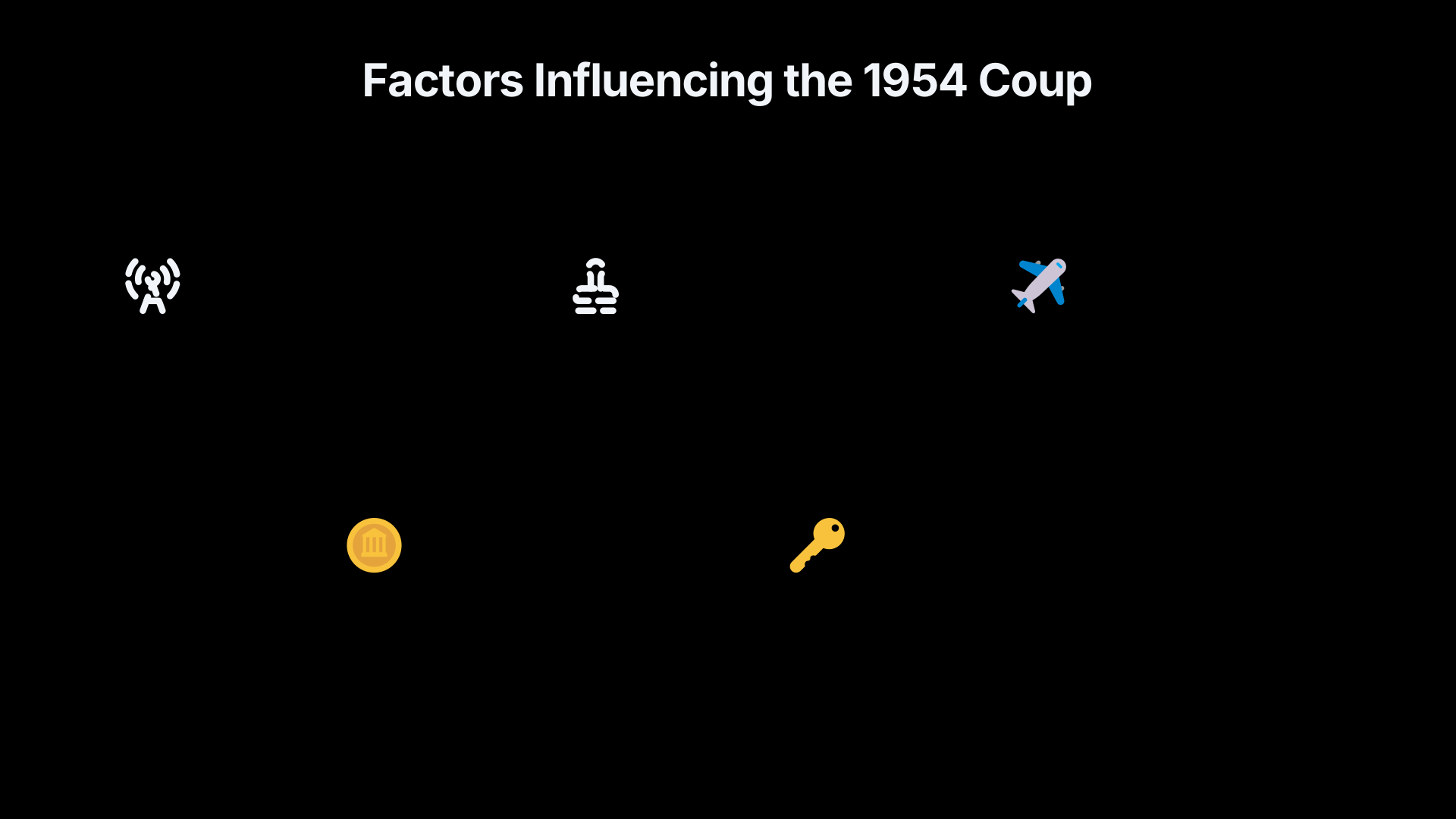
The Voice of Liberation was influential, but it did not single-handedly overthrow Árbenz. The coup also involved diplomatic pressure, covert political operations, military actions, economic pressure and efforts to influence members of the Guatemalan armed forces. Árbenz’s resignation resulted from the interaction of these factors rather than from radio broadcasts alone.[state.gov]history.state.govOpen source on state.gov.
What the station clearly changed was the perceived balance of power. It helped transform a small rebel force into what appeared to be a broad national movement. By magnifying the rebels’ strength and minimising their setbacks, the broadcasts contributed to a climate in which resistance seemed increasingly pointless.[wikipedia.org]WikipediaGuatemalan RevolutionGuatemalan Revolution
The deception therefore worked less as a substitute for military action than as a force multiplier. It exploited fear, uncertainty and the difficulty of verifying information during a crisis. The station’s success demonstrated that perceptions could become strategically important even when they diverged sharply from reality.[gwu.edu]nsarchive2.gwu.eduNational Security ArchiveE55-56The Voice of Liberation. As Guatemalans turned on their short-wave radios on the morning of 1 May 1954, th…
How the Story Was Exposed
The true nature of the operation became clearer over time through memoirs, historical research and the release of declassified US government documents. Records from the CIA and the US State Department revealed the planning behind Operation PBSUCCESS, including the central role assigned to psychological warfare and the Voice of Liberation broadcasts.[CIA]cia.govMATERIALS FOR PSYCHOLOGICAL WARFARE SUPPORTArbenz government does utilize the official radio, "La Voz de Guatemala," in presenting the…
Historians examining these records found that the station had been designed specifically to create an exaggerated image of rebel power. What many listeners experienced as spontaneous revolutionary reporting was in fact a carefully managed information campaign. The broadcasts became one of the best-documented examples of Cold War psychological warfare in Latin America.[gwu.edu]nsarchive2.gwu.eduNational Security ArchiveE55-56The Voice of Liberation. As Guatemalans turned on their short-wave radios on the morning of 1 May 1954, th…
Why the Radio Deception Still Matters
The Voice of Liberation remains relevant because it anticipated techniques that later became common in information warfare. The operation showed how a relatively small media outlet could shape political events if it appeared credible, repeated its message consistently and exploited existing fears.[Dialnet]dialnet.unirioja.esOpen source on unirioja.es.
For Guatemala, the episode stands as a reminder that one of the country’s most consequential political turning points was influenced not only by soldiers and weapons but also by a manufactured narrative. The coup’s radio campaign demonstrated that a fake army did not have to exist physically in order to affect real decisions. If enough people believed it existed, the illusion itself could become a political force.[wikipedia.org]Wikipedia1954 Guatemalan coup d'étatApril 8, 2026 — The most wide-reaching psychological weapon was the radio station Voice of Liberation, La Voz de la Liberación. E. Howard…
eBay marketplace picks
Marketplace Samples
Example marketplace items related to this page. Use the search link to explore similar finds on eBay.


Endnotes
1.
Source: Wikipedia
Title: 1954 Guatemalan coup d’état
Link:https://en.wikipedia.org/wiki/1954_Guatemalan_coup_d%27%C3%A9tat
Source snippet
April 8, 2026 — The most wide-reaching psychological weapon was the radio station Voice of Liberation, La Voz de la Liberación. E. Howard...
Published: April 8, 2026
2.
Source: cia.gov
Title: DOC 0000135031
Link:https://www.cia.gov/readingroom/docs/DOC_0000135031.pdf
Source snippet
CIA(ESTIMATED PUB DATE) THE SHERWOOD TAPESRadio Liberation first came up on the air on 1 May 1954. It closed down on 2 July. 1954. Statio...
Published: May 1954
3.
Source: cia.gov
Link:https://www.cia.gov/readingroom/docs/DOC_0000914007.pdf
Source snippet
MATERIALS FOR PSYCHOLOGICAL WARFARE SUPPORTArbenz government does utilize the official radio, "La Voz de Guatemala," in presenting the...
4.
Source: Wikipedia
Title: Guatemalan Revolution
Link:https://en.wikipedia.org/wiki/Guatemalan_Revolution
5.
Source: Wikipedia
Title: Central Intelligence Agency
Link:https://en.wikipedia.org/wiki/Central_Intelligence_Agency
6.
Source: history.state.gov
Link:https://history.state.gov/historicaldocuments/frus1952-54Guat/d51
Source snippet
Office of the HistorianForeign Relations of the United States, 1952–1954, GuatemalaAs a result of this, existing CIA assets personnelwise...
7.
Source: history.state.gov
Link:https://history.state.gov/historicaldocuments/frus1952-54Guat/d287
8.
Source: cia.gov
Link:https://www.cia.gov/readingroom/docs/DOC_0000917063.pdf
9.
Source: dsc.duq.edu
Link:https://dsc.duq.edu/cgi/viewcontent.cgi?article=2290&context=etd
10.
Source: history.state.gov
Title: Office of the Historian Historical Documents
Link:https://history.state.gov/historicaldocuments/frus1952-54Guat/d142
11.
Source: digitalcommons.denison.edu
Link:https://digitalcommons.denison.edu/cgi/viewcontent.cgi?article=1162&context=studentscholarship
12.
Source: adst.org
Link:https://adst.org/2016/06/cleaning-americas-backyard-overthrow-guatemalas-arbenz/
13.
Source: history.state.gov
Link:https://history.state.gov/historicaldocuments/frus1952-54Guat/d224
14.
Source: 2001-2009.state.gov
Link:https://2001-2009.state.gov/r/pa/ho/frus/ike/guat/20176.htm
15.
Source: nsarchive2.gwu.edu
Link:https://nsarchive2.gwu.edu/NSAEBB/ciacase/E55-56.pdf
Source snippet
National Security ArchiveE55-56The Voice of Liberation. As Guatemalans turned on their short-wave radios on the morning of 1 May 1954, th...
Published: May 1954
16.
Source: text-message.blogs.archives.gov
Title: The Text Message The CIA in Guatemala
Link:https://text-message.blogs.archives.gov/2012/02/13/the-cia-in-guatemala/
Source snippet
The Text MessageThe CIA in Guatemala - The Text MessageFeb 13, 2012 — CIA methods employed in their Guatemalan operations included misinf...
17.
Source: militarystrategymagazine.com
Title: Military Strategy Magazine Operation PBSUCCESS: U.S
Link:https://www.militarystrategymagazine.com/article/operation-pbsuccess-u-s-covert-action-in-guatemala/
Source snippet
Covert Action in GuatemalaOperation PBSUCCESS was a covert operation carried out by CIA that deposed the democratically elected Guatemala...
18.
Source: radiosurvivor.com
Title: how the cia used radio in the 1954 guatemala coup
Link:https://www.radiosurvivor.com/2011/03/how-the-cia-used-radio-in-the-1954-guatemala-coup/
19.
Source: dialnet.unirioja.es
Link:https://dialnet.unirioja.es/servlet/articulo?codigo=10075425
Additional References
20.
Source: youtube.com
Link:https://www.youtube.com/watch?v=lLj1x5J1iJs
Source snippet
Operation PBSuccess: Inside The CIA's Hunt for a Terrorist Mastermind...
21.
Source: youtube.com
Title: Operation PBSuccess: Inside The CIA’s Hunt for a Terrorist Mastermind
Link:https://www.youtube.com/watch?v=Vz85iXK5Z3o
Source snippet
The 1954 Guatemalan Coup Part 2 | STUFF YOU MISSED IN HISTORY CLASS...
22.
Source: youtube.com
Link:https://www.youtube.com/watch?v=Wo0uuySjfH4
Source snippet
How The CIA Invaded Guatemala Using A Rebel Army Of 500 Men...
23.
Source: youtube.com
Title: How The CIA Invaded Guatemala Using A Rebel Army Of 500 Men
Link:https://www.youtube.com/watch?v=A_Ho8cQ2ZZE
Source snippet
America's Regime Change Playbook, Explained...
24.
Source: ebsco.com
Link:https://www.ebsco.com/research-starters/history/guatemala-invasion
25.
Source: narratively.com
Link:https://www.narratively.com/p/the-literally-unbelievable-story-of-the-original-fake-news-network-full
26.
Source: facebook.com
Title: in 1954 the cia enlisted a right wing radio host and a us senator in a plot to s
Link:https://www.facebook.com/jacobinmag/posts/in-1954-the-cia-enlisted-a-right-wing-radio-host-and-a-us-senator-in-a-plot-to-s/1245792261050455/
27.
Source: youtube.com
Link:https://www.youtube.com/watch?v=CPWdLQCalX8
28.
Source: youtube.com
Link:https://www.youtube.com/shorts/HHJBNtEz_M0
29.
Source: narratively.com
Title: the literally unbelievable story of the original fake news network
Link:https://www.narratively.com/p/the-literally-unbelievable-story-of-the-original-fake-news-network
Topic Tree