Which Saudi Hoax Stories Survived the Evidence?
Saudi Arabia’s best-known hoax stories are not a single tradition of home-grown trickery. They are a mixture of fabricated “discoveries”, disputed archaeological claims, staged photographs stripped of their original meaning, religious pseudo-history and political disinformation that used Saudi media networks or Saudi locations to gain authority.
Page outline Jump by section
Introduction
These episodes matter because they show how readily a believable setting can substitute for evidence. Desert excavation sites, inaccessible mountains, official news channels and emotionally powerful photographs all make claims feel authentic before anyone checks their origins.
The giant skeleton that began as a Photoshop contest
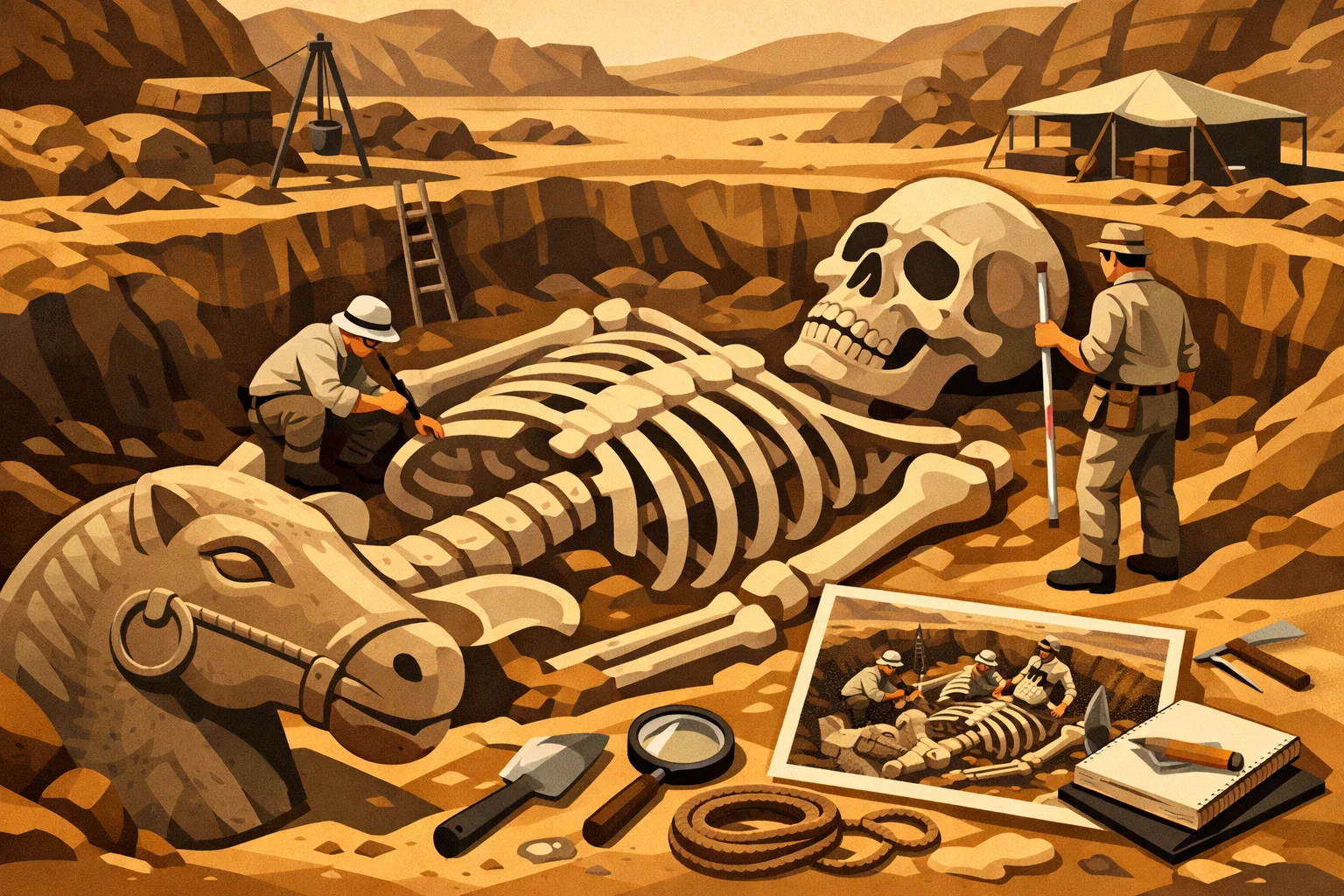
The image usually shows several archaeologists gathered around an enormous human skeleton in a deep excavation. In one widely circulated version, the bones were supposedly found in Saudi Arabia by an oil-exploration team connected with Saudi Aramco. The accompanying message often claimed that the discovery had been suppressed, sometimes adding that the skeleton belonged to an ancient race of giants mentioned in religious tradition.
No such excavation occurred. The picture was created for a 2002 competition on Worth1000, a website whose users manipulated photographs to produce imaginary archaeological discoveries. Its maker enlarged a real human skeleton and inserted it into a photograph of a mastodon excavation near Hyde Park, New York. The original contest context was lost as the image moved through email chains, forums and later social media.[National Geographic]nationalgeographic.comNational GeographicFind Out How the Giant Skeleton Hoax Started14 Dec 2007 — Alex Boese, "curator" of the virtual Museum of Hoaxes, said…
Saudi Arabia was an effective setting for several reasons. Its vast deserts made a secret excavation seem geographically plausible. The country’s association with oil exploration supplied an imagined discovery mechanism: a drilling or survey team could supposedly uncover something in a remote area. References to religious giants then gave the picture a ready-made explanation and encouraged recipients to treat scepticism as resistance to sacred history rather than as a request for evidence.
The deception also benefited from a familiar internet pattern. The image looked documentary, while the text supplied unnamed witnesses, institutional authority and a reason why no reliable report could be found: the authorities had allegedly concealed it. This made absence of evidence part of the story rather than a weakness in it. Variants later relocated the same or similar skeletons to India and elsewhere, showing that the landscape was interchangeable even though the Saudi version became especially persistent. Researchers studying belief in giant-skeleton stories have noted how the altered images continued circulating long after their contest origin had been identified.[Sage Journals]journals.sagepub.comSage Journals Who Believes in the Giant Skeleton Myth?An Examination…by V Swami · 2016 · Cited by 29 — Although a myth (the origin of accompanying photographs have been traced to an entry…
The case is a clear hoax, but its original creator did not necessarily intend the later religious and archaeological claims. The deliberate visual joke became misinformation when other people removed it from its creative setting and supplied a false history.
Al-Magar and the claim of the world’s earliest horse riders
The discoveries at Al-Magar in south-western Saudi Arabia present a different problem. The site is real, the stone objects are real, and its prehistoric occupation is archaeologically important. The disputed claim is that one large animal sculpture, sometimes described as wearing a bridle, proves that people in Arabia domesticated horses roughly 9,000 years ago—thousands of years earlier than the generally accepted evidence from the Eurasian steppe.
Saudi antiquities officials promoted this interpretation after the site became publicly known in 2010 and 2011. Reports described an approximately 86-centimetre stone sculpture resembling the head, neck and shoulder of an equid. Grooves or bands on the object were interpreted as possible harness equipment, while dated organic material from the wider site was used to place human occupation there in the Neolithic period. The discovery was therefore presented not merely as early art, but as evidence that Arabian communities had domesticated horses at an extraordinarily early date.[AramcoWorld]archive.aramcoworld.comSaudi Aramco World: Discovery at al-MagarBut there is no controversy that al-Magar constitutes a significant discovery…
The central difficulty is that dating a settlement does not automatically date every object associated with it, particularly when an artefact was not recovered during a fully documented controlled excavation. Nor does an image of a horse-like animal prove domestication. A band on a sculpture might represent tack, but it could also be decorative, anatomical or the result of damage. Even identifying the species is not straightforward when working from a stylised fragment.
A detailed academic review by archaeologist Jérémie Schiettecatte concluded that Al-Magar is an important prehistoric site but treated the horse-domestication claim cautiously. The animal sculptures may belong to the site’s Neolithic occupation and some appear to depict equids, yet the evidence does not securely demonstrate that the large sculpture is a domesticated horse or that it dates to the earliest occupation phase. Horse-domestication specialist David Anthony likewise said only that the object “might be” of the proposed date, rather than accepting the stronger conclusion.[OpenEdition Journals]journals.openedition.org3,500 years before the first evidence of horse domestication known so far. It has stirred up controversy about the ongoing…Read more…
Calling Al-Magar a hoax would therefore be misleading. No public evidence has established that the artefacts were deliberately forged or planted. The more defensible description is an authentic discovery burdened with an overextended interpretation. National prestige, the cultural importance of the Arabian horse and the appeal of overturning a familiar historical narrative all helped the strongest version of the claim travel farther than the cautions attached to it.
The episode demonstrates an important boundary in hoax history. A false or premature conclusion need not involve a conscious deceiver. Publicity can transform “this may depict an early equid” into “Arabians domesticated the first horses”, even though those statements require very different levels of evidence.
The Saudi photograph repeatedly turned into war propaganda
In January 2014, Saudi photographer Aziz Alotaibi created a staged image of a small boy sleeping between two long piles of stones. The picture was intended as a symbolic art project about an orphan’s continuing attachment to dead parents. The child was Alotaibi’s nephew, the supposed graves were constructed for the photograph, and the scene was shot near Yanbu in Saudi Arabia.
Once separated from the photographer’s explanation, the image acquired a succession of false captions. It was presented as a Syrian orphan sleeping beside the graves of parents killed in the civil war. Later versions moved the scene to Yemen, and in 2024 it circulated again as an image from Gaza. Reuters and AFP traced the picture back to Alotaibi’s project and found additional photographs of the same child and setting, confirming that it was staged rather than a record of a wartime death.[reuters.com]reuters.comImage of child sleeping between graves is an old art project, not in GazaImage of child sleeping between graves is an old art project, not in Gaza
This was not initially a photographic hoax. Staging is normal in conceptual photography when the image is presented as art. The deception arose through miscaptioning: people reused an emotionally forceful composition as documentary evidence of real suffering.
Several qualities made the photograph unusually reusable. Nothing visible in it fixed the location. The child’s face was partly hidden, the landscape was bare, and the stone piles could be described as graves in almost any conflict zone. The picture communicated grief instantly and therefore discouraged the slow questions that verification requires: Who took it? When was it first posted? Are there other frames? Do the alleged graves resemble local burial practices?
Alotaibi said he was upset that the picture had been twisted, noting that he had made the artificial nature of the scene clear when he published it. The false Syrian version nevertheless gained international attention within days.[The Independent]independent.co.ukOpen source on independent.co.uk.
The image illustrates how misinformation can exploit genuine compassion. People sharing it were not necessarily trying to deceive; many believed they were bearing witness to a real tragedy. Yet a fictionalised photograph can still distort public understanding, displace authentic images and turn an artist’s work into propaganda for causes he did not choose.

The Saudi mountain promoted as the “real” Mount Sinai
For decades, popular books, films, tours and websites have claimed that the biblical Mount Sinai is not in the Sinai Peninsula but at Jabal al-Lawz, or at a nearby peak in the same mountain range, in north-western Saudi Arabia. Advocates have identified a darkened summit as evidence of divine fire, stone formations as an altar, nearby rock art as depictions of the golden calf, and submerged shapes in the Gulf of Aqaba as the remains of Egyptian chariots.
The modern popularisation of the theory is closely associated with amateur explorer Ron Wyatt and later promoters who repeated or revised his claims. Its persuasiveness comes from assembling many suggestive-looking details into one narrative. A black mountain top resembles burning; ancient stone structures resemble biblical altars; local geography is fitted to descriptions of the Exodus route. Each item appears to support the others, even when none has been independently established.
Archaeological critiques have found major problems with this reasoning. The dark summit is ordinary rock rather than evidence of supernatural burning. Petroglyphs and structures in the wider region belong to known local archaeological traditions and are not securely connected with Israelites or the Exodus. Claims about chariot remains have not produced artefacts with documented recovery locations, laboratory analysis and publication in professional archaeological literature. The proposed identifications also rely heavily on selective resemblance rather than dated inscriptions or settlement evidence.[Associates For Biblical Research]biblearchaeology.orgOpen source on biblearchaeology.org.
The location of the biblical Mount Sinai remains debated within biblical studies, partly because the text does not provide a route that can be matched unambiguously to modern geography. That uncertainty does not make every proposed site equally credible. A plausible identification would require a coherent geographical argument supported by archaeological evidence that other researchers could inspect, date and challenge.
The Jabal al-Lawz story sits between pseudoarchaeology and religious legend rather than a simple one-off hoax. Some promoters may sincerely believe it. Others profit from books, documentaries, lectures and travel experiences. The absence of public access to some sensitive border areas has also helped the legend: restrictions can be reframed as proof that authorities are hiding a discovery, although restricted access is not evidence that the underlying claim is true.
Its continuing popularity reflects a wider appetite for biblical archaeology that seems visible and immediate. A scorched-looking summit is easier to understand than disputes over ancient place names, chronology and settlement patterns. The story offers viewers the sensation that a difficult historical problem has been solved by recognising objects in a landscape.
False quotations that helped trigger the Qatar crisis
The most consequential deception connected with Saudi Arabia was not an archaeological curiosity but a planted news report. On 23–24 May 2017, attackers compromised the Qatar News Agency’s website and social-media accounts and published remarks falsely attributed to Qatar’s emir, Sheikh Tamim bin Hamad Al Thani. The fabricated comments appeared to praise Iran, Hamas and Hezbollah, criticise aspects of United States policy and predict political trouble for the US president.
Qatar quickly said its systems had been hacked and that the statements were invented. Nevertheless, Saudi and Emirati-aligned television channels and news organisations treated the quotations as authentic and gave them extensive coverage. Some continued discussing their political meaning after the denial, allowing the false story to establish itself before forensic findings could catch up.[The Guardian]theguardian.comThe Guardian Quotes were falsely attributed to the emir of Qatar and itsThe Guardian Quotes were falsely attributed to the emir of Qatar and its
On 5 June, Saudi Arabia, the United Arab Emirates, Bahrain and Egypt severed relations with Qatar and imposed transport and economic restrictions. The hacked report was not the sole cause of the dispute—tensions over Qatar’s foreign policy, media operations and relations with political Islamist movements had developed over years—but it supplied an immediate and emotionally charged trigger.[Axios]axios.comAl Jazeera hit with cyberattackAl Jazeera hit with cyberattack
Attribution of the hacking was contested. Early reports suggested possible Russian involvement. The Washington Post later reported that United States intelligence officials believed the operation had been arranged by the United Arab Emirates, a claim the Emirati government denied. What became clear was that the quotations themselves were fabricated and had been planted on an authentic official platform.[washingtonpost.com]washingtonpost.comThe Washington Post UAE orchestrated hacking of Qatari government sitesThe Washington Post UAE orchestrated hacking of Qatari government sites
Saudi Arabia’s relevance lies primarily in amplification and political use rather than proven authorship of the hack. Saudi-controlled or aligned outlets helped turn the planted text into a regional event, and the Saudi government led the subsequent blockade. It would go beyond the available evidence to state as settled fact that Saudi officials created the false report.
The operation was effective because it reversed the normal warning signs of fake news. The story did not originate on an anonymous blog or an obviously manipulated screenshot. It appeared on the genuine website of a state news agency. Regional broadcasters could therefore cite an apparently primary source, while audiences encountering the reports later saw multiple outlets repeating the same allegation and mistook repetition for independent confirmation.
This episode shows why political disinformation can be more powerful than an ordinary rumour. A fabricated statement inserted into trusted infrastructure can provoke real government decisions before its authenticity is resolved. Once sanctions, broadcasts and public accusations begin, correcting the original falsehood does not reverse the consequences.

Celebrity fakes and the new Saudi setting
Saudi Arabia’s recent investment in international sport and entertainment has created another fertile setting for fabricated stories. Famous people now live, perform or compete in the kingdom, so manipulated images and invented claims about their behaviour can appear plausible.
A 2024 video, for example, was circulated as footage of footballer Cristiano Ronaldo reading the Koran after moving to Saudi club Al Nassr. Reuters found that the person in the original recording was a British-based Ronaldo lookalike and that the audio and presentation had been digitally manipulated.[Reuters]reuters.comOpen source on reuters.com.
The clip worked by combining resemblance with expectation. Ronaldo’s Saudi career made a story about his supposed religious life feel topical, while the use of a lookalike allowed the image to survive a quick glance. Such fabrications often invite viewers to celebrate or condemn what they see, encouraging immediate sharing before identity, source and editing are checked.
These celebrity stories are less consequential than the Qatar News Agency hack, but they reveal the same mechanism on a smaller scale: an authentic setting lends credibility to invented content. The person really is associated with Saudi Arabia; the fabricated behaviour is attached afterwards.
Why the same stories survive debunking
Saudi-linked hoaxes and false claims often persist because they make use of environments that most international readers cannot personally inspect. A remote excavation, a restricted mountain area or an unfamiliar archaeological site creates an information gap. Into that gap, a vivid photograph or confident narrator can place almost any interpretation.
Several recurring techniques appear across the cases:
- Borrowed authority. The giant-skeleton message invoked Saudi Aramco and archaeological teams. The Qatar fabrication appeared on a real state-news platform. Institutional names made the stories feel verified before the institutions themselves were checked.
- Ambiguous images. A stone band became a horse bridle; dark rock became a fire-scorched summit; staged piles of rubble became parents’ graves. The image was real, but its meaning was supplied by the caption.
- Suppression narratives. Lack of evidence was explained as censorship, restricted access or official concealment. This protected the claim from ordinary falsification.
- Emotional or identity rewards. The story might confirm scripture, establish national primacy, provoke sympathy for war victims or validate a political grievance. Believing and sharing it offered a social reward.
- Repetition across outlets. Once the same claim appeared in many posts, emails or broadcasts, audiences could easily mistake copying for corroboration.
The most reliable distinction is not between “official” and “unofficial” information, or between professional-looking and amateur material. It is between claims with traceable evidence and claims whose authority depends on appearance. Archaeological assertions need documented excavation contexts, direct dating and specialist scrutiny. Viral photographs need an identifiable first publication and surrounding frames. Political quotations require recordings, transcripts or confirmation that survives technical investigation.
Saudi Arabia’s hoax history is therefore less a collection of eccentric local beliefs than a study in how location, authority and emotion can be assembled into persuasive falsehood. Some stories were deliberate fabrications; others were art, speculation or sincere interpretation transformed by circulation. Understanding those differences is essential, because the methods used to expose a Photoshop joke are not the same as those required to assess a disputed artefact or investigate a hacked news agency.
Amazon book picks
Further Reading
Books and field guides related to Which Saudi Hoax Stories Survived the Evidence?. Use these as the next step if you want deeper reading beyond the article.
The Demon-Haunted World
Rating: 4.5/5 from 43 Google Books ratings
Classic guide to scientific skepticism and extraordinary claims.
Calling Bullshit
Explains how misleading claims gain credibility and how to evaluate evidence.
Suspicious Minds
Helps explain belief in hidden discoveries and suppression narratives.
eBay marketplace picks
Marketplace Samples
Live-tested eBay searches with available results related to this page.


Endnotes
1.
Source: archive.aramcoworld.com
Link:https://archive.aramcoworld.com/issue/201203/discovery.at.al-magar.htm
Source snippet
Saudi Aramco World: Discovery at al-MagarBut there is no controversy that al-Magar constitutes a significant discovery...
2.
Source: journals.openedition.org
Link:https://journals.openedition.org/arabianhumanities/3280
Source snippet
3,500 years before the first evidence of horse domestication known so far. It has stirred up controversy about the ongoing...Read more...
3.
Source: reuters.com
Title: Image of child sleeping between graves is an old art project, not in Gaza
Link:https://www.reuters.com/fact-check/image-child-sleeping-between-graves-is-an-old-art-project-not-gaza-2024-06-11/
4.
Source: factcheck.afp.com
Title: image was staged photography student saudi arabia
Link:https://factcheck.afp.com/image-was-staged-photography-student-saudi-arabia
5.
Source: reuters.com
Link:https://www.reuters.com/article/fact-check/photo-of-child-laying-between-graves-was-staged-and-originates-from-2014-idUSL2N2X11T9/
6.
Source: axios.com
Title: Al Jazeera hit with cyberattack
Link:https://www.axios.com/2017/12/15/al-jazeera-hit-with-cyberattack-1513302867
7.
Source: reuters.com
Link:https://www.reuters.com/fact-check/soccers-ronaldo-misidentified-video-lookalike-reading-koran-2024-09-27/
8.
Source: factcheck.afp.com
Link:https://factcheck.afp.com/doc.afp.com.343Y2P2
9.
Source: factcheck.afp.com
Title: busting coronavirus myths
Link:https://factcheck.afp.com/busting-coronavirus-myths
10.
Source: factcheck.afp.com
Title: fact checking search results
Link:https://factcheck.afp.com/fact-checking-search-results?keywords=gates&page=528
11.
Source: factcheck.afp.com
Link:https://factcheck.afp.com/doc.afp.com.32KP3CM
12.
Source: reuters.com
Title: video flooding is saudi arabia not libya 2023 09 18
Link:https://www.reuters.com/fact-check/video-flooding-is-saudi-arabia-not-libya-2023-09-18/
13.
Source: reuters.com
Link:https://www.reuters.com/fact-check/video-shows-2022-crimean-bridge-blast-not-explosion-saudi-bahrain-link-2026-03-11/
14.
Source: reuters.com
Title: photo harris walz rally michigan was not ai generated 2024 08 12
Link:https://www.reuters.com/fact-check/photo-harris-walz-rally-michigan-was-not-ai-generated-2024-08-12/
15.
Source: reuters.com
Title: video does not show mayor calling sharia law britain 2026 04 21
Link:https://www.reuters.com/fact-check/video-does-not-show-mayor-calling-sharia-law-britain-2026-04-21/
16.
Source: reuters.com
Title: video iran missile barrage tel aviv is ai generated say experts 2026 03 10
Link:https://www.reuters.com/fact-check/video-iran-missile-barrage-tel-aviv-is-ai-generated-say-experts-2026-03-10/
17.
Source: reuters.com
Title: image shows footballer sadio mane with tv presenter not wife 2025 02 28
Link:https://www.reuters.com/fact-check/image-shows-footballer-sadio-mane-with-tv-presenter-not-wife-2025-02-28/
18.
Source: reuters.com
Title: online list japans restrictions islam includes false claims 2023 12 08
Link:https://www.reuters.com/fact-check/online-list-japans-restrictions-islam-includes-false-claims-2023-12-08/
19.
Source: reuters.com
Title: putin video russian relations with yemen is altered 2024 05 15
Link:https://www.reuters.com/fact-check/putin-video-russian-relations-with-yemen-is-altered-2024-05-15/
20.
Source: reuters.com
Title: cristiano ronaldo interview altered show support palestinians 2025 04 23
Link:https://www.reuters.com/fact-check/cristiano-ronaldo-interview-altered-show-support-palestinians-2025-04-23/
21.
Source: nationalgeographic.com
Link:https://www.nationalgeographic.com/history/article/skeleton-giant-photo-hoax
Source snippet
National GeographicFind Out How the Giant Skeleton Hoax Started14 Dec 2007 — Alex Boese, "curator" of the virtual Museum of Hoaxes, said...
22.
Source: journals.sagepub.com
Title: Sage Journals Who Believes in the Giant Skeleton Myth?
Link:https://journals.sagepub.com/doi/10.1177/2158244015623592
Source snippet
An Examination...by V Swami · 2016 · Cited by 29 — Although a myth (the origin of accompanying photographs have been traced to an entry...
23.
Source: independent.co.uk
Link:https://www.independent.co.uk/news/world/middle-east/heartbreaking-syria-orphan-photo-wasn-t-taken-in-syria-and-not-of-orphan-9067956.html
24.
Source: biblearchaeology.org
Link:https://biblearchaeology.org/research/exodus-from-egypt/2264-mount-sinai-is-not-jebel-allawz-in-saudi-arabia
25.
Source: biblearchaeology.org
Link:https://biblearchaeology.org/mount-sinai-is-not-jebel-allawz-in-saudi-arabia/
26.
Source: theguardian.com
Title: The Guardian Quotes were falsely attributed to the emir of Qatar and its
Link:https://www.theguardian.com/world/2017/may/30/quotes-were-falsely-attributed-to-the-emir-of-qatar-and-its-foreign-minister
27.
Source: theguardian.com
Link:https://www.theguardian.com/world/2017/jun/06/qatar-panic-buying-as-shoppers-stockpile-food-due-to-saudi-blockade
28.
Source: washingtonpost.com
Title: The Washington Post UAE orchestrated hacking of Qatari government sites
Link:https://www.washingtonpost.com/world/national-security/uae-hacked-qatari-government-sites-sparking-regional-upheaval-according-to-us-intelligence-officials/2017/07/16/00c46e54-698f-11e7-8eb5-cbccc2e7bfbf_story.html
29.
Source: theguardian.com
Title: uae denies arranging hack of qatar news agency
Link:https://www.theguardian.com/world/2017/jul/17/uae-denies-arranging-hack-of-qatar-news-agency
30.
Source: sydhav.no
Link:https://www.sydhav.no/giants/saudi_arabia.htm
31.
Source: boingboing.net
Title: national geographic 1
Link:https://boingboing.net/2007/12/20/national-geographic-1.html
32.
Source: washingtonpost.com
Link:https://www.washingtonpost.com/world/national-security/qatars-investigation-of-cyberattack-stops-just-short-of-naming-suspects/2017/07/20/de721b26-6d8a-11e7-96ab-5f38140b38cc_story.html
33.
Source: committees.parliament.uk
Link:https://committees.parliament.uk/writtenevidence/104196/html/
Additional References
34.
Source: biblicalarchaeology.org
Link:https://www.biblicalarchaeology.org/daily/news/saudi-archaeologists-claim-earliest-evidence-of-horse-domestication/
35.
Source: politifact.com
Title: tales of unearthed and documented giant human skel
Link:https://www.politifact.com/factchecks/2023/sep/22/facebook-posts/tales-of-unearthed-and-documented-giant-human-skel/
Source snippet
Tall tales of giant human skeletons don't...Sep 22, 2023 — National Geographic, 'Skeleton of giant' is internet photo hoax, Dec...
36.
Source: youtube.com
Title: The ENTIRE History of SAUDI ARABIA | Rise of the Desert Kingdom | Documentary 4K
Link:https://www.youtube.com/watch?v=4ohEPH2XmK8
Source snippet
Unearthing History: The Al Magar Civilization | Myth and Fact...
37.
Source: snopes.com
Title: giant skeleton uncovered saudi arabia
Link:https://www.snopes.com/fact-check/giant-skeleton-uncovered-saudi-arabia/
Source snippet
"'Skeleton of Giant' Is Internet Photo Hoax." National...Read more...
38.
Source: youtube.com
Title: Unearthing History: The Al Magar Civilization | Myth and Fact
Link:https://www.youtube.com/watch?v=90PvxeaiT4I
Source snippet
Real Archaeology vs Giant Conspiracy Theories...
39.
Source: youtube.com
Title: GIANT SKELETON Photo
Link:https://www.youtube.com/watch?v=dbIc6UUAbRg
Source snippet
The ENTIRE History of SAUDI ARABIA | Rise of the Desert Kingdom | Documentary 4K...
40.
Source: academia.edu
Link:https://www.academia.edu/41629493/_MOUNT_SINAI_IS_NOT_AT_JEBEL_EL_LAWZ_MAQLA_IN_SAUDI_ARABIA_A_SCIENTIFIC_STUDY_WHY_JEBEL_MUSA_IS_MT_SINAI_AND_HOW_PRE_WRITING_HEBREW_PETROGLYPH_DEPICTIONS_REVEAL_THE_ISRAELITE_EXODUS_VOLUME_1
41.
Source: researchgate.net
Link:https://www.researchgate.net/publication/338990482_MOUNT_SINAI_IS_NOT_AT_JEBEL-EL-LAWZ_MAQ%27LA_IN_SAUDI_ARABIA_A_SCIENTIFIC_STUDY_WHY_JEBEL-MUSA_ISMT_SINAIAND_HOW_PRE-WRITING_HEBREW-PETROGLYPH-DEPICTIONS_REVEAL_THE_ISRAELITE_EXODUSVOLUME_1_1Ronald_Stew
42.
Source: instagram.com
Link:https://www.instagram.com/reel/DWPz_l-DyLl/
43.
Source: instagram.com
Link:https://www.instagram.com/reel/DZHaNvSOAKZ/?hl=en
Topic Tree
Follow this branch
Related pages 192
- Albanian Hoaxes
- Algerian Hoaxes
- Antigua Deceptions
- Argentina Hoaxes
- Armenian Hoaxes
- +187 more in sidebar