When False Stories Became Political Weapons in Qatar
Qatar does not have a well-documented tradition of famous monsters, forged relics or theatrical newspaper hoaxes comparable with those recorded in some larger countries.
Page outline Jump by section
Introduction
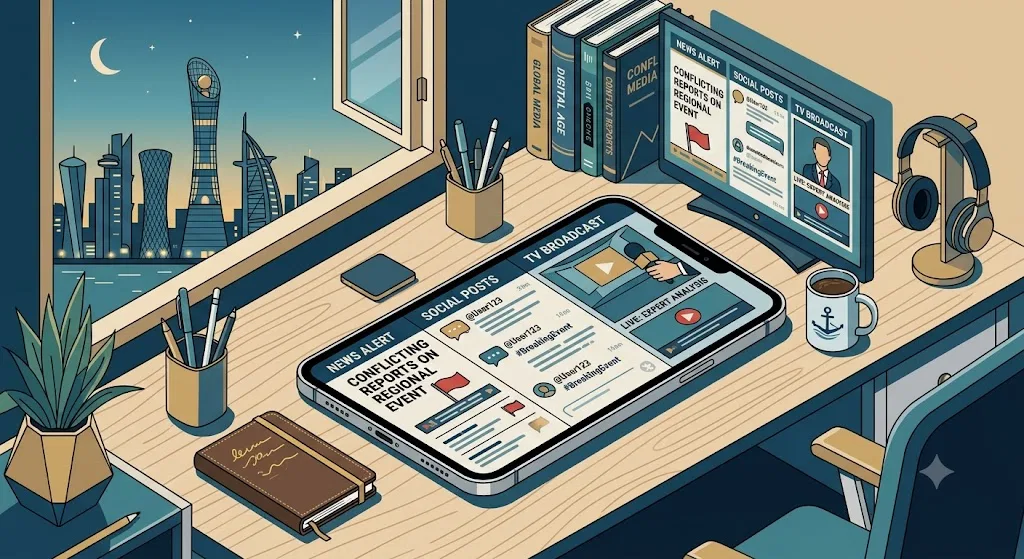
The defining case came in May 2017, when fabricated remarks attributed to Qatar’s ruler appeared on the state news agency’s genuine website. The false story was rapidly repeated across regional television and online media and helped intensify a diplomatic confrontation that soon isolated Qatar from several neighbouring states. Later episodes reused the same basic formula: exploit an existing political fear, attach it to apparently authoritative evidence and amplify it faster than corrections can travel.[reuters.com]reuters.comQatar investigation finds state news agency hackedQatar investigation finds state news agency hackedJune 8, 2017 — 7 Jun 2017 — A preliminary investigation has confirmed that Qatar…
These cases matter because they blur familiar boundaries. Some were deliberate fabrications; others were disputed accusations, misleading captions or rumours that acquired credibility through repetition. Qatar’s hoax history is therefore less a cabinet of curious fakes than a study of how modern authority can itself be counterfeited.
The fake news report that helped trigger a regional crisis
In the early hours of 24 May 2017, statements supposedly made by Emir Sheikh Tamim bin Hamad Al Thani appeared on the website and social-media feed of the Qatar News Agency. The remarks appeared to praise Iran and Hamas, question hostility towards Tehran and express views sharply at odds with the policies of several neighbouring governments. Qatar’s Government Communications Office said it noticed the compromised material shortly after midnight and warned news organisations that the quotations were not authentic.[The Guardian]theguardian.comThe Guardian Quotes were falsely attributed to the emir of Qatar and itsThe GuardianQuotes were falsely attributed to the emir of Qatar and its…May 30, 2017 — 30 May 2017 — Qatar's Government Communications…
The deception was powerful because it did not imitate a news agency from the outside. It placed invented material inside the real agency’s publishing system. Readers did not encounter an anonymous screenshot or an obscure blog. They saw incendiary statements carrying the appearance of official confirmation.
Regional broadcasters and websites repeated the quotations despite Qatar’s denial. On 5 June, Saudi Arabia, the United Arab Emirates, Bahrain and Egypt severed diplomatic and transport ties with Qatar, presenting a wider set of allegations about its foreign policy and alleged support for extremism. The fabricated remarks were not the sole cause of a dispute that had deeper political roots, but they provided an immediate and highly reusable piece of apparent evidence.[aljazeera.com]aljazeera.comAl Jazeera UAE arranged hacking of Qatari media: Washington PostAl JazeeraUAE arranged hacking of Qatari media: Washington PostJuly 17, 2017 — 17 Jul 2017 — The Qatari emir, Sheikh Tamim bin Hamad Al T…
A preliminary Qatari investigation concluded that the news agency had been hacked and that the statements were false. United States intelligence officials later told The Washington Post that the operation had been arranged by the United Arab Emirates, although the UAE denied responsibility. Early reports had also speculated about Russian hackers, illustrating how uncertainty over attribution became part of the information war. The existence of the hack is much better established than the full chain of command behind it.[reuters.com]reuters.comQatar investigation finds state news agency hackedQatar investigation finds state news agency hackedJune 8, 2017 — 7 Jun 2017 — A preliminary investigation has confirmed that Qatar…
The episode demonstrates why hacked-source disinformation is especially dangerous. A forged document can be examined as an object, but a compromised news platform briefly turns a trusted institution into the delivery mechanism for the lie. Even after the institution regains control, archived copies, broadcasts and screenshots preserve the falsehood.

How repetition made the fabrication persuasive
The 2017 attack did not succeed merely because someone wrote a convincing false article. It worked because the article entered an already polarised media system. Qatar and its neighbours had longstanding disagreements over Iran, political Islam, regional uprisings and the role of the Qatari-funded Al Jazeera network. The fabricated quotations were tailored to those tensions, making them sound plausible to audiences already expecting evidence of Qatari disloyalty.
Social-media manipulation magnified the confrontation. Research into the Gulf crisis found that bots and highly active partisan accounts helped promote propaganda, hostile hashtags and misleading narratives. Automated or coordinated activity could make a political position appear more popular and spontaneous than it really was.[ijoc.org]ijoc.orgInternational Journal of CommunicationThe Weaponization of Twitter Bots in the Gulf Crisisby MO Jones · 2019 · Cited by 210 — Propaganda…
This is an important distinction. A bot does not necessarily invent the central claim. Its role may be to repeat, rank and surround that claim until users encounter it everywhere. The resulting illusion is not simply “many people believe this”, but “this must be important because everyone is discussing it”.
The diplomatic crisis also shows why corrections often fail. Qatar announced quickly that the quotations were fraudulent, but a denial issued by the accused party can be dismissed as self-defence. Once foreign broadcasters, political figures and large networks of accounts had circulated the story, the argument shifted from whether the quotation was genuine to whether it represented something Qatar might privately believe. The literal fake was therefore able to nourish broader allegations even after its authenticity collapsed.
The coup that existed mainly on social media
In May 2020, online accounts began reporting gunfire, military movements and an attempted coup in Qatar. Videos and photographs supposedly showed unrest around Doha, while hashtags helped create the impression that a major political event was unfolding in real time. No credible evidence emerged that a coup had occurred.
Investigators found that some of the visual material was old, miscaptioned or unrelated. A video presented as recent gunfire in Qatar had circulated previously, while images of military vehicles did not prove an organised attempt to overthrow the government. The campaign relied less on one decisive fake than on a swarm of fragments that appeared to confirm one another.[aljazeera.com]aljazeera.comAl Jazeera Anatomy of a disinformation campaign: The coup thatAl Jazeera Anatomy of a disinformation campaign: The coup that
The story gained additional credibility when established media outlets reported that coup rumours were trending. Such reporting can be technically accurate—people really were posting about a coup—while still strengthening the false impression that the underlying event might be real. The volume of discussion became a substitute for evidence.
Researchers and commentators linked the episode to regional political hostility, although identifying the exact sponsors of coordinated online activity is difficult. The safer conclusion is that the campaign benefited actors seeking to portray Qatar as unstable and its leadership as vulnerable. It also recycled a familiar political genre: the alleged palace revolt in a state where reliable real-time information about elite politics is limited.[responsiblestatecraft.org]responsiblestatecraft.orgthe coup that never was how a disinformation campaign chaos in qatarthe coup that never was how a disinformation campaign chaos in qatar
The supposed coup reveals a change in how political hoaxes are built. Traditional fabrications often present a single forged document or witness. Networked disinformation can manufacture an atmosphere instead. Noise, repetition and ambiguous footage encourage viewers to assemble the false narrative themselves.
Were Qatar’s World Cup supporters “fake fans”?
Before the 2022 FIFA World Cup, videos showed large groups of supporters in Qatar wearing the colours of teams such as England, Brazil, Argentina and Germany. Many participants appeared to be South Asian residents rather than visitors from the countries whose teams they supported. Social-media users and some newspapers accused Qatar of hiring “fake fans” to stage enthusiasm for the tournament.
The accusation mixed genuine evidence with an unproven generalisation. Qatar’s World Cup organisers did operate a Fan Leader programme that paid for flights and accommodation for selected international supporters. Participants were encouraged to promote tournament material and engage positively online. That arrangement was real, documented and criticised as an attempt to manage publicity.[Reuters]reuters.comqatar world cup pays fans flights hotels good prqatar world cup pays fans flights hotels good pr
It did not, however, establish that the residents seen in every street parade were paid actors. Qatar has a large migrant population, including many people from countries with deeply rooted football cultures. Supporting an overseas national team does not require sharing its nationality, and organisers of some gatherings said participants had joined voluntarily. Claims that apparently Asian supporters must therefore have been fraudulent often rested on assumptions about what a “real” England, Germany or Argentina fan should look like.[DIE WELT]welt.deDIE WELTBerichte über Fake-FansDIE WELTBerichte über Fake-Fans
The most accurate assessment lies between the competing slogans. Qatar did sponsor selected supporters and sought favourable online activity. At the same time, the sweeping claim that visibly non-European or non-South-American fans were paid impostors was not demonstrated. “Fake fans” became a label applied to several different things: invited guests, organised supporter groups, expatriate enthusiasts and, possibly, staged promotional activity.
This controversy is useful because it shows how exposure can itself become careless. A genuine public-relations programme made more speculative accusations feel plausible, while images stripped of context encouraged audiences to treat ethnicity as proof of deception.
Old video, new threat: the false gas ultimatum
After the outbreak of the Israel–Hamas war in October 2023, posts circulated claiming that Qatar had threatened to halt global liquefied natural gas supplies unless Israel stopped bombing Gaza. A widely shared video supposedly showed the emir delivering the warning.
The clip was genuine but the interpretation was false. It dated from 2017 and contained no such threat. Qatar’s International Media Office said that neither the emir nor another government official had announced plans to cut gas exports over the conflict. Fact-checkers found that the subtitle or accompanying caption, rather than the original footage, supplied the alarming claim.[AP News]apnews.comAP News NOT REAL NEWS: A look at what didn't happen this weekAP News NOT REAL NEWS: A look at what didn't happen this week
The fabrication was persuasive because Qatar is a major gas exporter and was also acting as a diplomatic intermediary in negotiations connected with Gaza. A threat involving energy therefore seemed geopolitically possible even though it had not been made.
This was not a sophisticated deepfake. No one needed to manufacture the emir’s face or voice. The creators simply reassigned an old video to a new crisis and told viewers what they were supposedly hearing. Such false-context material is often more effective than visibly artificial imagery because the underlying recording survives basic checks: the person is real, the venue is real and the speech genuinely happened. Only the date and meaning have been falsified.
Vaccine rumours and the difference between misinformation and fraud
During the COVID-19 pandemic, Qatar also became a setting for vaccine misinformation. Researchers examining Arabic- and English-language posts associated with Qatar found false claims, rumours, emotional language and propagandistic framing in discussions about vaccination. Arabic posts were more likely to contain misinformation or expressions of doubt, while English posts were generally more factual but often more overtly propagandistic in tone.[arXiv]arxiv.orgarXiv A Second Pandemic? Analysis of Fake News About COVID-19 Vaccines in QatararXiv A Second Pandemic? Analysis of Fake News About COVID-19 Vaccines in Qatar
These messages should not all be classified as deliberate hoaxes. Some users knowingly spread fabricated medical claims; others repeated stories they sincerely believed or misunderstood. The distinction matters because false information can travel without a single identifiable hoaxer.
Pandemic rumours drew credibility from genuine uncertainty. Guidance changed as evidence developed, different vaccines had different risk profiles, and official authorities were asking the public to accept unfamiliar medical technologies at speed. Misleading posts exploited that uncertainty by presenting isolated anecdotes, unsupported causal claims or suspicion itself as evidence.
The episode also illustrates the limits of describing every error as “fake news”. That phrase can collapse fraud, political persuasion, misunderstanding and legitimate criticism into one category. A more useful approach asks what a post claims, what evidence it offers, who first published it and whether its creator had reason to know it was false.
Commercial impersonation and the counterfeit authority of brands
Not all Qatar-related deception is political. Qatar Airways and its customers have repeatedly been targeted by phishing pages, fake promotions and social-media accounts posing as airline support staff. Typical scams promise free tickets, subsidies, refunds or urgent help, then ask victims for passwords, payment details or personal information.
The airline warns that phishing messages often direct users to imitation websites or request banking and Privilege Club account details. Fact-checkers have also identified websites copying Qatar Airways branding to advertise invented promotional schemes.[qatarairways.com]qatarairways.comOpen source on qatarairways.com.
These schemes use the same principle as the 2017 news-agency hack: counterfeit institutional authority. The victim is not expected to trust an unknown fraudster. The fraudster borrows the name, design and reputation of an organisation the victim already trusts.
Travel disruption creates particularly favourable conditions. A passenger whose flight has been cancelled may post publicly asking an airline for assistance. Impersonator accounts can then reply immediately, appearing helpful while directing the traveller into a private conversation. During major disruptions in 2026, travellers were warned about fake accounts posing as airlines including Qatar Airways and offering fraudulent refunds.[The Guardian]theguardian.comThese impersonators often create seemingly authentic profiles with logos and support-related names but have limited followers and minimal…
The practical warning is simple: a logo, familiar name or fast response does not establish identity. Airline assistance should be reached through contact details entered independently from the company’s official website, not through links supplied by an unsolicited account.

What Qatar’s deception cases have in common
Qatar’s best-documented hoaxes and false narratives are products of a highly connected state situated within intense regional rivalries. They generally depend on one of four mechanisms:
- A real channel is compromised. The Qatar News Agency hack placed false statements inside an authentic source.
- Real material is given a false setting. Old speeches and unrelated videos are recaptioned as evidence of a new crisis.
- Online activity simulates public confirmation. Bots, coordinated accounts and repeated hashtags create the appearance of widespread independent reporting.
- A trusted identity is copied. Fake airline accounts and promotional websites borrow institutional branding to obtain money or data.
The most important lesson is that falsehood and truth are often interwoven. The 2017 diplomatic dispute had real political causes, but a fabricated quotation intensified it. Qatar really did sponsor selected World Cup supporters, but that did not prove that all expatriate fans were paid actors. The gas video really showed the emir, but not making the threat described in its caption.
That mixture explains why these stories survive debunking. A completely invented tale may collapse when one fact is disproved. A misleading narrative built around authentic people, genuine grievances and real footage can retreat into ambiguity. Its defenders can abandon the literal claim while preserving the suspicion that made the claim attractive.
Qatar’s modern hoax history is therefore chiefly about the manufacture of credibility. The decisive trick is rarely to invent an impossible marvel. It is to make a partisan story look official, immediate and already believed.
Amazon book picks
Further Reading
Books and field guides related to When False Stories Became Political Weapons in Qatar. Use these as the next step if you want deeper reading beyond the article.
Information Wars
Explains how false narratives become political weapons and spread through media ecosystems.
The Age of Surveillance Capitalism
Provides context on digital platforms that amplify misinformation and influence.
Qatar
The Persian Gulf state of Qatar has fewer than 2 million inhabitants, virtually no potable water, and has been an independent nation only...
eBay marketplace picks
Marketplace Samples
Live-tested eBay searches with available results related to this page.
Endnotes
1.
Source: reuters.com
Title: Qatar investigation finds state news agency hacked
Link:https://www.reuters.com/article/world/qatar-investigation-finds-state-news-agency-hacked-foreign-ministry-idUSKBN18Y2X4/
Source snippet
Qatar investigation finds state news agency hackedJune 8, 2017 — 7 Jun 2017 — A preliminary investigation has confirmed that Qatar...
Published: June 8, 2017
2.
Source: time.com
Link:https://time.com/4808609/russia-hacker-qatar-diplomatic-crisis/
Source snippet
investigators suspect that Russian hackers may have contributed to the diplomatic crisis among Gulf states by planting a fake news story...
3.
Source: reuters.com
Title: qatar world cup pays fans flights hotels good pr 2022 10 31
Link:https://www.reuters.com/lifestyle/sports/qatar-world-cup-pays-fans-flights-hotels-good-pr-2022-10-31/
4.
Source: welt.de
Title: DIE WELTBerichte über Fake-Fans
Link:https://www.welt.de/242169579
5.
Source: arxiv.org
Title: arXiv A Second Pandemic? Analysis of Fake News About COVID-19 Vaccines in Qatar
Link:https://arxiv.org/abs/2109.11372
6.
Source: qatarairways.com
Link:https://www.qatarairways.com/en-nl/online-fraud.html
7.
Source: reuters.com
Link:https://www.reuters.com/world/middle-east/exclusive-qatar-planning-world-cup-fans-avoid-prosecution-minor-offences-sources-2022-09-21/
8.
Source: reuters.com
Link:https://www.reuters.com/video/watch/idRW437421042026RP1/
9.
Source: reuters.com
Link:https://www.reuters.com/sports/soccer/fifa-made-false-claims-about-carbon-neutrality-qatar-world-cup-regulator-2023-06-07/
10.
Source: washingtonpost.com
Link:https://www.washingtonpost.com/world/national-security/uae-hacked-qatari-government-sites-sparking-regional-upheaval-according-to-us-intelligence-officials/2017/07/16/00c46e54-698f-11e7-8eb5-cbccc2e7bfbf_story.html
Source snippet
The Washington PostUAE orchestrated hacking of Qatari government sites...16 Jul 2017 — Hackers planted news stories with false quotes at...
11.
Source: theguardian.com
Title: The Guardian Quotes were falsely attributed to the emir of Qatar and its
Link:https://www.theguardian.com/world/2017/may/30/quotes-were-falsely-attributed-to-the-emir-of-qatar-and-its-foreign-minister
Source snippet
The GuardianQuotes were falsely attributed to the emir of Qatar and its...May 30, 2017 — 30 May 2017 — Qatar's Government Communications...
Published: May 30, 2017
12.
Source: aljazeera.com
Title: Al Jazeera UAE arranged hacking of Qatari media: Washington Post
Link:https://www.aljazeera.com/news/2017/7/17/uae-arranged-hacking-of-qatari-media-washington-post
Source snippet
Al JazeeraUAE arranged hacking of Qatari media: Washington PostJuly 17, 2017 — 17 Jul 2017 — The Qatari emir, Sheikh Tamim bin Hamad Al T...
Published: July 17, 2017
13.
Source: ijoc.org
Link:https://ijoc.org/index.php/ijoc/article/view/8994/2604
Source snippet
International Journal of CommunicationThe Weaponization of Twitter Bots in the Gulf Crisisby MO Jones · 2019 · Cited by 210 — Propaganda...
14.
Source: pomeps.org
Link:https://pomeps.org/tracking-adversaries-and-first-responding-to-disinfo-ops-the-evolution-of-deception-and-manipulation-tactics-on-gulf-twitter
15.
Source: aljazeera.com
Title: twitter bots fake news and propaganda in the qatar crisis
Link:https://www.aljazeera.com/news/2018/6/4/twitter-bots-fake-news-and-propaganda-in-the-qatar-crisis
16.
Source: aljazeera.com
Title: Al Jazeera Anatomy of a disinformation campaign: The coup that
Link:https://www.aljazeera.com/features/2020/5/19/anatomy-of-a-disinformation-campaign-the-coup-that-never-was
17.
Source: responsiblestatecraft.org
Title: the coup that never was how a disinformation campaign chaos in qatar
Link:https://responsiblestatecraft.org/2020/05/07/the-coup-that-never-was-how-a-disinformation-campaign-chaos-in-qatar/
18.
Source: apnews.com
Title: AP News NOT REAL NEWS: A look at what didn’t happen this week
Link:https://apnews.com/article/1010b2b68d37f807ef9c59340272c1a5
19.
Source: apnews.com
Link:https://apnews.com/article/e58f9ab8696309305c3ea2bfb269258e
20.
Source: theguardian.com
Link:https://www.theguardian.com/money/2026/mar/15/travel-scam-airline-accounts-fake-refunds-iran-war-flight-disruption
Source snippet
These impersonators often create seemingly authentic profiles with logos and support-related names but have limited followers and minimal...
21.
Source: aljazeera.com
Title: was qatar a victim of fake news
Link:https://www.aljazeera.com/video/inside-story/2017/7/17/was-qatar-a-victim-of-fake-news
22.
Source: theguardian.com
Title: disappointing and unsurprising qatar 2022 organisers reject fake fan claims
Link:https://www.theguardian.com/football/2022/nov/16/disappointing-and-unsurprising-qatar-2022-organisers-reject-fake-fan-claims
Additional References
23.
Source: gco.gov.qa
Title: qatar marks one year since qna hack
Link:https://www.gco.gov.qa/en/media-centre/top-news/qatar-marks-one-year-since-qna-hack/
Source snippet
ernment Communications OfficeQatar marks one year since QNA hack24 May 2018 — In the early hours of 24 May 2017, fabricated quotes att...
Published: May 2018
24.
Source: facebook.com
Link:https://www.facebook.com/thehistoriansden/posts/in-2000-a-sensational-discovery-surfaced-in-pakistan-when-a-remarkably-preserved/885418731199803/
25.
Source: kaspersky.com
Link:https://www.kaspersky.com/resource-center/preemptive-safety/world-cup-ai-scams-deepfakes
26.
Source: instagram.com
Link:https://www.instagram.com/reel/DV8huKjDHN4/
27.
Source: facebook.com
Link:https://www.facebook.com/euronews/posts/false-claims-and-ai-generated-videos-with-racist-overtones-have-circulated-durin/1404483751726951/
28.
Source: instagram.com
Link:https://www.instagram.com/reel/Dak_uOND1Hy/
29.
Source: facebook.com
Link:https://www.facebook.com/QatarTribune/posts/given-the-current-situation-attempts-to-spread-rumours-and-misleading-informatio/896483659663296/
30.
Source: facebook.com
Link:https://www.facebook.com/dohanews/posts/in-an-official-instagram-post-on-monday-qatars-government-communications-office-/1353196806838261/
31.
Source: facebook.com
Link:https://www.facebook.com/QatarLiving/posts/new-investigations-carried-out-by-al-jazeera-pinpoint-the-origin-of-the-hack-of-/10156471182923817/
32.
Source: facebook.com
Link:https://www.facebook.com/QatarTribune/posts/notice-urging-the-public-not-to-follow-rumours-or-misleading-video-clipsmoiqatar/896202273024768/
Topic Tree
Follow this branch
Related pages 192
- Albanian Hoaxes
- Algerian Hoaxes
- Antigua Deceptions
- Argentina Hoaxes
- Armenian Hoaxes
- +187 more in sidebar